

Four 1963s on my desk this afternoon. Three on the left look like the same watch. The fourth, on the right, looks like the same watch from an earlier decade. It is not. All four left Chinese factories within the past three years. The fourth, the cream-dialed Panda Pilot, is the only one Tianjin Sea-Gull itself assembled.
The other three are not fakes. The other three are not even homages, not in the way that word usually gets used. The other three are 1963 chronographs built by Time King Industrial, founded by a former Tsinlien Sea-Gull employee in Macau, using genuine Tianjin ST1901 movements purchased from the factory. They run real Tianjin engines in cases that Time King designed and assembled. They are sold under the Red Star brand, sometimes under other branding. They are legitimate watches from a legitimate maker. They are also, by production timeline, older than Tianjin Sea-Gull's own modern 1963 line.
The 1963 chronographs being sold today by Red Star and Time King are older as a product than the 1963 chronographs being sold today by Tianjin Sea-Gull. Tianjin, the factory that drew the original D304 in 1963 and built the first ST3 column-wheel chronograph movement, did not start producing its own modern 1963 reissue until after several other entities had been making one for years.
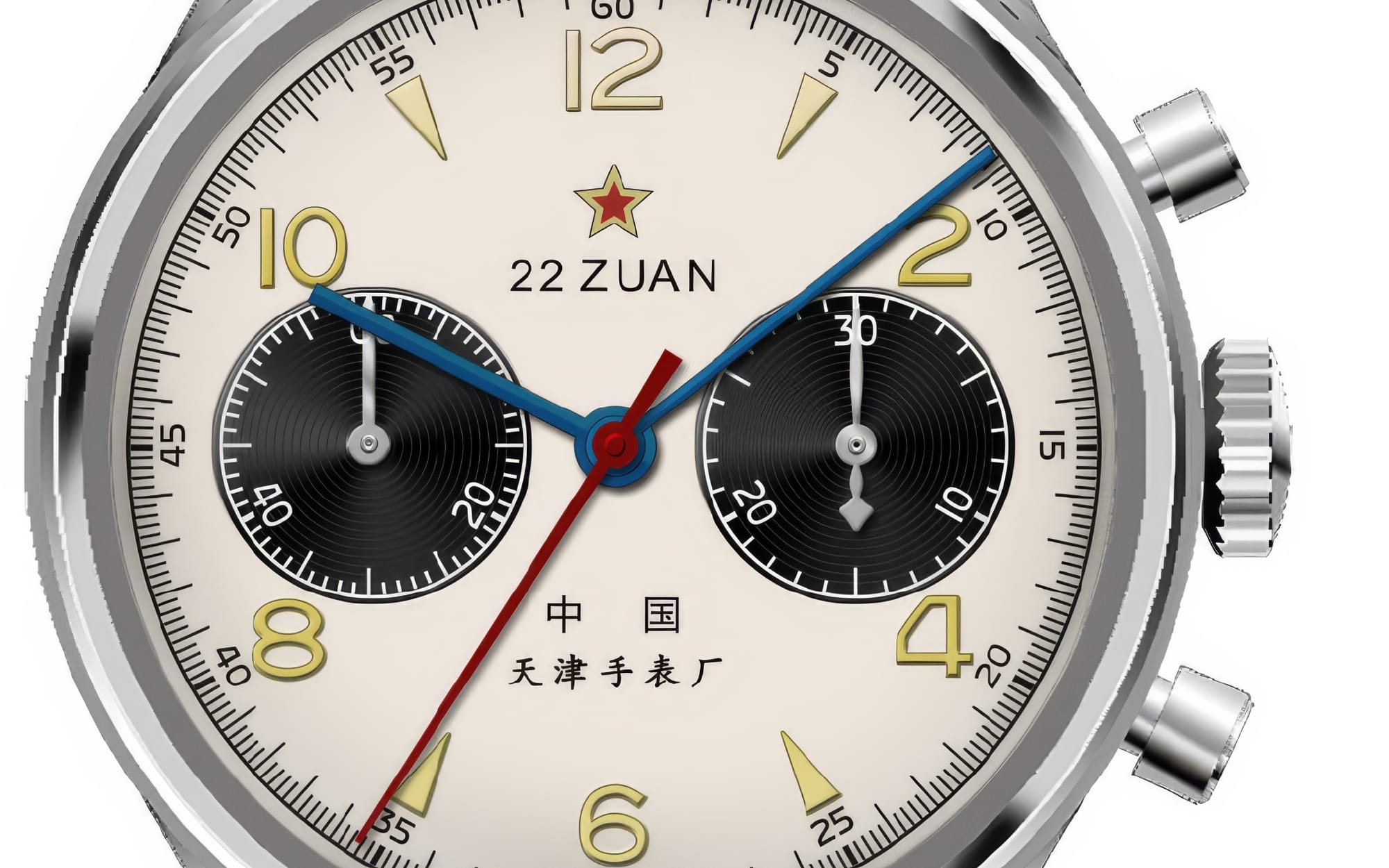
The dial text above six o'clock sorts the genealogy. The cream dial of the watch on the right reads "中国 天津手表厂": China, Tianjin Watch Factory. The dials of the other three read "中国制造": Made in China. The first phrase says the watch was assembled inside the factory whose name is on it. The second phrase says the watch was assembled somewhere in China by people who paid Tianjin for the engine and built the rest themselves. Both phrases are true on the dials where they appear. Neither phrase is a forgery flag.
The Sea-Gull 1963 family is the most genealogically tangled object in modern affordable watchmaking. Once you understand the tangle, the value math on the original-factory Panda Pilot at $649 makes sense. Until you understand it, the math looks wrong.
Brand context
Sea-Gull is more confederation than brand. The factory at the center of it, Tianjin Watch Factory, was founded in January 1955 and is one of the original Chinese watch factories. In 1990 the factory was promoted to a national enterprise. In 1992 it was reorganized as the Tianjin Seagull Corporation. And in 1997, as one collector-facing source describes it, the broader Sea-Gull Group was incorporated as a network of more than twenty separate entities, including the Tianjin Watch Factory itself, Sea-Gull Hong Kong, and Sea-Gull Singapore. That corporate history is not independently confirmed, and other sources date the Hong Kong operation to the early 2000s rather than 1997. So when people say "Sea-Gull," they may mean the 1955 factory, the 1992 corporation, the 1997 group, or one of the twenty-plus licensees and subsidiaries inside it. All are real. None is the simple unitary brand that the marketing copy implies. Tianjin makes the ST19 family of column-wheel chronograph calibers (ST1901, ST1906, the 19, 21, and 22-jewel variants) and supplies them to whoever pays for them. As far as the market knows, Tianjin is their only producer. Every legitimate 1963-style chronograph on the market runs a genuine Tianjin engine. The differences live in the cases, the dials, the assembly, and the channel.
The genealogy of the modern reissue is the part most people get wrong. Sometime in the late 2000s, while working at the Hong Kong Tsinlien subsidiary, Thomas Leung saw a Sea-Gull executive's original 1960s D304 across a counter when the executive came in for a strap exchange. Mr. Leung showed the watch to a German collector friend, who reacted strongly. Tsinlien built nineteen modern reissues using Tianjin's ST1901 movement on the strength of that German interest. The Germans loved them. Tsinlien did a second, larger limited run of 180 pieces. By 2010, Mr. Leung had left Tsinlien to start his own company, Time King Industrial, still buying ST1901 movements from Tianjin, building cases and assembling watches in his own facilities, and selling under the Red Star brand. Through the 2010s, Time King's 1963 reissues were a major presence in the Western market. Tianjin during that period produced only a different Project 304 variant, its own modern D304 reissue, not the 1963.
Tianjin started making its own modern 1963 only later. By Mr. Leung's account, the impetus was customer demand: enough buyers had asked Tianjin directly how to get a 1963 that the factory decided the volume justified opening its own production line. Tianjin owns the original drawings and the institutional memory and the ST19 supply chain, all of which matter, but the modern 1963 reissue as a market category was not Tianjin's first idea. It was their late-arriving idea. The "Seagull 1963" name itself is largely a Western-collector convention. As one detailed history puts it, inside China the watch is still simply called the "304 Air Force Chronograph"; the year-name attached itself in the Western market and the factory eventually adopted it. The Tianjin Sea-Gull About Us page now refers to the watch as "the iconic 1963 Chronograph," a phrase that would have made no sense to anyone in 1963.
Which means the moral structure of the 1963 ecosystem is not "Tianjin makes the real one and everyone else is copying it." The structure is closer to: several legitimate makers have been producing variations of the same watch for years using genuine Tianjin engines, the original factory eventually entered the same market with its own version, and the original factory's version is now one option among several. The premium Tianjin charges for the original-factory version is paid for the original-factory assembly, the limited-edition framing, the commemorative caseback, and the cleaner dial-text provenance. It is not paid for being "the real one" against fakes. The Time King watches are also real watches. As one veteran collector who interviewed Mr. Leung put it, Tianjin's higher price is justified by lineage and history, not by other re-issues being inauthentic.
Counterfeits exist. They are a smaller part of the ecosystem than the legitimate-parallel-maker scene, and they are the reason the QR system was built. Tianjin Sea-Gull started using factory QR codes in the summer of 2017. The codes are generated and registered at the factory. The buyer scans through Sea-Gull's official WeChat store page, and the system returns confirmation, model identification, and warranty activation. The factory controls the backend, which means the codes cannot be forged in any meaningful sense; an attacker cannot generate a code that validates against a database they do not control. Most of what I know about the system in detail comes from collector reports rather than from a first-party technical document. The brand's own materials confirm the QR exists and that registration is required for warranty. The "uncrackable" framing is the consensus on the forums where the watches are bought and sold.
The single barrier is on the buyer's side. WeChat is the app most of China runs on: messaging, payments, ride-hailing, food delivery, government ID, the works, all under one login. The official Sea-Gull store page sits inside it, in Mandarin. The average Western collector has neither a WeChat account nor the language. That is a buyer-experience problem, not a system problem. (Chinese consumer goods broadly are moving toward QR-plus-WeChat authentication. My Giant bicycle came with a QR on the frame that authenticates the bike and identifies every component on it through Giant's own WeChat store. The 1963 Panda Pilot is not an outlier in its category.)
I have not registered the QR on my Panda Pilot. The definitive authentication is in the box. I have simply not bothered to use it. The dial text, the June 2024 release timing matching when my dealer received stock, the Panda Pilot artwork on the caseback specific to the D1963 reference, the price I paid in the right neighborhood for a 520-piece run, and the correct paperwork are enough for me. If you buy one of these and want certainty, the certainty is one WeChat scan away. Have a contact in China do it if you do not have an account yourself.
The channel is where the picture gets harder to draw cleanly. The October 2025 announcement on en.seagullwatch.com declares: "en.seagullwatch.com and www.seagullwatch.com are the only two official websites of SEA-GULL® Watch." Same domain, two subdomains: "en." for the international English site, "www." for the China mainland site. The statement warns against websites that claim to be SEA-GULL in the way pirate sites claim to be Rolex. At the same time, a separate site at seagullwatchofficial.com describes itself as a wholly-owned Sea-Gull subsidiary and asserts that the two official websites are www.seagullwatch.com and seagullwatchofficial.com (note: not en.seagullwatch.com). Both statements cannot be simultaneously true. The most charitable reading is that the brand's first-party retail and its various authorized subsidiaries are still working out who gets to call themselves "official," and that the answer changed between when seagullwatchofficial.com was set up and when en.seagullwatch.com launched in 2025. The reader should treat both pages skeptically until the brand publishes a single unified retailer list. As of this writing, no such list exists.
Underneath the first-party-website confusion, there is also an authorized retailer track that has always run in parallel. Sea-Gull's own About Us page names Amazon and AliExpress as additional authorized channels. The USSea-Gull AliExpress store appears to be the longest-running verified Tianjin-direct Western channel, although the previously authorized USSea-Gull standalone storefront has closed. Beyond those, the Western dealer landscape includes operators like seagullwatchcompany.com, who self-describe as authorized dealers sourcing directly from the Tianjin Watch Factory. The watches arrive with factory QR codes and correct paperwork. Whether the dealer's authorization is formal in the way that AliExpress USSea-Gull's authorization is formal is not something I can verify from outside. I bought my Panda Pilot from seagullwatchcompany.com in June 2024, sixteen months before en.seagullwatch.com existed. The watch arrived with everything it should have arrived with. I have not exercised the QR scan that would close the loop.
That is the channel reality. It is messier than the brand's public-facing communications make it sound, and cleaner than the worst-case framing some forum posters make it sound. The QR system means anyone with WeChat can resolve the question for any specific watch in seconds. Most Western buyers, including me, do not.
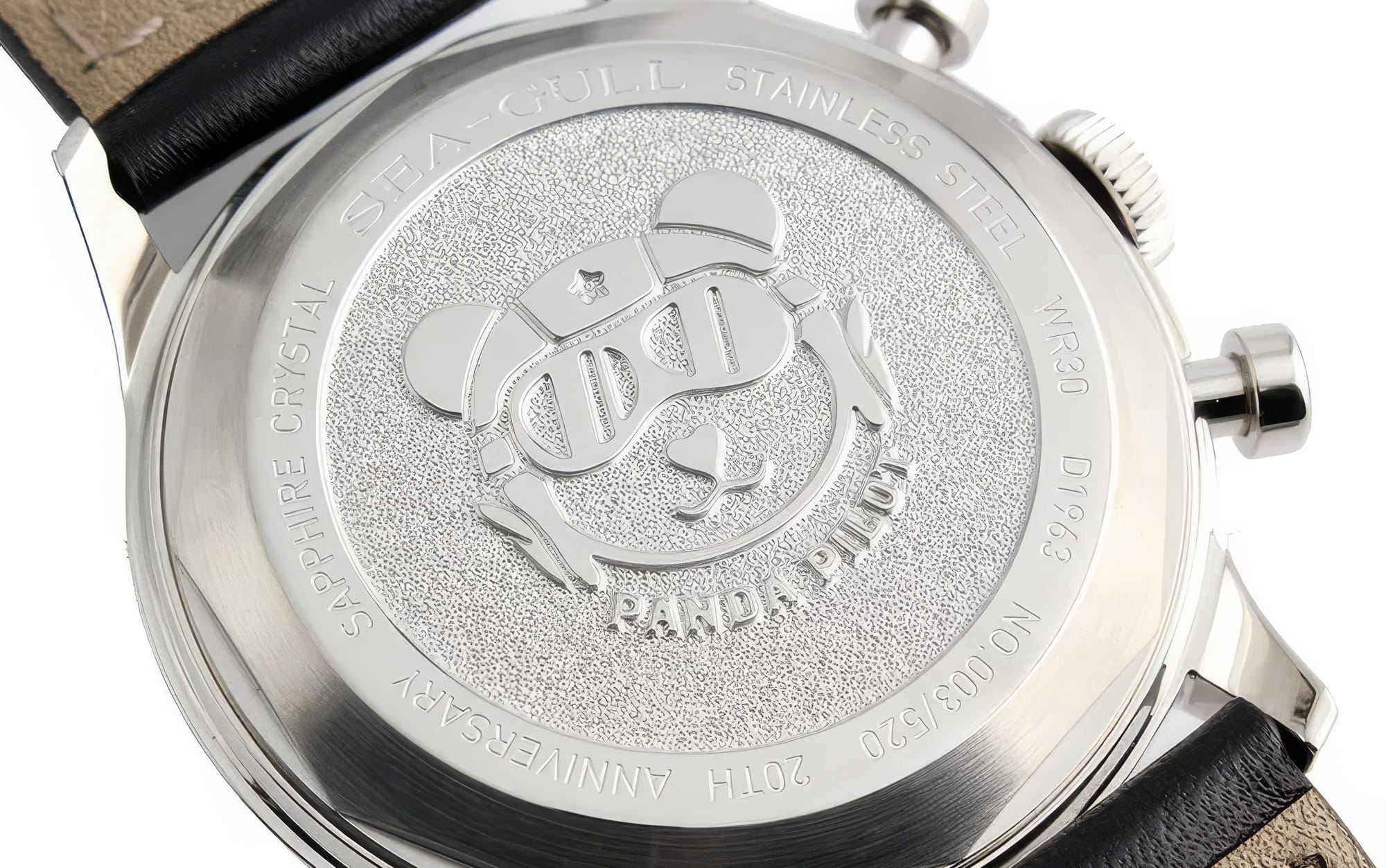
The case and dimensions
The case is 40mm across, 14.5mm thick, 46mm lug-to-lug. 316L stainless steel. Polished bezel, polished case sides, no brushing anywhere I can see. The lugs are short and slightly downturned, which gives the watch a vintage seating posture on the wrist that the dimensions alone would not predict.
The crystal is the trick. It is high-hardness sapphire, but it has been domed and shaped to mimic the acrylic crystal of the original 1960s D304. From three feet away you read it as a vintage watch. From three inches you can confirm it is sapphire by the lack of the soft micro-scratching acrylic accumulates with age.
The caseback is solid stainless steel with the Panda Pilot commemorative artwork engraved into it. This is the trade-off, and it is real. The standard 1963 Times Edition (reference 819.87.1963) ships with a sapphire display caseback because the ST1901 column wheel and swan-neck regulator are the visual reward of the watch. The Panda Pilot trades that reward for an etching honoring Yang Liwei's 2003 Shenzhou 5 mission. As a commemorative choice, it makes sense. As a daily-wear choice, it costs you the only window into the movement you paid for. I would have taken the display back. The factory did not give me the option, and the limited-edition framing is what it is.
Water resistance is rated at 30 meters, or 3 ATM. That number is industry shorthand for "do not get this watch wet." Treat it accordingly. The crown is pull-and-push, not screw-down, which is consistent with the 30m rating; this is a watch that lives on dry land.
The box ships with the watch on the leather strap, the nylon strap and the steel mesh strap stowed separately, a manual, a strap-change tool, and an "Anniversary space pin" that nods at the Yang Liwei commemoration. It also carries a 2-year warranty. Whether the warranty is factory-backed through Tianjin's WeChat system or seller-backed by the dealer is a fair question to ask whichever channel you buy from. For factory-backed warranty service the QR code in the box has to be scanned and registered through Sea-Gull's official WeChat store, and the Western buyer has to be willing to do that or have a contact in China do it.
The dial
The dial is the best thing on this watch, and it does not photograph well. It is cream, leaning warm. Two black sunray sub-dials sit at 9 and 3, recessed slightly into the surface, with the radial brushing visible only when light catches them at an angle. Black Arabic numerals occupy 12, 2, 4, 6, 8, and 10. Elongated triangular hour markers sit in the four non-numeral positions at 1, 5, 7, and 11, painted in an aged-cream tone that evokes faded vintage tritium even though the hands themselves are not luminous. The red star sits below 12. The Mandarin pinyin "22 ZUAN" (twenty-two jewels) sits below the red star. "中国 天津手表厂" sits above 6. A minute track runs around the outer rim.
The hands are the conversation. Deep blue sword hands for the hours and minutes. A central chronograph seconds hand in red. The sub-dial hands inside the black sub-dials are pale steel-toned, which makes them readable in a way that black-on-black sub-dial hands often are not.
Read out the palette: cream, black, red, blue, gold. Five competing colors on a 40mm dial. By any reasonable design rule it should be a mess. It is not. It is the most cohesive multi-color dial I own, and I have spent a long time trying to figure out why.
The closest answer I can give is that each color is doing one job and only one job. The cream is the field. The black is the chronograph register. The red is the live-time hand. The blue is the static-time hands. The gold is the heritage marker. Nothing competes, nothing duplicates. The pilot-chronograph layout, established in the 1940s and refined for the next thirty years before the original D304 was drawn up, was already a small miracle of legibility under stress. The Panda Pilot is faithful to that layout in a way the busier modern reissues of the 1963 are not.
The movement
The ST1901, also known by its TY2901 designation, is a hand-wound column-wheel chronograph descended from the Swiss Venus 175 tooling Tianjin acquired in the early 1960s. It runs at 21,600 vibrations per hour. It carries a swan-neck fine regulator on the balance assembly. The 22-jewel variant in this Panda Pilot is the same caliber the 60th Anniversary Times Edition carries; the standard 1963 reissue runs the 21-jewel version of the same movement. Power reserve is rated at 38 hours at full wind, the figure the factory lists for this edition and a little below the roughly 45 hours the ST1901 is usually quoted at. Functions are chronograph, hour, minute, and small seconds.
In daily wear, the chronograph engages with the crisp, palpable click of a real column wheel. The reset snaps the hands back to noon with a directness no quartz chronograph reproduces. Time-keeping has been excellent across the months I have worn it. I have not put it on a timegrapher. I do not need to.
What this watch will not give you is the sight of the movement working. The ST1901 is a beautiful caliber. It deserves to be looked at. The Panda Pilot will not let you look at it. If you want to see the column wheel turn and the swan-neck flex, buy the standard 1963 Times Edition, save $200, and accept that you will not own a limited-edition variant. The Panda Pilot makes you pay more for less to see, in exchange for the commemorative back and the 520-piece run. That is a real trade. Decide if you want it.
I should also acknowledge what I said in my review of the Hoffman Racing 40, which runs the same ST1901 in a different case. I cannot detect a difference in how the movement performs across the watches I own that use it. Hoffman, Sea-Gull, Studio Underd0g; the winding feels the same, the chronograph engagement feels the same, the time-keeping is in the same range. The movement is not the differentiator at this price point. The movement is a commodity. Whatever premium you pay over a Hoffman or a Red Star is paid for the case, the dial, the assembly, and the channel, not for the heart.
The straps
The watch ships with three straps: a black leather, a black nylon, and a stainless steel mesh. None of them is good. The leather is stiff in a way that does not soften, the nylon is the kind of nylon a watch ships with when the budget for the strap was zero, and the mesh is the kind of mesh you replace within the first week.
I wear mine on a grey perlon NATO. The perlon is what made the watch work for me as a daily piece. Add $40 to the purchase price for a strap you actually want to wear. That puts the all-in cost closer to $700 than $649. Build it into the value math.
On the wrist
40mm is a millimeter or two smaller than I prefer. On a 7.5-inch wrist the watch wears tidy, dressy, slightly under-sized. The downturned lugs help; the 46mm lug-to-lug helps; the polished case helps catch light and read bigger than the strict diameter would suggest. None of those things make the watch present like a 42mm or 44mm chronograph. It is a small chronograph in the era of large ones.
That smallness is also why it works on a NATO. A perlon NATO adds presence to the case in a way a bracelet does not. It is also why the watch is more versatile than its specifications would suggest. I have worn it with a suit, with jeans, and with running clothes, and it does not look out of place in any of those settings. The Panda Pilot is a weekender that can pass for dressier than it is.
In a room of executives wearing Submariners, this would not be the most expensive watch on any wrist. It would be the most interesting one.
Comparisons
Inside the family, the relevant choice is between the original-factory Panda Pilot at $649 and the Time King or Red Star equivalent at roughly $300 to $400. Both are real watches. Both run the same Tianjin movement. The Time King watches have, in production timeline, the older claim. So what does the extra $250 to $350 buy you when you choose the Tianjin Panda Pilot?
Three things, in descending order of how much they will matter to a given buyer. The first is original-factory assembly, which means the case is finished, the dial is printed, and the movement is regulated inside the building where the ST1901 is made. The second is the limited-edition framing: 520 pieces, commemorative caseback, a connection to a specific moment in Chinese aerospace history. The third is the cleanest provenance the collector market currently offers, which is the dial text matching the assembly facility matching the QR code matching the paperwork. If any of those three things matters to you, the premium is rational. If none of them does, the Time King watch is the rational play. There is no middle.
Outside the family, the comparison set is more conventional. A new Tissot Heritage 1973 sits around $2,100 on a Valjoux 7753-based automatic, polished steel, and a more contemporary execution. A Hamilton Intra-Matic Auto Chrono runs around $2,195 on the same Swatch Group 7753-family base. Neither is a hand-wound column-wheel chronograph. Neither carries a swan-neck regulator. Neither is a limited edition of 520 pieces commemorating a specific event. I would take the Panda Pilot over the Tissot, and I would think hard before I took it over the Hamilton, but both Swiss watches cost roughly three times the Panda Pilot and address a different buyer.
The truer comparison is with watches that share the cult-classic register: the Vostok Komandirskie, the Strela 3017 reissue, the Raketa 24-hour. These are watches whose value proposition is not "best-built sub-$700 chronograph" but "essential to a complete collection because the conceptual space is unique." That is where the Panda Pilot belongs. On its own terms, it is the most distinctive of them.
Final thoughts
The thesis I started with was that Sea-Gull may be the best value watches there are. After living with this Panda Pilot for sixteen months, I would expand that, not refine it. The thesis is true across a wider band of the catalog than I had originally framed. It is true at $300 for a Time King 1963, where you get a column-wheel chronograph from a maker with longer 1963 production history than Tianjin's own modern line, running a real Tianjin movement. It is true at $450 to $500 for the standard Tianjin 1963 Times Edition, where you get original-factory assembly and a display caseback. And it is true at $649 for this Panda Pilot, where you get original-factory assembly, the limited-edition framing, and the commemorative caseback, in exchange for giving up the view of the movement.
For me, the Panda Pilot is the version I wanted. I am a sucker for novelty, for cult classics, for the watches other watch people recognize but no one else does. The five-color dial that should not work and somehow does. The deep blue sword hands. The 22 ZUAN script. The Tianjin Watch Factory line where the lazy version of this watch would have read "Made in China." The Panda Pilot is not the rational choice in the family on a strict dollar-per-feature basis. It is the choice you make when you want the original factory's version of the watch, in the limited variant the original factory issued for the twentieth anniversary of Yang Liwei's flight, with everything that comes from that.
I would take this over a Tissot any day. Over most Hamiltons most days. Over almost any other sub-$700 chronograph at the moment I am writing this. I will probably never take it over the Cartier or the Vacheron, but those are not the comparison. The comparison is what else I could have done with $649 in a market where the homages are real watches and the original-factory limited edition asks a premium for the things only the original factory can sell. The answer, for me, is nothing else like this.
The watch is genuine factory product. The dealer is unverified by anyone whose verification I would trust. Both are true at the same time. The QR code in the box would resolve the dealer question definitively. I have not used it. If you want certainty, you can. If you do not, the dial text, the paperwork, the timing, the commemorative caseback, and the price all line up.


