

On December 26, 2024, at an anniversary presentation in Tianjin, Sea-Gull marked seventy years of watchmaking with four complicated watches. Three were the kind of machines a manufacture builds to show off: an astronomical tourbillon, a minute-repeater automaton, and a triple complication stacking a tourbillon, perpetual calendar, and repeater into one case. The fourth was the modest one, a titanium chronograph limited to 500 pieces at $3,499. It was also the one that mattered. It's a rattrapante, the first split-seconds chronograph China has ever produced, and the least expensive new example of the complication in the world.
A rattrapante, from the French rattraper, to catch up, is a chronograph with two seconds hands stacked so precisely they read as one. Start the timer and both sweep together. Press a third pusher and one hand freezes to mark a split while the other keeps running. Press again and the frozen hand snaps forward to rejoin its partner. Watchmakers have been building the mechanism since the nineteenth century, and it's spent that entire life at the top of the market. Patek Philippe builds rattrapantes. A. Lange & Söhne built part of its modern reputation on them, up through the Triple Split. Until Tianjin joined in, the cheapest way into a new one was the Habring² Doppel at roughly $10,000.
The enthusiast press noticed within days. Brice Goulard at Monochrome called it arguably the most accessible rattrapante on the market. Johnny Brayson at Gear Patrol filed it under the democratization of high complications. Zach Kazan at Worn & Wound called it "extremely under the radar" and wondered in print why more people weren't talking about it. Bilal Khan, writing for Teddy Baldassarre, asked whether it might be the best value in watchmaking and wrote, "wow do I want to handle this watch." Then something strange happened, which is that nothing happened. Every one of those pieces was written from Sea-Gull's press renders. Goulard said plainly he couldn't judge the movement without handling it and wanted to test the split function. Khan printed the case as 12mm thick. It's 16. Eighteen months later, none of those outlets has published wrist time with the watch that I can find, and the watch has quietly gone on selling, one price bump at a time. What is the watch actually like? Nobody who wrote about it could say.
So I bought one. Number 004 of 500, the blue dial, from BackWatch Department, an independent-watch specialist in Sheung Wan, Hong Kong, for $3,580 plus $327 in shipping. It left Hong Kong in mid-June, spent a few weeks starting and stopping through customs, and arrived this week, new and unworn, with both straps, the manual, and a numbered card in the box. I bought it because I love oddities, and this is one of the oddest watches on sale anywhere: a grand complication from the factory the West knows for $400 chronographs. Eighteen months of coverage never got closer to it than a press photo. On the wrist, the renders undersold it.
Case and dimensions
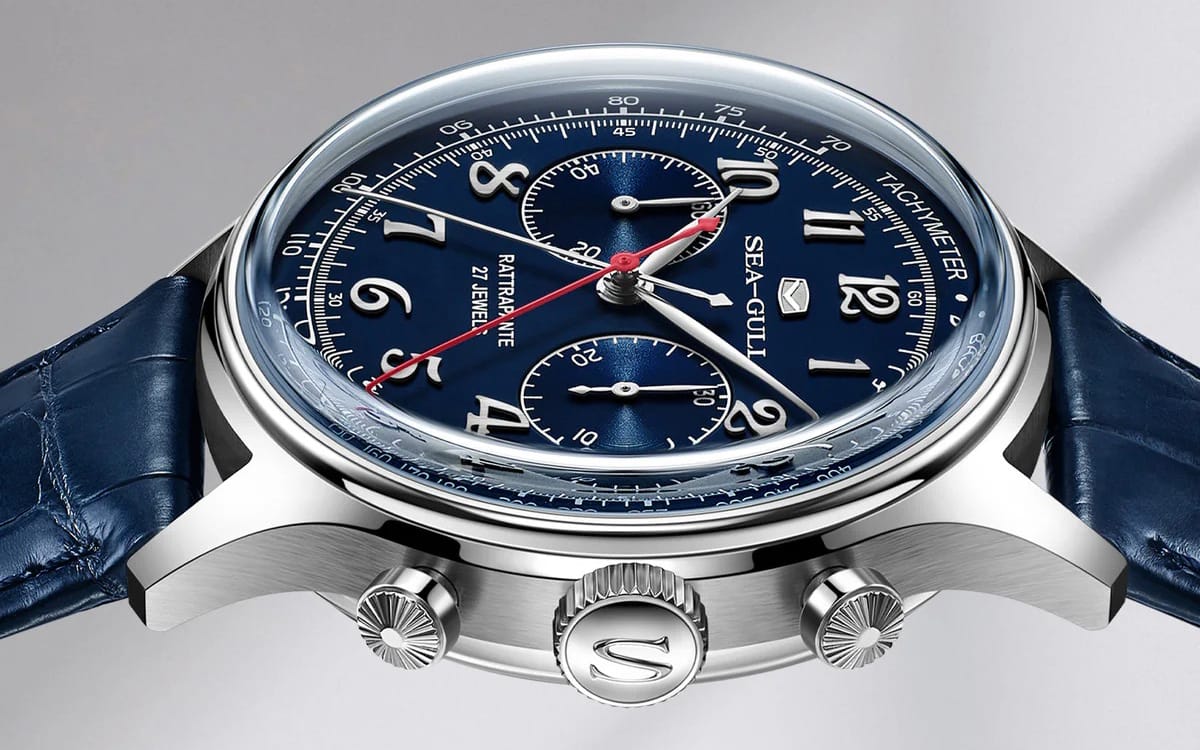
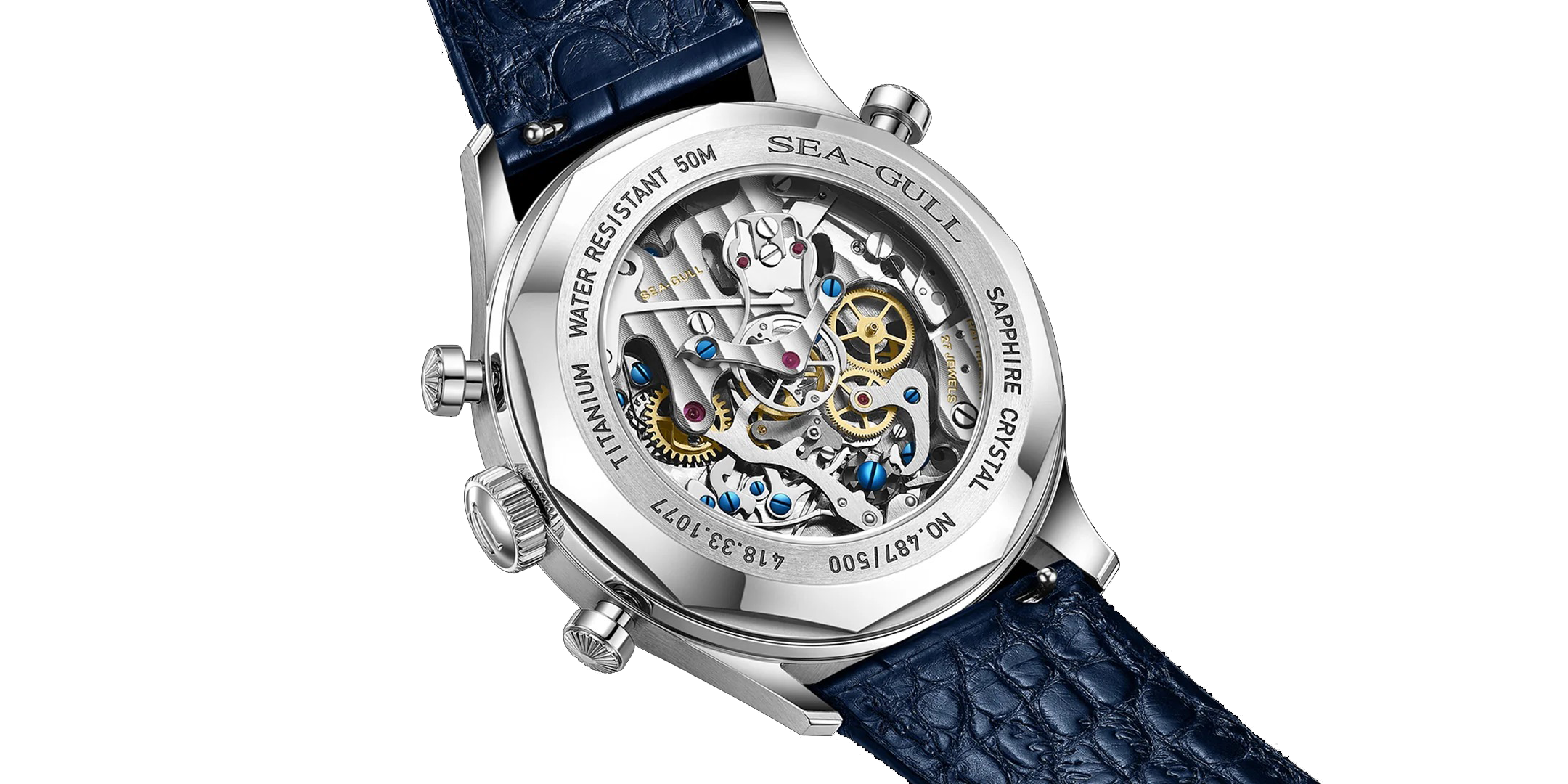
The case is 42.5mm across and 16mm tall, titanium throughout, with 50 meters of water resistance, a double-domed sapphire crystal, and a ten-sided sapphire display back that screws in. Sea-Gull calls the alloy Grade 5. The engraving on the back keeps it simpler: SEA-GULL, SAPPHIRE CRYSTAL, WATER RESISTANT 50M, TITANIUM, and, on this example, No. 004/500. A note on the name while we're reading engravings: the dial and caseback spell it Sea-Gull, hyphenated, and that's the spelling I'll use, though the store you'd order from brands itself Seagull.
The back also carries a reference number, and it's not the one in any of the coverage. Every published spec sheet lists this watch as 418.13.1077, a designation that traces to the press materials for the white dial. My blue example is engraved 418.33.1077. Presumably the middle digits encode the dial. As far as I can find, nobody has printed the blue's reference before, which says something about how thoroughly this watch has been covered from photographs.
The finishing splits between brushed and polished: brushed flanks and lugs with a polished ring around the crystal, and because all of it is titanium, even the polished ring sits a shade quieter than steel would. The crown is knurled, engraved with the Sea-Gull logo, and push-pull rather than screw-down, which is the right choice on a watch you'll wind every morning. A threaded crown would turn the daily ritual into a chore and put wear on the threads. The cost of that convenience is the modest water rating. Fifty meters on gaskets alone covers rain and a hand wash and stops short of a swim.
The pushers are the case's one flourish. There are three: start and stop at 2 o'clock, reset at 4, and the split at 10, and their caps carry a radial sunburst fluting, crisp polished rays around a plain center. Goulard compared the decoration to the pushers on Patek's ref. 5172 and the vintage 1463, whose fluted caps auction catalogs describe with the word guilloché, and in use I'd call it a touch rather than a gimmick. Whether Sea-Gull cuts the pattern or presses it, I can't say from the outside, so I'll describe the pattern and leave the method alone.
Sixteen millimeters is the number every writer printed and then waved off, reasonably enough for people who never wore the watch. Kazan asked whether anyone was really going to complain about dimensions at this price. Here's the answer from a 7.5-inch wrist: it's a little chunky and it sits a little high, and I wear Panerai regularly, so it lands inside my normal range without complaint. The titanium is what makes the equation work. Most watches this size feel hefty. This one is very light, and the lightness is the first thing the spec sheet couldn't have told you. The double dome bends light at the dial's edge, so the outer numerals stretch and swim at low angles, while the anti-reflective coating keeps the view clean straight on.
The dial
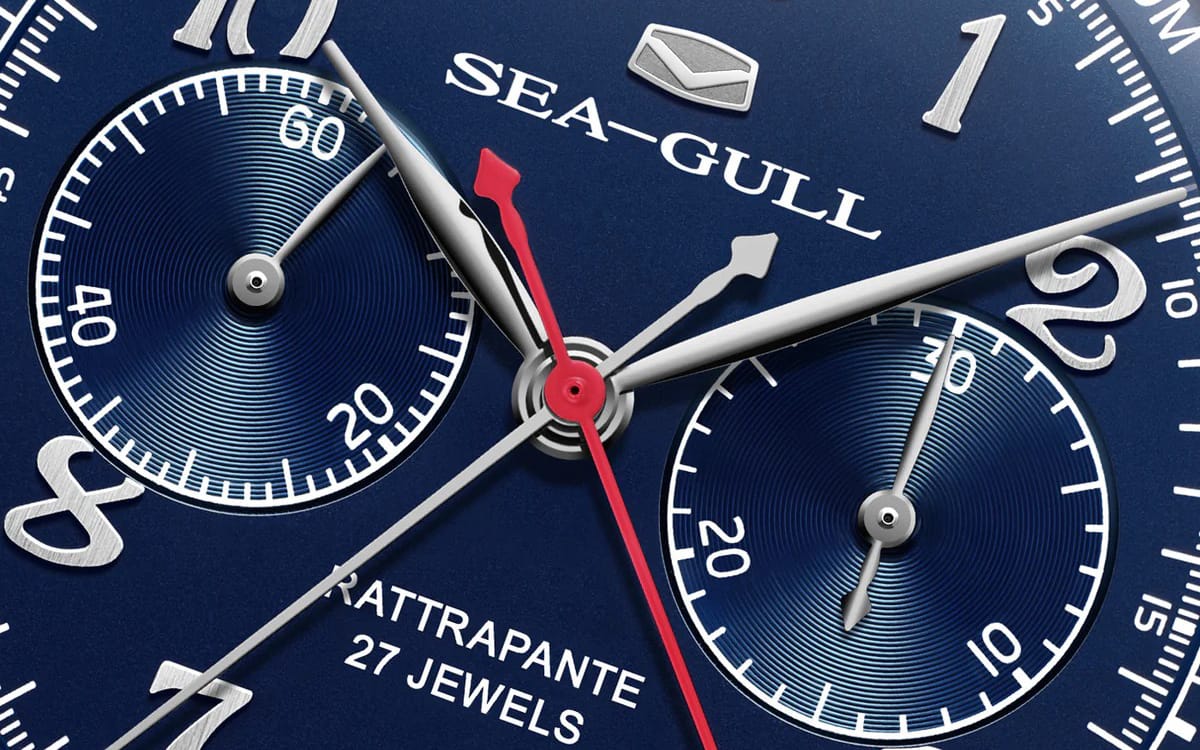
The dial is matte blue, deeper than navy in some light, with none of the sunburst you might expect from the press photos of the white version. A raised flange rings it, carrying the tachymeter scale and its BASE 1000M label, and two recessed registers sit in a two-register bicompax layout: running seconds at 9 o'clock, a 30-minute counter at 3, both finished with concentric snailing that catches light in rings. The hour markers are applied, polished, Breguet-style Arabic numerals, substantial enough to throw shadows, and Kazan's careful phrasing holds up in the metal: Breguet-like without being true Breguet numerals. Above center sit an applied emblem and the SEA-GULL wordmark; below it, RATTRAPANTE and 27 JEWELS curve in white print.
The hands are where the blue dial quietly departs from everything written about this watch. The published descriptions of the white version don't even agree with each other: Sea-Gull's own blog describes a gray primary chronograph hand with a blued split hand, while other introductions described both central hands as silver, over blued leaf hands for the time. The blue runs a different specification entirely. The hour and minute hands are silver leaf shapes, the primary chronograph hand is red, and the split hand is silver, hidden completely behind the red when the two are stacked. Why change the handset? Presumably the answer is legibility, since blued steel would sink into a navy dial. Whatever the reason, the blue isn't a color swap on the white watch. It's a re-spec, with its own handset and its own reference number, and as far as I can find there's no record of either anywhere in print.
The red hand over blue is why my first association, before I'd read a single specification, was a much less expensive version of the Patek 5470P-001, the 1/10th-second monopusher with the blue dial and red chronograph hand, with the 5172G-001 close behind it. I wasn't alone in going to Geneva for comparisons; Goulard reached for the 5172's pushers without ever holding the watch. The dial earns the association. The numerals are a serious touch of class, and despite everything happening here, a tachymeter, two snailed registers, four lines of text, and three colors of hand, it doesn't feel like too much. It's close, though.
If I ran Sea-Gull, I'd trim two things. The wordmark would go, leaving the emblem alone, though the emblem carries its own risk, since Monochrome's commenters keep mistaking it for an envelope. And 27 JEWELS would go with it. Jewel counts stood in for precision two generations ago, and I'm not sure anyone chooses a watch by bearing count anymore. The line does have a pedigree: the Seagull 1963, the watch this movement descends from, prints its own jewel count on the dial, 19 ZUAN or 21 ZUAN depending on the version, so 27 JEWELS is that inheritance translated into English. Everything else on this dial looks excellent.
There's no lume anywhere on this watch, not on the hands, not in the numerals, and after dark the dial simply goes away, which makes this a daylight instrument and worth knowing before you buy. And under a macro lens, piece 004 passes inspection: the printing is crisp, nothing is fuzzy, the applied work sits flat, and I can find no mistakes. At $3,580 from a factory whose reputation was built at $400, the clean sweep isn't a footnote. It's the answer to the question everyone was actually asking.
The movement
The calibre is the ST1961, and its family tree is the most Swiss thing about it. In the early 1960s the Tianjin Watch Factory bought the tooling and drawings for the Venus 175, a column-wheel, horizontal-clutch chronograph from the same mid-century generation that powered Breitlings. Venus's machines went east, the design became the ST19 and then the ST1901, and the movement spent the next six decades powering the Seagull 1963, China's first aviation chronograph, and, more recently, a large share of the microbrand chronograph wave: Studio Underd0g, Lorier, and Baltic all build on it. Sea-Gull knows this architecture the way Toyota knows the Corolla. The company, founded in Tianjin in 1955 around China's first domestically produced wristwatch and often called the world's largest maker of mechanical movements, recently rattled its microbrand customers by setting a 10,000-piece minimum order on the ST19 family. Then, for its seventieth anniversary, it kept the interesting version for itself.
The ST1961 takes that hand-wound base and adds a split-seconds module on top, and the design of the module is the entire cost story. The split is cam-operated rather than column-wheel-operated: a clamp grips the split wheel to freeze one hand, and a heart-shaped cam snaps it back to catch up. It's the same pragmatic route Richard Habring took in 1993 when he built IWC's split-seconds on top of the Valjoux 7750, the design that later became the Habring² Doppel once the patent lapsed. Sea-Gull says the development took seven years. The base keeps its column wheel and horizontal clutch. In other words, the expensive architecture stayed, and the shortcut lives entirely in the layer above.
The confirmed numbers are 27 jewels, 21,600 vibrations per hour, and a claimed 45-hour reserve, which I haven't run down against a clock. I say confirmed because Sea-Gull's own product page claims 28,800 vibrations per hour while its spec table says 21,600, and the wrong number already propagated into one major introduction. The black numbered card in my box prints 21,600, the base architecture runs 21,600, and the card wins. A manufacture contradicting its own spec sheet on its flagship's page is a loose bolt worth recording, mostly for what it suggests about how far the marketing trails the watchmaking here.
Here's what the introductions couldn't test. Stacked, the two central hands read as one. The silver split hand disappears completely behind the red. Press the pusher at 10 and the split arrives on demand, the silver freezing at the mark while the red runs on, with no hesitation or flutter in the running hand at the moment the clamp bites. Press again and the catch-up snaps home with real force, in both modes, the split hand leaping forward to rejoin the red and the pair returning to 12 on reset. The snap carries enough energy that the red hand visibly springs ahead for an instant before settling back to its exact position. I haven't put the movement on a bench, so I'll make no claim about how it holds time through repeated splits. What I can report is that in these first days the split has never failed to arrive and never failed to catch up.
Through the ten-sided back, the finishing runs ahead of the price. Geneva stripes cross the signed upper bridge in crisp lines, with the Sea-Gull plate set in gold against them. Blued screws sit everywhere against the steel. The split-seconds deck itself, a grained three-armed bridge with bevels that read as polished and curved clamp arms wrapped around the split wheel, stands proud of the base, so the view has layers, with gold train wheels and chronograph levers running underneath the new works. Whether those bevels are cut by hand or by machine, a photograph won't settle, and neither will I. What I can say is that this doesn't read as a dressed-up 1963. The bottom layer is recognizably the old Venus architecture. The second storey built on top of it is the show. There's even visible room where a rotor could have gone, and leaving the watch hand-wound reads as a decision against still more height.
The mechanism's reputation is the one substantive knock anyone landed. Rattrapantes are notoriously unfriendly to service, and on this movement the split module sits over the balance, which led one commenter to worry that even regulating the watch would mean opening up the rattrapante works. It won't, or not entirely: there's a cutout in the module for the regulator arm, visible on my example. The longer answer is Sea-Gull's warranty, three years, with free round-trip shipping to the Tianjin workshop and a US repair presence the company says is coming. The numbered black card in the box has no field for a dealer's stamp, so the warranty clock is your invoice. Keep it. My own position is uncomplicated. I'm not worried about servicing, and if it has to go back to China, it goes back to China. I don't baby my watches, and I didn't buy this one to start.
Daily life with the movement runs through the crown, and the crown is good. It winds easily, even with my fat fingers, and arrives at a definite stop when the mainspring is full. If hand-wound watches make you nervous about overwinding, and they make me a little nervous, that stop is the design doing its job. The stopped-by-overwinding story is almost always a dirty movement with a convenient excuse. Wind to the wall, then stop. Timekeeping so far is the qualitative kind of good: it hasn't drifted enough for me to notice, and I'll leave the bench numbers to someone with a timegrapher.
On the wrist
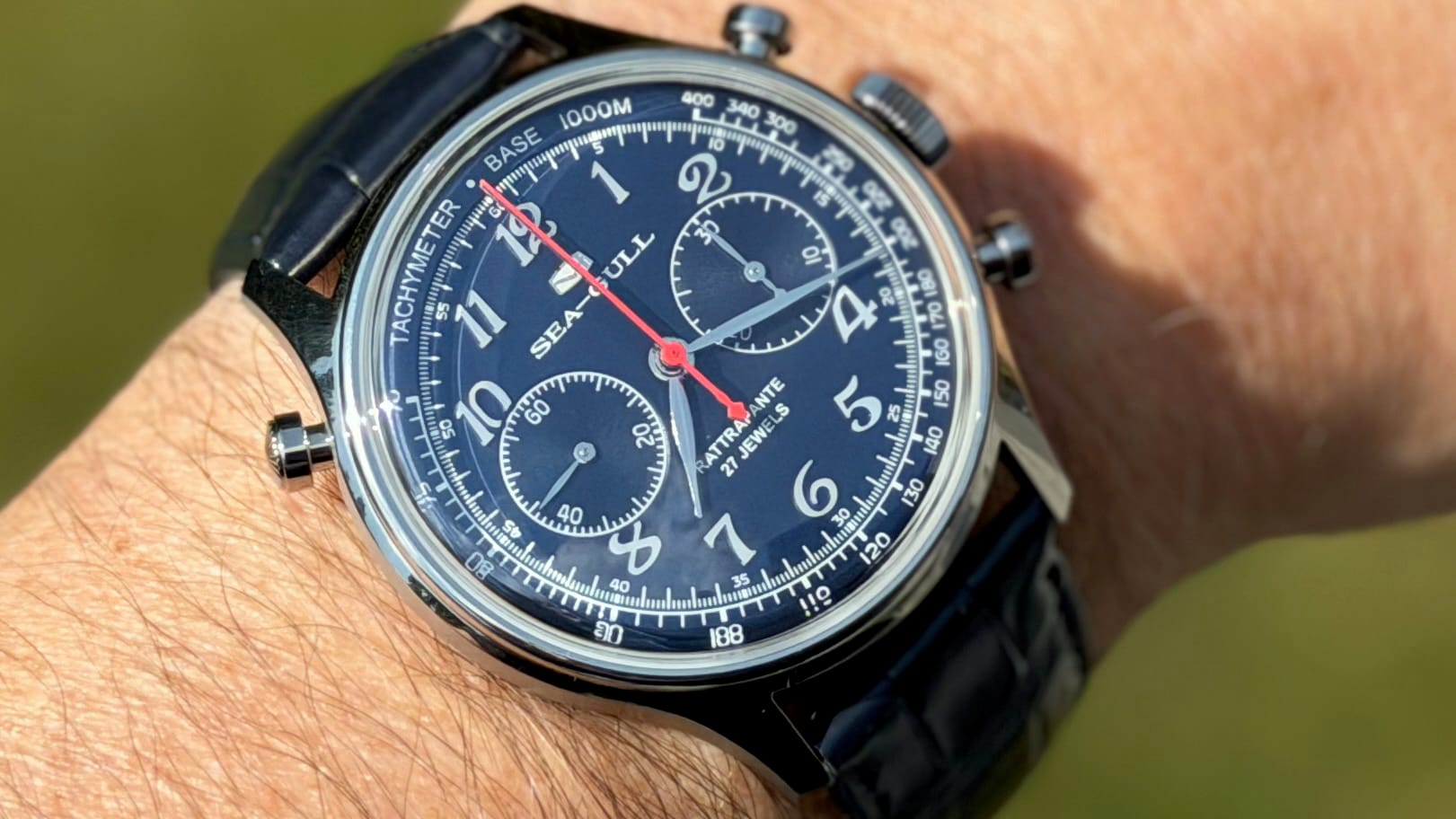
It wears easy, and it wears light, which is the sentence a 16mm spec-sheet height can't predict. Most watches this size carry real heft. This one doesn't, and the titanium is the reason a tall watch spends the day unnoticed. But it does sit a little high, the way tall watches do, and that's the whole complaint.
On the wrist it looks more expensive than it is. I braced for the opposite, because ordering a watch nobody has photographed on a wrist means accepting that the metal might disappoint the renders. Sometimes you open the package and the watch looks nothing like the pictures. This one may look better than them.
But the straps are the one place the budget shows. The watch ships on black alligator with a suede strap included as a gift, both just OK, and it's clear the money didn't go into them. The titanium pin buckle is the plainest part of the package. A deployant would have suited a watch with these ambitions. Of the two straps, I prefer the alligator, and a brown leather experiment is next.
Where it slots in a rotation, I genuinely don't know yet. Dressed up, the applied numerals and the complication fit right in. As a daily, the titanium, the tachymeter, and the 50 meters hold up. After dark, the missing lume takes it out of service either way. For now the answer is both and neither, and I'm pleasantly surprised to be unsure. One thing I'd state with confidence: at a watch event in America, you'd be the only person in the room wearing one.
Comparisons
Start with what a new mechanical rattrapante costs. The Habring² Doppel, the standing answer to the accessible split-seconds ever since Maria and Richard Habring built their own version after the IWC patent lapsed, runs roughly $10,000. The Breitling Premier B15 Duograph, hand-wound on the B01 base, lists around $11,250. Sinn's 910 Anniversary came in at $5,940 in 2016 and sold out years ago. Against that field, Sea-Gull's current list of $4,299, let alone my $3,580, makes this the least expensive new mechanical rattrapante on the market, and it isn't close.
The used market is where the superlative gets an argument instead of a walkover. The neo-vintage IWC Doppelchronographs, the 3711 and the Portugieser Rattrapante 3712, both running Habring's 7750-based split, trade in the low-to-mid four figures, and forum collectors greeted this watch by pointing exactly there. One reported a used IWC Ingenieur Rattrapante and a Panerai Ferrari rattrapante bought for about $4,000 apiece. In a small collision of my own interests, the dealer I bought this from currently lists a vintage Universal Genève Master Tech split-seconds at $4,578. New, the Sea-Gull has no rival. But against the secondhand market, it's a choice between a fresh warranty on an unproven mechanism and a proven mechanism carrying somebody else's mileage.
The price itself has wandered enough to matter. The watch launched at $3,499, most of the coverage carried $3,649, Sea-Gull's AliExpress store showed $4,279 last spring, and the official store reads $4,299 as I write this. I paid $3,580 for the watch plus $327 in shipping at BackWatch Department, roughly $700 under the maker's own current price for the watch itself, and that's the pattern worth knowing: third-party dealers are where the deals live on this watch. The trade-offs are the expected ones, a few weeks of customs roulette on the way in, and a warranty that leans entirely on your invoice, since there's nothing on the card for a dealer to stamp.
The frame every writer reached for is real as far as it goes. Kazan coined the Bel Canto Effect for the moment Christopher Ward put a chiming watch under $4,000, and Gear Patrol groups this Sea-Gull with the Bel Canto, MB&F's MAD1S, and SpaceOne's Tellurium as the democratization of complications. But the frame misses something. Sea-Gull isn't a plucky microbrand borrowing someone else's movement. This is the supplier itself, putting its own name on a complication it could have sold to everyone, and it's already followed this watch with a meteorite-dialed version on an upgraded ST1961-2. The rattrapante isn't a stunt for them. It's a line now.
Which leaves the objection that has followed this watch through every comment section: it's Chinese, and it costs what Swiss entry-level costs. The reception genuinely split, between buyers who can't get past the name on the dial and buyers who look at the price of the nearest alternative and shrug. I'm in the second camp, with a reason. A meaningful share of the components inside watches sold as Swiss are already made in China, so a Chinese factory finishing the climb to complications isn't an upset. It's a timetable. I wouldn't underestimate them.
Would you spend $3,580 on a Sea-Gull? Most people shopping at that number wouldn't consider one, and most people who buy Sea-Gull would never spend it on one. On paper, that's a watch with no customer. In practice, the white dial shows sold out on Sea-Gull's store as I write this, and a single-digit serial was still findable in Sheung Wan a year and a half after launch, so somebody is buying, slowly.
Final thoughts
The customer, it turns out, is the collector who loves a genuine oddity, and I can report that from the inside. I don't expect this watch to become a precious collector's piece, and I didn't buy it as one. I bought it because a working split-seconds chronograph from Tianjin at a third of the going rate is one of the strangest value propositions in modern watchmaking, and because I still have no idea how they did it at this price. After these first days, the parts that matter have held up. The split arrives every time and the catch-up snaps home. The finishing survives a macro lens. The titanium keeps 16 millimeters comfortable. And the blue dial, the variant nobody bothered to document, turns out to carry its own handset and its own reference number.
The introductions from January 2025 all closed the same way, with some version of the same sentence: we'd like to see it in the metal. Eighteen months later, in the metal, the watch is better than its coverage. Press the pusher at 10 and the hands split, one holding your mark while the other runs on, and a mechanism that spent its whole history behind Geneva prices does it on demand, on a wrist, for the cost of a used entry-level Swiss chronograph. I came for the oddity. The watch underneath it is the pleasant surprise.

