

On the evening of October 26, 2017, a steel chronograph sat under the lights at Phillips in New York while a voice on a telephone opened the bidding at ten million dollars. Twelve minutes later it was finished. The hammer landed at $17,752,500, including premium, and the watch had belonged to Paul Newman.
It was the actor's own Rolex Cosmograph Daytona, reference 6239, the one with the strange "exotic" dial. His wife, Joanne Woodward, had given it to him and had "Drive Carefully Me" engraved on the back. For decades it lived on the wrist of a man named James Cox before it reached that saleroom. The price set a world record for any wristwatch sold at auction.
Most of us are never getting near that watch. A vintage Paul Newman Daytona starts in the six figures and climbs from there. So what does a person who loves that dial do about it?
The most faithful homage to the most expensive Rolex ever sold, reissued with a Sellita heart.
The watch world has rules about copies. A homage that borrows a silhouette earns side-eye. An exact duplicate is usually just called theft. The Gevril Tribeca is about as exact as a copy gets, and the watch world mostly waves it through. The reason is the same one that lets a fiberglass Porsche 356 Speedster replica park at a Sunday meet without anyone reaching for a tire iron. The real thing is so rare and so expensive that nobody mistakes the tribute for fraud. There is no crown on this dial. It says GEVRIL.
The brand's own pages and the trade press don't fully agree on its history, so it's worth laying the conflict out rather than smoothing it. Gevril traces to Jacques Gevril, born in La Chaux-de-Fonds in 1721, who became watchmaker to the Spanish crown after presenting musical automata to King Ferdinand VI on a 1758 trip to Madrid with Pierre Jaquet-Droz. The modern revival is messier. The name passed through a Swiss group, a Chicago firm, and a Philadelphia jeweler before the watch entrepreneur Samuel Friedmann bought it, in 2000 by one telling and 2001 by another. The factory stayed in Switzerland and the headquarters moved to New York, which is why the collections carry Manhattan names. Tribeca is the Triangle Below Canal Street.
The Tribeca shipped in 1999, which puts it before Friedmann's purchase. The reputation that made Gevril collectible traces to a watch its modern owners had nothing to do with.
By the account of Danny Govberg, then a Gevril shareholder, the team bought real Paul Newmans, took them apart, and measured every part with calipers down to the micron. The vintage-Rolex authority Eric Ku has said the result is faithful enough that the bezel and pushers will swap onto a genuine 6263 or 6265. That is closer to a tracing than a tribute.
The watch on my wrist is the modern reissue of that 1999 design, reference A508ANAA-AN-BMA508A, one of a run of 500, mine is numbered 023. The dial is the same one Gevril traced a quarter century ago. What changed is the heart underneath it.
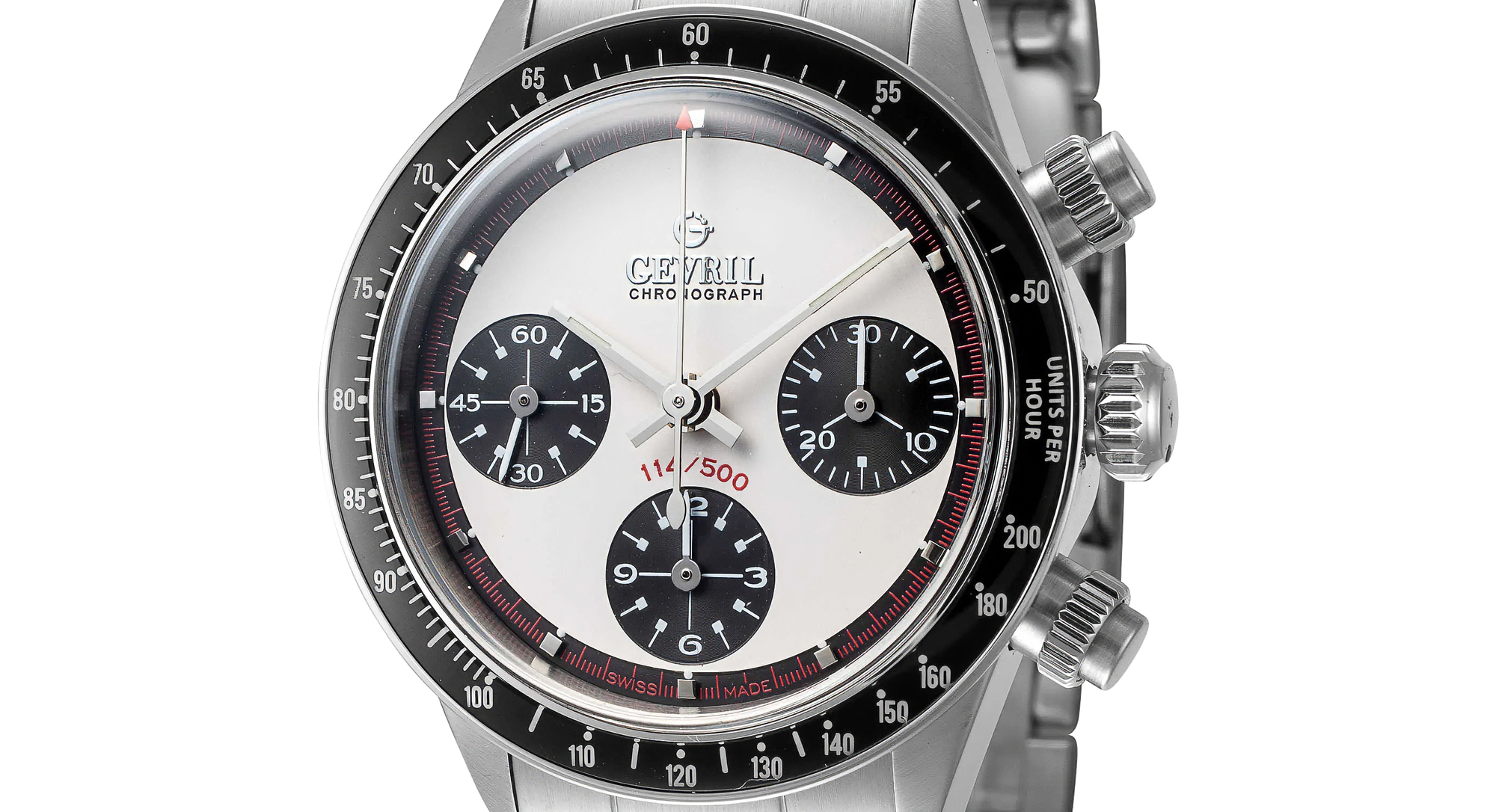
Case and dimensions
The case is stainless steel, 37mm across, 15mm thick, and 44mm from lug tip to lug tip. The caseback is solid steel with nothing engraved on it.
That 37mm figure is the headline, and the thickness is the surprise sitting behind it. Fifteen millimeters is tall for a case this narrow, and the reason is the movement.
The faithfulness shows up at the edges. The crown and both pushers screw down. The lugs are drilled all the way through, the holes visible from outside, which is true to the originals and, on a practical level, makes strap changes painless. The links are drilled too. A tiny screwdriver is all it takes to size the bracelet or pull it off entirely.
The bezel is a glossy black tachymeter, the outer scale reading UNITS PER HOUR. The spec record contradicts itself here. Gevril's own history page calls the insert black enamel. Revolution, covering the same watch, calls it ceramic. On this one it reads as a deep, glossy black track, and I won't claim a material the brand and the press can't agree on. The crystal is hesalite, domed, and you can see it bend the dial at the edges the way acrylic does and sapphire never will. It scratches more easily and it polishes out at home. That trade is the vintage charm, and Gevril made it on purpose.
Dial, bezel, and lume
This is the reason the watch exists. The dial is white with three black sub-registers, the configuration collectors call a panda. The layout is the one that matters: running seconds at nine, a thirty-minute chronograph counter at three, a twelve-hour counter at six. That is the Paul Newman arrangement exactly. There is no date window.
That last detail is harder to pull off than it looks, but Gevril got the geometry right. The sub-dials carry the squared-off markers and the contrasting track. GEVRIL and CHRONOGRAPH sit under the G logo up top. Where a real Daytona reads "Daytona" in red above the six o'clock register, this one reads 023/500 in the same red.
The 1999 originals faked tritium. The dots and plots were made to look luminous and did not glow. The reissue fixed it. The lume here works, and it works well on the hands and indices. It is a thin strip rather than a full fill, so in the dark it reads as a clean line, not a glowing baton.
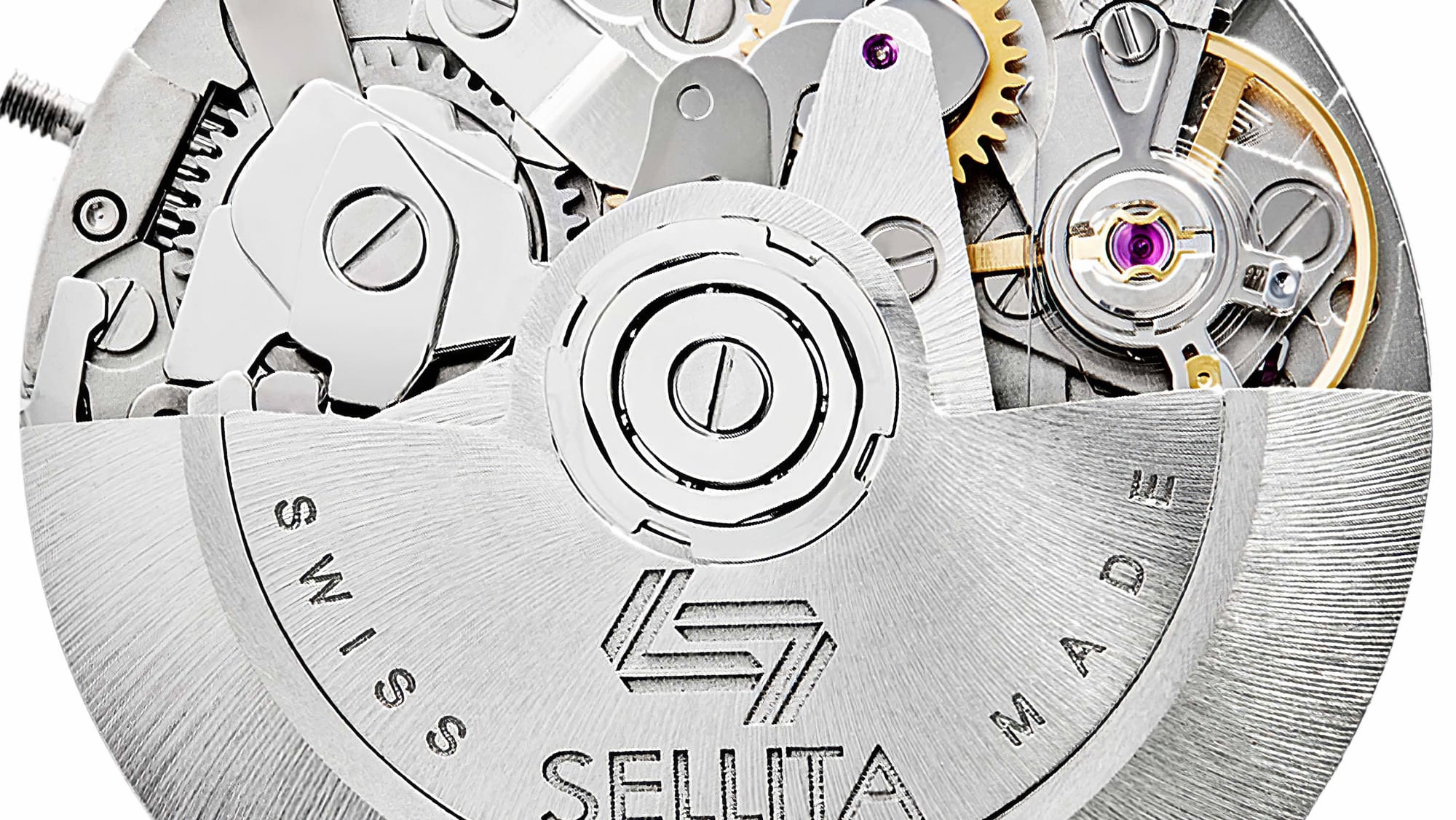
Movement
Inside is a Sellita SW510A, the automatic member of Sellita's SW510 family. It is the firm's take on the Valjoux 7750, running at 4Hz on 27 jewels with a power reserve of roughly 62 hours. It is also a physically large, nearly 8mm-tall movement, and that is most of why a 37mm case ends up 15mm thick. The original 1999 Tribeca got to the same height a different way, by stacking a Dubois-Dépraz chronograph module on a thin ETA 2824 base for 51 jewels. Same result, two completely different architectures. It winds easily by hand.
There is a quirk worth flagging before an owner trips over it. The SW510 in this configuration is a date movement, but Gevril fitted a dial with no date window. The date wheel turns where you can't see it, and there is a crown position that sets a date that doesn't exist on the dial. It is the faithful choice, no window on a Paul Newman, reached by hiding the movement's date rather than fitting a no-date caliber. The dead crown click is a side effect, not a fault.
This, however, is a fault. I ran the chronograph. The pushers are firm and click cleanly. On reset, the central chronograph seconds hand snaps back to twelve, and the thirty-minute counter at three returns to its zero. The twelve-hour counter at six does not. On a watch that has never been worn, one of the three resets is failing.
I can't tell you with certainty why, and I won't guess past what I can support. The most likely explanation is that the hour-counter hand was set a hair off its zero during assembly, so the reset hammer does its job but the hand lands short of the mark. A watchmaker can confirm it in minutes and reseat the hand. It is a small, correctable defect. It is also exactly the kind of thing a borrowed review unit never reveals, and the reason I buy what I review.
The crown and pushers screw down, and the original was rated to around 100 meters. This piece carries no depth marking on the dial or the caseback. Paired with a hesalite crystal, the sensible read is splash resistance, not a swimming watch.
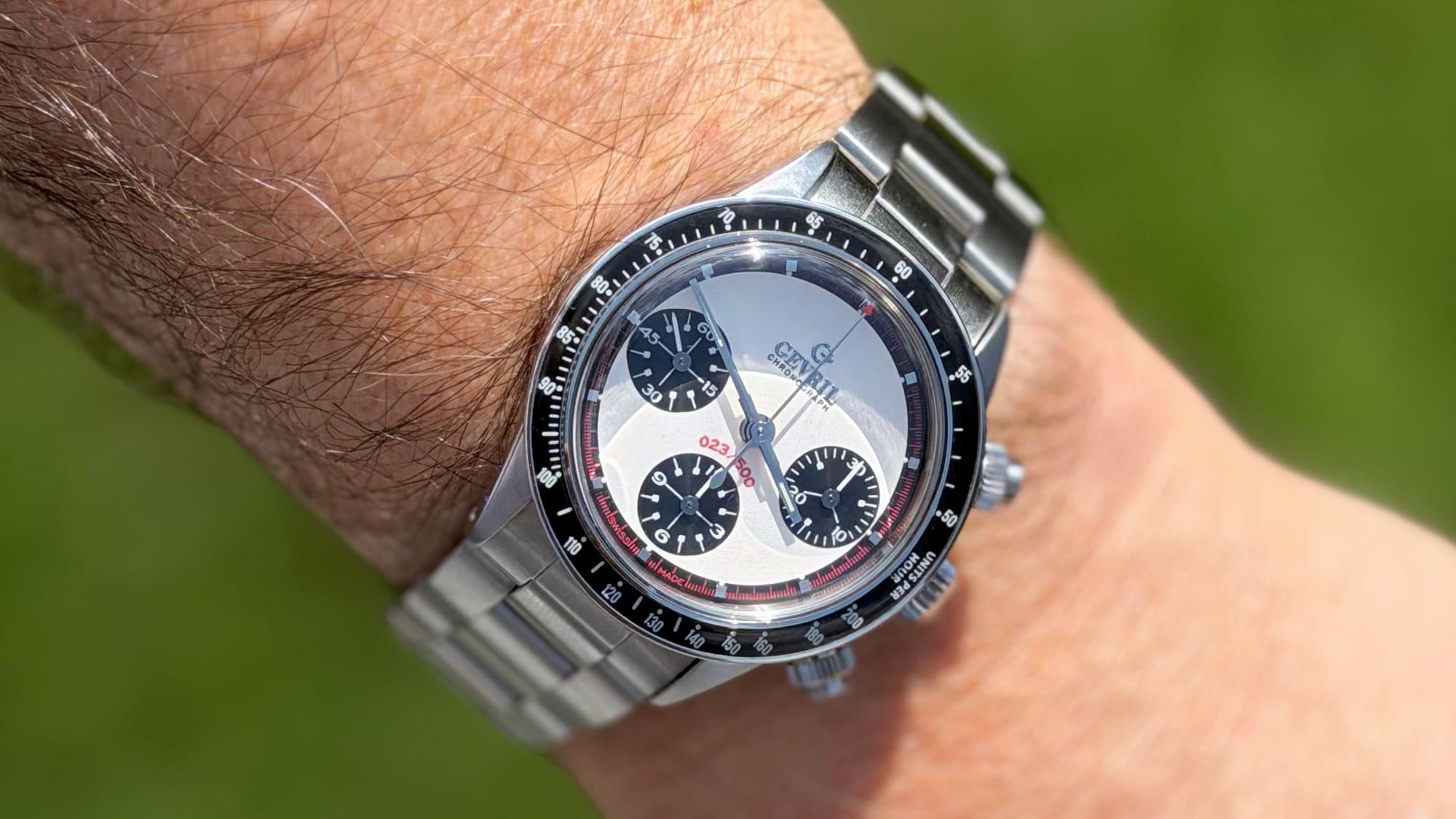
On the wrist
I live at 42 to 45mm. This is 37, and I needed to take out one link for a good fit. It is small, but not impossibly small. It is not a 23mm toy. It took getting used to, about as much adjustment as a 48mm watch takes coming from the other direction. Against the rest of my rotation it reads thin. The honest summary surprised me: it feels like a normal-sized watch and looks small for my wrist.
The height has never bothered me. I'm not in French cuffs often, so the 15mm stack stays out of my way, and it looks thin to me regardless of what the calipers say.
The weak point is the bracelet. It looks like an Oyster but does not operate like one. The clasp looks and feels cheap. There is a method for micro-adjustment, but not the on-the-fly kind, and the whole assembly is the part of this watch that most betrays the price. The saving grace is the case, not the bracelet: those drilled lugs and links mean a spring-bar tool and a strap get you out of the problem entirely.
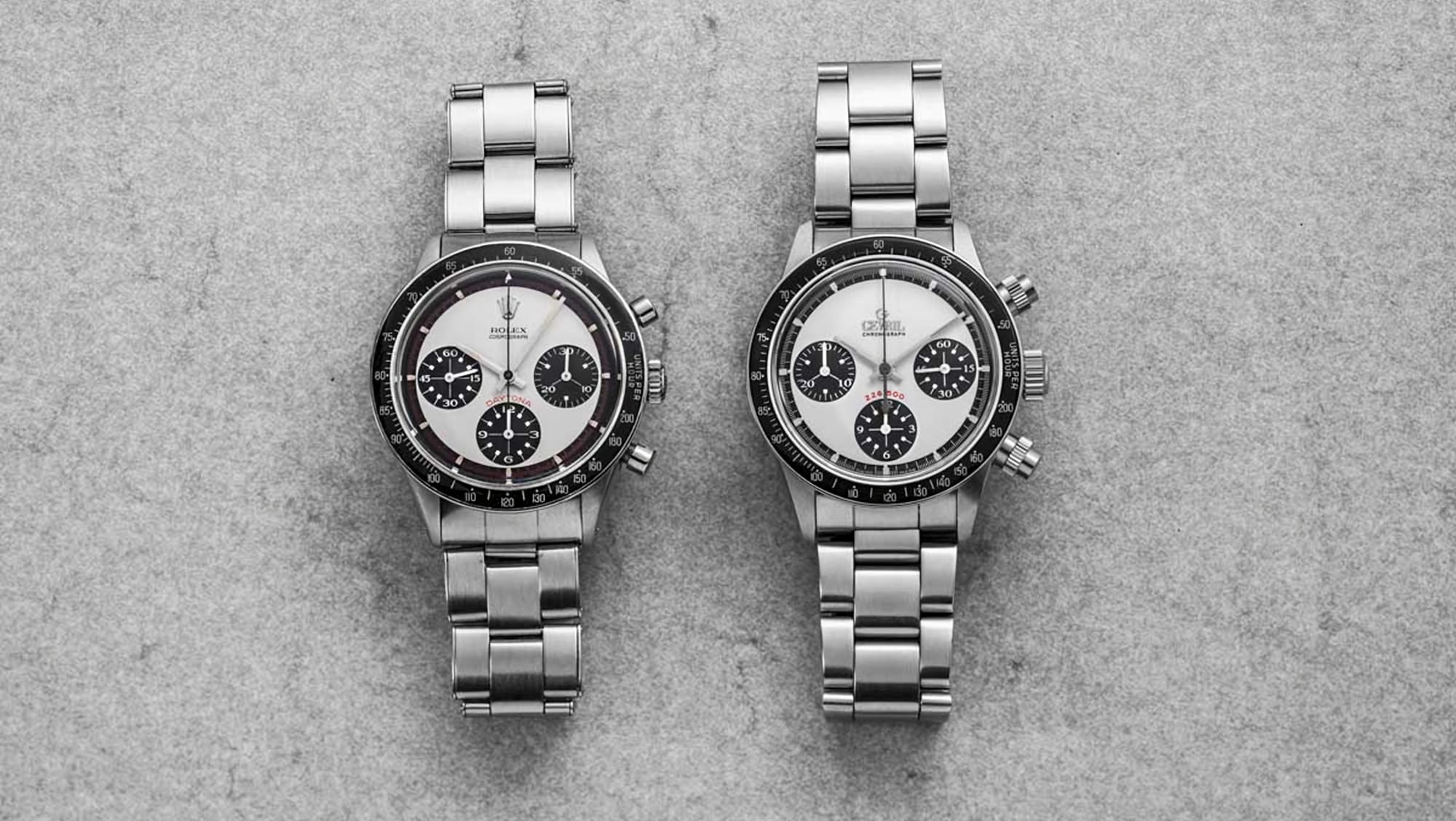
Comparisons
Start with the watch this one replaces. The 1999 Gevril R005 wears the same dial in the same case, but with the ETA-and-module heart instead of the integrated Sellita. A clean vintage R005 now asks more on the secondary market than this new one cost, yet the vintage has the dead faux-tritium lume and no warranty, while the reissue glows and comes with Gevril's coverage. The instinct that older always means better does not survive contact with these two.
Then the real thing. A vintage Paul Newman Daytona starts in the six figures, and Newman's own brought $17.75 million. This Gevril is a hundredth of that.
That 2017 result was the most expensive wristwatch ever sold at auction at the time. It isn't anymore. A steel Patek Philippe Grandmaster Chime took the overall record in 2019 at about $31 million. What's still true: Newman's 6239 remains the most expensive Rolex ever sold at any auction.
For a collector building a shelf of panda chronographs, this is the most literal Daytona stand-in you can buy new, and a 7750-grade automatic at a price that lands among microbrand chronographs rather than luxury ones. The competition at three thousand dollars is deep, though, and most of it ships with a chronograph that fully resets.
Final thoughts
This watch exists because the real one is unreachable, and on that count it does its job. The dial is faithful, the layout is right, and the lume works. The case is soundly made, down to the drilled lugs that let you change straps yourself.
The rest of the watch undercuts it. The bracelet is cheap where it counts, at the clasp. The water resistance is a question mark. And on a watch fresh out of the box, bought at full retail, the chronograph doesn't fully reset. That is a hard thing to forgive at three thousand dollars.
So the recommend, as the watch sits in the box, is no. Reseat the hour-counter hand, swap the bracelet, and the calculation changes, because what you're really buying is the panda dial that stopped an auction in 2017, on your wrist for a hundredth of what it brought.
Gevril copied the most famous dial in watchmaking, and in this case, I think that's ok.
