

I own four Hoffman Racing 40 chronographs. Three quartz, one mechanical. All with the same basic dial layout. None of them will ever be worth more than I paid, but I really don't care. Because very few brands get the panda dial right, and Hoffman is one of them.
Most panda dial chronographs suffer from the same problem. The designers can't leave well enough alone. Hamilton, Sea-Gull, Omega, Seiko, Longines. They all overstuff the dial with date windows, extra subdials, chunky indices, and text until the whole point of a panda is buried. The watches I keep coming back to for panda execution are Rolex, Audemars Piguet, Vacheron Constantin, and Parmigiani Fleurier. The Parmigiani Tonda PF Chronograph has a panda dial about as spartan as you can get, and I love it. The Rolex Paul Newman ref. 6264 is probably the one I'm measuring all pandas against, which isn't really fair.
But it's clear Hoffman keeps that simplicity in mind. A white dial, two dark subdials, a tachymeter bezel, and nothing else competing for attention. At $269 for the quartz and $599 for the mechanical, the Racing 40 costs less than a nice dinner for two. I have the white panda in both quartz and mechanical, a purple panda, and a blue panda. The blue hasn't made it out of the house yet. The mechanical panda is the one I reach for most often.
Hoffman: a Kickstarter success story from New York
Hoffman Watches is an American company founded in 2016 in New York City by Will Hoffman. The first model, the Racing 40 Midnight, launched through a 2018 Kickstarter campaign that raised $191,830 from 872 backers. The tagline is "Sports Watches - Vintage Reimagined," and the Racing 40 is clearly rooted in 1960s motorsport chronograph design.
Since the Kickstarter, Hoffman has expanded to three product lines: the Racing 40 mechaquartz, the Racing 40 Mechanical, and the Diver 40 automatic. The brand sells direct through its own website and through a handful of authorized retailers. With over 1,500 customer reviews on record, Hoffman has moved past the anonymous Kickstarter phase. Customer service gets consistent praise on forums. It's still a niche brand, though. Most buyers find it through word of mouth rather than mainstream media coverage.
The case and dimensions
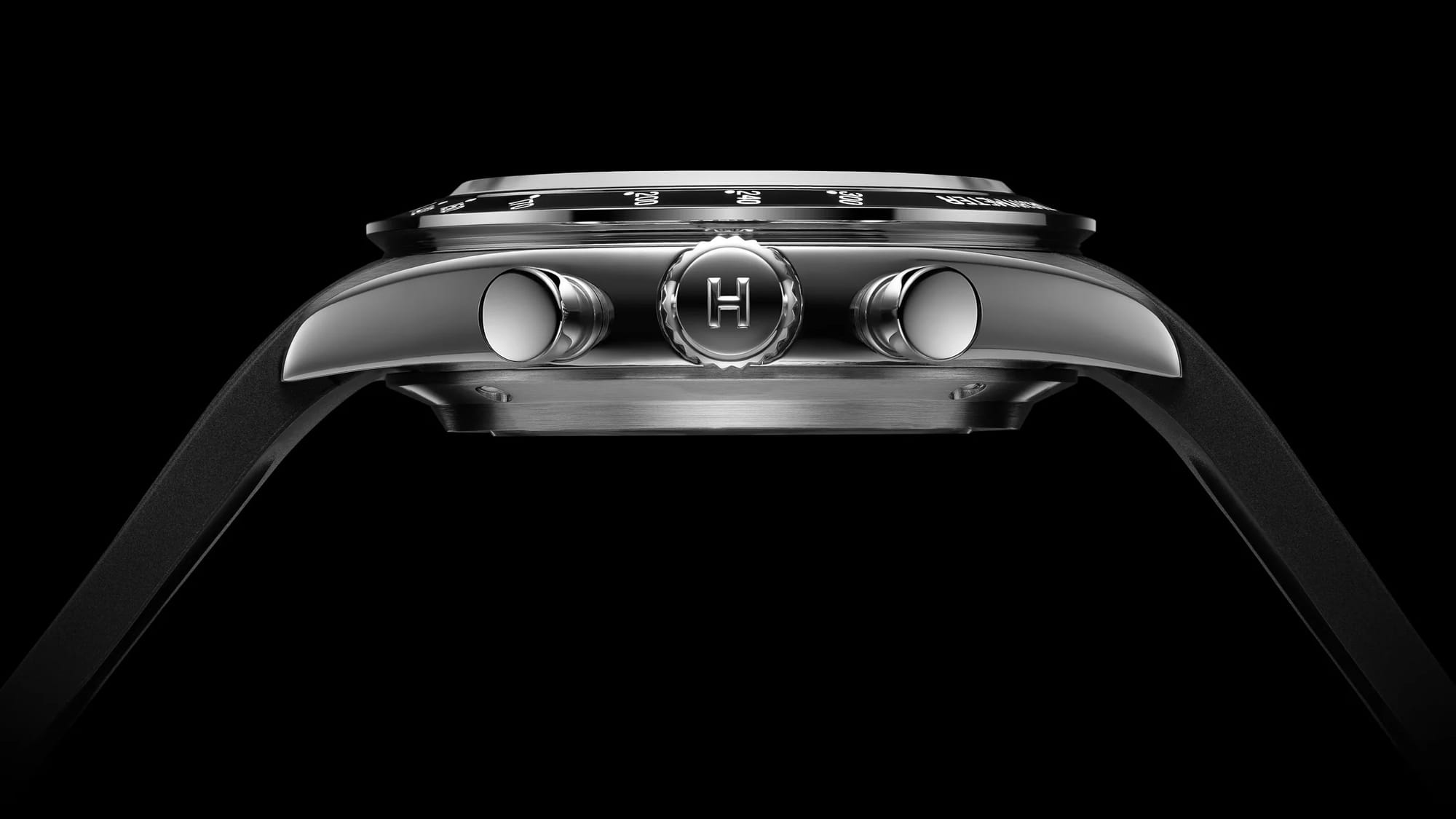
Both the quartz and mechanical Racing 40 share a 40mm case in 316L stainless steel with a mix of polished and brushed surfaces. Lug-to-lug is 48mm and the lug width is 20mm.
Where they split: the quartz version is 12mm thick, and the mechanical Mk3 is 13.5mm. On paper, 1.5mm should be noticeable. On my 7.5-inch wrist, I can't feel the difference. Both wear the same.
I'm normally not a fan of 40mm watches. I tend to prefer 42mm. But the Racing 40 somehow reads bigger than its measurements suggest. The IPG-coated black bezel with its engraved tachymeter scale adds visual diameter beyond the steel case, and the overall proportions just work. This watch actually helped me get more comfortable with 40mm as a case size.
Several third-party reviews have called it ceramic. It's not. Hoffman's own spec sheets confirm it's a black IPG (ion-plated) steel bezel on both the quartz and mechanical versions. It looks good and has held up well on all four of my watches, but IPG coating can wear over time in a way that ceramic won't. The crown is screw-down on both versions. The chronograph pushers are not.
The dial
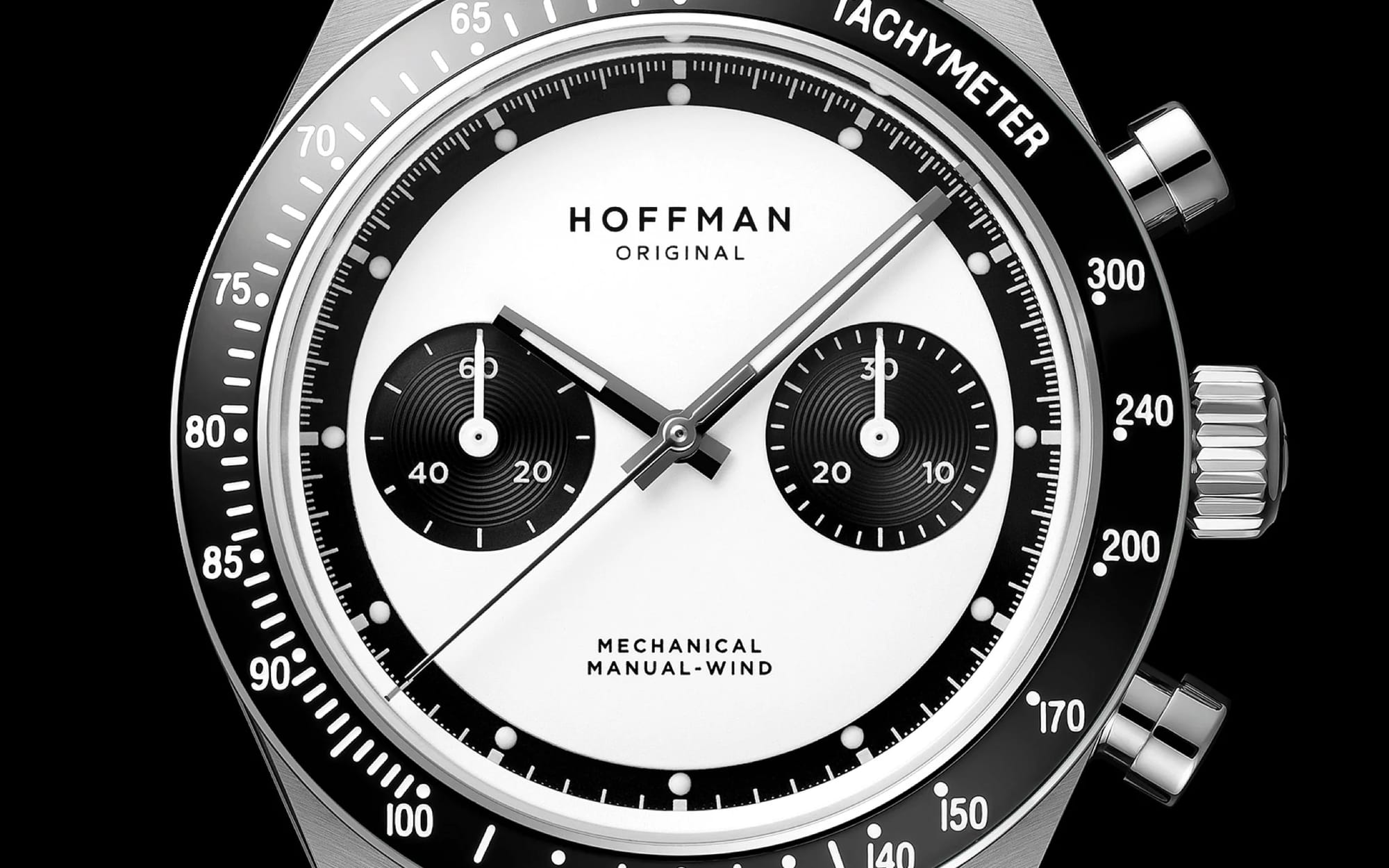
This is the whole reason I keep buying these watches. The Racing 40 panda dial is a clear nod to the Paul Newman Daytona without being a knockoff. Hoffman struck the right balance between homage and originality. White main dial, two black subdials with concentric patterns, and that's it. No date window. No extra text cluttering things up. The Hoffman name sits at 12 o'clock and a water resistance note at 6. The restraint is what sells it.
The subdial layout differs between the two movements. On the quartz VK64, you get a 60-minute chronograph counter at 9 o'clock and a 24-hour indicator at 3. On the mechanical ST1901, the 9 o'clock subdial tracks chronograph minutes while 3 o'clock becomes a running seconds display. The mechanical layout is more traditional for a column-wheel chronograph.
The dial uses a dual-layer construction with the subdials sitting slightly recessed. Up close, the concentric patterns in the subdials add depth. The finishing holds up to scrutiny, though I'll say this: analyzing finishing on a $269 watch is beside the point. These look good on the wrist and they look good across a table. Other than watch nerds examining macro shots, nobody is going to notice or care. Wear what you like.
The quartz panda has polished steel hands with no lume mentioned in the specs. The Mk3 mechanical upgrades to polished hands with Super-LumiNova C1. I rarely use lume or think about it. Nobody will be diving in this watch, so it's not a big deal. I can still read the time at night.
The movement
The quartz Racing 40 models run the Seiko VK64 mechaquartz. It's a hybrid: quartz timekeeping accuracy with a mechanical chronograph module. The chronograph seconds hand sweeps at five beats per second rather than ticking, and the reset snaps back to noon with a satisfying click. Even on the quartz version, that snap-back feels good.
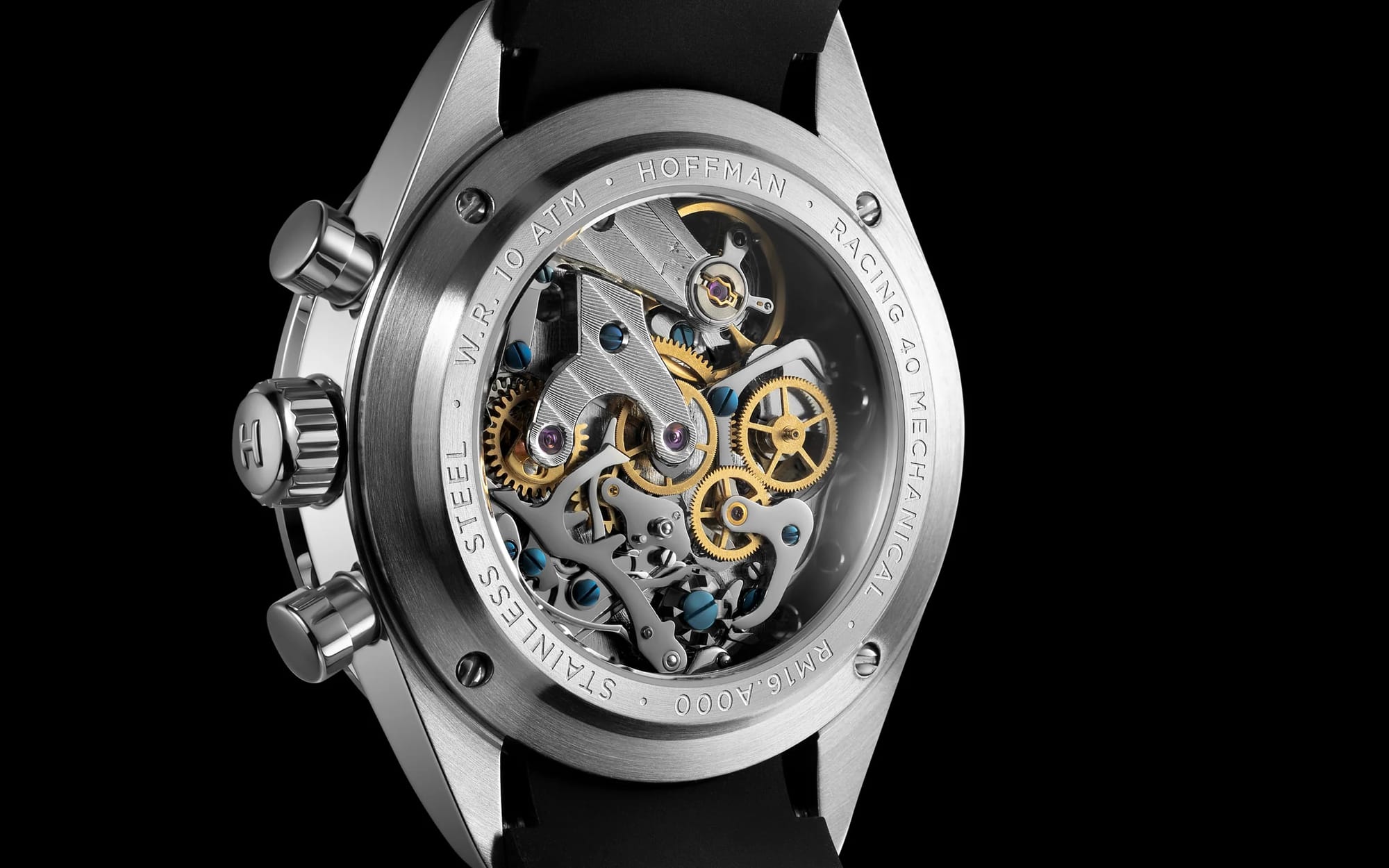
The mechanical Panda Mk3 runs a Seagull ST1901, also known as the TY2901. It's a hand-wound column-wheel chronograph based on the Venus 175 architecture. Twenty-one jewels, 21,600 vibrations per hour, with a power reserve of about 40 hours. This is the same movement used by Baltic, Sugess, the Seagull 1963 reissues, and Studio Underd0g. I own a couple of Sea-Gulls and a Studio Underd0g with this same caliber, and I can't detect any difference in how Hoffman has implemented it. The winding is smooth, the chronograph engagement feels the same across all of them.
I haven't timed the ST1901 on a timegrapher, but based on daily wear it's running somewhere between 10 and 30 seconds per day. That's within the normal range for this movement and doesn't bother me.
The VK64 is, of course, dead accurate. Battery life is rated at 2-3 years, though many owners report four or more years on the original cell.
The mechanical version has a sapphire exhibition caseback that lets you watch the column wheel operate. A genuine column-wheel chronograph for under $600, regardless of where the movement was made.
On the wrist
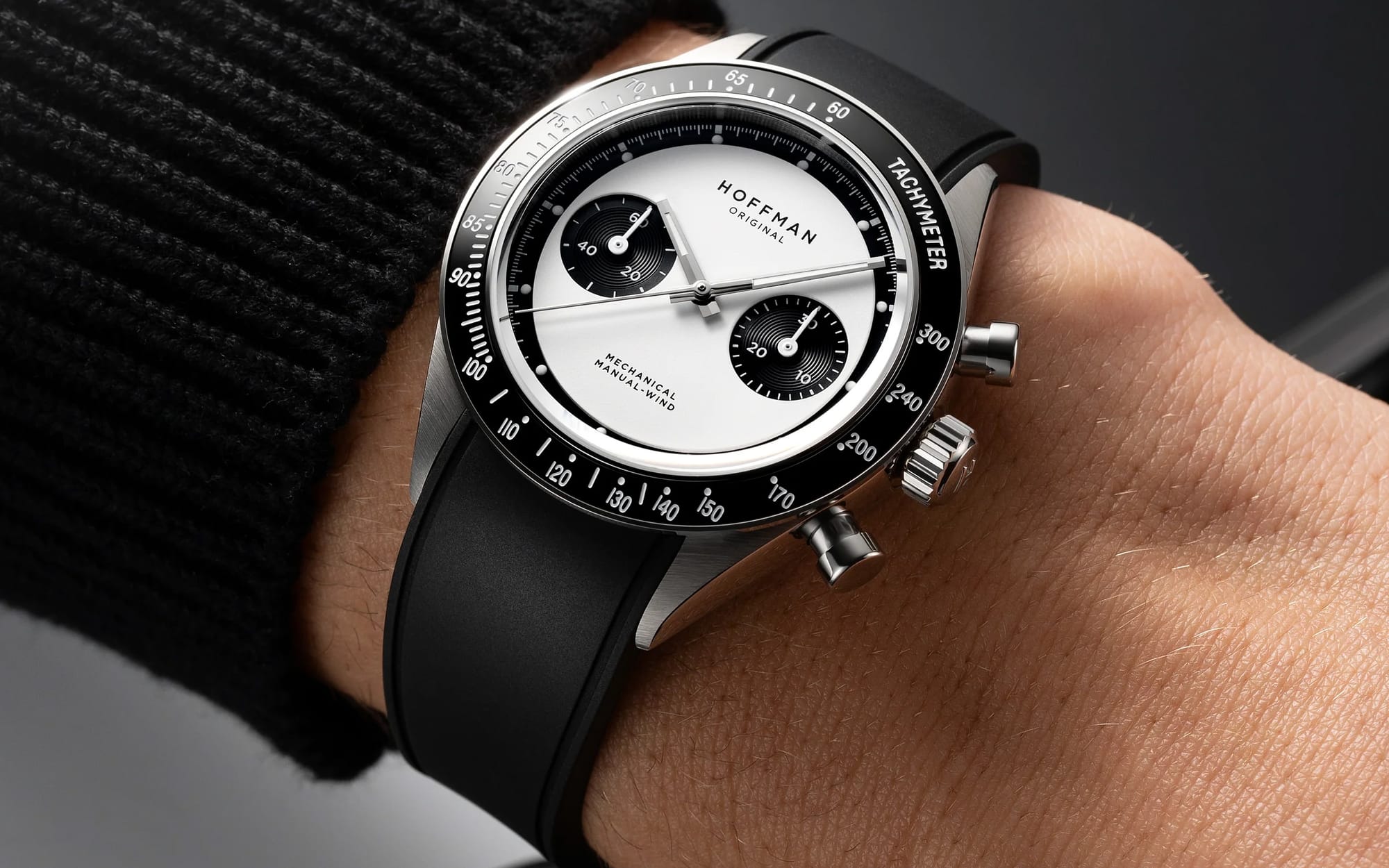
These are weekend watches. They match just about anything you wear, and they're priced at a level where I don't worry about them. That changes how you wear a watch. There's no anxiety about scratching a $5,000 piece. You just put it on and go.
The Racing 40 is also a strap monster. I've replaced the strap on all four of mine, which I tend to do with more affordable watches. At this price point, brands aren't spending much on straps, and that's fine. It's about expectations. I wasn't expecting anything more than a good design, and that's what I got. The quartz models ship with a semi-matte leather strap that tapers from 20mm to 18mm. The Mk3 mechanical comes with an integrated FKM rubber strap that tapers from 20mm to 16mm. I didn't particularly like the rubber strap on the mechanical. Right now I have all four on NATO straps: two on brown leather NATOs, two on black cloth.
Water resistance is 50 meters on the quartz versions and 100 meters on the Mk3 mechanical. I don't consider 50 meters actually resistant to water and wouldn't even shower or swim with these watches. Hoffman makes dive watches for that. These are racing chronographs, not dive watches.
When I have the choice between the mechanical and quartz versions of the same watch going out the door, I pick the mechanical. Maybe it just feels more authentic. That said, I'm not anti-quartz. I have quartz watches I wear regularly. It's more that when two nearly identical watches are sitting next to each other, the one with a beating heart wins.
Final thoughts
The Hoffman Racing 40 is not really a collector's watch. You can buy a brand new one for $269. That said, somehow the limited runs and sold-out references are trading above retail on the secondary market, particularly outside the US. The mechanical limited editions (300 pieces for the Mk3) might hold some interest for people looking for the rarer references, but I'm not buying any of these with resale in mind.
What Hoffman gets right is discipline. The brand picked a design language, committed to it, and resisted the urge to add complications nobody asked for. The result is one of the cleanest panda dials available at any price. It sits in the same conceptual space as six-figure watches from Rolex and Parmigiani Fleurier while costing less than a nice pair of shoes.
If someone asked me whether to buy the $269 quartz or stretch to $599 for the mechanical, I'd tell them to save the money. It's the same watch. Unless you really need a mechanical movement and an exhibition caseback, the VK64 does the job.
I own four of these and I'll probably buy another colorway when one catches my eye. At this price, the only question is which color.
References
- Hoffman Watches Kickstarter campaign page. https://hoffmanwatches.com/pages/about
- Hoffman Watches. "PANDA" (Racing 40 Quartz) product page. https://hoffmanwatches.com/products/racing-40-panda
- Hoffman Watches. "PANDA Mk3" (Racing 40 Mechanical) product page. https://hoffmanwatches.com/products/panda-mechanical
- The Time Bum. "Hoffman Racing 40." March 2019. https://www.thetimebum.com/2019/03/hoffman-racing-40.html
- KaminskyBlog. "Hoffman Racing 40 Panda Chronograph (Review)." February 14, 2020. https://kaminskyblog.com/2020/02/14/hoffman-racing-40-panda-chronograph-review/
- WatchUSeek Forums. "Hoffman Chronograph Review." https://www.watchuseek.com/threads/hoffman-chronograph-review.5092849/
- WatchUSeek Forums. "Hoffman Racing 40 mechanical Panda chrono $325." https://www.watchuseek.com/threads/hoffman-racing-40-mechanical-panda-chrono-325.5090679/
