I've owned, or still own, most of the Breitling collections that interest me: the Navitimer, the Chronomat, the Classic AVI, the Premier, the Top Time, and the Superocean. The only gaps left are Professional and Superocean Heritage, and until this one landed, the Avenger.
The Avenger never excited me the way the rest of the catalog does. It has the Breitling look and the toughness, but next to the Navitimer or the AVI it carries far less of the brand's aviation history.
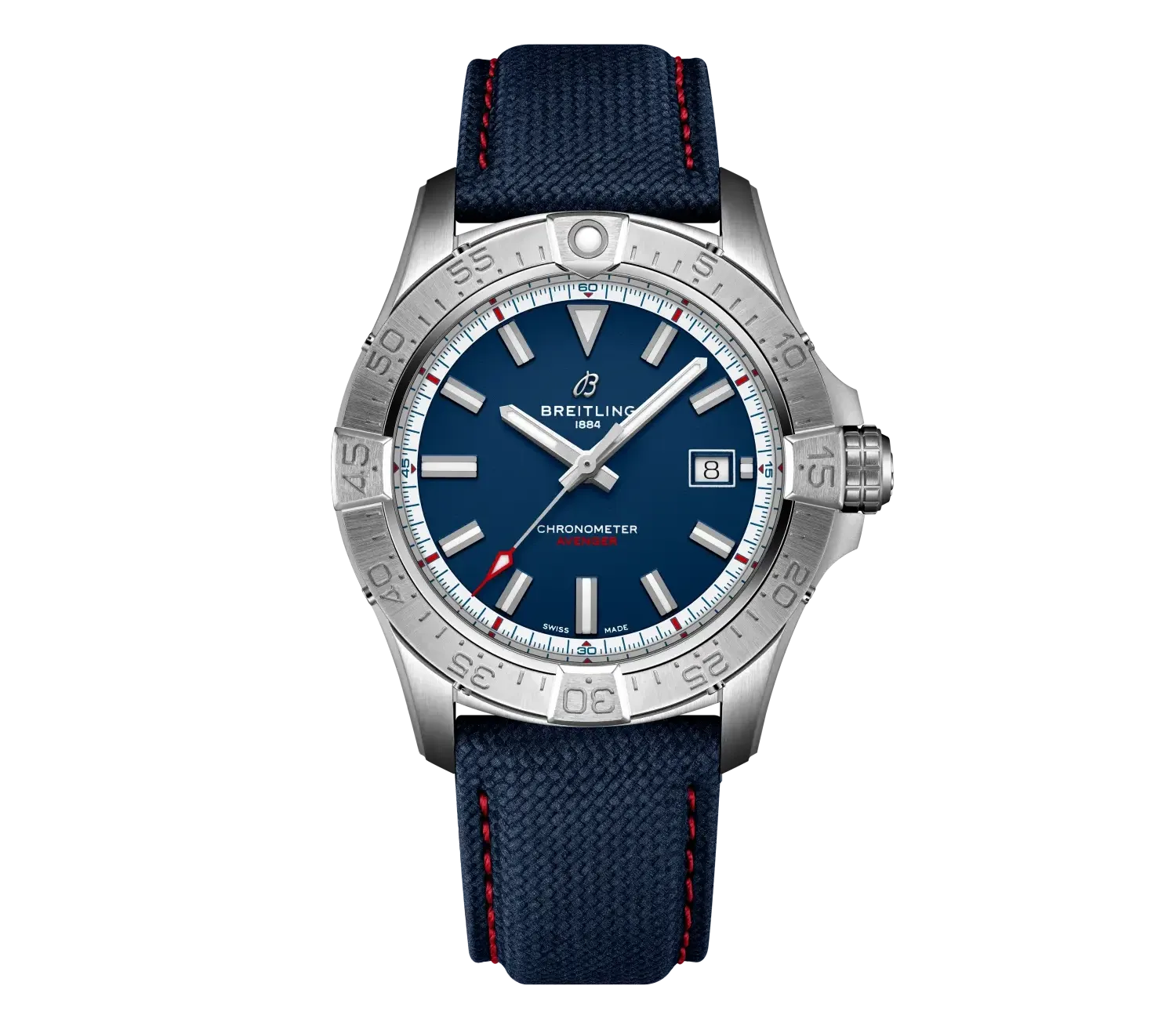
Then Breitling built an America250 version, 250 pieces, with a deeper blue dial, red stitching on the strap, and a Liberty Bell engraved on the back. The official page lists it at $5,100, which is only $200 more than the standard blue-strap Avenger Automatic 42. For a limited edition, that is not much.
The single most specific part of this watch, the part that makes it an America250 and not just a nicer blue Avenger, is engraved on the caseback. It's the one surface you stop seeing the moment you put the watch on. Everything you actually live with, the case, the bezel, the crown, the dial, the strap, is a very competent modern Breitling tool watch that has almost nothing to do with America at all.
It's good but not great.
Brand and history
Breitling's aviation credibility didn't begin with lifestyle photography. It began with timing instruments.
Leon Breitling opened a workshop in Saint-Imier in 1884, specializing in chronographs at a moment when accurate timing mattered to industry, science, and sport. His son Gaston filed a 1923 patent that separated chronograph control from the crown, putting a dedicated pusher at 2 o'clock for start, stop, and reset. Willy Breitling later added the second pusher at 4 o'clock. If you've ever operated a two-pusher chronograph, you've used the layout the Breitling family pushed into its modern form.
The aviation part became literal in the late 1930s. Willy founded the HUIT Aviation department to build cockpit instruments for military and civil aircraft, and tested them against vibration, temperature, and the other ways an instrument fails at altitude. In 1939 the British Air Ministry commissioned Breitling onboard chronographs for the Royal Air Force. The Navitimer arrived in 1952 with its slide-rule bezel, AOPA adopted it as its official watch, and the ref. 765 AVI, the Co-Pilot, gave pilots a large and legible chronograph cut from the same cloth. Ten years later, Scott Carpenter's 24-hour Cosmonaute orbited the Earth on a Navitimer, on May 24, 1962. None of that is marketing. It happened.
That's the Breitling I'm most attached to. The Classic AVI is, to me, the brand's best design, because it grows directly out of that flying-instrument history and doesn't have to explain itself. You can see why it exists.
The Avenger is a different kind of watch, with a different relationship to the past.
By aBlogtoWatch's account, the Avenger entered the catalog in 2001, which makes it decades younger than the Navitimer, the Chronomat, or the AVI. It was never a heritage reissue. It was built as a rugged, military-leaning, hard-use tool watch, and the modern version really took shape when Breitling refreshed the line at its 2019 Los Angeles Summit, folding the discontinued Colt into a wave of new references and pushing an "air universe" identity built around astronauts and jet pilots rather than one specific aircraft. The 2023 overhaul calmed it down: stepped lug bevels, mostly brushed cases, a consistent 300 meters of water resistance, and more than 20 references.
So the Avenger isn't fake heritage. It's modern Breitling heritage, introduced in 2001 and rebuilt around the brand's current strategy. The question an America250 edition has to answer is whether that's enough to make a 2026 limited edition feel special. The difference between a watch that descends from the 765 and a watch that descends from a marketing summit is the reason this one never quite wins me over.
Case and dimensions
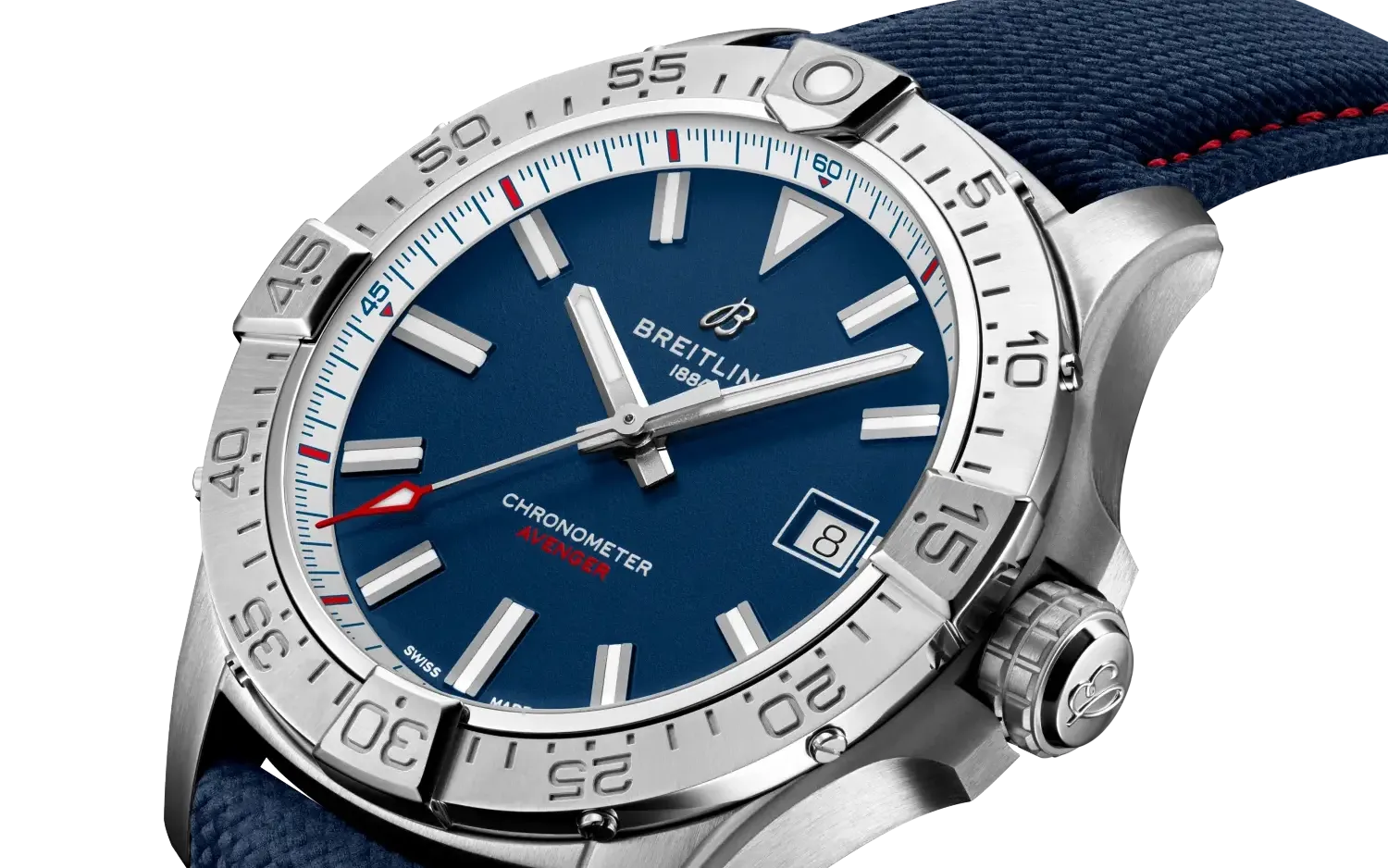
The case is stainless steel, 42mm across and 12.15mm thick, with 22mm lugs, a cambered sapphire crystal that's glareproofed on both sides, a screw-locked crown with two gaskets, and 300 meters of water resistance under a solid screw-in caseback. Breitling doesn't publish a lug-to-lug figure for this reference. The standard Avenger Automatic 42 platform it's built on measures 51.21mm. The head weighs 91.9 grams, and the whole watch on the strap comes to 114 grams.
On my 7.5-inch wrist, 42mm is the right call. I don't wish it smaller and I don't wish it larger, which matters because so much of the Avenger line has historically run big. A 42mm time-and-date version is the one that wears like a normal watch instead of a statement.
The bezel is more interesting in the hand than in a photograph. Visually it's an Avenger bezel: raised rider tabs, a 0-to-60 scale, plenty of steel. I don't find it memorable. The action is another matter. The resistance is judged correctly for a unidirectional bezel, and the click has a tactile weight and sound I associate with watches that cost considerably more. This is what I didn't expect from an Avenger: the bezel action is closer to what I feel from Rolex or Breguet than to what the price tag implies. It makes the watch feel more expensive than the dial does.
The crown is the other tactile high point. I have larger fingers, and a small, smooth, polished crown turns winding and setting into a fussy operation. This one is large and grippy, easy to operate even with gloves on, which makes winding and setting noticeably less delicate than it is on watches with smaller crowns.
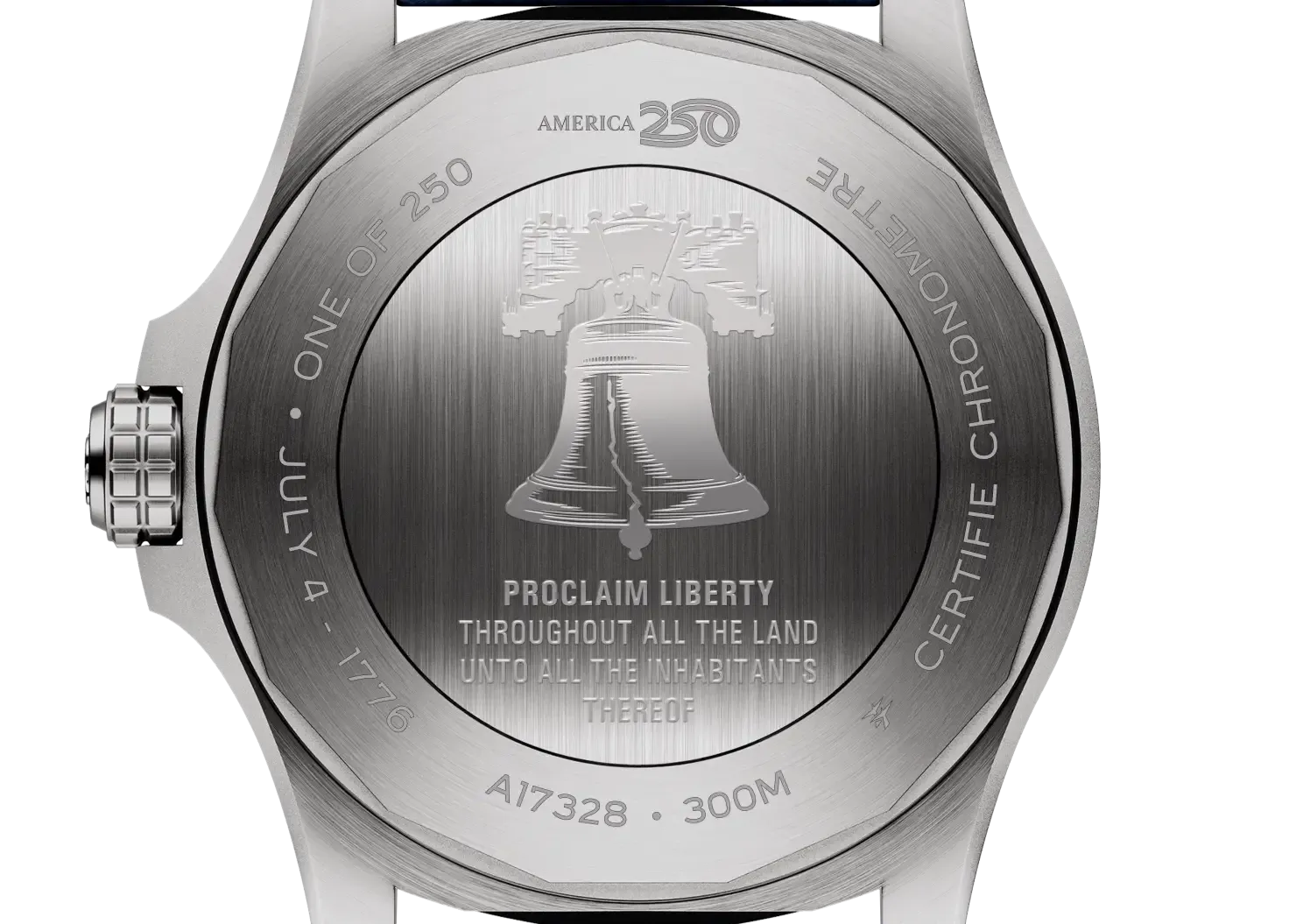
Then there's the back, which is where the America250 actually lives. The solid caseback carries the America250 logo, a Liberty Bell engraved in the center, and the line that appears on the real bell: "Proclaim liberty throughout all the land unto all the inhabitants thereof." Around it run the markings that make this a limited edition: ONE OF 250, 1776 - 4 JULY, CERTIFIE CHRONOMETRE, the A17328 family code, and 300M.
I like it. I also forget it exists the moment the watch is on my wrist. This caseback is more interesting on the desk than it is on the wrist, and the rest of the time you're living with the case, the bezel, and the crown. The good news is that those happen to be the best things about this watch.
The dial
The dial is blue, and Breitling's whole design brief here is red, white, and blue. The blue is deeper than the standard Avenger Automatic 42 blue. A white chapter track runs around the edge with red minute accents on it, the central seconds hand is tipped in red, the hour markers are applied batons, and a large triangle at 12 orients the dial. The B logo and "Breitling 1884" sit under 12, the chronometer and Avenger text above 6, and the date is at 3.
Most people will never notice the difference. The deeper blue is a real change and a good one, but it's subtle, and the white track is the only thing that reads at a glance as different from any other time-only Avenger. Put this next to the standard model and an enthusiast picks out the white track, the red accents, and the red stitching on the strap. Everyone else sees a blue Breitling. I like the changes. I just wish Breitling had gone one step further. The front of this watch doesn't feel like a commemorative edition. It feels like a slightly better Avenger dial, which is what it is.
The layout I have no complaints about. The batons are large and legible, and because I almost always wear chronographs, I've gotten used to something moving in the center of the dial. A time-only watch with an always-running central seconds hand has become a feature I notice and appreciate rather than take for granted.
The date at 3 didn't need to be here. I tend to feel that way about dates on symmetrical sports dials. But Breitling kept it compact and let the dial absorb it, and it doesn't distract me. I'd prefer no date. I'm not bothered by this one.
The lume is the surprise. It's excellent, bright enough that I can read it in daylight, which is usually a sign it'll be very strong in the dark. I haven't charged it fully and tested it in a black room yet, but Breitling is normally good at this, and nothing about this watch suggests an exception.
The movement
Inside is the Breitling 17, a self-winding automatic with a 28,800 vph beat rate (4 Hz), 25 jewels (WatchBase's caliber table lists 26 in one field), a date, and an approximate 38-hour power reserve. Breitling is straightforward about what this is. It's not a manufacture movement. WatchBase identifies the Breitling 17 as a movement built on the ETA 2824-2 architecture and supplied through the ETA and Sellita family. It's COSC-certified here, which Breitling prints on the dial and engraves on the caseback.
That's not a problem. It's a proven, chronometer-grade workhorse, and it does exactly what it's supposed to do. It hacks, which I always want, and winding it through that grippy crown is genuinely pleasant. None of this is the reason you buy the watch, and Breitling doesn't pretend otherwise. Breitling's deep mechanical story is chronographs. This is a time-and-date automatic in a rugged case. It tells the time.
The one number I keep snagging on is the power reserve. 38 hours is short in 2026, especially on a $5,100 watch with a limited-edition number engraved on the back. It isn't unusable, and for me it's a minor irritation rather than a real problem, because the watch lives on a winder. But take a 250-piece commemorative edition off on Friday night and there's a decent chance it has stopped by Sunday. At this price, a sub-40-hour reserve doesn't feel generous.
What the Avenger doesn't do clarifies what it is. The Zenith Chronomaster Sport I reviewed earlier is built to be watched: the high-beat El Primero drives a chronograph hand that tears around the dial six times a minute, and that visible motion is the whole argument for the watch. The Avenger does the opposite. The movement stays hidden behind a solid steel caseback. You read the time off the dial and never think about what is underneath.
On the wrist
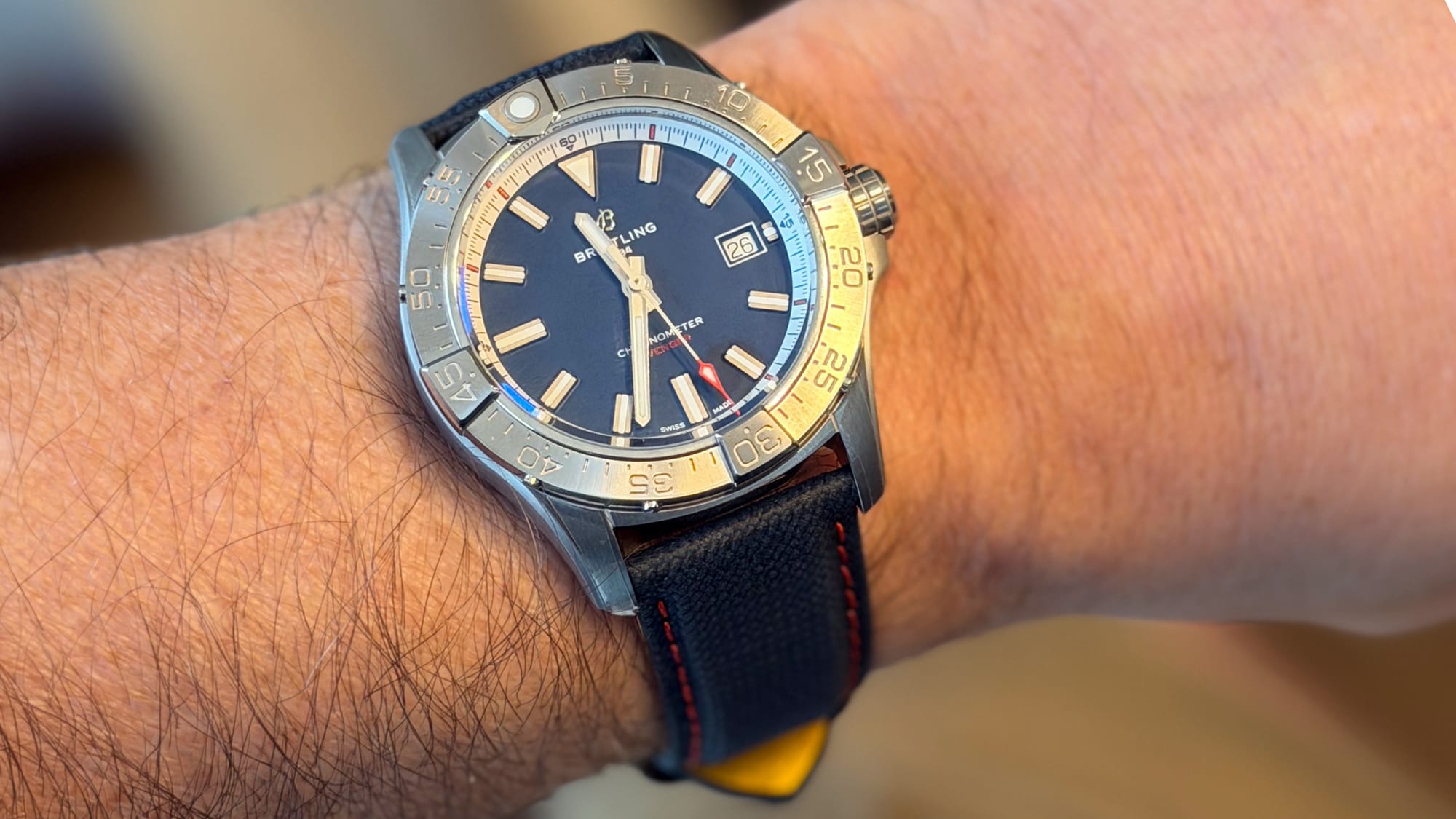
I've worn it enough to know where it's comfortable and where it isn't, and on a 7.5-inch wrist almost all of it is comfortable. The case size is right, which was the thing I most wanted to be true. The bezel keeps pulling my hand back to it. The crown is easy. The dial is legible in any normal light, and the lume earns its keep after dark.
The strap is the exception, and it's a real one.
Breitling fits this reference to a blue woven textile strap with red stitching, a yellow underside, and a steel folding clasp, sized 22mm at the lug and 20mm at the buckle. I love the red stitching. It's one of the small choices that makes the America250 better-looking than the standard blue strap. But the strap is too long. Breitling doesn't appear to offer short, medium, and large options for this reference, almost certainly to simplify a 250-piece run, and the result is that on my 7.5-inch wrist I'm buckling into the fifth hole with a tail of strap still hanging over the side.
That isn't a theoretical complaint. It changes how the watch looks and how it sits. And it raises a sharper question: if there's this much overhang on a 7.5-inch wrist, which is not small, I can't picture what this strap does on a 6-inch wrist, let alone a 5.5-inch one. A limited edition that only a subset of buyers can wear well is a strange thing to make 250 of.
The clasp also sticks now and then when I'm taking the watch off. It doesn't happen every time, and it has never ruined anything, but I notice it. Both are strap-and-clasp problems, which means both are the kind of thing Breitling could fix without touching the watch itself.
The case is good. The crown is good. The bezel action is excellent. The lume is strong. Then the strap makes the whole package feel less resolved than the rest of it deserves.
And then, once it's on, I mostly forget the strap. I also forget the caseback, which is still the most interesting single detail on the watch. What's left is a legible, tactile Breitling with a better dial than the standard version and a bezel I keep coming back to.
Comparisons
The obvious comparison is the watch this one is based on. The standard Avenger Automatic 42 on blue strap (Ref. A17328101C1X1) is, mechanically and dimensionally, the same watch: 42mm steel case, Breitling 17, 300 meters, folding clasp. It costs $4,900. The America250 adds the white chapter track, the red accents, the red stitching, the Liberty Bell caseback, the 250-piece number, and $200.
For $200, I'd take the America250 every time. You get a better dial, a better strap, and a limited edition that's at least more interesting to own than the standard model. Whether it's also more valuable later is a separate question. New Breitling limited editions like the Navitimer Cosmonaute Artemis II have started attracting the kind of attention and asking-price chatter that used to be reserved for vintage, and a 250-piece run may well be easier to resell than the standard reference. But asking prices and sellout noise aren't completed sales. I haven't seen the data that would let me promise a premium, so I won't.
There's a second price worth knowing. The standard Avenger Automatic 42 on the steel bracelet (Ref. A17328101C1A1) is $5,200, which makes the America250 on strap $100 cheaper than the bracelet version of the plain model. Frame the America250 as a more interesting watch for less than the bracelet model, and the $5,100 stops looking like a premium at all.
The Avenger Automatic GMT 44 (Ref. A32320101C1X1) is a close visual cousin, especially in blue, but it's the wrong watch for what I wanted. It's a 44mm case with the Breitling 32 GMT movement and a 24-hour function at $5,550. The appeal of the America250, for me, is that it keeps the Avenger formula at 42mm and lets a single moving seconds hand carry the dial without adding another hand or another scale.
The harder comparison is the one inside Breitling, and it isn't about specifications. The Navitimer has the slide rule and the AOPA story. The Chronomat has real chronograph history. The Classic AVI traces to the 765 Co-Pilot. The Avenger has modern toughness and a 2001 debut. On paper that shouldn't bother me. In practice it does, more than I expected, and it's the reason a very good tool watch doesn't become one I love.
Which is also why my attention, and my money, is mostly somewhere else right now. I already have a paid Universal Geneve Compax White pre-order in for March 2027, and I'm watching Gallet's relaunch as the ownership group behind Breitling builds out a portfolio of revived heritage brands. Those are watches that pull on me because they feel tied to history in a way I can hold onto. The America250 Avenger pulled on me because it was limited and just different enough. That's a real pull. It's just a thinner one.
Final thoughts
Everything that makes this watch an America250, the Liberty Bell, the inscription, the ONE OF 250, lives on the caseback, the one surface you stop seeing the moment it's on your wrist. The side you look at all day is a competent blue Avenger, barely changed from the standard model. That split is the whole story of the watch.
So what you actually live with is the front and the feel, and the verdict there is clear enough. The case is well made, the bezel action is the best thing about the watch, the crown is excellent, the lume is strong, and 42mm is the right size. The dial is better than the standard Avenger's, in ways most people won't notice. The strap is too long. The movement tells the time. Add it up and you get a genuinely good modern tool watch wearing a commemorative theme you can't see while wearing it, sold for a little more than the standard model and a little less than the standard model on a bracelet.
But there's a second thing here, and it runs deeper than the strap or the power reserve. Suppose Breitling had put the Liberty Bell on the dial instead of the caseback. Suppose the America250 theme were impossible to miss on the front. I don't think I'd love it any more, and working out why has been the most useful part of owning it. The Avenger has no history of its own to commemorate. It was introduced in 2001 and rebuilt at a summit in Los Angeles. Bolting someone else's 250-year anniversary onto it doesn't give it a past. The Classic AVI doesn't need an occasion, because its connection to the 765 is genuine. The Avenger needs the occasion, and even with one, its history goes no further than Los Angeles.
So, would I recommend it? Yes, with conditions. If you already want an Avenger Automatic 42, buy this one over the standard blue-strap version without thinking twice. The dial is better, the strap is better, the caseback is more interesting, and the 250-piece number gives you at least a thread of a collector story for $200.
Would I recommend it as the Breitling to buy? No. If you want the actual heart of Breitling, you start with the Navitimer, the Chronomat, or the Classic AVI. The Avenger is good. The Classic AVI is the one that makes me feel something.
I don't see another Avenger in my future. This one was enough, and most of what I'll remember about it is the click of the bezel and commemorating America's 250th birthday.