

In 1755, a young Genevan named Jean-Marc Vacheron signed his first apprentice and set up a workshop. The company that grew out of that room has never once stopped making watches. Through revolutions, recessions, two world wars, and the quartz crisis that nearly buried mechanical watchmaking for good, Vacheron Constantin kept going, which makes it the oldest continuously operating watch manufacturer in the world.
So here's the strange thing. The Vacheron I want to tell you about, the one I saved for and circled for months before I bought it, isn't a thin gold dress watch with Roman numerals. It's a steel sports chronograph called the Overseas, reference 5500V/110A-B481. The category it belongs to, the luxury steel sports watch, didn't exist until the early 1970s, when Audemars Piguet gambled on a steel watch called the Royal Oak and priced it like gold. The oldest house in watchmaking does its most convincing modern work in the youngest idiom it makes.
Vacheron's own answer to that gamble came in 1977: a watch known by its reference, the 222, built for the company's 222nd anniversary. It was a cult object then and it still is. The Overseas, which arrived in 1996, is its grandchild, the same integrated bracelet and sculpted bezel and knockabout case, rebuilt for people who actually travel. The name isn't decoration. Vacheron has been selling its watches around the world since François Constantin joined the firm in 1819 with a motto it still quotes: "Do better if possible, and that is always possible."
My first impression
I found it the way I find most watches I end up wanting, late at night, working through other people's reviews and zooming in on photographs I'd already seen a dozen times. The Overseas became the one I measured other watches against, and then kept buying nothing instead. It took a while, and some rearranging of priorities, before I owned one. I remember closing the clasp the first time and thinking I hadn't oversold it to myself.
Specifications at a glance
- Reference: 5500V/110A-B481
- Case Material: Stainless Steel
- Case Diameter: 42.5 mm
- Thickness: 13.7 mm
- Movement: In-house Caliber 5200 (Self-winding)
- Water Resistance: 15 bar (150 m)
- Power Reserve: ~52 hours
- Frequency: 28,800 vph (4 Hz)
- Straps: 3 options (Steel bracelet, Black rubber, Black calfskin leather)
- Certifications: Hallmark of Geneva
Case & dimensions
On paper the case reads big. Forty-two and a half millimeters across, a hair under fourteen thick, the kind of numbers that usually mean a watch you feel all day. This one doesn't wear that way. The lugs are short and they turn down hard, the bracelet is built into the case rather than hung off it, and the whole thing sits closer to the wrist than the spec sheet promises. The surfaces do the rest. Vacheron alternates brushed flanks with polished angles, so the case catches light along its edges and reads as sharp rather than heavy. It works with a shirt cuff and it works with a t-shirt, which is the entire point of the genre.
The bezel is the signature. Six sides, with the half-circle cutouts that echo the Maltese cross in Vacheron's logo, a quiet bit of brand DNA rather than a billboard. The crown guards are the same story, sporty enough to read as a tool watch, contoured enough that they never look bolted on.
Dial & legibility
I'm a sucker for a panda dial, the dark face with light subdials, or in this case the reverse, a black lacquer field with silvered counters set into it. Up close the dial is three finishes pretending to be one. The counters are snailed, turned in fine circular grooves that hold the light. The minute track around the edge has a soft, almost velvet texture. The center is smooth and glossy. You see all three only when the watch tilts.
It's also easy to read, which isn't a given on a chronograph with this much going on. The hour markers are 18K white gold, the hands are skeletonized, and both are filled with blue Super-LumiNova that comes up cleanly in the dark. The date sits between four and five o'clock, far enough into the corner that it never interrupts the symmetry. Three subdials on a dial this size should feel crowded. This one doesn't.
Movement & technical details
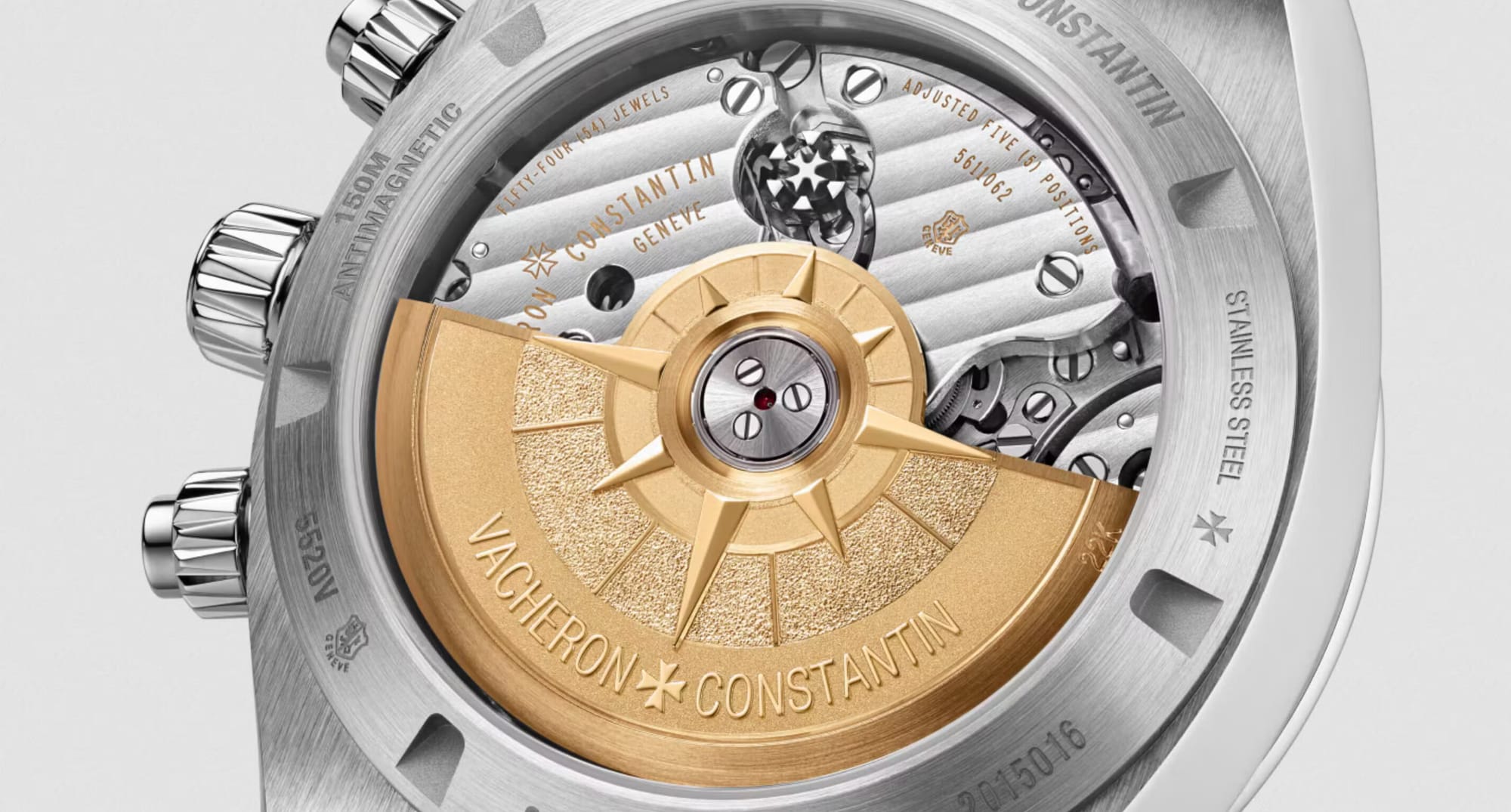
Turn it over and the sapphire back shows you the in-house Caliber 5200, a column-wheel chronograph of 263 parts and 54 jewels running at 28,800 beats an hour. Column wheel matters here. It's the older, harder, more expensive way to build a chronograph, the way that gives the pushers their clean action, and most brands at any price reach for a cheaper cam instead. The movement also carries the Hallmark of Geneva, the city's old certification for finishing and precision, which is why the bridges show perlage and beveled edges you'll mostly never see, and why the 22K gold rotor is engraved with a wind rose. None of it makes the watch keep better time. All of it is the reason you bought a Vacheron and not something else.
The power reserve is about 52 hours, which in practice means you can take it off Friday night and it's still running Monday morning. And the pushers really are that good. They give a short, mechanical click on start, stop, and reset, the kind of action that makes you invent reasons to use a chronograph. I've timed a French press with it more than once.
Straps & wearability
The Overseas ships with three straps and a tool-free way to swap them, which is more useful than it sounds. The steel bracelet is the default, polished outer links against satin centers, heavy enough to feel serious and somehow still comfortable for a full day. The black rubber is the one I reach for near water, pliant and tough and backed by 150 meters of resistance. The black calfskin turns the same watch into something you could wear to dinner. One watch, three personalities, and the change takes about a minute.
The clasp is a triple-folding steel piece, secure in the way you want a clasp on an expensive watch to be, and finished to match the case so it never reads as the cheap part. Plenty of watches cost this much and forget that the clasp is the part you actually touch.
On the wrist
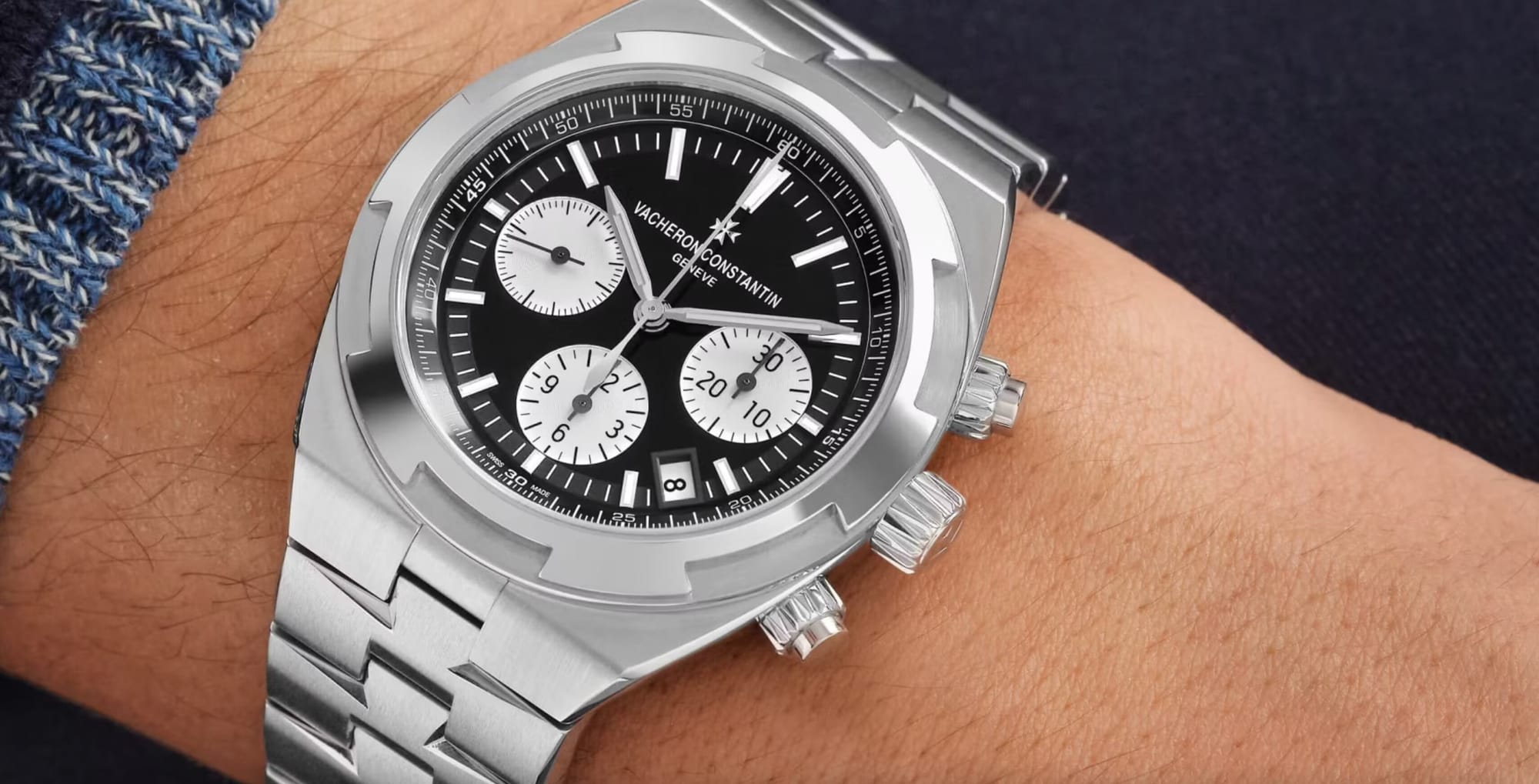
I've owned chronographs that wore like a roll of coins strapped to the arm, top-heavy and always slightly in the way. This one doesn't. The downturned lugs and the low center of gravity keep it planted, and it slides under a shirt cuff without a fight. It isn't a small watch and it doesn't pretend to be. You feel it on the wrist, and after a day you stop minding that you do.
There's a small, expensive club of steel watches that people name in the same breath, the Royal Oak and the Nautilus chief among them, and the Overseas is the third name that belongs there and usually gets said last. Part of that is price and rarity. Part of it is that Vacheron came to this category a few years after the others and has spent the time since being quietly underrated in it.
Final thoughts
So you have a company that's been making watches since 1755, that could coast forever on hand-finished dress pieces and tradition, and instead it makes its strongest argument for itself in steel, in a category it didn't invent and arrived at late. The reverse panda dial, the column-wheel movement behind sapphire, the three straps and the one-minute swap: none of it does anything no other watch can do. All of it is done a little better than it has to be.
None of that is a new idea at Vacheron, and the Overseas is just the most recent place it shows up. I wanted this watch for years before I owned it. Owning it hasn't made me want it less.
Source: https://www.watchcrunch.com/nautis/reviews/vacheron-constantin-overseas-chronograph-review-703628


