

I had been circling the Hamilton Jazzmaster Face 2 Face III (Ref. H32876550) for a while: a chronograph with two dials that flips inside its case like a pocket watch. It is pure theater, and I loved it the moment I saw it.
Hamilton did not invent the reversible watch (Jaeger-LeCoultre owns that crown), but they did something cheeky and democratic with the idea. The Face 2 Face III channels the same spirit of play (mechanical curiosity with a dash of showmanship) but at a price that does not make your accountant wince.
This was my first Hamilton purchase, though not my last. I wanted something different, something that could stand on its own in a collection of more restrained pieces. It is not the most comfortable or versatile watch I own, but it is one of the most fun.
Brand context and some history
Hamilton's story begins in 1892 in Lancaster, Pennsylvania, where the company helped solve a national crisis: trains colliding because everyone's pocket watch told a slightly different time. Hamilton became the brand that kept the railroads running on time, and that precision-first mindset stayed in its DNA long after it crossed the Atlantic.
When I think of Hamilton, I still picture that mix of American practicality and Swiss discipline. Yes, it is part of the Swatch Group now, but its spirit feels distinct. It is a brand that has never been afraid to experiment: electric watches, Ventura asymmetrical cases, Khakis that actually saw field use, all delivered at prices that feel anchored in reality.
The Face 2 Face III fits squarely in that lineage. I own a few other Hamiltons (the Khaki Field Titanium Far Cry 6 LE, the Intra-matic, the Jazzmaster Maestro, and the Khaki Navy Pioneer LE), and every one of them delivers more than the price suggests. But the Face 2 Face III is the brand at its most experimental.
Case and Wearability
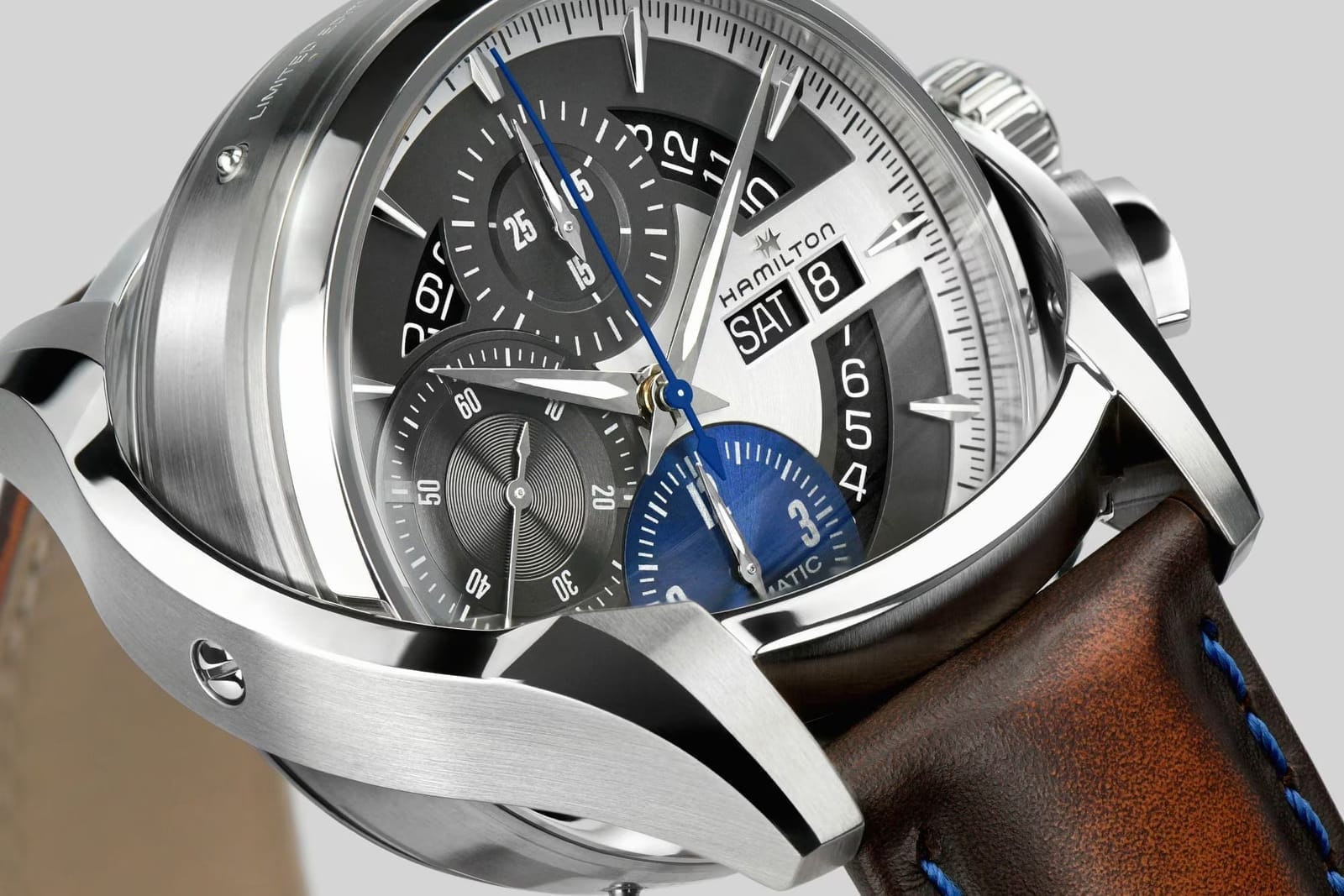
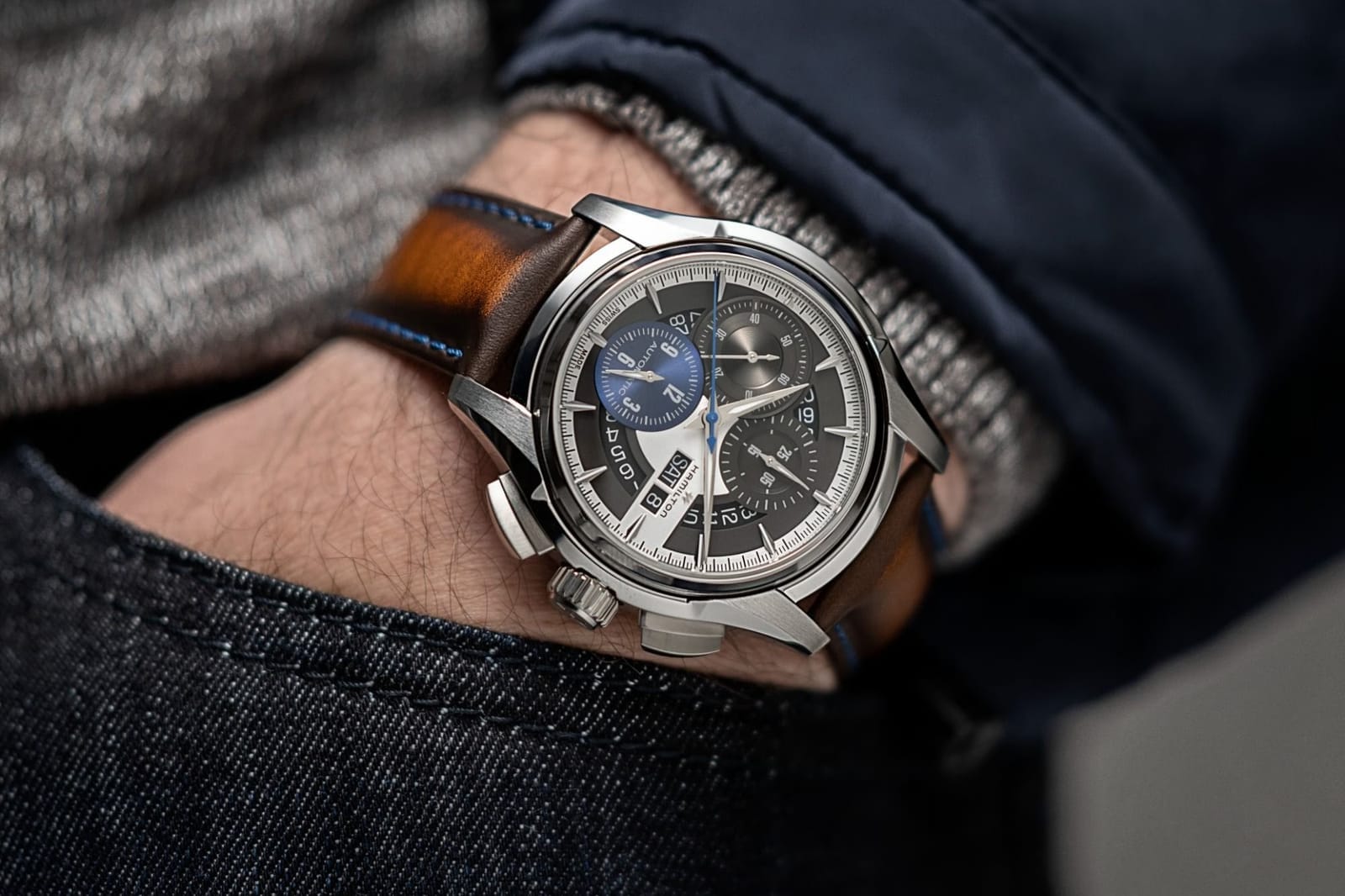
Let us be honest: 44 mm wide and 17.25 mm thick is not mid-size. This is a large watch. Yet on my 19 cm (7.5 in) wrist it does not feel monstrous; the curved lugs and the case shape keep it sitting better than the numbers suggest.
That said, this is not a flipper you operate on the wrist like a JLC. The mechanism works well, but it is meant to be admired, not performed in motion. You feel it click, pivot, and settle into place, a small ritual every time you turn it over.
There is a quirk: the rotating cradle does not lock as firmly as you might expect. On rare occasions, it shifts slightly during wear. It is not a deal-breaker, more a reminder that every clever bit of engineering comes with trade-offs. Hamilton had to design a system that lets the case flip while keeping the pushers and crown fixed. That is no small feat. I can forgive a little wobble for the magic trick it delivers.
Dial and Aesthetics
The dial side is busy. White, black, several shades of gray, and multiple blues that shift with the light. It should look like a design committee gone wrong, but it holds together.
The open date ring is a highlight. Instead of hiding the mechanics, Hamilton shows them off, which gives the watch an industrial, under-the-hood character. With the subdials and day window the face reads like a small architectural model, and despite all that information it stays balanced.
Under bright light, the dial wakes up: the blues glow and the depth deepens. In dim conditions the palette darkens and those blues fade to near-black. I like how much it changes.
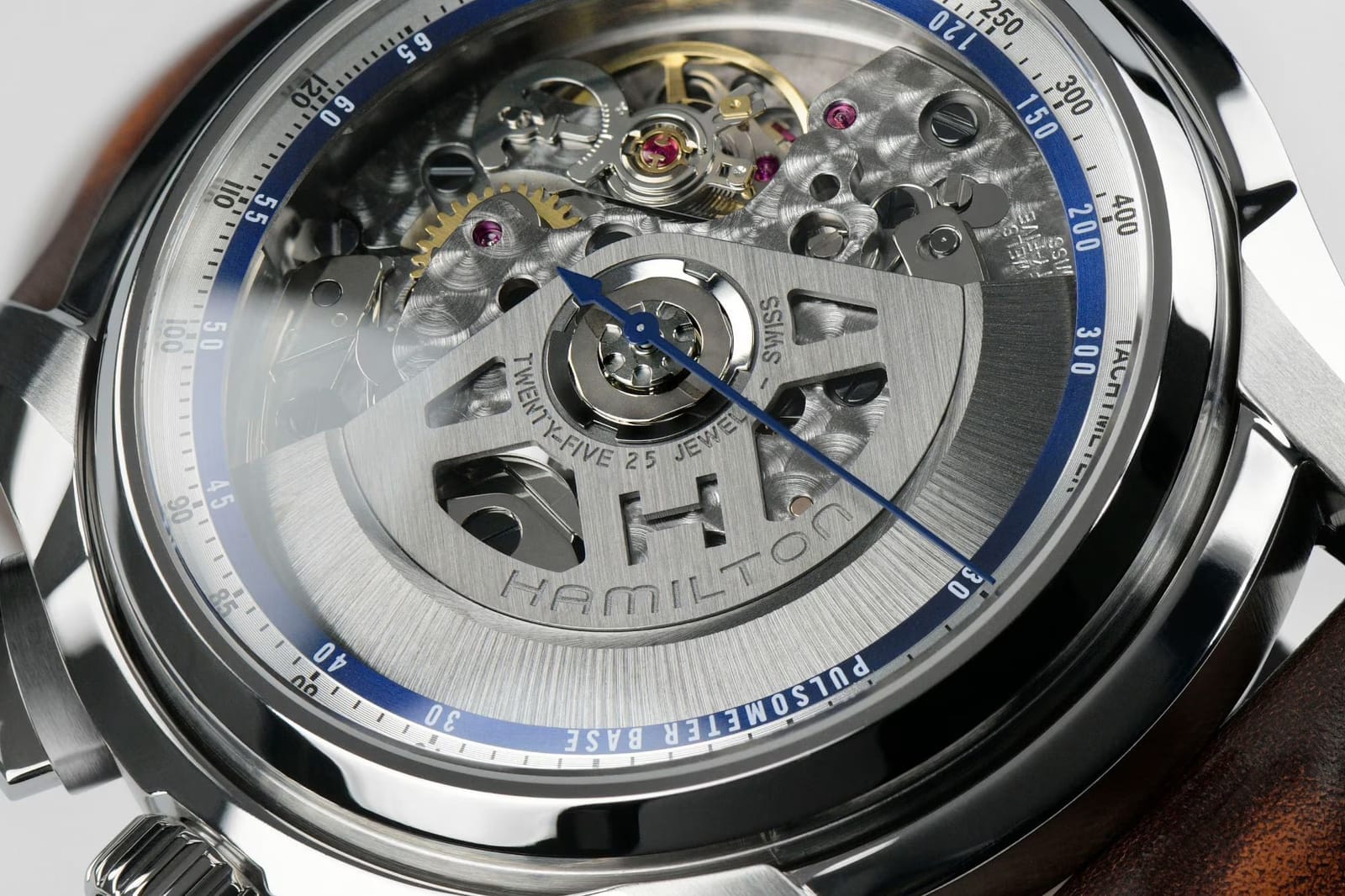
Flip it over and you get a completely different experience. The second face is mostly a display of the movement, ringed by printed tachymeter and pulsometer scales. No one is measuring heart rates or race speeds with a wristwatch in 2024. Those scales are there for tradition's sake, a respectful nod to the history of chronographs. They also look great, which is really the point.
Movement and performance
Powering the Face 2 Face III is Hamilton's H-41 automatic movement, derived from the Valjoux 7753, a tried-and-true workhorse that Hamilton has refined and decorated with pride. Mine keeps time at an astonishing +/- 2 seconds per day. That is Rolex territory, but in a watch that costs a fraction of the price.
The rotor is lively: you feel it whirring on the wrist, a constant tactile reminder that you are wearing a machine. Flip the watch and you will see the perlage finishing, another touch that shows Hamilton was not phoning this in. The 60-hour power reserve gives it practicality, while the chronograph action feels crisp and deliberate.
The pushers have a satisfying resistance and a soft, audible click. The one compromise is the blued chronograph hand, which can blend into the dial depending on the light. The lume, though, is excellent: a bright green that cuts through the dark, and the seconds hand sweeping across it at night is genuinely good to watch.
Strap or bracelet
My watch came with a brown leather strap featuring blue contrast stitching and a folding clasp. The strap is not trying to steal attention, it is there to complement the watch, not compete with it. The blue stitching perfectly echoes the dial's accents, and the clasp feels secure and easy to operate.
I did try swapping it once, out of curiosity, but nothing else worked as well. Hamilton made the right call. The stock strap nails the balance between comfort and character. Considering the 2,995 USD retail price when these launched, the quality of the strap and clasp feels like part of the overall value proposition: a complete design, not an afterthought.
On the wrist
The Face 2 Face III is not a quiet companion. It is a conversation starter, a mechanical flex that does not take itself too seriously. People notice it immediately: the dual crystals catch the light, the flipping case draws curiosity, and before long, you are explaining how it works. It is fun.
I wear it selectively, not because it is uncomfortable, but because it is special. It fills a niche in my collection that no other piece does, and it reminds me that watches can still be whimsical.
There is also a satisfying honesty about it. It is big, bold, a little impractical, and entirely unapologetic. It is not an everyday watch, but it is impossible to forget.
Final Thoughts
This watch feels like the product of a dare: make something visually wild, mechanically clever, and technically ambitious, and sell it for under three grand. Hamilton actually did it.
The Face 2 Face III was limited to 999 pieces, which feels about right. It is too eccentric to be mainstream, but perfect for collectors who love mechanical imagination. It is the kind of watch that rewards curiosity: you do not buy it for daily wear, you buy it for the grin it gives you when you flip the case and realize just how absurdly well-executed this whole idea is.
I bought mine new from an authorized dealer in June 2024, via another collector. A few still turn up on Chrono24. For me it is a keeper, not a daily wearer, and a reminder that a watch can be playful and still be well made.
References
- Hamilton Official Product Page
- Hamilton Press/Overview Page
- Monochrome Watches: The Hamilton Jazzmaster Face-2-Face III (Live Pics & Price)
- aBlogtoWatch: Hamilton Debuts Limited-Edition Jazzmaster Face-2-Face III Watch
- WatchBase: Hamilton Caliber H-41
- Time+Tide: Introducing the Hamilton Jazzmaster Face-2-Face III


