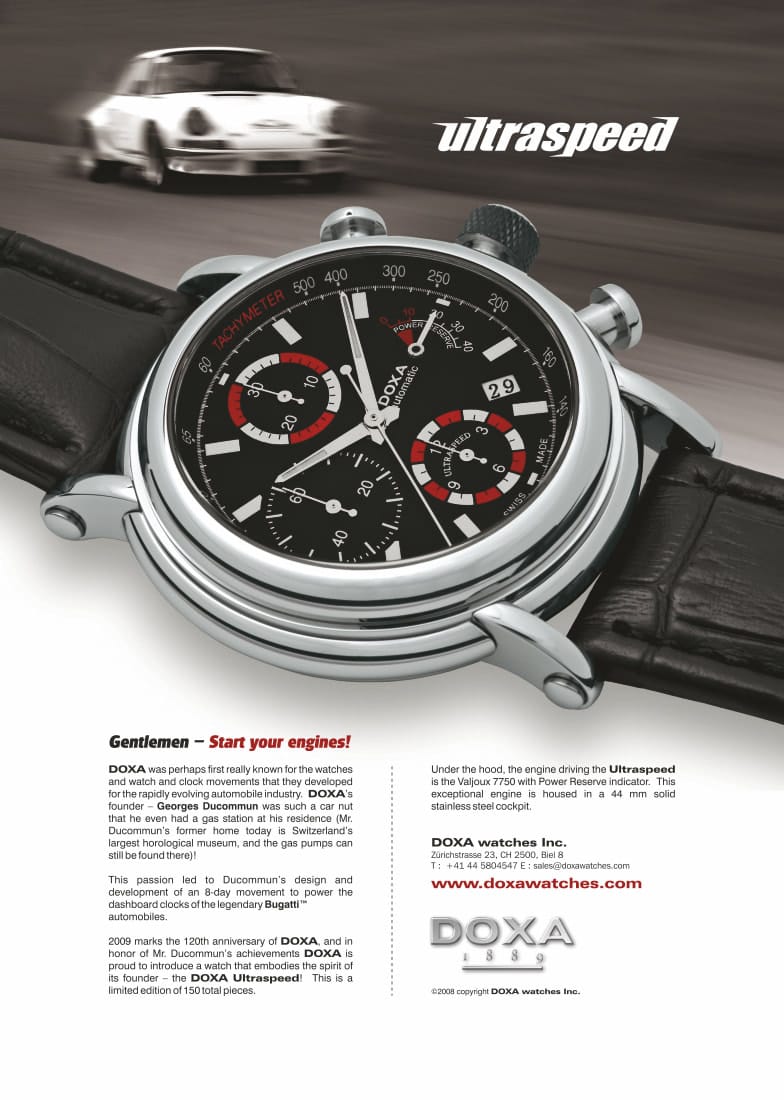
Most racing watches borrow the look: a tachymeter, some red, a checkered-flag font, and a press release about the spirit of motorsport. The Doxa Ultraspeed has an actual claim to it. Doxa's founder, Georges Ducommun, designed the clock movements that sat in the dashboards of early automobiles, including the eight-day clocks Bugatti used. So when Doxa built this chronograph, reference 896.10, for its 120th anniversary in 2009 and printed "Gentlemen, start your engines" on it, the motorsport theme was inherited, not invented.
Ducommun was a genuine car-clock man; he even kept a gas station at his home that is now a horological museum. The Ultraspeed exists to wave at that history, and Doxa kept it scarce: 150 pieces in 2009, another 30 in 2013, 180 in all, which is why you rarely see one now.
Technical details
The movement is a Valjoux 7750 with an added power reserve indicator. That's unusual. Most 7750-based watches just have the standard chronograph and date functions. Adding a power reserve requires extra modification, which is why you don't see it often at this price point.
Functions
- Automatic chronograph with 12-hour totalizer
- Running seconds subdial
- 30-minute and 12-hour counters
- Central chronograph seconds hand
- Date window at 3-4 o'clock
- Power reserve indicator on the right side of the dial
Case and dimensions
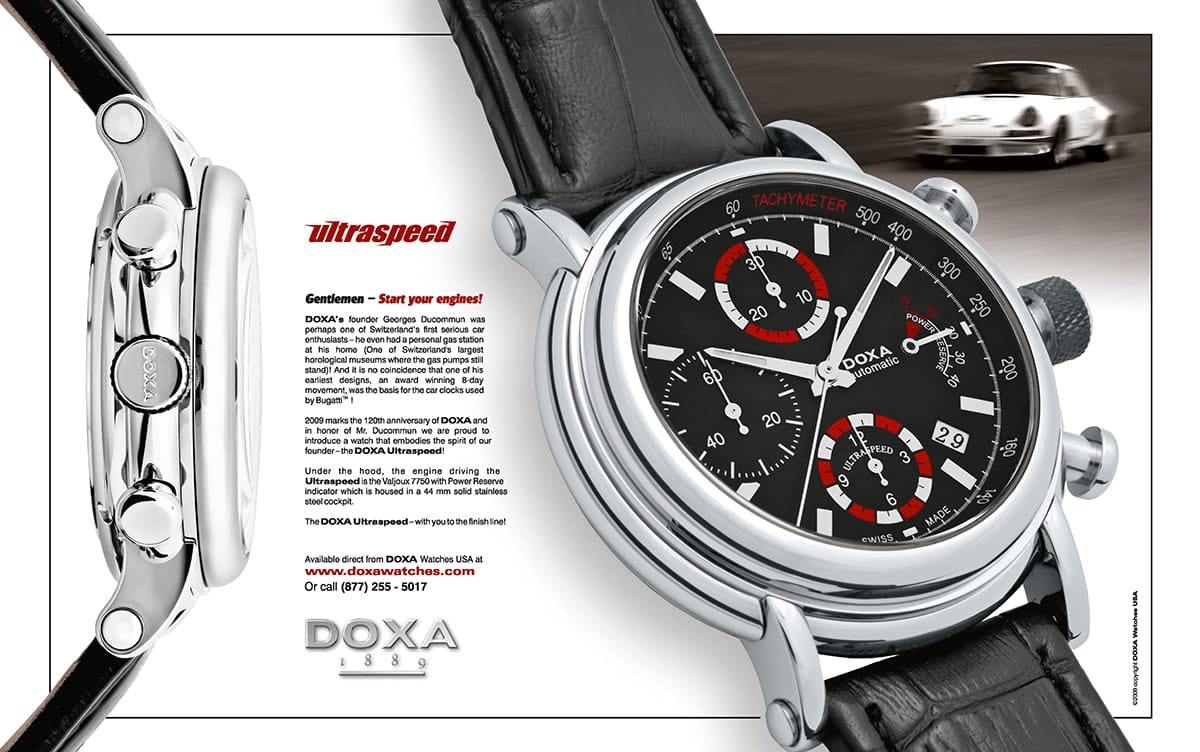
The case is 44mm stainless steel with a polished finish and triple-layered sides. Doxa's marketing called it a "stainless steel cockpit," which is a bit much, but the case does have some visual depth to it.
The chronograph pushers are pump-style. The crown is knurled for grip. Curved lugs fit a substantial leather strap, usually alligator or crocodile pattern, though you can swap in other straps.
Dial and design
Black dial with red and white accents. The subdials follow the standard 7750 layout at 6, 9, and 12 o'clock, plus the power reserve subdial. A red tachymeter scale runs around the outer edge.
The lower subdial has "Ultraspeed" printed on it with color-block segments. It leans into the racing aesthetic pretty hard, but that's the point.
Why collectors care
The 120th anniversary connection and the Georges Ducommun tribute give it some historical weight. But the real draw is the modified 7750 with power reserve. You don't see that combination often, and the engineering required to add that complication makes the movement more interesting than a stock 7750.
With only 180 made, finding one in good condition with box and papers takes some patience. They show up occasionally but not frequently.
The 44mm case and bold dial make this a weekend/casual watch for most people, but the finishing is good enough to dress up if you want. I put mine on a black Bark & Jack strap (don't call it a nato) and it looks great.
Bottom line
What you get is a limited-edition racing chronograph with a genuinely modified 7750, a power-reserve hand most 7750s never wear, in a 44mm steel case, from the one brand whose motorsport story predates its marketing department. If you like racing chronographs and have tired of the usual suspects, this is a quieter, stranger, better-pedigreed way in. You will just have to hunt for one.