

I'd hit a point where every device in my life was barking at me, and the one on my wrist was the worst offender. I couldn't even reliably figure out how to make it stop. The Apple Watch had to go.
I'd been wearing one for years, which is the kind of thing that gives your watch-collecting friends material. They were patient about it the way friends are patient about your worst habits. A man who loves mechanical watches, walking around with a small computer on his wrist. I didn't have a good defense. The Apple Watch did things. The mechanical pieces, somehow, just sat in their boxes.
The simplification project came first, the watch came second. I'd started cutting noise out of the day where I could, and I'd been hearing other people talk about doing the same. The Cartier wasn't part of a plan. It just turned up on Chrono24 in May 2024: new old stock, reference W7100016, ¥603,000 (about $3,800 at the time), before tariffs. I bought it. The Apple Watch went into a drawer the day the Cartier arrived. I haven't put it back on since. This is the watch that finally settled the argument with my friends.
Brand context
I had a complicated relationship with Cartier before this watch. The last one I'd owned was a Tank chronograph, quartz, bought in 2001 with my first bonus to celebrate. I lost it within months: left it at a hotel on a work trip, never saw it again. I spent the next two decades wearing watches that cost less than a hundred dollars on the theory that I would just lose anything more expensive. Twenty-three years later, the Calibre showed up and the experiment ended.
Worth saying that I never thought of Cartier as a fashion brand, even during my exile. The conventional wisdom on the brand goes that Cartier is a jeweler that happens to make watches: Tank, Santos, Panthère, beautiful objects, but not "serious" the way a Patek or a Lange is serious, with movements bought from Switzerland and case design and marketing as the actual product.
That view isn't wrong, exactly. It's just incomplete, and Cartier did something about it.
In 2010, the Manufacture in La Chaux-de-Fonds released the 1904 MC, the brand's first true in-house automatic movement. The number isn't a model designation: it's a date. 1904 is the year Louis Cartier built the first wristwatch, the Santos, for his friend Alberto Santos-Dumont. The new movement carried a hundred and six years of grievance the brand had never quite admitted to: we've always done this work, and now we'll sign it with our name. The Calibre de Cartier was the watch built around it. A round, sporty case at 42mm, deliberately modern, deliberately not a Tank. The first Cartier designed from the ground up to house the new movement.
I didn't know any of this when I bought it. All I knew was that the watch looked good and the price was reasonable. The in-house movement was a discovery I made later, the way you find out a friend you've been having dinner with for years also won a Pulitzer.
I've come to like Cartier's posture about all of this, more than I expected to. They seem largely indifferent to whether the watch press takes them seriously, and they make the products and let the market sort it out. There's something genuinely irreverent in that, and the longer I've owned this watch, the more I think the irreverence is most of what I'm paying for.
Case and dimensions
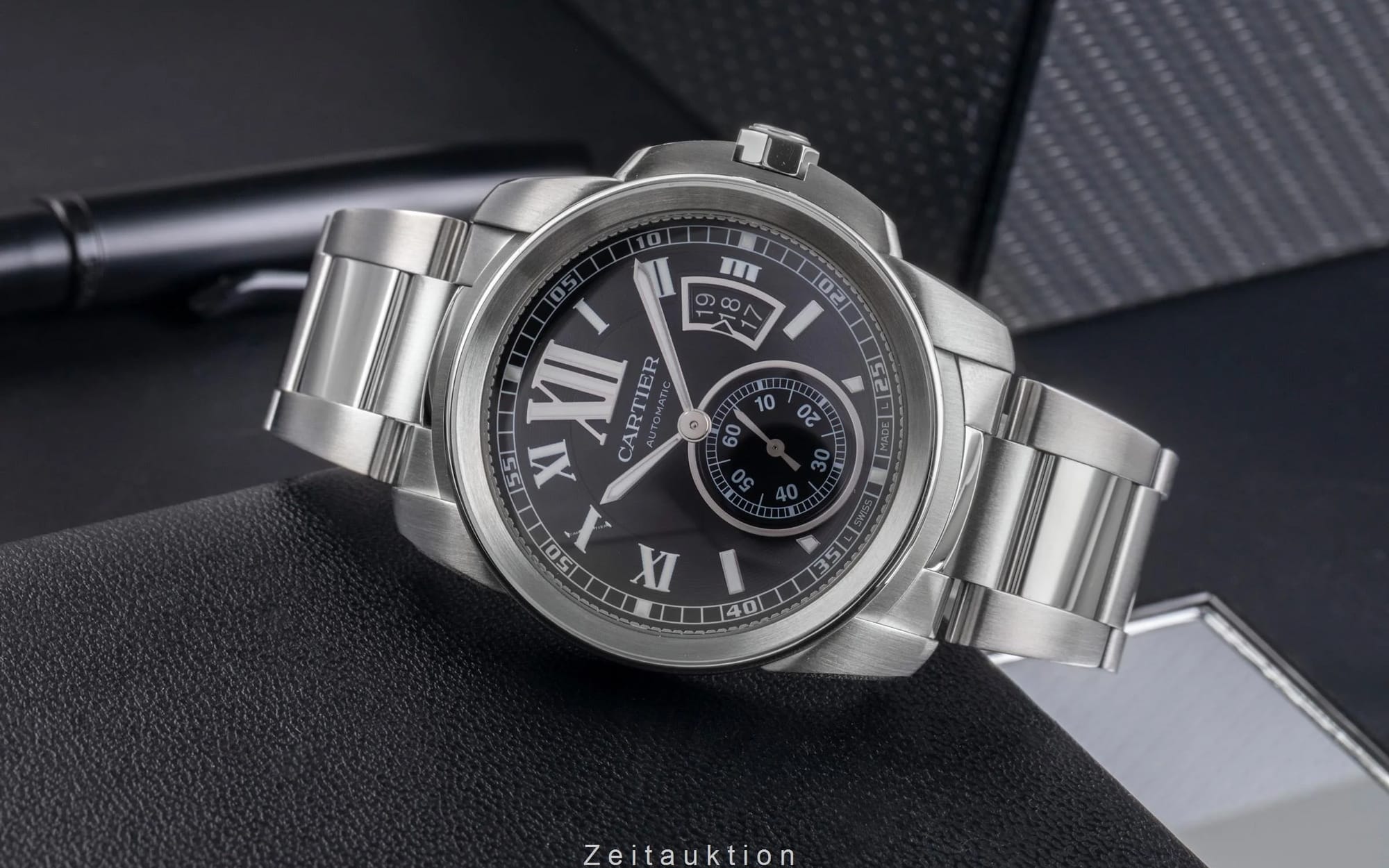
The case is 42mm wide and 10mm thick, in stainless steel, with a sapphire crystal front and back. On paper, that's a medium-large watch. In practice it wears chunkier than the spec sheet would tell you. The Calibre sits up on the wrist with real presence, the kind of watch you remember you're wearing.
The bezel is high-polished, the case sides brushed, the lugs short and integrated cleanly with the bracelet. Sportier proportions than anything else in the Cartier lineup, and the brushwork on the flanks is honest enough that the case doesn't feel like a Tank pretending to be a Submariner.
The crown is the giveaway. Cartier's crowns are signatures: the seven-sided faceted shape, the cabochon set in the top. On a Tank or a Santos, the cabochon does dress-watch jewelry work. On a 42mm steel sport watch with brushed flanks, you'd expect Cartier to have left it at home. They didn't.
On this watch, the cabochon is a synthetic blue spinel rather than a sapphire, a fact I learned somewhere around month four of ownership and was briefly disappointed about. The disappointment didn't last. On a sportier case, the cabochon does something subtle. It tells you the watch knows what it is, and isn't embarrassed about being a Cartier.
Water resistance is 30 meters, which is honest about what this watch is and isn't. It's a daily-driver mechanical, not a pool watch. I haven't had a problem with it.
The dial
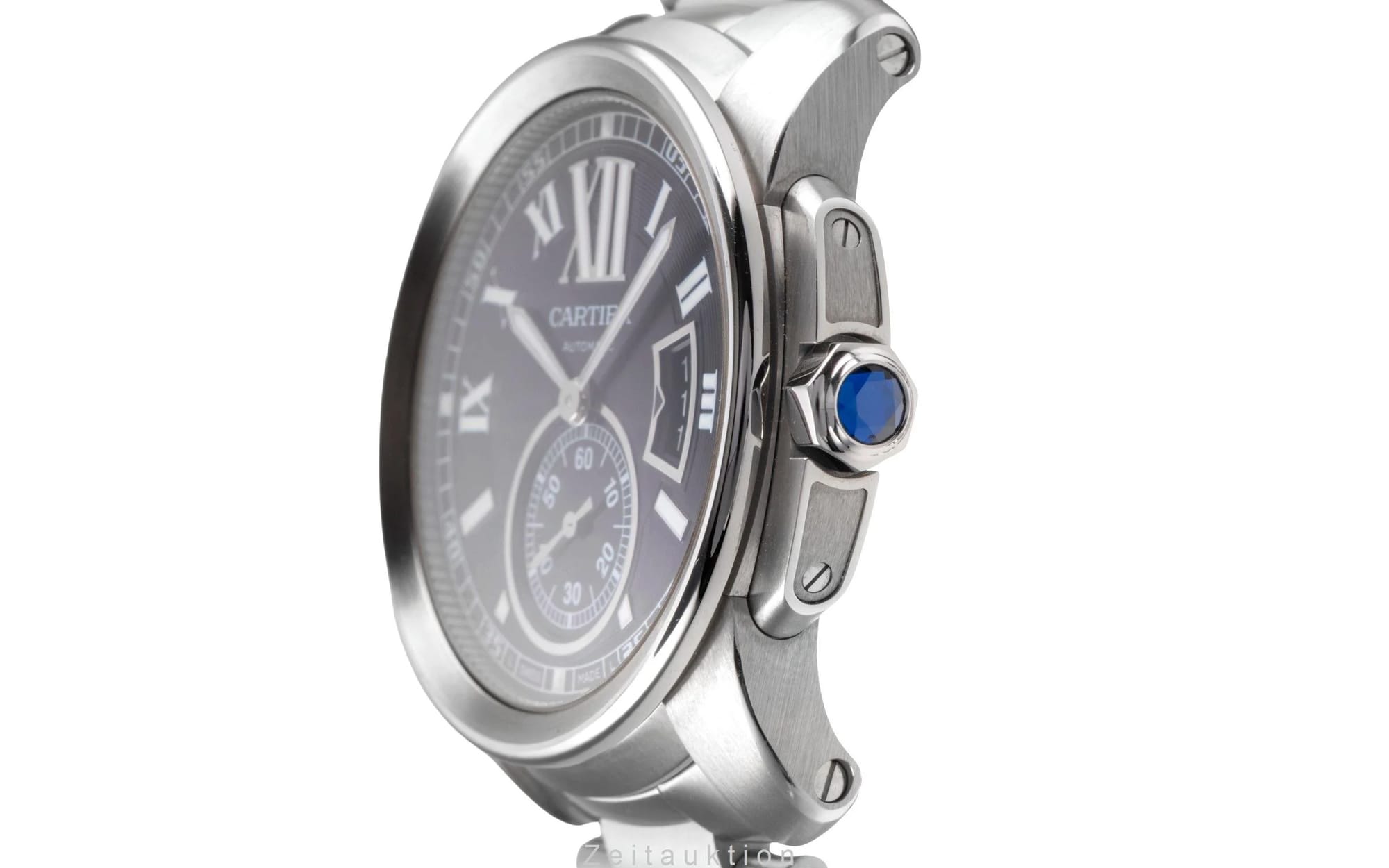
The dial is the black version. I'd agonized over the choice between black and white the way one does, and the black won late in the deliberation. Both are good. The black is better for the way Cartier handles the typography. The Roman numerals stand off the matte black field in a clean, slightly silvered relief, and the contrast does the work an opaline dial would have to earn through sheen.
The Roman numerals run around the perimeter, with XII sized larger as an anchor. The minute track is a railroad design, thin and elegant, the kind of detail you'd expect on a finer watch than the price tag suggests. The seconds are split into a sub-dial at six o'clock, a small concession to the 1904 MC's architecture, and a touch I've come to like. A small seconds hand sweeping at the bottom of the dial is the simplest way to know the watch is alive. The date sits at three, in a window that shows three days at once: yesterday, today, tomorrow. I've learned over time that I prefer this to a single-date window. There's something pleasant about seeing where you are in the week.
The hands are rhodium-plated sword hands with luminous fill, instantly recognizable as Cartier. The metal indices alternating with the Roman numerals are also lumed; the Roman numerals themselves are not. At night, what you get is a small constellation of bright marks and two glowing arrows. It's enough. This isn't a dive watch. The small seconds hand at six is blued, a contrast that's hard to notice.
Inside one of the Roman numerals on the left side of the dial, the word CARTIER is engraved in script so small you'd never see it without knowing to look. This is the brand's secret signature, present on every legitimate Cartier dial, hand-applied. The official reason it exists is authentication, a counterfeiter's trap. The unofficial reason is more interesting. Cartier puts it there for the people willing to look, and the watch doesn't need you to find it, it just rewards you when you do.
A confession about the typography. I generally prefer Arabic numerals on a watch dial. They're easier to read at a glance, less ornamented, more honest about being numbers. Roman numerals on most watches feel like a costume. Cartier, somehow, knows how to draw a Roman numeral. The strokes are weighted correctly, the serifs don't crowd, and the whole alphabet has been beaten into a particular Cartier shape over a century of use. On this dial it works in a way it wouldn't on someone else's watch, one of those small places where brand history pays a real, visible dividend.
The movement
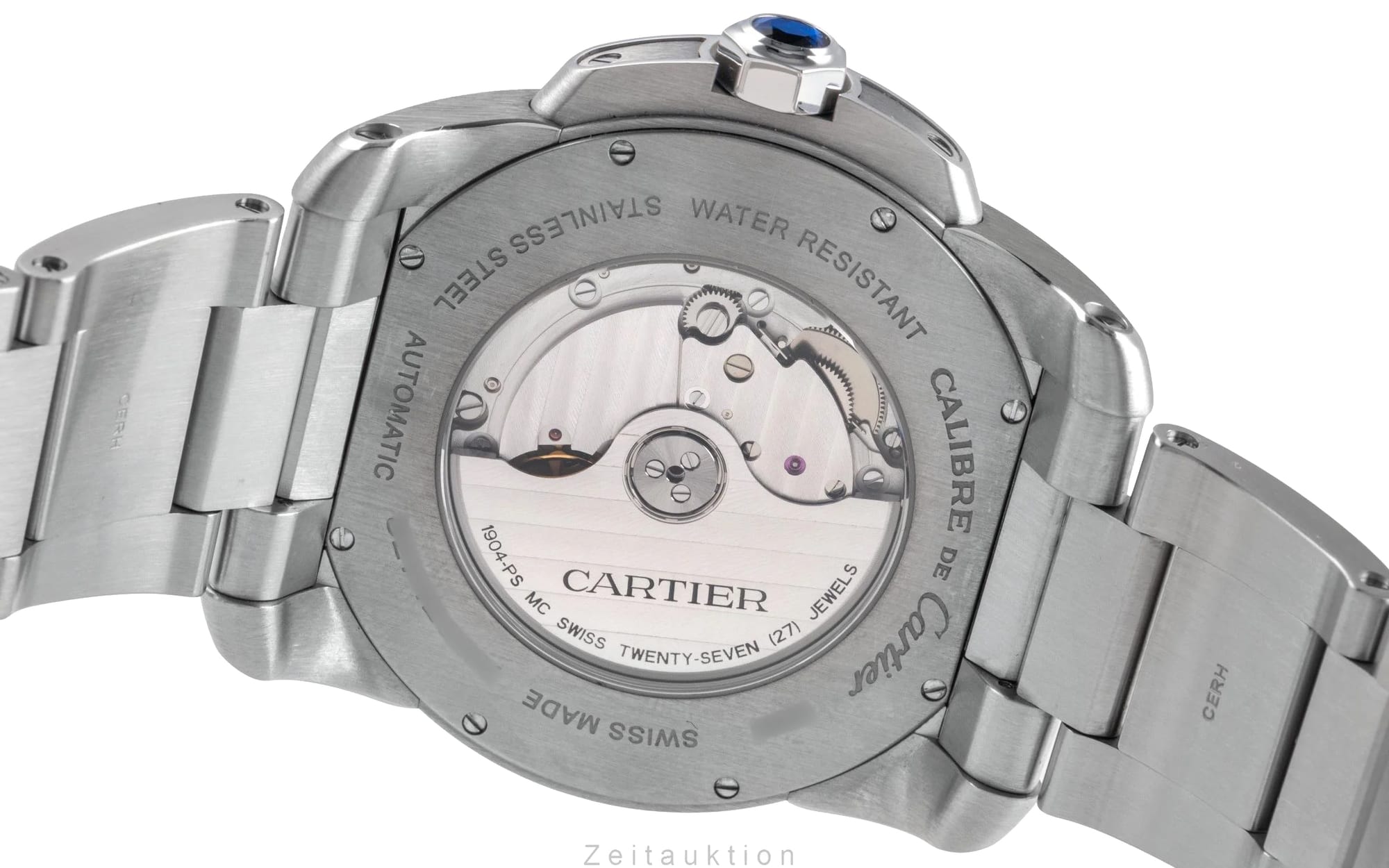
Inside is the 1904-PS MC. 27 jewels, 186 components, 25.6mm wide, 4mm thick, beating at 28,800 vibrations per hour, with a 48-hour power reserve. The PS in the name stands for petite seconde, the small seconds at six. The numbers aren't exotic. They're competent: a 4Hz workhorse built to be made in volume and to be reliable. What matters is who made it.
Cartier did. Every part of consequence, in-house, at the Manufacture in La Chaux-de-Fonds, with finishing and assembly in Neuchâtel. For the brand that had spent decades fighting the perception that it bought movements off a shelf, the 1904-PS MC was the rebuttal. It didn't need to be the most decorated movement in the world. It needed to exist and keep time.
There's also some real engineering under the plain decoration. Twin barrels unwind in series for more consistent torque across the 48 hours, the rotor rides on ceramic ball bearings for shock resistance, and Cartier abandoned reversers for a pawl winding system that builds the reserve faster than the alternative. None of this is on the marketing brochure. None of it shows through the caseback either, which is part of what makes the movement feel like a working object instead of a showpiece.
Both functional conditions (exists, keeps time) are met. Is five seconds a day great? It's fine, by my standards, and probably better than the brand promises. The rotor isn't silent. You can feel it spin when you move your wrist, and it has a weight to it, a small reminder that something inside is doing real work. I wouldn't call that a flaw.
The caseback is sapphire, displaying the movement, which is where the cheerful honesty has to start. The styling on the rotor and bridges is, to put it kindly, restrained. No Côtes de Genève flourishing, no anglage on the bridges. It's plain. I cut Cartier some slack on this: the 1904 was a first effort, and the priority was clearly to make the thing work and keep it cost-effective. The decoration comes later, on more expensive references. I'd rather have a movement that runs than one that poses.
On the wrist
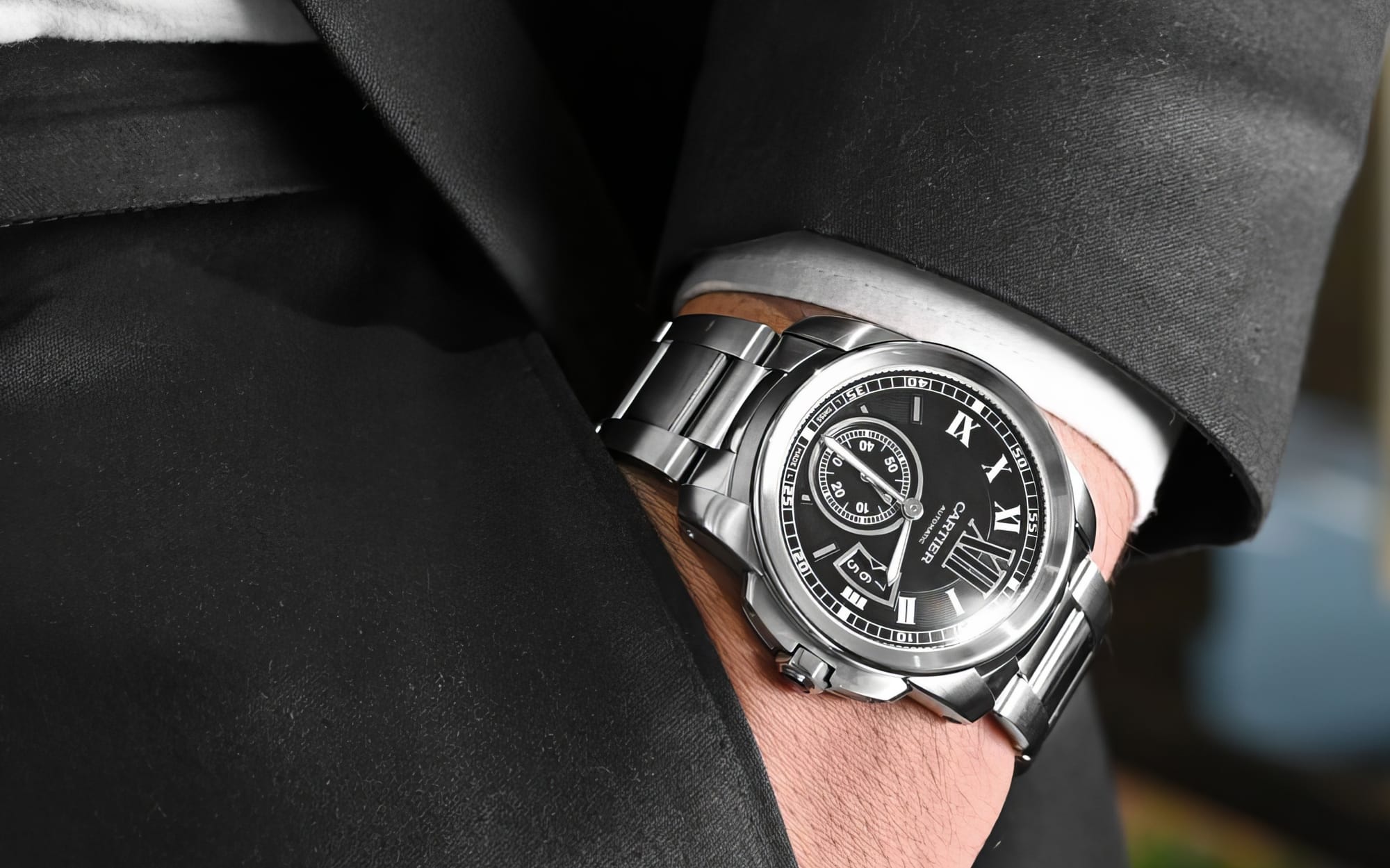
I have a 7.5-inch wrist. The watch wears centered and balanced. I've worn it to the office, to dinner, to weddings, weekends in jeans, and ordinary travel. It's handled all of these contexts without complaint and without ever feeling like the wrong watch for the room.
The bracelet is steel, integrated, with sizable links that taper modestly toward the deployment clasp. There is no micro-adjustment. Most modern watches in this category have figured out that wrists swell in summer and shrink in winter, and they engineer half-links and on-the-fly clasp extensions to cope. Cartier didn't, on this generation. You size the bracelet once at the dealer, and you live with it. I got lucky: the fit on my 7.5-inch wrist worked. Friends with wrists between standard sizes haven't been so fortunate. Adding or removing links is straightforward; swapping the bracelet for a strap is a different story.
The clasp itself is a double-push button deployant: secure, conservative, and mechanically uninteresting in a way I don't mind at all. Comfort over a full day is good. The watch sits without sliding, and the weight is distributed evenly enough that you forget about it within an hour.
Cartier may still keep a rubber strap option in stock for this reference. I haven't worn this watch on rubber, but I have its sibling (the Calibre Diver, on the factory rubber strap) and the comfort there is excellent. Putting a rubber strap on a Calibre de Cartier is the kind of move that delights some collectors and offends others. I think it's great. The rubber leans into the sport-watch character of the case, and the irreverence of the combination is exactly the kind of thing the brand should be doing more of.
A warning about strap swaps. The integration between bracelet and case on this generation is not friendly to home strap changes. I tried it once and don't recommend you try it. If you want to run this watch on a strap, take it to a watchmaker. (Removing and adding bracelet links is, by contrast, easy.)
The bigger story about wearing this watch is what happened to my Apple Watch. I want to be careful here, because I don't think the Cartier is "better than" the Apple Watch in any functional sense. The Apple Watch tracks my heart rate. The Cartier doesn't. The Apple Watch buzzes when people call. The Cartier doesn't, and I haven't missed those buzzes. By every measure of utility, the Apple Watch wins.
But. When I put the Apple Watch on, I was preparing for the day. When I put the Calibre on, I'm dressing for it. The mechanical watch doesn't improve my life in any quantifiable way, it improves the day in a way I'd have a hard time defending if you pressed me. That turns out to have been what I wanted.
Comparisons
The Calibre de Cartier W7100016 isn't in the same conversation as my Royal Oak. That comparison isn't honest: the Royal Oak plays in a different league, in price and in finish, and pretending otherwise would be silly.
The honest comparisons, when I think about mid-market integrated-bracelet watches, are these. The Jaeger-LeCoultre Polaris. Same general size, same sporty-but-not-tool intent, similar pricing. The Polaris has the more decorated movement, the more refined finish, and the deeper watchmaking heritage: JLC is older than Cartier and was actually Cartier's movement supplier for stretches of the 20th century. What the Cartier brings is a more distinctive design language and the cultural recognition that lands outside watch circles. A buyer cross-shopping the two wouldn't be wrong to pick either.
The Omega Speedmaster Moonwatch. A different complication, obviously, but a similar position in a collection: the daily-driver mechanical that punches above its weight. Nobody's going to argue with the Moonwatch on history. The Cartier just has a more interesting case to look at on a Tuesday. I wear them in rotation.
The Frederique Constant Highlife and the Breitling Superocean live in the same price bracket and play similar roles. Both are pleasant watches. The Cartier wins on broader cultural recognition.
I'll also say that steel integrated-bracelet sport watches all look more or less the same to 99 percent of people on the street. They do. The watch geeks notice the differences; everyone else sees a silver round watch on a silver bracelet. A visible signal that separates the Calibre is the Cartier crown. What you're paying for is everything underneath that signal: the 1904-PS MC, the dial typography, and a name that lands the moment somebody reads it on the dial.
Final thoughts
The question that hangs around Cartier (serious watchmaker, or fashion brand that makes watches?) is poorly formed. Cartier is a serious watchmaker that's never quite stopped being a fashion brand, and that combination is the trick rather than a problem to be solved. The W7100016 is the watch where Cartier did the work to back up the position: the 1904-PS MC was their declaration that they could build movements as well as anyone they used to buy them from.
There's a separate question about whether a sportier Cartier makes sense, or whether it betrays the dressier instinct that made Cartier Cartier in the first place. It makes sense, and the betrayal framing has it backwards. Cartier has been making sport watches for over a century. The Santos was a sport watch, built for an aviator who needed to read the time without taking his hands off the controls. The willingness to keep dress-watch character on a sport watch and dare you to call it dressy is the real Cartier move. The Calibre is in that lineage: a serious sport watch with one foot still in the jewelry box, and the friction between those two stances is most of what makes it interesting.
Who is this watch for. Someone who already has the obvious sports watches and wants something with a different design vocabulary. The watch geek who's tired of the Submariner-Aqua-Terra-Polaris-Royal-Oak rotation and wants, on a random Wednesday morning, to surprise himself a little. People who are willing to own a Cartier without apologizing for it. Not for someone trying to buy social signal. The Calibre is too quiet for that.
The watch I bought in 2024 is the watch that finally allowed me to leave behind the Apple Watch. It's also the watch that ended a 23-year exile from the lux market, after I'd convinced myself I couldn't be trusted to own one. That's the highest compliment I have to pay it. I expect to be wearing it for a long time.


