

If you draw one famous watch in your lifetime, you have done well. Gérald Genta drew two: the Audemars Piguet Royal Oak and the Patek Philippe Nautilus, the watches that more or less invented the luxury steel sports watch. Most of the people who covet those watches could not pick Genta out of a lineup. The Bvlgari Octo Retrogradi, reference 101831, is one of the few places you can still buy his geometry directly, because in 2000 Bvlgari bought his brand.
Brand context
Understanding the Octo Retrogradi means knowing something about Gérald Genta, the watchmaking designer who created the Royal Oak and Nautilus. But Bvlgari's own history matters too. Founded in 1884 by Sotirio Bulgari, a Greek silversmith, Bvlgari started as a small jewelry shop in Rome before becoming synonymous with bold Italian luxury.
Bvlgari entered watchmaking in the 1970s. Their first major success was the "Bvlgari Bvlgari" watch in 1977, which combined minimalist design with prominent branding. The acquisition of Gérald Genta's brand in 2000 gave them access to Genta's angular, architectural aesthetic. The Octo Retrogradi is part of that lineage.
Case design
The stainless steel case measures 48.5mm by 42.5mm and 12.35mm thick. That is large on paper, but it is engineered to wear smaller than the numbers, hugging the wrist instead of perching on it. The mix of polished and brushed facets throws the light differently with every turn of the arm, which is pure Genta: he treated a watch case like a piece of architecture, not a circle to fill.
The fixed black ceramic bezel adds contrast against the steel, and the black rubber strap reinforces the sporty, contemporary feel. The deployment clasp keeps it secure.
Dial and complications
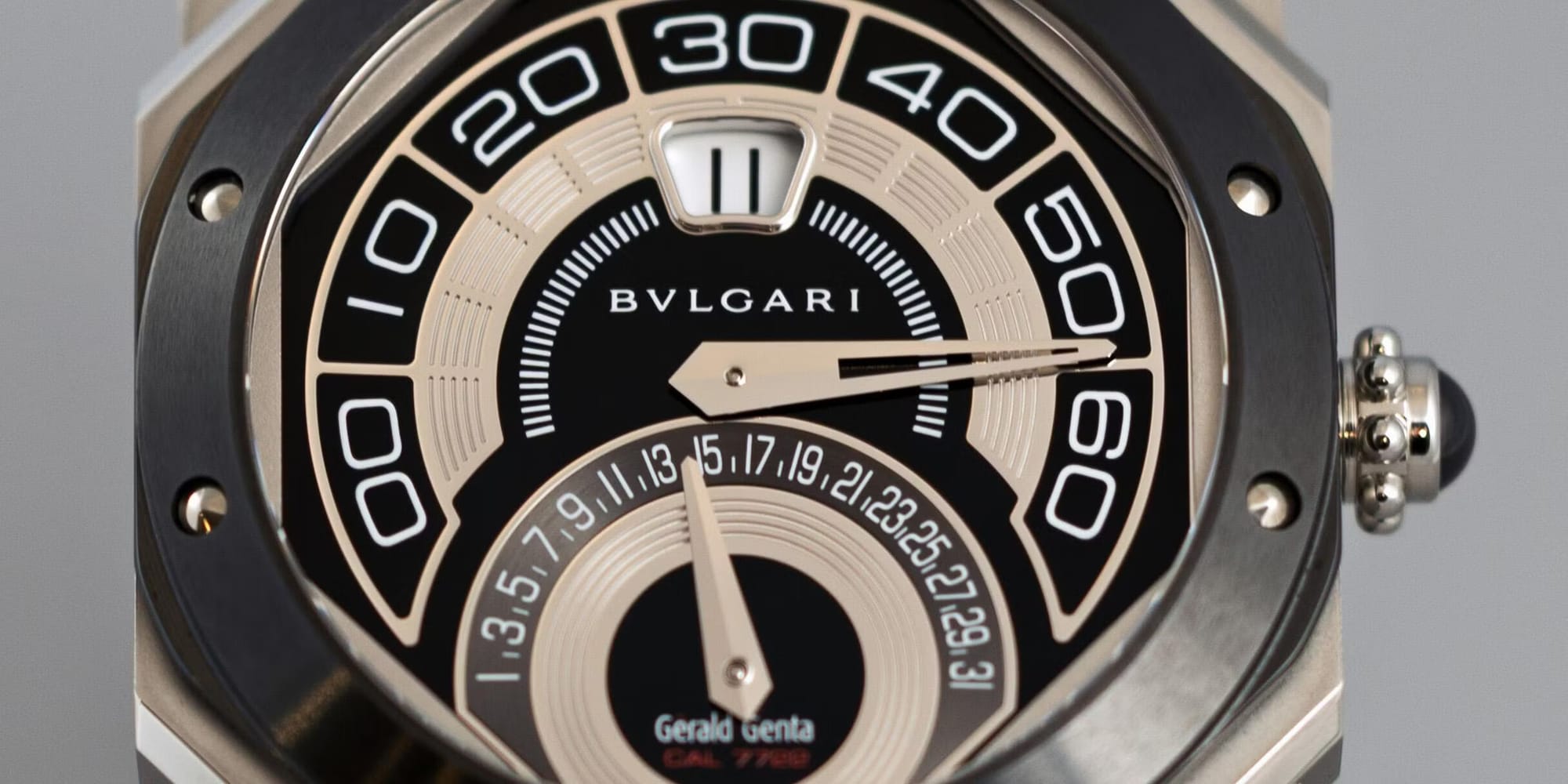
The black lacquered dial is busy in the best way. The jumping hour owns the top half. Instead of an hour hand creeping around, a single numeral sits in a window and, on the hour, snaps to the next one in an instant. It never gets old.
Arabic numeral minute markers sit at 10-minute intervals around the dial's edge. The retrograde minutes hand sweeps along a semi-circular arc, then snaps back to zero at the top of each hour. Below, a retrograde date display mirrors this arc. The symmetry works well, and the layout invites you to actually watch the time change rather than just read it.
Movement
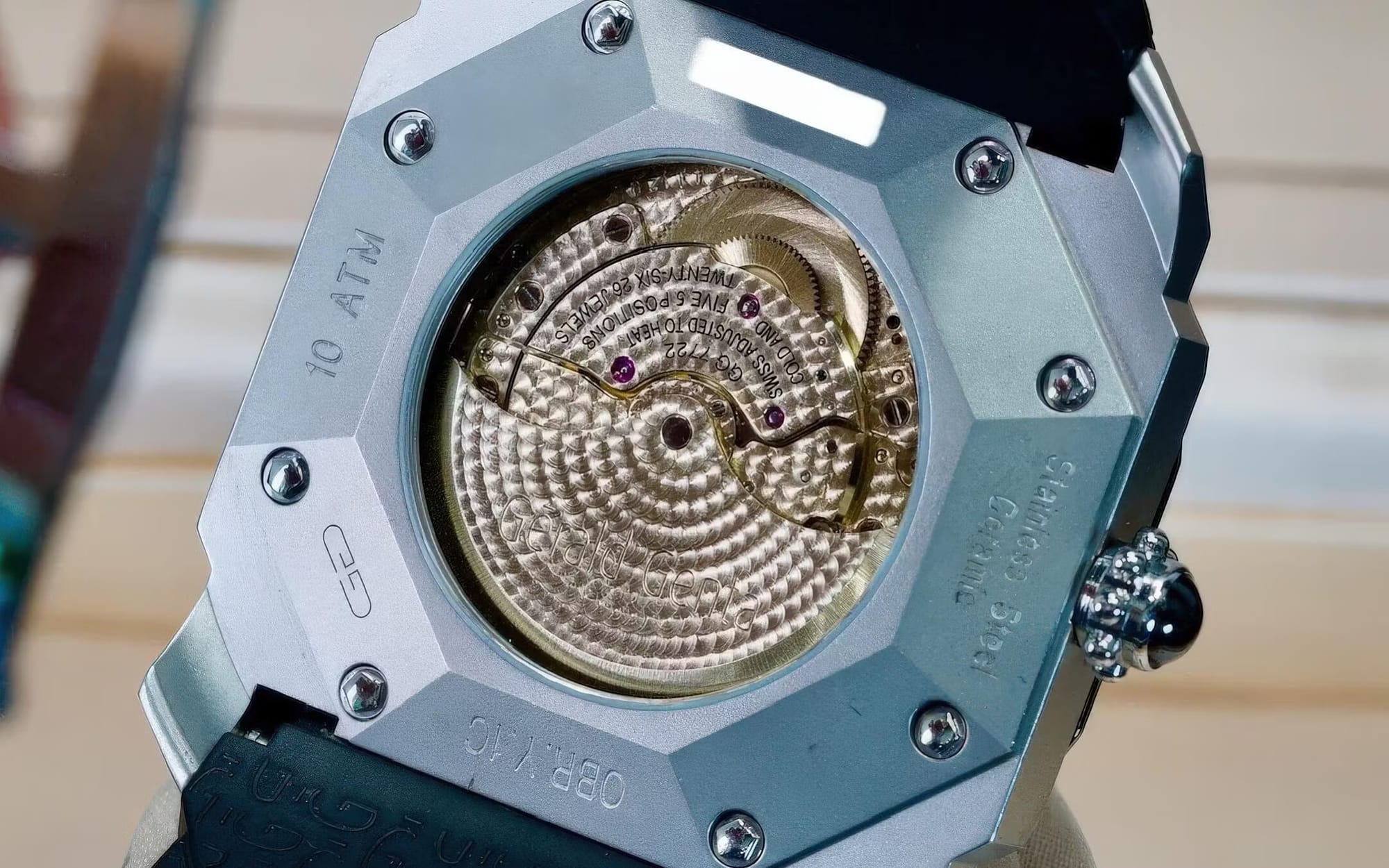
Inside is the Bvlgari Gerald Genta Calibre GG 7722, an automatic movement running at 28,800 vibrations per hour with 26 jewels and a 45-hour power reserve. The transparent sapphire caseback shows the movement's finishing, which is solid if not spectacular.
The real appeal is watching the complications work. The hour jump is crisp, and the retrograde hand reset is smooth.
Strap and wearability
The black rubber strap is comfortable for daily wear and integrates well with the case design. The deployment clasp is secure. Despite the angular case and substantial dimensions, the Octo Retrogradi sits reasonably well even on smaller wrists thanks to careful proportioning.
Personal experience
I've long been interested in jumping hour complications, and the Octo Retrogradi scratches that itch well. The instant transition of the hour display is satisfying to watch, and the retrograde displays add visual interest throughout the day. It's not a subtle watch, but it earns its attention through mechanical ingenuity rather than just size.
The connection to Gérald Genta's work adds context. It carries forward a specific design philosophy that influenced some of the most recognizable watches ever made.
Final thoughts
The Octo Retrogradi is not for everyone. It is big, angular, and a little theatrical, and it asks you to enjoy watching the time change rather than just reading it. But if you like jumping hours and retrograde displays, and you want to wear the geometry of the man who drew the Royal Oak and the Nautilus without paying Royal Oak or Nautilus money, this is one of very few ways to do it.


