

In the summer of 2025 I was at Diamond Cellar in Columbus, Ohio, leaning over a case and asking to try on a Bell & Ross BR-X5 Black Steel. The lighting was bright, the way jewelry-store lighting always is, engineered to make polished steel throw light and diamonds throw fire. The AD set the watch on the velvet and turned it on its side, and the small red 100M/325FT line on the dial caught the light. The Iridescent was sitting in the same case. It's a real eye-catcher, but the black, white, and red is closer to what I actually like.
Then I looked at the price. At retail, a BR-X5 Black Steel goes for $7,800. That's closing in on Panerai, past basic Omega. I thanked the AD and left.
I had no plans to leave for good. My favorite hunting ground for new-but-not-retail luxury watches is online no-reserve auctions. The mechanic is plain. A seller lists with no minimum, and the auction settles wherever the bidders take it. With two collectors paying attention the price climbs to roughly fair market. Without them, you can sometimes walk away with something for less than it deserves. I set an alert for the BR-X5.
It didn't take long. The auction I caught was on Grailzee, which runs optional no-reserve auctions. The auction I won opened on June 24 with a $750 bid and crawled up over thirty-six hours to a $2,601 winner four nights later. Then the seller declined to sell at $2,601, Grailzee opened a post-auction negotiation round, the original winner walked, and four days later I came in fresh: $3,800 in the morning, $3,980 by lunchtime, and the seller, finally, said yes. The watch was mine, brand new, unworn, for slightly more than half of retail.
Brand and history
Bell & Ross was founded in Paris in 1992 as a university project between two childhood friends from the Lycée Carnot, Bruno Belamich and Carlos A. Rosillo. Belamich, an industrial designer, became the "Bell" and the brand's creative director. Rosillo, who handled business and finance, became the "Ross." The ampersand in the name was meant to symbolize the partnership, and it has remained the visual core of every Bell & Ross watch since.
The first watches weren't made in Switzerland. They were made in Germany, by Helmut Sinn's tool-watch company Sinn Spezialuhren, and were sold under the dial signature "Bell & Ross by Sinn." The Sinn partnership lasted roughly a decade and gave Bell & Ross its early credibility as a maker of utilitarian timepieces for professionals: pilots, divers, French special forces, and the demanding markets that valued robustness over decoration.
Two events redirected the brand. In 1998, Chanel acquired a minority stake in Bell & Ross. By 2002, that relationship enabled Bell & Ross to break from Sinn and move production into Chanel-controlled facilities in La Chaux-de-Fonds, Switzerland, where the brand has manufactured ever since. The headquarters and design studio remain in Paris.
The watch that defined the brand arrived three years later. The 2005 BR-01 took the visual language of military aircraft cockpit instruments, square brushed metal with four exposed corner screws, oversized luminous numerals, and a round dial set inside a square case, and translated it onto the wrist at 46 millimeters. The BR-03, a 42mm version that followed in 2006, did the same in a more wearable size. Together they gave Bell & Ross an instantly recognizable silhouette and carried the brand for the next fifteen years.
The BR-05 launched in 2019 as a deliberate departure. Where the BR-01 and BR-03 cases referenced cockpit instruments, the BR-05 referenced integrated-bracelet sport watches: a softer square with rounded edges, a polished-and-brushed steel case fused to a matching bracelet, the family resemblance to Genta-derived sports watches deliberate. It was Bell & Ross's first move toward urban dress-sport rather than military instrument.
The BR-X5 is the version of that line built around a manufacture movement. It debuted at WatchTime New York on October 21, 2022, with a global launch tour through Tokyo, Taipei, Kuala Lumpur, Paris, London, Shanghai, Hong Kong, and Madrid in the weeks that followed. Its caliber, the BR-CAL.323, is built by Kenissi, the Swiss movement manufacturer founded by Tudor in 2016. The connection runs through Chanel, which holds a minority stake in Bell & Ross and acquired a 20% stake in Kenissi in 2018. The BR-X5 is the first Bell & Ross watch ever submitted to COSC for chronometer certification, and Bell & Ross extended the standard two-year warranty to five years on the line. For a brand that spent its first thirty years using ETA and Sellita ébauches, this was a move into manufacture territory.
Case and dimensions
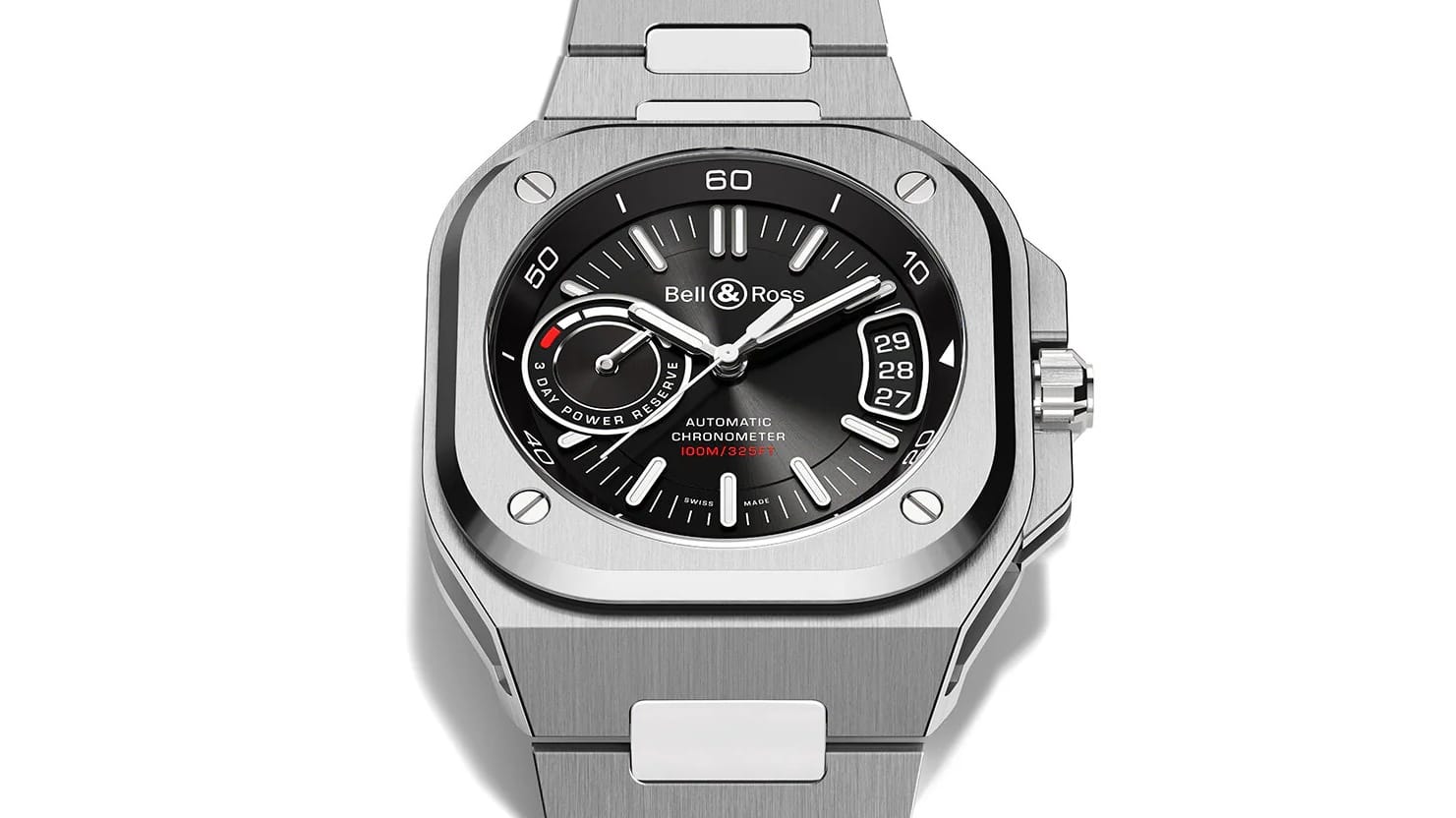
The case is 41 millimeters across and 12.80 millimeters thick. On paper it's a midsize sport watch. The construction is multi-component: a brushed-and-polished steel inner case held inside an outer frame, secured at four corners by visible screws. The architecture distributes the steel cleverly enough that the BR-X5 wears noticeably lighter than its dimensions suggest. You pick the watch up expecting it to be heavy and it isn't.
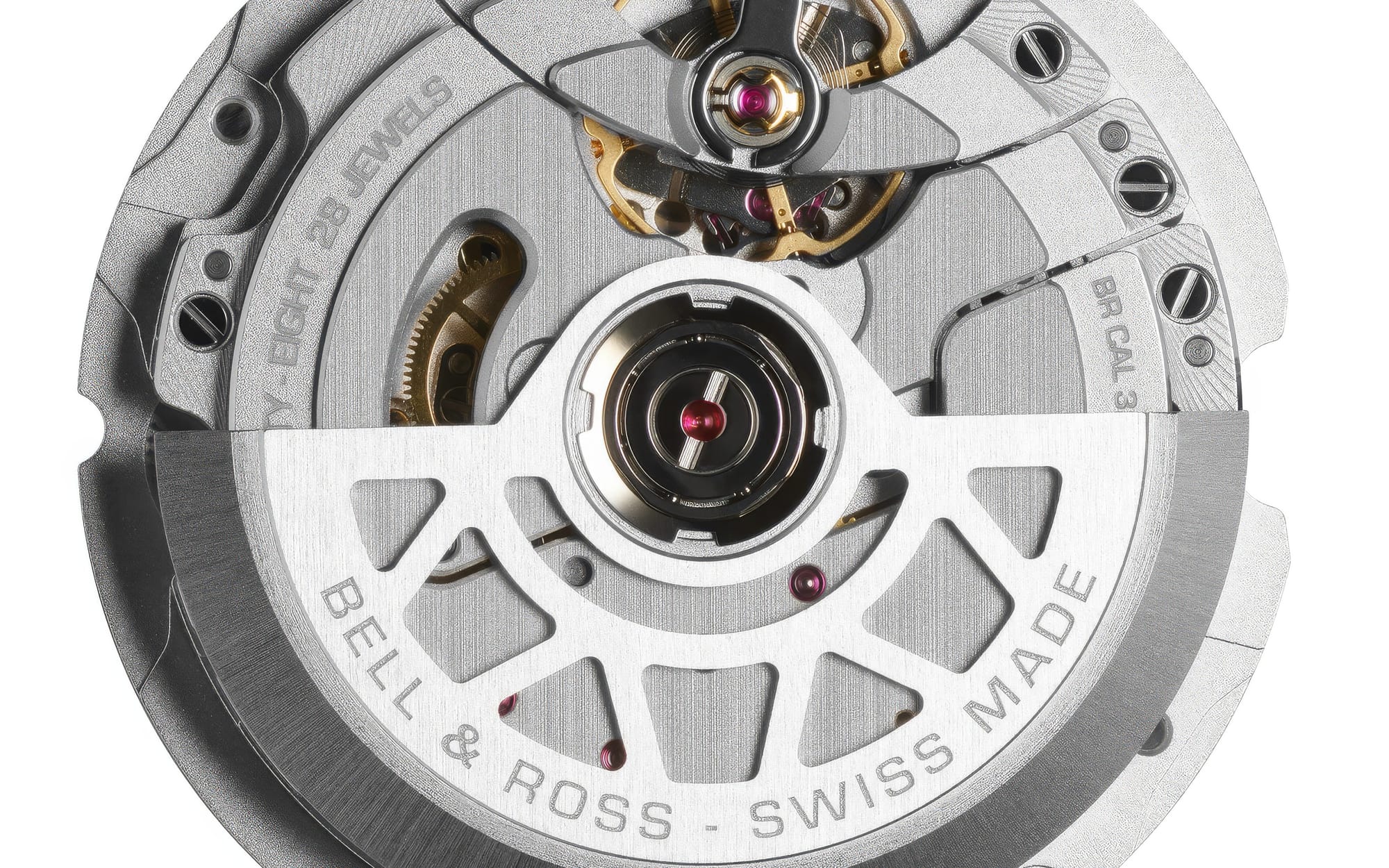
Water resistance is rated to 100 meters, with a screw-down crown, a crown protector, and a screw-down sapphire caseback that displays the oscillating weight. The crystal is anti-reflective sapphire.
The integrated bracelet is brushed and polished in alternating links and sits flat against the wrist instead of riding above it the way many integrated-bracelet sports watches do. The folding clasp is satin-and-polished steel.
The dial
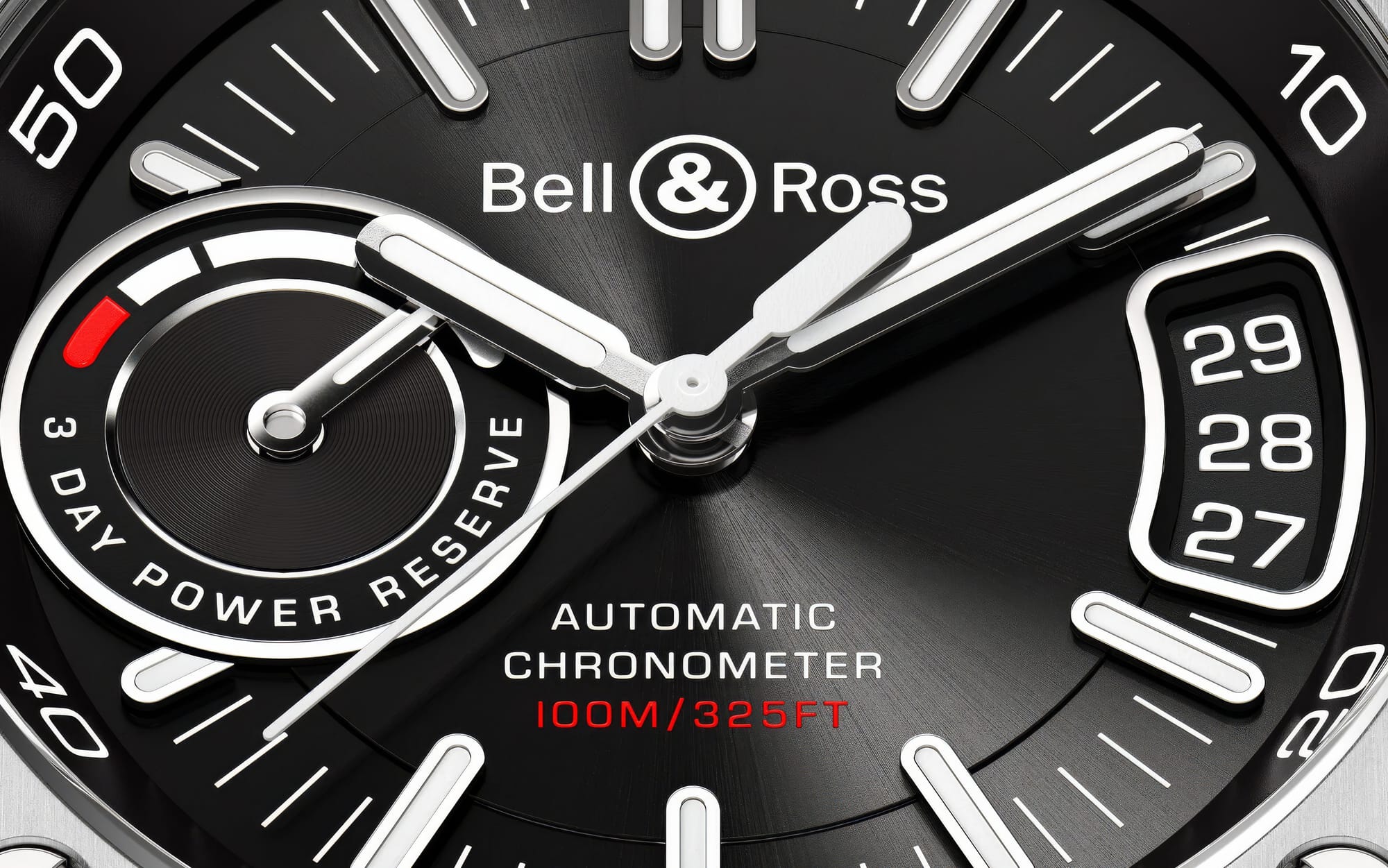
The dial is sunburst black, with applied indexes and skeletonized hour and minute hands, all filled with Super-LumiNova. A large date window sits at 3 o'clock. At 9 o'clock, divided into thirds, sits a circular power reserve indicator with a red wedge at the bottom that announces, when you've been ignoring the watch too long, that it's running out of energy and would like your attention. The black flange around the dial carries a 60-minute graduation in white markings. At the bottom, in red, sit the words "100M / 325FT."
Chronographs get the press, tourbillons get the museum displays, perpetual calendars get the magazine spreads. The power reserve indicator gets nothing. It's also the only complication on that list that genuinely changes how you live with a mechanical watch on the wrist. Chronographs are stopwatches you almost never use, and tourbillons answer a problem pocket watches stopped having a hundred and fifty years ago. The power reserve, by contrast, is a fuel gauge. It tells you whether the watch you're reaching for tomorrow morning is going to be running, or whether you're going to be resetting the date and time before your first cup of coffee. The mechanical watch becomes a tool you actually maintain instead of an ornament you wind once and put down. The dial of the BR-X5 makes that complication the architectural anchor of the design, opposite the date, and it's the reason I bought this watch.
The movement
Inside the case is the BR-CAL.323, a manufacture-grade automatic movement Bell & Ross doesn't make in-house. It's built for them by Kenissi, the movement company best known as Tudor's industrial sibling, which also supplies Breitling, Norqain, Fortis, TAG Heuer, and Chanel. The caliber runs at 28,800 vph, holds approximately 70 hours of power reserve, uses a variable inertia balance, and is COSC certified, a first for Bell & Ross. COSC certification means the bare movement, prior to casing, was tested over fifteen days in five positions at three temperatures, and met the body's accuracy threshold of -4/+6 seconds per day.
What makes the BR-CAL.323 worth talking about is its provenance. Kenissi was founded by Tudor in 2016 to industrialize movement production, and its calibers have become the spine of the modern non-Rolex Swiss sport watch. The same architecture underpins the Tudor MT5612, the Breitling-related calibers in their joint family, the Chanel J12 caliber, and now the BR-CAL.323. Bell & Ross's relationship with Kenissi exists because of Chanel, which sits as a minority shareholder in both companies. The BR-X5 is the first watch Bell & Ross built around this connection, and Carlos Rosillo has signaled that the brand intends to extend the Kenissi relationship across more of the collection over time. The five-year warranty on both the movement and case is meaningful, given that most Swiss watches at this price come with two.
On the wrist
The BR-X5 wears comfortably for an all-day watch. Its multi-component case design makes it lighter than its 41mm by 12.80mm dimensions suggest, and the integrated bracelet sits flat against the wrist. People notice it because the shape is unusual. It isn't a round sport watch and it isn't a strict square; it occupies its own territory, which is part of the point.
I'll admit I don't wear this watch very often. I have lots of watches in my collection. I tend to reach for Panerai and Ulysse Nardin most weeks, partly because both brands have a nautical history that pulls me back, and partly because their company stories are ones I know in detail and feel connected to. Bell & Ross is younger to me. Watches, for me, get worn most when there's a story I want to keep telling myself by putting them on.
That isn't a complaint. I also have lots of books, and I don't read each one every day. Some I pull off the shelf when I'm interested in a specific topic, or when I'm in a mood for a specific kind of voice. Some sit on the shelf for years and come down at the right moment and earn their place all over again. The collection isn't the rotation. The collection is the inventory of moods I might one day be in.
Final thoughts
The Bell & Ross BR-X5 Black Steel is a serious watch. The Kenissi-built BR-CAL.323 is the brand's most ambitious movement to date, the first to wear the COSC chronometer label, and the basis of a new technical chapter for a company that built its name on cockpit-instrument design rather than on movement engineering. The 70-hour power reserve and chronometer accuracy mean it can sit unworn for nearly three days and pick up where it left off. The dial layout, with its big date and architectural power reserve indicator, is genuinely well resolved.
What it isn't, yet, is a heritage watch. Bell & Ross is a young brand by Swiss standards, and the BR-X5 line is a recent offshoot of a recent offshoot: the urban-design BR-05 from 2019 reimagined with a manufacture movement in 2022. For collectors, the brand's truly distinctive silhouette remains the BR-01 and BR-03 cockpit-instrument square. The BR-X5 is, in form, an integrated-bracelet sports watch. It's a very good one. It just doesn't occupy unique design territory the way a BR-03 does.
At $7,800 retail, the BR-X5 Black Steel is a fair-but-steep proposition in a competitive bracket. Bought for closer to half that on the secondary market, as I did, it's one of the better deals in modern Swiss watchmaking right now. The watch is identical either way; what changes is who takes the depreciation hit on the brand story. Somebody else took it on mine.
I'm thinking about adding the matching black openwork rubber strap. That might be the thing that tilts the rotation.


