

In September 1967, off Brenton Reef Light near Newport, Rhode Island, a 12-meter yacht called Intrepid swept Australia's Dame Pattie four races to nothing. The boat was designed by Olin Stephens. She was captained by Emil "Bus" Mosbacher Jr., the celebrated New York yachtsman who would later be inducted into the America's Cup Hall of Fame. Heuer, the Swiss chronograph maker, was Intrepid's official timekeeper. The crew wore Heuer-branded wristwatches on the boat. Handheld stopwatches sat in cradles below deck. When Mosbacher crossed the finish line for the fourth time and the Auld Mug stayed in New York, the watches that had timed the win were Aquastar Regates, co-branded for the campaign with a small disappearing-red-balls disc that turned over in the five minutes before the start gun.
The Skipper didn't exist yet. It would be made later, in 1968, by a brand that wanted to commemorate a win that the wristwatches on the boat had already finished timing.
Image credit: Tag Heuer
Brand context
Heuer released the Skipper in 1968 as a tribute to Intrepid. The colors on the dial were chosen for sentimental reasons, not for racing legibility. The teal of the running seconds sub-dial matched the deck of the boat, which Stephens had specified in turquoise because the color killed reflections off the water. The green matched the rigging. The orange marked the final five-minute warning before the start gun. The case was a 35mm Carrera, the dressy chronograph Jack Heuer had introduced five years earlier and named after the Carrera Panamericana road race in Mexico. The movement was a Valjoux 7730 modified to convert the standard 30-minute chronograph register into a 15-minute regatta countdown, with the hand jumping in 30-second increments. Reference 7754, although the case itself was actually engraved 7753, because Heuer cataloged Skippers under the 54 suffix and Carreras under the 53 suffix and the two cases were physically identical.
The watch flopped. Production lasted about a year. Estimates of the original run vary from 300 to 400 pieces. Today only about twenty examples are documented. Heuer moved the Skipper into the larger Autavia case in 1969 and that case stayed until production ended in 1983. The original Carrera-cased Skipper was never listed in a Heuer catalog at any point during its short life. It was simply forgotten.
In 2008, at the opening of the TAG Heuer Museum in La Chaux-de-Fonds, the watch was rediscovered. Vintage Heuer collectors who had come to the opening spotted an unfamiliar Carrera-cased chronograph with a blue dial and a tricolor 15-minute counter in one of the display cases. They could not identify it. Jeff Stein, who runs OnTheDash and is the closest thing the Heuer collecting world has to a chief justice, posted images on Hodinkee asking the community to help. The community pieced together what it was: the original Skipper, in a Carrera case, that had never been cataloged. Someone proposed a nickname by taking Skipper, dropping the final r, and grafting on the era ending of Carrera. The watch had a name now, forty years after it was made. Skipperera.
Auction prices followed the naming. A poor example with a degraded dial sells for around $20,000. An exceptional one will clear $80,000, and good examples with provenance and original parts have approached $130,000 with the buyer's premium. The Skipperera is now consistently named in collector circles as one of the top ten vintage Heuer grails. The cult was built by the people who had to teach the brand what it had once made.
In June 2017, TAG Heuer collaborated with Hodinkee on a 125-piece reissue commemorating the fiftieth anniversary of Intrepid's victory. It sold out in minutes. Six years after that, in July 2023, the brand brought the Skipper back as a permanent collection piece. The CBS2213.FN6002 launched at the new TAG Heuer flagship boutique on Fifth Avenue in New York, opening night, July 12. The CEO of TAG Heuer was wearing one.
Here is what he said about it later, to an interviewer in Singapore: "It's a watch that a lot of collectors loved, but it had no place in our collection anymore. We relaunched it as a modern watch that will stay in the collection at a much higher price point than the usual average price for Tag Heuer. It was very positively received."
The CEO is Frédéric Arnault, the third son of Bernard Arnault, who runs LVMH and who is, depending on the day, either the wealthiest or the second-wealthiest person on earth. Frédéric was appointed CEO of TAG Heuer in 2020 at age 25. He has a degree in computational and applied mathematics from École Polytechnique. The strategy he has executed since arriving is unambiguous: fewer stores, fewer references, higher prices, more visible heritage. Average prices at the brand were about $2,400 in 2018. Under Arnault they have climbed past $3,300. The Skipper, at $6,750 at launch and $7,550 now, is squarely on that line.
Modern competitive yacht racing does not run on mechanical regatta chronographs. It runs on Garmin sailing watches, on integrated race-management software, on GPS systems that know exactly where the starting line is and exactly when the gun is going to fire. The Revolution Watch piece that covered the Skipper's revival concedes this directly: the modern Skipper, the writer notes, "has not been designed to time yacht races. It's easy enough for GPS and computer systems to do that." Even the original 1968 Skipper was a tribute object rather than a tool. The Intrepid crew wore Aquastars. So the Skipper has always existed at one remove from the activity it depicts. You are not buying a sailor's instrument. You are buying a wearable mythology: the colors of a 1967 yacht's deck and rigging and warning gun, rendered onto a dial three layers deep from the original act.
Case and dimensions
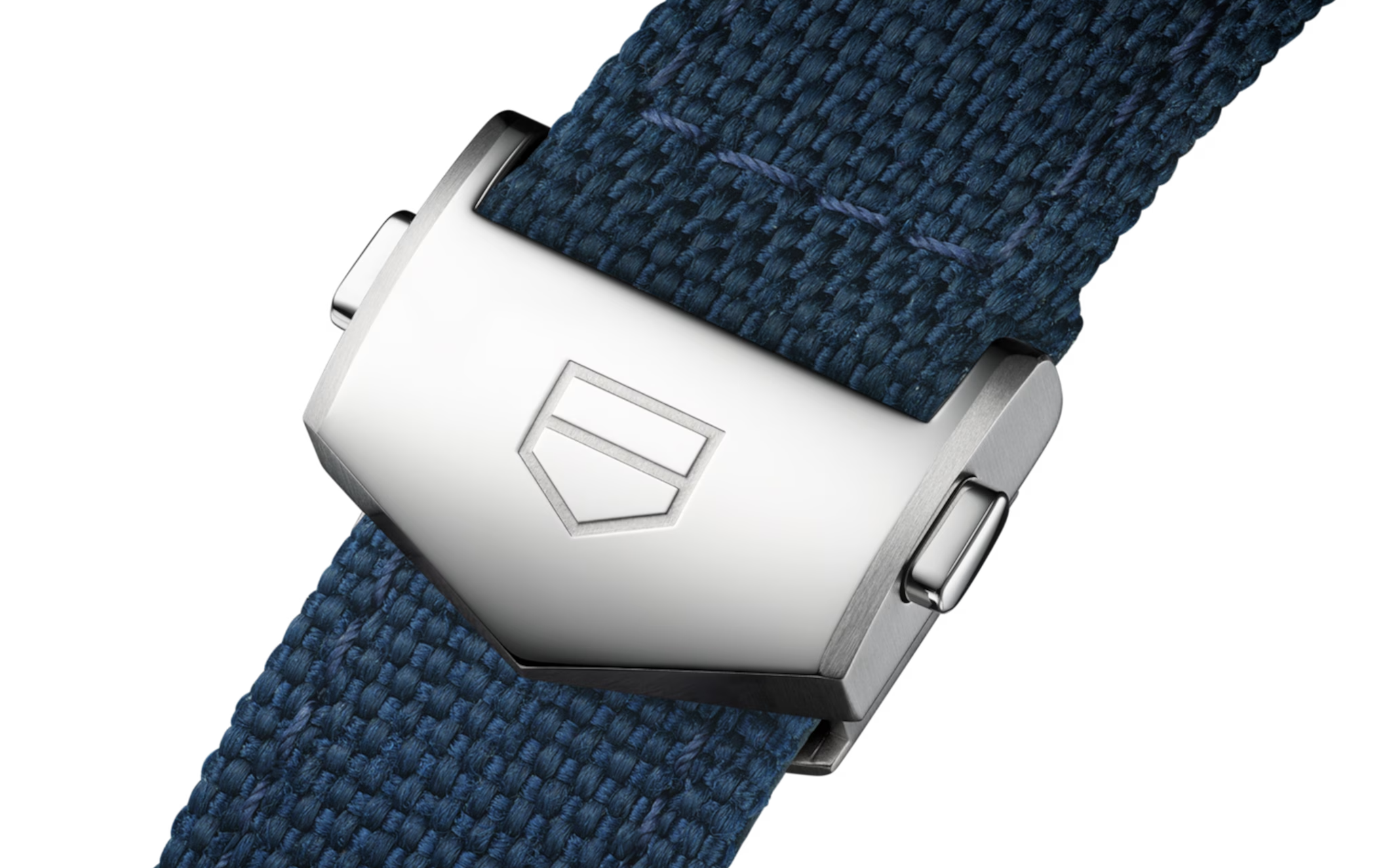
The CBS2213 sits in TAG Heuer's first-generation Glassbox case, introduced in March 2023 to mark the Carrera's sixtieth anniversary. The diameter is 39mm. Thickness is 13.9mm. Lug-to-lug is 46mm. Lug distance is 20.7mm. Compared to the 42mm cases I own across the Seafarer x Hodinkee, the Seafarer permanent collection, the CBN201N France LE, and the Bamford collaboration, this case wears noticeably smaller.
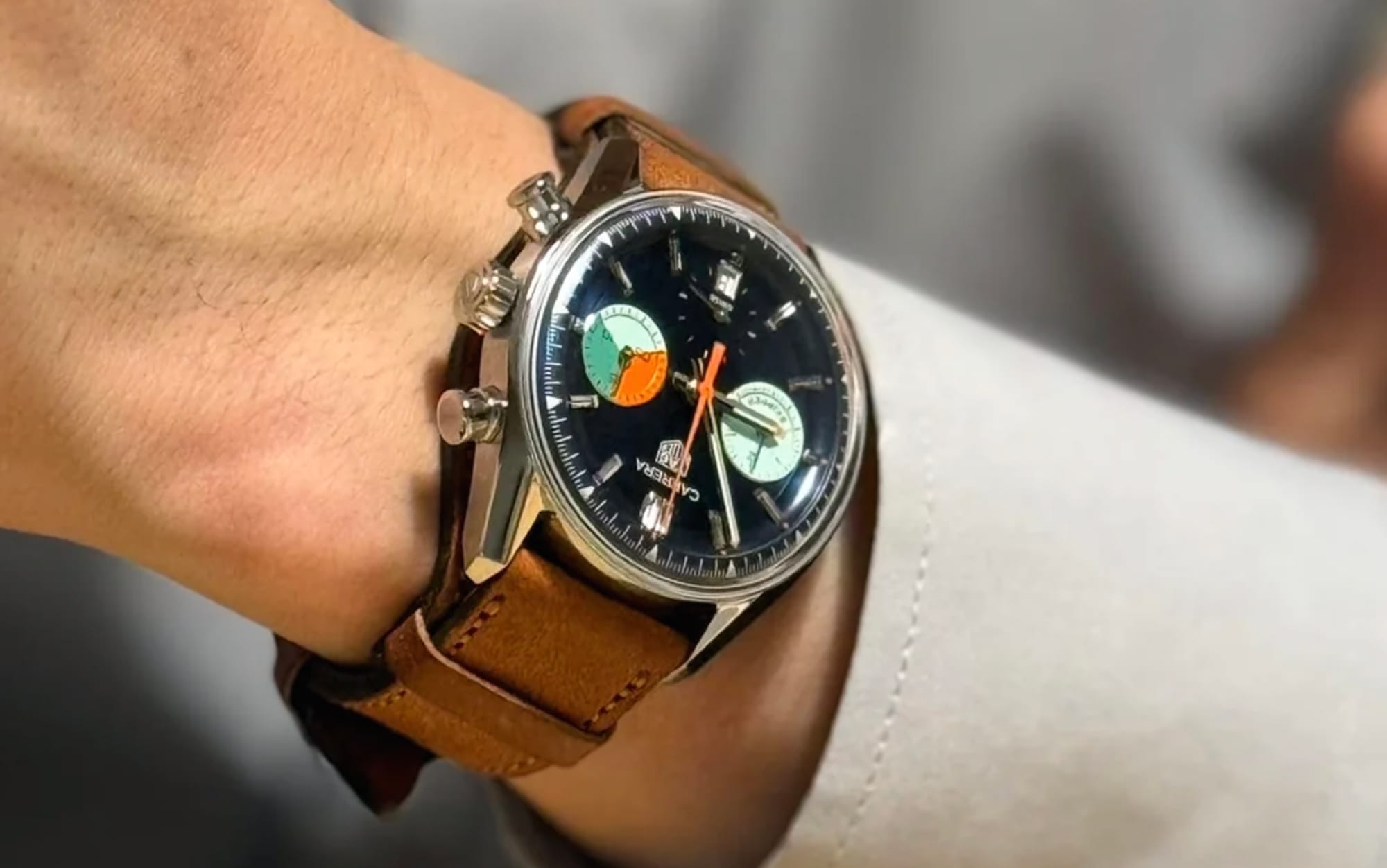
The defining feature of the case is the absence of a bezel. The crystal is a highly-domed sapphire box that mounts directly onto the case and runs all the way to the outer edge. There is no metal frame around the dial. The dial is visible from the side through the curve of the crystal, which produces a warm period-correct distortion that a flat sapphire would not. The pushers are oversized pump-style cylinders rather than the flatter rectangular pushers of the older Heuer 02-era Carreras. The crown is steel, fluted, at 3 o'clock. The case finishing alternates brushed flanks and polished tops, the standard Carrera vocabulary, executed cleanly.
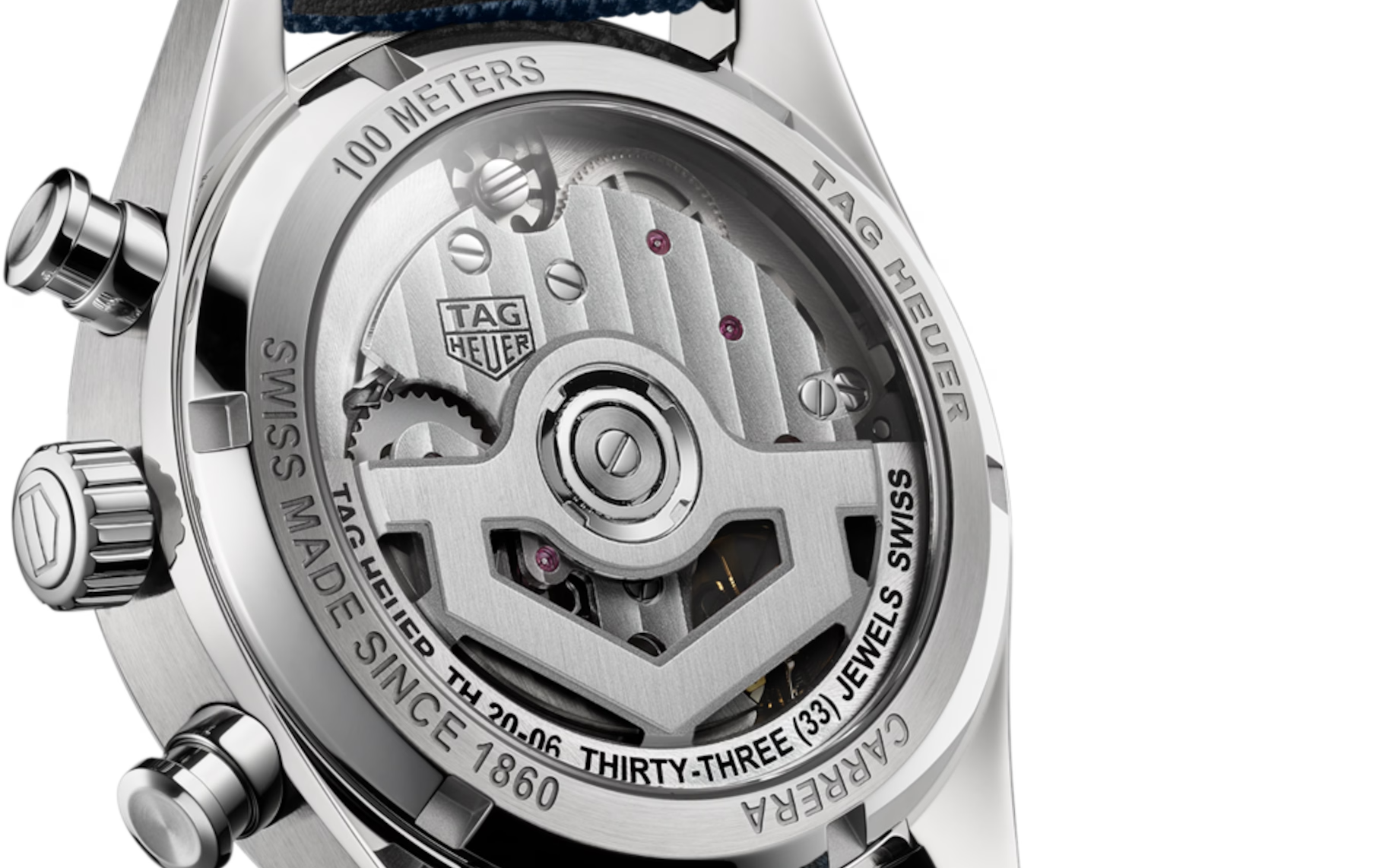
Water resistance is 100 meters, adequate for the maritime theme and well past what the watch will actually be doing. The caseback is a screw-down sapphire. Through it you can see the new shield-style rotor of the TH20-06.
The dial and lume
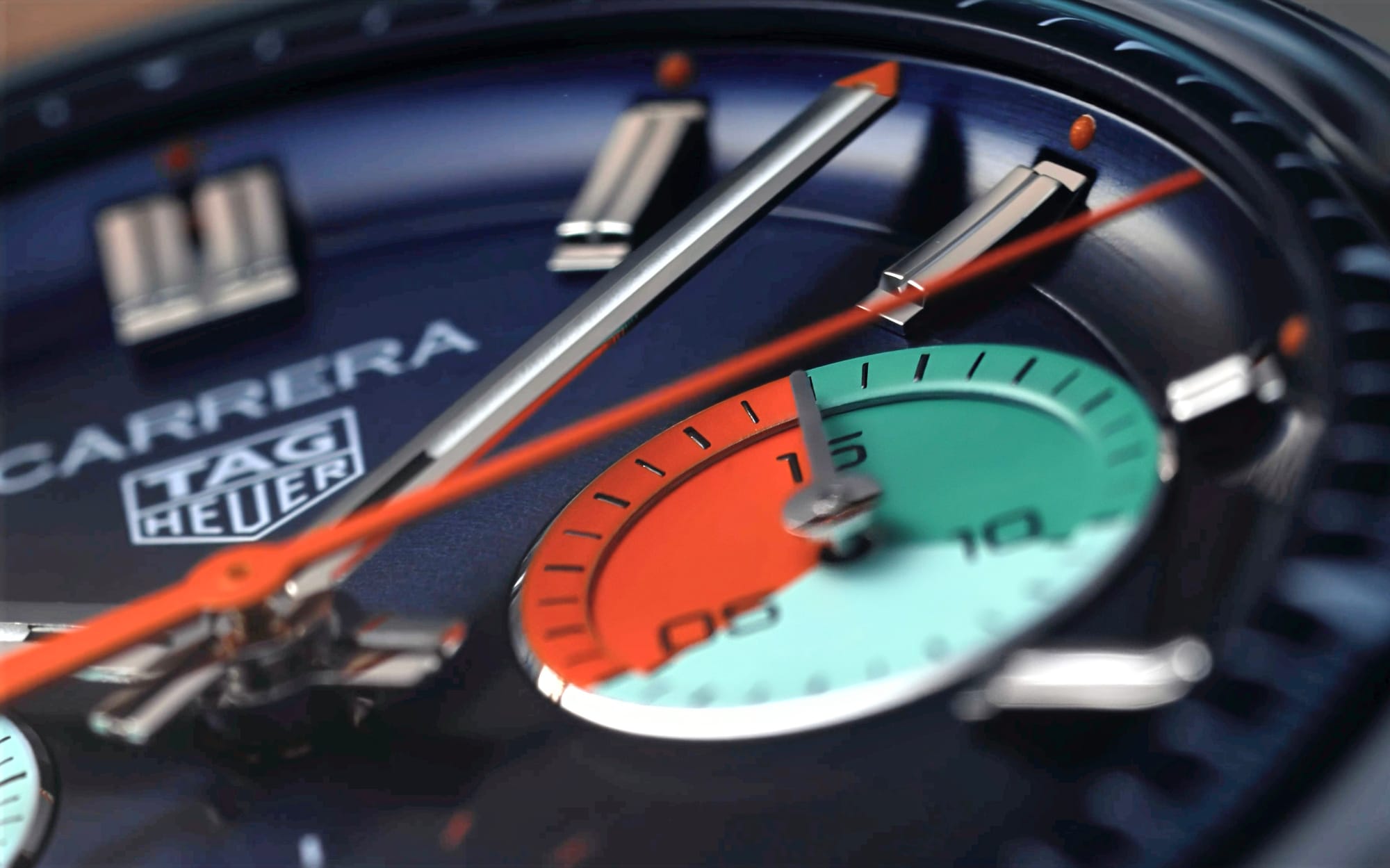
The dial is what you pay for. It is finished in a warm metallic blue with a fine circular-brushed surface, called Carrera Signature Blue, that reads darker in low light and lifts toward navy under direct sun. The bezel-less construction means the dial is the entire front of the watch.
Two sub-counters carry the regatta vocabulary. At 9 o'clock the 12-hour counter is finished in Intrepid Teal and engraved with the word Skipper. At 3 o'clock the 15-minute regatta counter holds the color story that matters: a tricolor disc divided into three five-minute segments in Intrepid Teal, Lagoon Green, and Regatta Orange. The orange segment marks the final five minutes before the start gun. This is the segment that, in the actual mechanics of a regatta start, would tell a crew to be approaching the line but not over it. On the wrist of someone who is not racing a yacht, it is the part that catches the eye and makes the dial work.
The central chronograph seconds hand is lacquered in the same Regatta Orange. The hour and minute hands are rhodium-plated and faceted, with small orange tips at the very end. The orange tips are the dial's most divisive choice. The Monochrome commenter Jeff called them "completely unnecessary." Another reader responded: "The sea AND sun." I am with the second reader. The tips give the hands a small visual handshake with the seconds hand, which without them would float across the dial alone.
A phantom-style running seconds sub-dial sits at 6 o'clock, almost invisible against the brushed blue base. The date window cuts into it. The framed treatment is tidy and the white date numerals are easy to read.
Lume is applied to the rhodium hands and the applied indices. It is not applied to the sub-counter color segments. You can read the time at night. You cannot read the regatta countdown in the dark. The watch is honest about which of those functions it expects you to use.
The movement
Inside is the calibre TH20-06, a variant of the TH20-00 platform that replaced the Heuer 02 in TAG Heuer's chronograph lineup. The architecture is column-wheel switching with vertical-clutch engagement, both of which produce the precise pusher click and smooth seconds-hand start that distinguish the TH20 family from the cam-and-horizontal-clutch chronographs at this price tier. Frequency is 28,800 vph (4 Hz). Power reserve is 80 hours, more than enough to leave the watch off Friday evening and pick it back up Monday morning with the date still correct. Jewels: 33. Winding: bi-directional, through a new shield-shaped rotor that TAG redesigned for the TH20 series.
The TH20-06 specifically is the variant tuned for the Skipper's 15-minute regatta countdown. Most TH20 chronographs use a standard 30-minute register. The Skipper required the same kind of modification that the original 1968 7754 demanded of its Valjoux 7730, with the minute hand making a full revolution every 15 minutes and jumping in 30-second increments. The mechanical accommodation is small. It is also why TAG could not simply drop a stock TH20-00 into the Glassbox case and call it a Skipper.
The finishing visible through the caseback is competent rather than ornate. The bridges carry light Côtes de Genève. The column wheel is visible through the rotor cutouts. There is no Geneva striping in the showroom-photograph sense, no perlage that would catch a macro lens. For a watch at $7,550 some buyers will find that thin. My Seafarer permanent collection review from earlier this year made the same critique, and the same answer applies: TAG backs the movement with a five-year warranty, extended from the standard two, which buys back some of the ground that the finishing concedes.
The proprietary TH-Carbonspring hairspring that TAG announced in 2025 is not in this calibre. That is worth flagging if you are comparing technically against current Tudor or Omega chronographs in this price band.
On the wrist
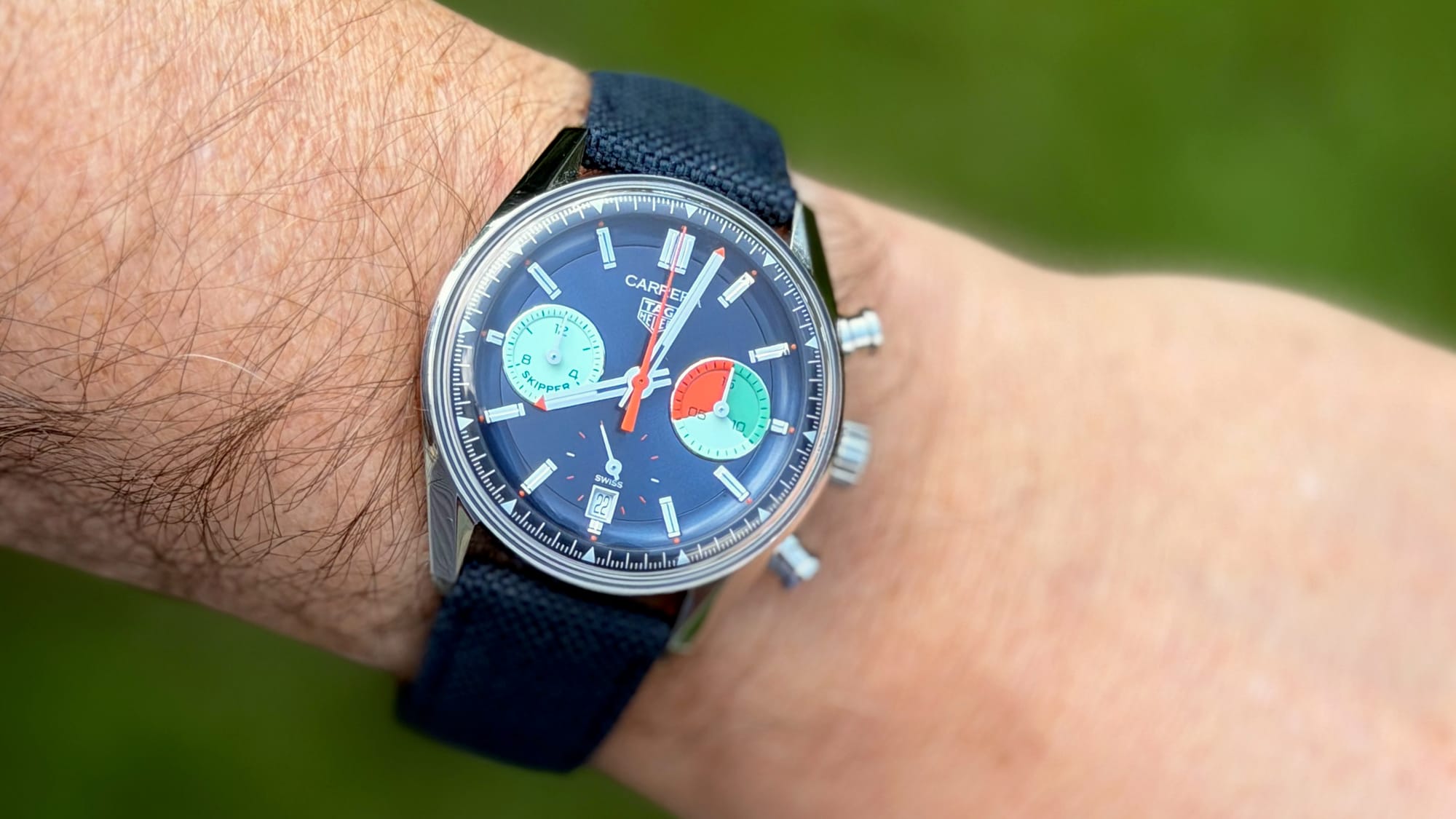
The 39mm reads small. This is my first Glassbox case and I came to it from a stable of 42mm Carreras, so my calibration is biased. But it isn't only mine. The TAG Heuer forum thread on the CBS2213 is full of owners reporting that 39mm in the Glassbox feels smaller than 39mm in a conventional case. The reason is mechanical. Because the crystal runs all the way to the edge of the case without a framing bezel, the actual visible dial opening is narrower than the 39mm case measurement suggests. The eye reads the dial, not the case.
I added some wrist presence with the Curious Curio strap but the watch ships on a blue textile strap intended to evoke sail canvas. The execution does not land. The texture is closer to a budget NATO than to actual sailcloth, the edges feel underfinished, and the color sits closer to royal blue than to the warm Carrera Signature Blue of the dial. A non-watch friend looked at the watch on day one and said the strap looked cheaper than the other watches in my rotation, without prompting. He was right. The idea was correct: a sail-canvas tribute that would carry the maritime theme through to the wrist. The execution is the cheapest thing on the watch.
The strap that solved the problem came from a Reddit post. Someone had photographed the CBS2213 on a brown leather Bund from Curious Curio, a small Japanese strap maker whose work circulates among collectors. That image was what flipped me from interested to buying. I ordered a similar Curious Curio Bund for my own watch. I also went looking for TAG's own brown calfskin Carrera strap as a more conservative alternative. It is sold out in every length on the US site. The aftermarket is doing work that the brand has left undone.
The Bund construction sits a leather pad between the case back and the wrist, which adds visual mass to the watch and pushes the 39mm closer to 41mm in apparent size. It also separates the steel case from skin contact, which in summer is a small but real comfort. On a 7.5 inch wrist the watch with the Bund sits flat. The 46mm lug-to-lug clears the wrist bone without any overhang. The 13.9mm thickness fits under a dress shirt cuff without snagging.
Comparisons
I own four close cousins to the Skipper, and writing about them in sequence has made me notice something I had not quite articulated before. Each of them solves a slightly different version of the same problem, which is what to do with the Carrera chronograph when you do not want to make another standard Carrera chronograph.
The CBN201N France LE wears the Seafarer's color language, the blues and the turquoise and the yellow, on the 42mm 160th anniversary case, without the tide complication. It is a tribute that borrows the look and leaves the function behind. The Carrera Seafarer x Hodinkee (CBS2014.FT6293) is the actual mechanical revival, with the working tide indicator on a TH20-13 movement in a 42mm case that I find slightly underwhelming on the wrist. It is the one I wear least and the one I would let go if I were thinning the rotation, though I have no plans to do that. The Carrera Seafarer permanent (CBS2016.EB0430) is the most fully realized of the maritime cousins, with the cream dial and the warm beige palette and the tide complication built into the TH20-04. The Bamford CBN2011 is the most overtly personalized, with the gradient blue-to-gray dial and the asymmetric sub-dial palette that TAG would not produce on its own.
The Skipper sits at a different point on this map. It is the smallest case of the five. It is the only one with a true regatta complication built into the movement. It is the most aggressively colorful of any of them. And it is the only one whose entire reason for existing is to memorialize a single sporting event from 1967. The other four either honor a broader lineage (the Seafarers and the Carrera racing tradition) or assert an individual aesthetic (Bamford). The Skipper points at a specific boat, in a specific harbor, on a specific weekend.
If you already own a Carrera and you want one more for variety, the question is which kind of variety. The Skipper gives you small and loud. The Seafarer permanent gives you medium and warm. The Bamford gives you 42mm and personalized. They do not replace each other.
Final thoughts
I would probably not have paid full retail for this watch. At $7,550 the Skipper is priced into the lower Swiss luxury tier, where you start running into the Omega Speedmaster Professional and the new Tudor Black Bay Chronograph and the Breitling Premier B01 family. The TH20-06 is a strong movement, well backed by warranty, and the dial is genuinely without peer in the modern market. None of that, in my arithmetic, was worth $7,550. A dealer I contacted was willing to ship the watch new at $6,200. That is an 18 percent discount on a permanent collection piece roughly two years into its production run.
I do not know whether TAG will keep the Skipper in the collection next year. The Arnault strategy is built on selling fewer watches at higher prices, and a model that is moving at a discount cuts against that strategy. The 2017 Hodinkee limited edition of 125 sold out in minutes. The permanent collection version, on the open market, is being discounted to clear. The original 1968 Skipperera was forgotten within a year of release and rediscovered four decades later. The pattern is not encouraging for permanent-collection longevity. It is encouraging if you bought one and would like it to be uncommon.
What I keep returning to is the dial palette. It should not work. Three saturated colors on a tricolor sub-dial, an orange seconds hand, orange tips on the hour and minute hands, an Intrepid Teal twelve-hour register with the word Skipper engraved on it, a phantom sub-dial at six, a date window cutting into it. Read aloud, that is a costume. On the wrist it is one of the most cohesive maritime dials I have seen at this price. The reason it works is that the colors were not chosen by a designer in 2023. They were chosen in 1968 to match a specific boat that sailed a specific race off Brenton Reef Light. Every color on the dial points at a physical object. The teal at the deck. The green at the rigging. The orange at the warning gun.
The Skipper is not a sailor's tool. It was not one in 1968 and it is not one now. It is a piece of wearable mythology, made by a brand that learned its own history from the collectors who had to teach it. At $6,200, with the cheap fabric strap replaced by a Bund from Japan, it is the most original Carrera I own.


