

On May 25, 2026, TAG Heuer announced a new generation of the Aquaracer Professional 200 Solargraph. The 40mm bezel was resculpted with six rider tabs, the small raised grip elements TAG used in the 1990s. The hour and minute hands were redrawn, the case geometry sharpened, the flange ring changed from stepped to sloping, and a new interchangeable bracelet system introduced. The launch covered four references: two steel models with blue or green textured dials, and two titanium models, one with the line's signature polar-blue accents and one with rose-gold tones.
I bought the outgoing version that same day. I had seen the new design, decided it was not the one I wanted, and ordered the previous-generation reference WBP1180.FN8027 instead.
This is a first impression. I have had the watch on the wrist for a couple of days of ordinary desk-and-daily wear, not a long-term test, so what follows is what stands out early, not a verdict on how it lives over years. But the central question does not need years to ask: what is a solar-powered quartz watch built to look like a mechanical diver actually for?
Brand and history
TAG Heuer's connection to dive watches starts in 1978. Watching Japanese quartz reshape the industry, and aware that divers wanted a capable tool watch cheaper than a Rolex Submariner, Jack Heuer decided to build his own. He had it made in France by a manufacturer called Monnin. The result was the Reference 844: a sturdy professional diver with a unidirectional bezel, a screw-down crown, and a set of design fundamentals (200m water resistance, a luminous dial, a sapphire crystal) that TAG still treats as the Aquaracer's family traits. The 844 evolved through a run of numbered series watches across the 1980s and 1990s, took on the Aquaracer name in 2004, and has been through several visual revisions since.
The most consequential of those came in 2021, when TAG substantially redesigned the line and introduced new materials, including titanium. The Solargraph followed in 2022. TAG's first official light-powered movement, the Calibre TH50-00, arrived in an Aquaracer Professional 200. The early coverage was measured rather than excited. Solar quartz is a well-established category, long dominated by Citizen and Seiko, and a TAG entering it at a premium price was not, on its face, a headline.
Then came the Formula 1 Solargraph in 2024: the same TH50-00 movement in a smaller, cheaper, more colorful package. It sold well, and it changed the conversation. A TAG Heuer with a quartz heart could be something people actively wanted, not merely tolerated. Three years after its quiet debut, the Aquaracer Solargraph is the model getting the full redesign treatment, which is a fair indication of how TAG now views the line.
Case and dimensions
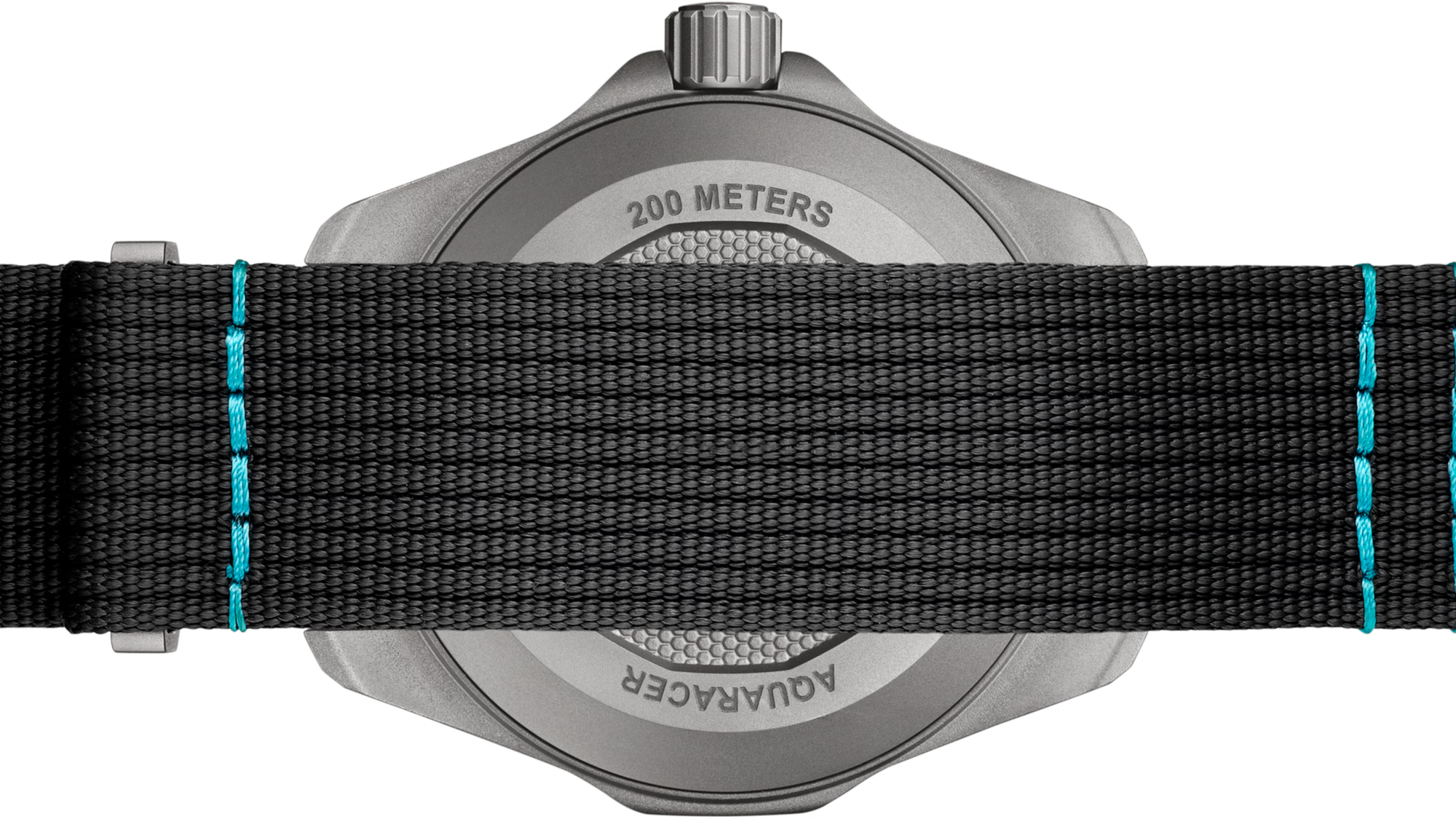
The case is 40mm wide, roughly 10mm thick, with a lug-to-lug of about 48mm. Those are good modern dive-watch proportions, but the number that matters most here is not a dimension. It is the weight, or the near-absence of it.
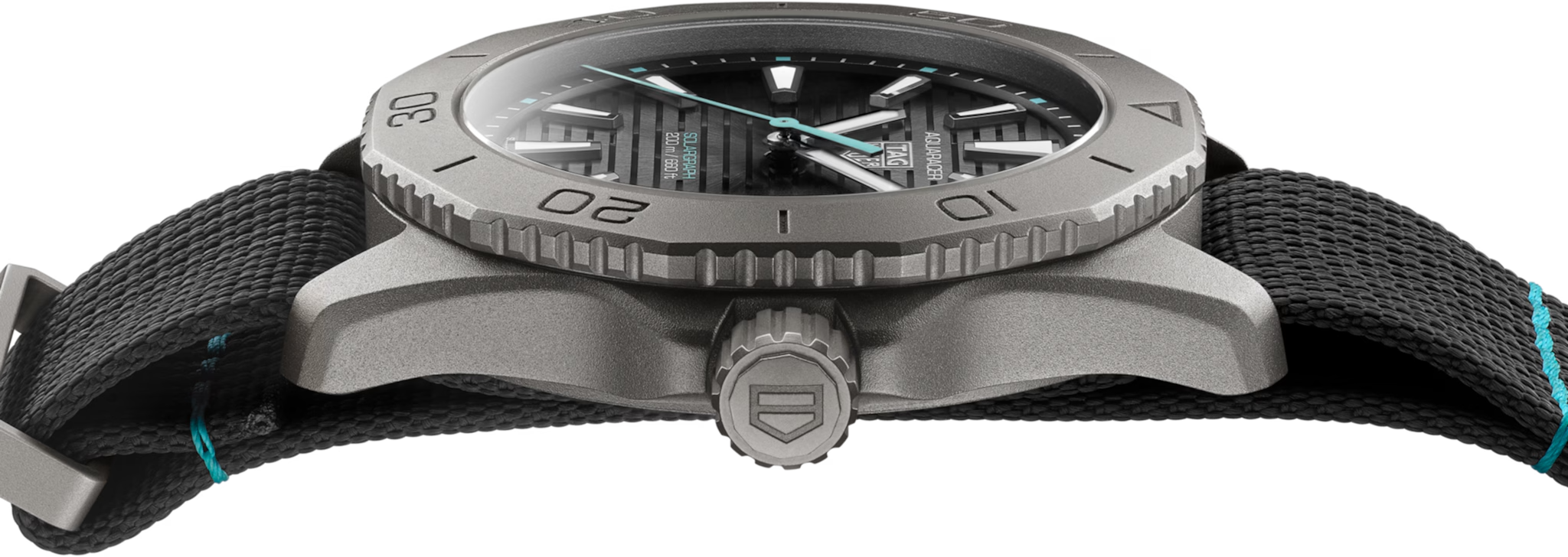
The case is made from Grade 2 titanium, which is around forty percent lighter than the equivalent stainless steel, and TAG has finished the entire case by sandblasting it to a uniform matte grey. There is no polished bevel, no glossy contrast. The result reads as a single piece of tool-watch material rather than a dressed-up sport watch.
On the wrist the lightness is the first and most lasting impression. The watch is so light it is genuinely easy to forget you are wearing it.
The bezel has the Aquaracer's familiar twelve-sided silhouette and is sandblasted to match the case. The crown is steel and screws down. The caseback is plain titanium, engraved with the model details, with no display window, which is the right call for a quartz movement that has nothing to show. On my 7.5-inch wrist the 40mm case sits comfortably with no overhang, and the matte finish keeps it from drawing more attention than its size warrants.
Dial, bezel, and lume
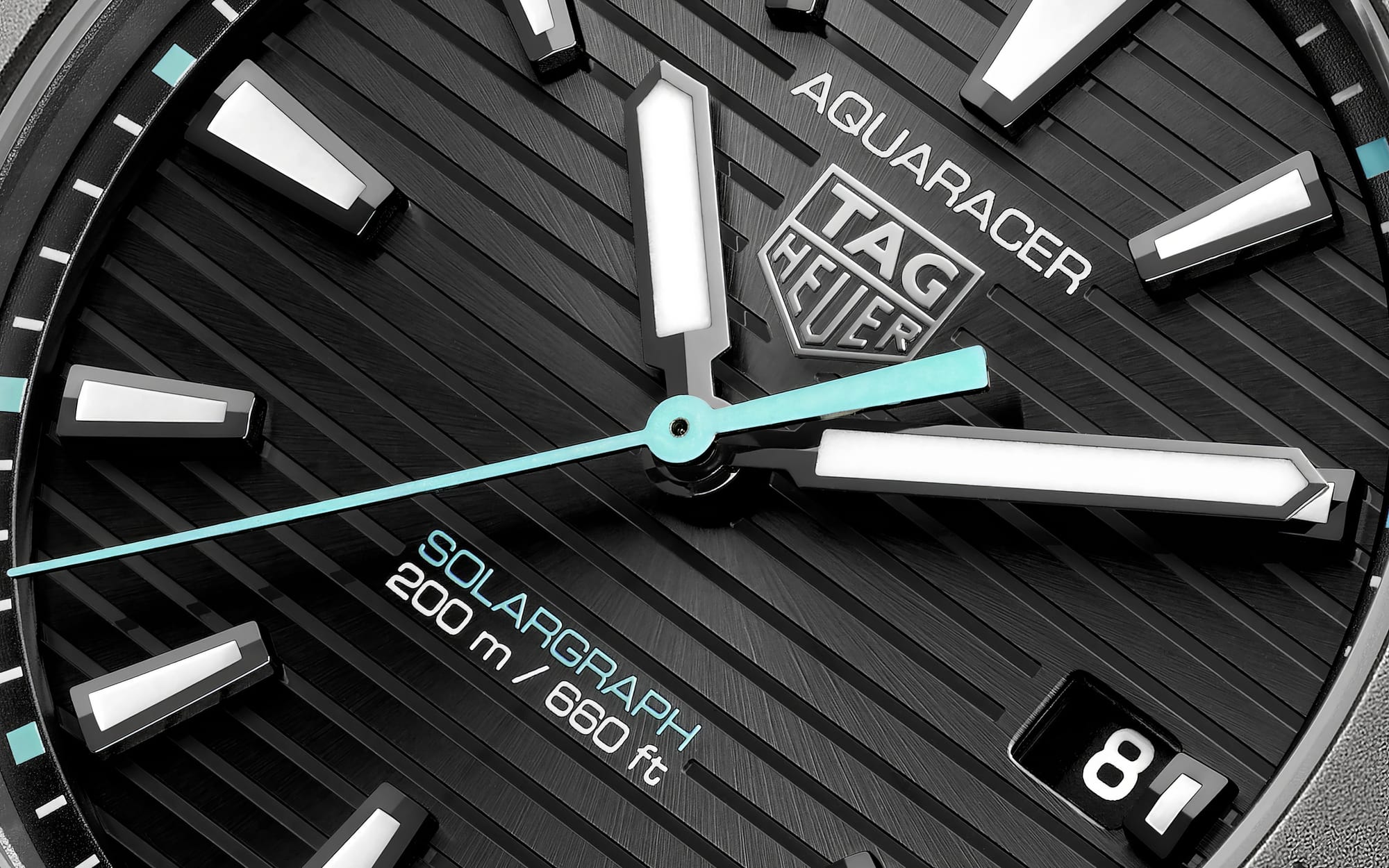
The dial is an anthracite sunray-brushed surface crossed by fine horizontal lines, with small polar-blue accents around the perimeter. It looks, at a glance, like an ordinary dark tool-watch dial. The dial is semi-translucent, with the solar cells positioned discreetly beneath it, so the face that looks like decoration is also the window the movement charges through.
This is the design problem any solar watch has to solve. The cell needs light, and the cell sits under the dial. Many solar watches make that obvious with a visibly translucent or photovoltaic-looking face. TAG did not want that. The brand wanted the watch to look like an Aquaracer, and the semi-translucent sunray dial is how it gets there.
The indices are applied and luminous. The hour and seconds hands are pale with luminous fill. The minute hand is the one piece of visual showmanship, a long polar-blue arrow that runs nearly the full width of the dial. TAG ties the "polar blue" name to the northern lights and to the glacier theming of this titanium reference. Whatever you make of the marketing, the color reads closer to cyan than to blue, and it functions less like an accent than like the watch's signature. Everything else on the dial is restrained.
That same cyan is picked up in the stitching on the strap, echoing the minute hand. It is a small thing, but it is the kind of detail that tells you the watch and its strap were designed together rather than assembled from separate parts.
The bezel is a high point. It turns tightly, with a great click, and there is no slop in the action.
The lume is the one place I would push back. Freshly charged, it is very bright, brighter than I expected from a watch I was not buying for its lume. The problem is that it fades fast: within an hour or two of darkness the glow is largely gone. For a watch that carries "Professional" and a 200m rating in its name, that is the one spec that does not quite live up to the billing.
Movement
The Calibre TH50-00 is a solar quartz movement showing hours, minutes, central seconds, and a date at three o'clock. By TAG's figures, roughly one minute of light is enough to run it for a day, a full charge takes about forty hours of light exposure, and from full it will run up to ten months in total darkness. The rechargeable cell is rated for around fifteen years.
In practice this means the watch asks nothing of you. There is no winding, no daily setting, no rotor, no mainspring to keep tensioned. You wear it, ambient light keeps it charged, and it runs. That is the entire proposition of solar quartz, and it is a genuinely appealing one: the convenience of quartz with none of the battery-swap ritual.
On accuracy, TAG does not publish a specific figure for the TH50-00, but solar quartz movements of this type generally run within about fifteen seconds a month, far tighter than any mechanical watch. I cannot speak to the long-run figure on my own example after only a couple of days, but the premise is not in doubt: it will keep excellent time and do it without any help from me.
The interesting tension is that all of this sits inside a watch that costs $3,400. Whether that is a clever piece of engineering or a strange thing to pay Swiss-luxury money for depends entirely on where you stand on quartz. I went in wanting exactly this: something accurate and reliable that looks like a mechanical diver and asks nothing of me.
On the wrist
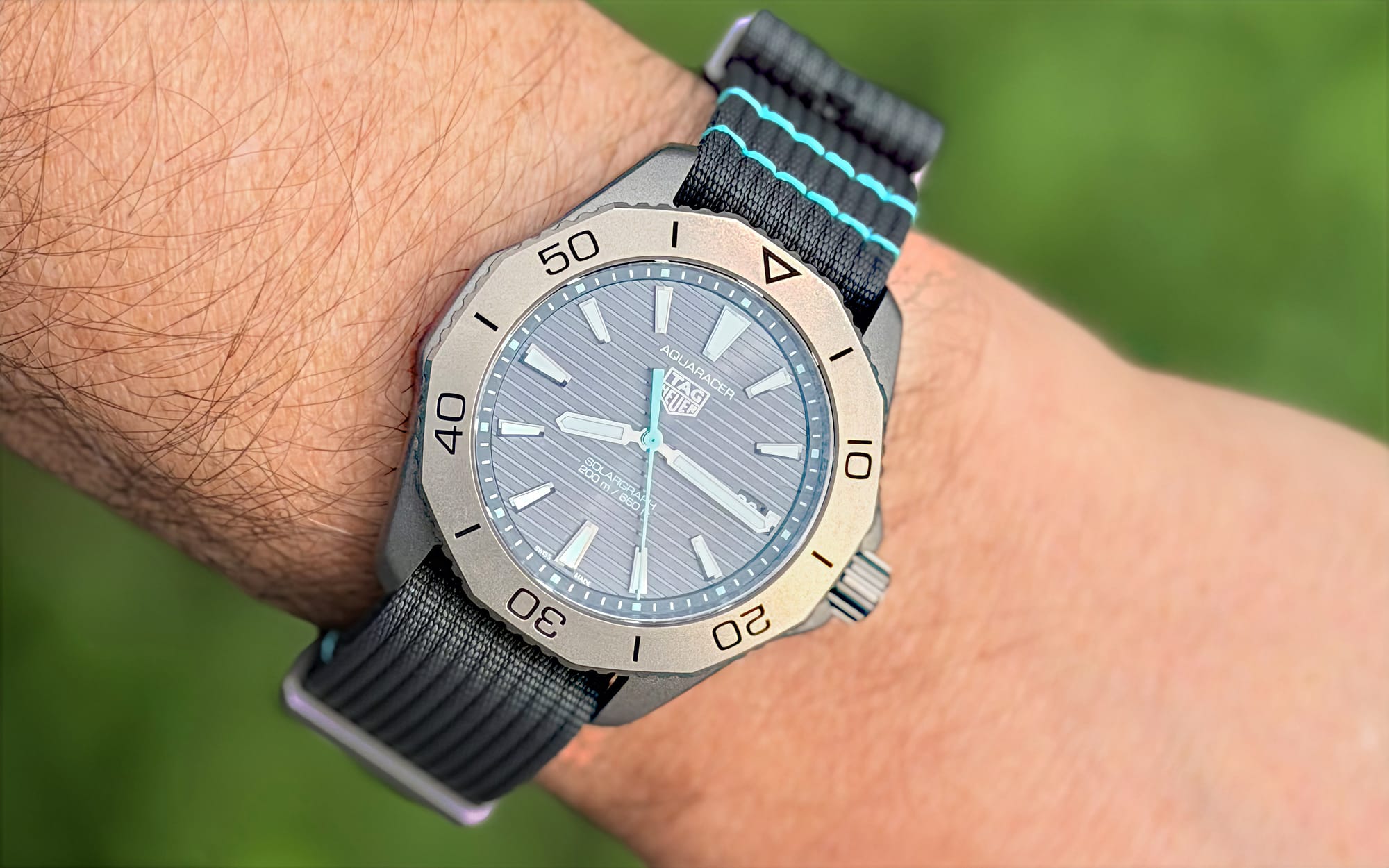
This is the first solar quartz watch I have owned, and the appeal is straightforward: it looks like a mechanical diver, runs on light, weighs almost nothing, and requires no attention. The strap is what made the purchase work for me. I could have bought the bracelet version, but a metal bracelet adds weight to a watch whose whole appeal is how little it weighs. The grey textile strap keeps it as light on the wrist as it is in the hand. There was also a practical reason: this strap is tied to this specific reference and, as far as I can tell, cannot be ordered on its own. So I bought the version it comes on.
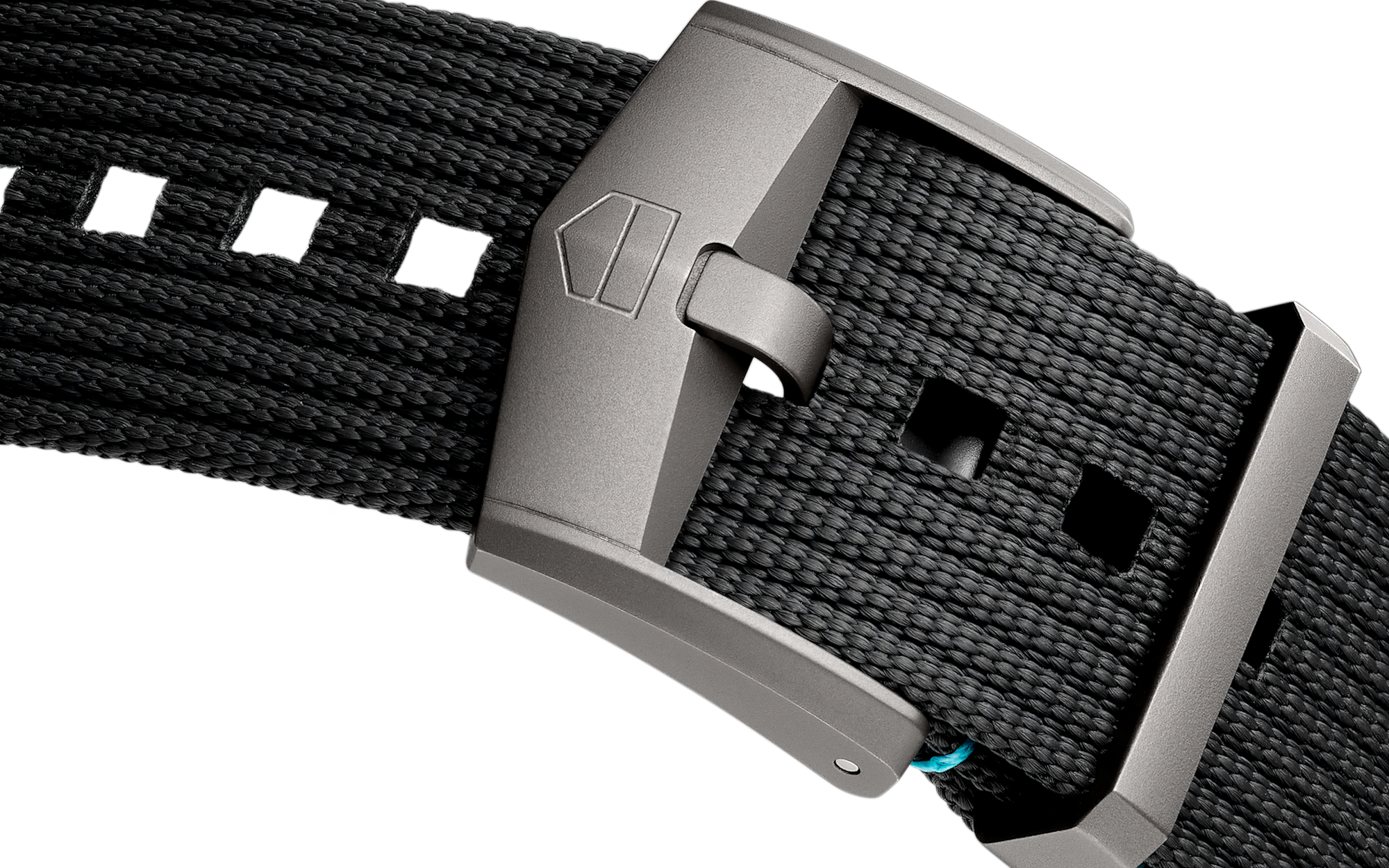
The strap is excellent. It is a densely woven grey textile with cyan stitching that matches the minute hand, branded titanium hardware finished to match the case, and a buckle that does not catch on a cuff. OEM straps with properly branded hardware are hard to beat, and this is a good example of why: the parts are made for this watch, not adapted to it, and it shows.
The size was the one thing I went back and forth on before buying. At 40mm it sits at the top of what I find ideal for everyday wear, and I did wonder whether something a little smaller would suit me better. In practice the light titanium and the tapering lugs take the edge off that concern, and it wears easier than 40mm usually does. But the hesitation was real, and if you prefer compact watches it is worth knowing the 2026 generation now branches into smaller sizes if you want one.
Comparison: the Hestur Military Tactical Titanium
The closest thing I own to this watch is the Hestur Military Tactical Titanium. On paper they share a lot. Both are solar quartz. Both are titanium. Both ask nothing of the wearer beyond occasional light.
The execution could hardly be more different. The Hestur is unambiguously a tool: a 44.5mm titanium case, a compass bezel, chronograph and alarm functions, sapphire crystal, 150m of water resistance, and broad luminous hands that read "field watch" from across a room. It looks like a piece of equipment, and it is honest about being one.
The Aquaracer is the same basic idea, dressed completely differently. It hides its solar cells behind a semi-translucent sunray dial, uses applied indices and polar-blue accents, and is built to pass for a mechanical diver. At a glance it does. The two watches make opposite choices about whether the technology should announce itself or disappear.
Because I have only had the Aquaracer for a couple of days, I would point anyone wanting a longer-term view toward two reviews of the same watch from people who lived with it: Hodinkee on the surprising lightness of the titanium version and Worn & Wound's hands-on of the steel.
Final thoughts
I bought this watch the same day TAG announced its replacement. I looked at the new generation, with its returning rider tabs and busier, more sculpted bezel, and decided I preferred the cleaner outgoing design. At least one reviewer has already called the new bezel treatment polarizing, and to my eye it is doing more than the old one did. The new model is a good watch, and the quick-change bracelet sounds like a real improvement. It is simply not the one I wanted.
What I wanted was the quieter version: a light titanium diver that looks mechanical, runs on light, and gets out of the way. After a couple of days that is exactly what it has been. The size gave me pause, and the lume fades faster than I would like, but the core of the watch (the weightlessness, the bezel, the fact that it looks like something it isn't) is doing precisely what I hoped.
If you are shopping the Aquaracer Solargraph today, the new generation is what is on the shelf, and it is a good watch. If you can still find this previous version from an authorized dealer, on the textile strap or the bracelet, I think it is the more interesting object. Either way, the bet is the same: that a solar quartz dressed as a mechanical diver is worth a Swiss premium over a Citizen or a Seiko. For me, so far, it is.


