

When you buy something (clothing, a car, jewelry) you probably like it partly because of the way it makes you feel. It's a faintly ridiculous need we have for identity. We send out signals socially, we broadcast to the people around us, whether or not we admit it. Whether I drive a Porsche or a Toyota, the brand says a little something about me. Watches are no different, and brands like Panerai know it. So why pick a Panerai? Well, first, it's rare you'll find someone else with one. Rolexes are everywhere. You'll see a few every week. Panerai, not so much. The Mare Nostrum, even less so.
So why would anyone buy a watch like this if watches really do project something about us? Well, being obscure, rare, bold, and somewhat utilitarian could be the brand you're going for, whether you know it or not. And among the few people who care, this one is pre-Vendome, before Panerai was, you know, corrupted by the world of large corporate interests. I'm mostly joking. But these are considered to be from the golden age of Panerai, before 1998.
I love this watch and also have the PAM00716. I'd love to have the PAM00007, the one with a white dial, but I had to draw the line somewhere, right? Sounds like I'm the dude broadcasting that I'm like a Mare Nostrum: a utilitarian throwback, maybe lost in time.
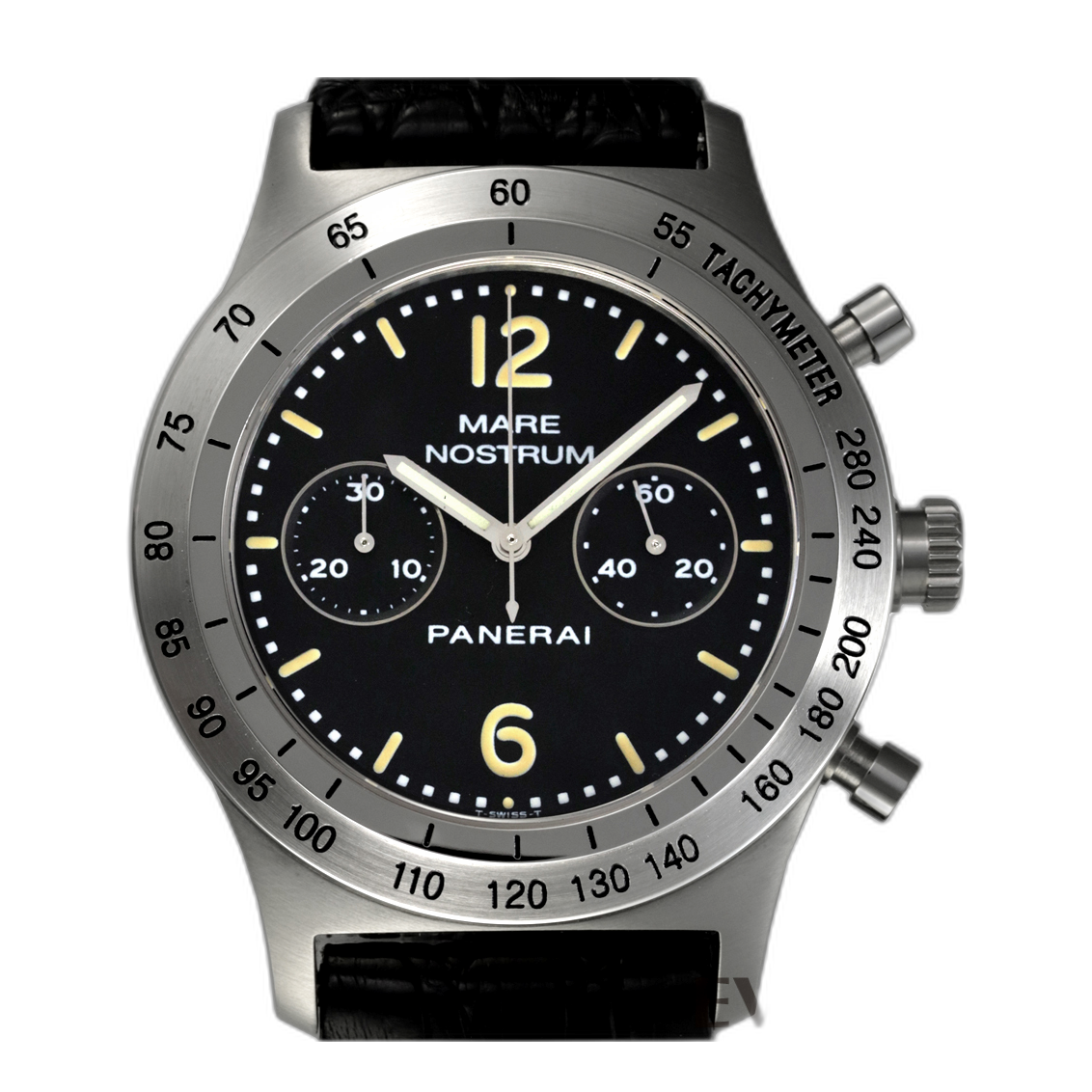
Brand and history
Panerai was founded in Florence in 1860 as a watchmaking school and shop. The company became a supplier to the Italian Navy, producing luminous instruments, depth gauges, compasses, and timing devices for military operations. That naval relationship lasted most of the 20th century.
The Mare Nostrum's origin story is murky. According to Panerai, they developed this chronograph in 1943 for Italian Navy deck officers. The name translates from Latin as "Our Sea", the Roman term for the Mediterranean that Mussolini's regime had revived. Only prototypes, supposedly, were made before the war halted production.
But independent research, mostly led by Jose Pereztroika at Perezcope.com, raises serious doubts about that 1943 date. When you compare the Mare Nostrum's case to other Panerai instruments across decades, early compasses from 1940 and 1944 look nothing like it. Place the Mare Nostrum next to depth gauges from 1955 onward and the match is immediate. Identical lug shapes. Identical inter-lug geometry. A Panerai compass marked "GPF 4/55" uses the same design language all the way down. The case is doing 1950s things in a way that an actual 1943 case wouldn't.
Almost all Panerai records were destroyed when Florence flooded in November 1966. A single photographic plate survived, showing the watch in three-quarter view. That plate became the only reference for every reproduction that followed.
Then in 2005, a Mare Nostrum prototype surfaced at Christie's Geneva. Angelo Bonati, then CEO of Panerai (under Richemont), purchased it for CHF 132,000. It now sits in the Panerai Museum. And the strange part of the story turns up at the back of the watch. The prototype's caseback is nearly identical to the caseback on the 1993 replica. The designers of that 1993 version were working only from the front-and-side photographic plate. They had no image of the original's rear at all. Mario Paci, Panerai's quality assurance manager until 1997, confirmed to Pereztroika that the 1993 caseback was improvised. Improvising a convex shape and a slotted tightening method that happen to match the unseen original feels like long odds.
The modern Mare Nostrum story begins with Dino Zei, a naval engineer who took charge of Panerai after the last family member, Giuseppe Panerai, fell ill in the 1970s. The Italian Navy wanted to keep its instrument supplier alive, but military contracts eventually dried up. Zei sensed an opportunity in the early 1990s when vintage Rolex collecting surged. Many Panerai military watches had been built by Rolex with Rolex movements, which put Panerai on collectors' radar.
On September 10, 1993, Zei launched Panerai's first civilian watches: the Luminor (ref. 5218-201/A) and the Mare Nostrum (ref. 5218-301/A). The 52mm prototype got shrunk to 42mm and a tachymeter bezel got added. Approximately 990 cases were made for the 5218-301/A. Of those, about 492 became true pre-Vendome pieces with blue dials. The rest were transferred to the Vendome Luxury Group when it acquired Panerai in March 1997.
Vendome reworked 398 of those leftover cases with new dials, bezels, casebacks, and straps. The minute track moved to the outside of the hour markers and the bezel got a polished inner ring. Three references came out of that rework, distinguished only by dial color: the PAM00006 (blue, 120 pieces), PAM00007 (white, 90 pieces), and PAM00008 (black, 172 pieces). When the parts ran out, production stopped.
Step back from all that and the PAM00008 turns into a slightly strange object. The cases were manufactured for the pre-Vendome blue-dial version, then reworked under new corporate ownership, based on a prototype whose actual age is disputed by the people who study these things for a living. Confused lineage isn't quite the phrase, but it's close.
Case and dimensions
The case is stainless steel, 42mm in diameter and 12mm thick, with a 22mm lug width. The diameter feels right. It's modest by Panerai standards: 44mm is the baseline for most Luminors and Radiomirs. The watch looks heavier than it actually wears. On the wrist you don't really notice the weight or the thickness.
The tachymeter bezel is angled, which is one of the visible differences from the PAM00716. That watch has a flat bezel made with more steel. The angled bezel on the PAM00008 gives the case a slightly slimmer profile even though both watches share the 42mm diameter.
The caseback is closed and screwdown with slotted tightening. The crystal is sapphire at 1.6mm. Water resistance is 50 meters, fine for handwashing and rain, not for any actual water activity.
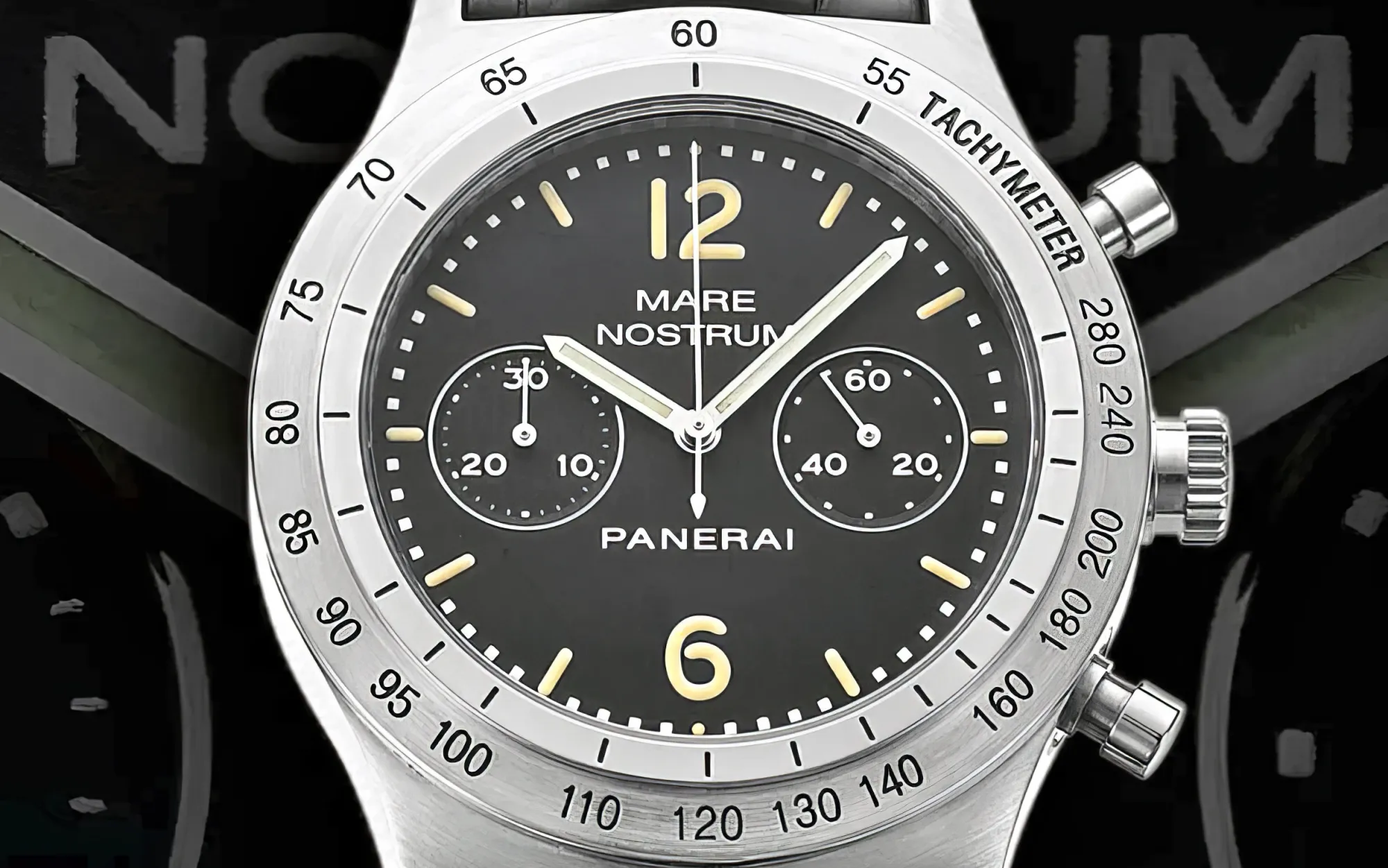
The dial
I appreciate the spartan, monochromatic design. The dial gives you what you need to read time and use the chronograph, and stops there. The black dial, black subdials, and white printing create a layout that's simple without being self-consciously minimal. Nobody is going to confuse this with a Max Bill or a Junghans Bauhaus. It's military tool watch simplicity, which doesn't need to apologize for being plain.
That said, the PAM00008 has a bit more going on than the more stripped-down PAM00716. The tachymeter scale on the bezel adds visual information. The dial uses a mix of Arabic numerals and markers with stick hands. Small seconds at 9 o'clock, the 30-minute chronograph counter at 3 o'clock.
The lume is tritium, marked T-SWISS-T on the dial. That dates the Vendome-era pieces. Later Panerai models switched to Super-LumiNova. The tritium will continue to develop patina over time. Some collectors find that ugly. I'm not one of them, and on a watch this old I think the patina's part of the point.
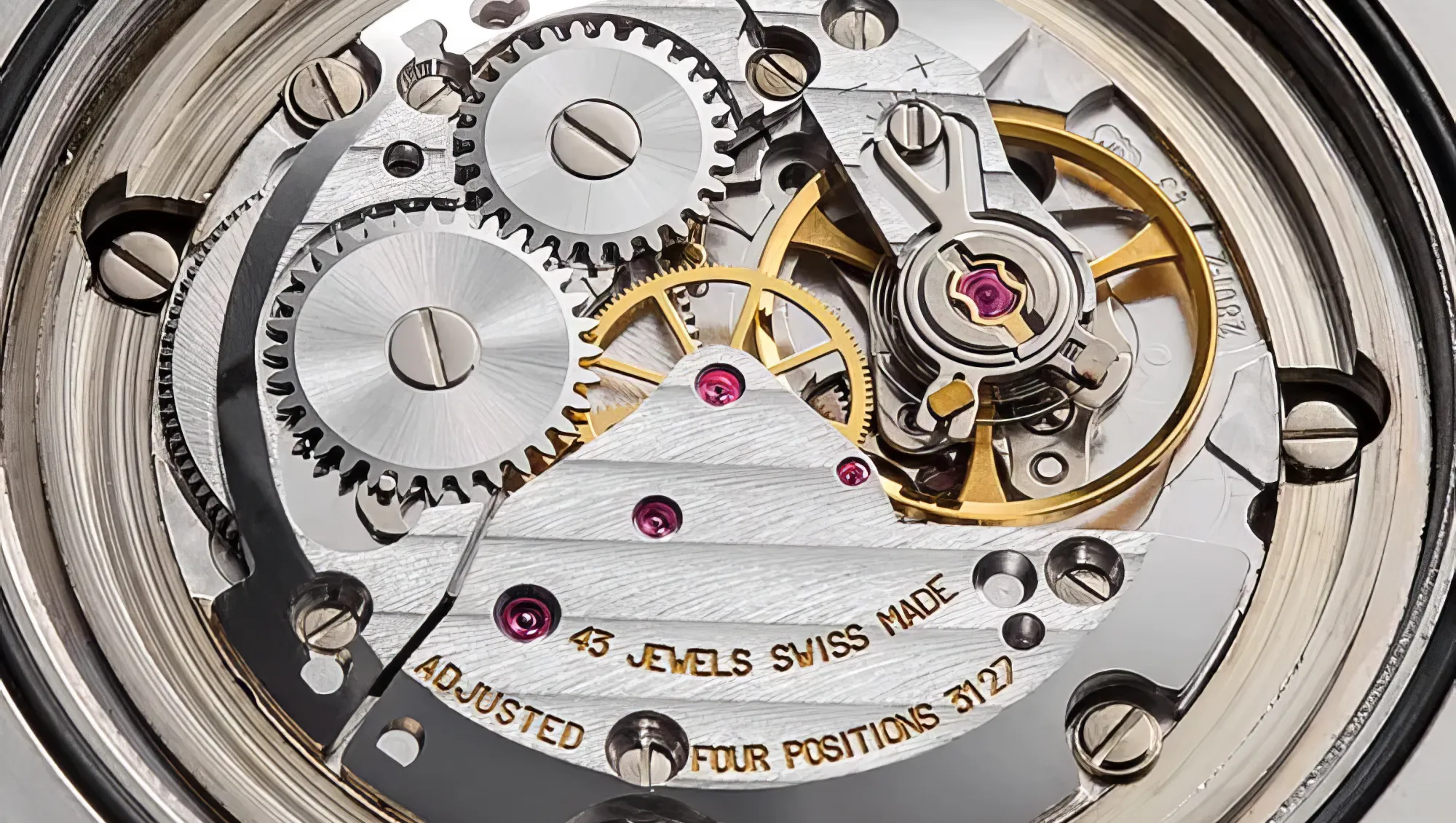
The movement
The PAM00008 runs the OP XXXIII, which is Panerai's designation for a modular chronograph setup. The base is an ETA 2801-2 hand-wound caliber with a Dubois-Depraz 3127 chronograph module bolted on top. Manual wind only.
A common misconception identifies this movement as a Valjoux 7733. It isn't. That movement, a cam-switching manual-wind chronograph produced from 1969 to 1978, was never used by Panerai. Another mix-up involves the OP XXV, which is a completely different caliber. The OP XXV is a hand-finished Minerva 13-22 column-wheel movement with 22 jewels and a swan's neck regulator. It was reserved for the 52mm Mare Nostrum re-editions: the PAM00300 (2010, 99 pieces) and the PAM00603 (2015, 300 pieces in titanium).
The ETA/Dubois-Depraz combination isn't doing anything fancy and isn't trying to. What surprised me is how fresh the movement still feels despite this watch dating to 1997. The chronograph pushers click with conviction, and winding is smooth and easy. It's hard to believe the watch is nearly thirty years old based on how the movement operates. The closed caseback means you'll never see it, which is fine, and probably part of the brief, since not every chronograph movement is engineered to be looked at.
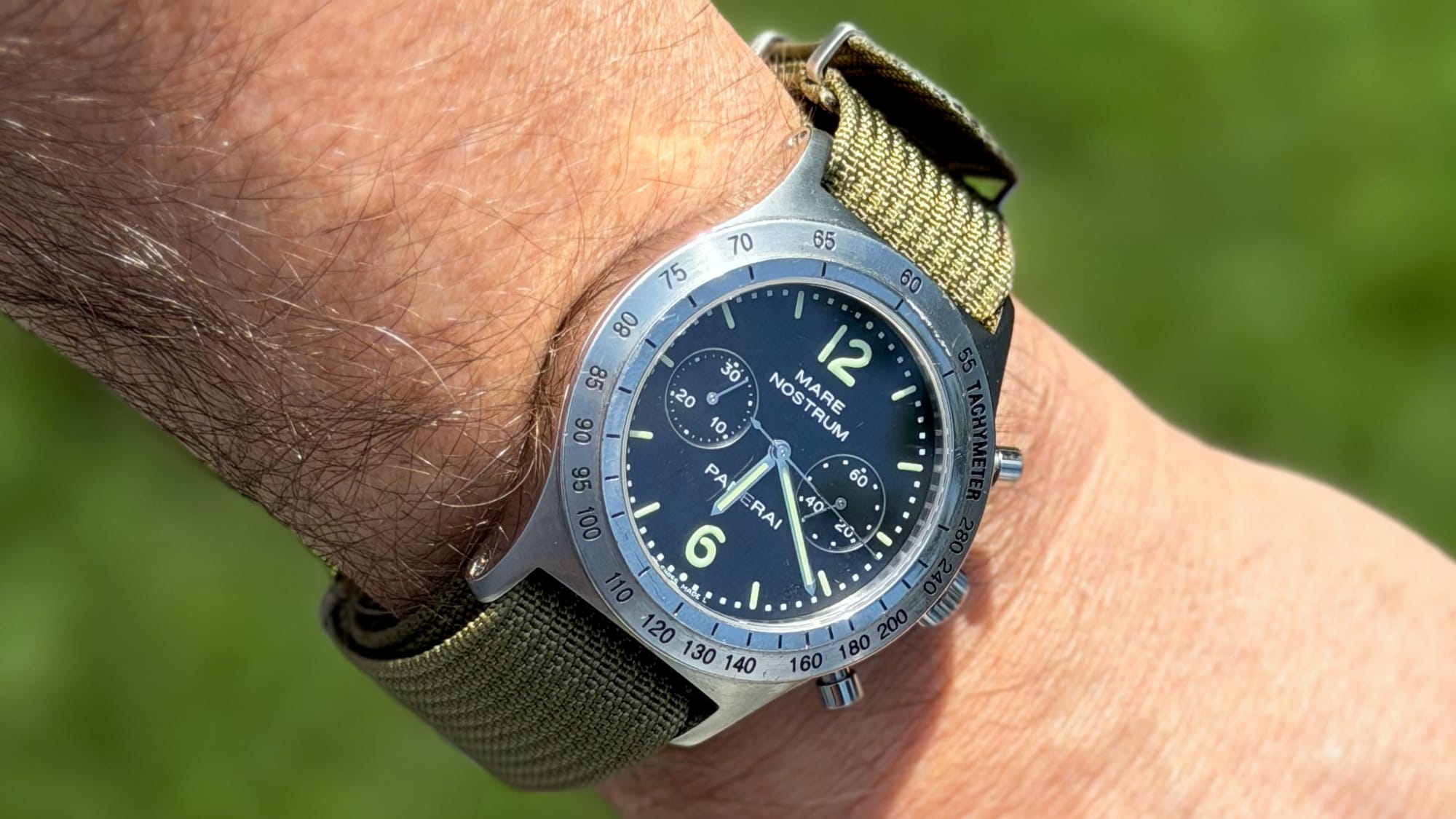
On the wrist
The 42mm case does feel a bit undersized for a Panerai. On my 7.5-inch wrist it wears comfortably, but without the wrist presence Luminor and Radiomir owners are used to. That's part of what I like about it. When every Panerai you encounter is a Luminor or a Radiomir, the Mare Nostrum is the one even other Panerai people sometimes haven't seen.
The black NATO strap suits the watch. The monochrome match works, and a NATO is the right kind of strap for something with this much military flavor in its lineage. The original strap was black alligator leather, which I'm sure looked fine, but the NATO feels closer to the watch's actual roots.
Final thoughts
The PAM00008 is a watch I love owning. It has a strange and contested history, and only 172 were made. On the secondary market it trades between $12,500 and $16,000, roughly ten times its original retail price of about EUR 1,500. WatchCharts data shows the PAM008 gained 1.1% over the past five years while the broader Panerai market dropped 22.2% over the same period. Most of that price gap is just scarcity, and it's holding.
So would I recommend it? Honestly, unless you're a dedicated Panerai collector, probably not. The PAM00716 from 2017 covers the same Mare Nostrum design in a newer, cheaper, and more easily serviced package. It has 1,000 pieces in production and retailed for EUR 9,900. If what you want is the Mare Nostrum experience, the 716 is what I'd point you at first.
The PAM00008 is for someone who cares about the specific history and wants a pre-Vendome-era case with a tritium dial. Someone who'd rather own one of 172 than one of 1,000. I'm that geek.
References
- Perezcope. The Mare Nostrum Prototype. Jose Pereztroika,
- Telling Time. The Mysterious Panerai Mare Nostrum.
- Revolution Watch. From 1993 to 2017: The Panerai Mare Nostrum 42mm.
- Revolution Watch. A Mare Nostrum Story From Before The Days Of The Vendome Group.
- WatchProSite. Mare Nostrum Revisited.
- Watchfinder. Review: Panerai Mare Nostrum PAM00008. Jon Richford.
- WatchBase. Panerai PAM00008 Mare Nostrum.
- Monochrome Watches. Panerai Mare Nostrum 42mm PAM00716 (Specs & Price).
- Chrono24. PAM00008 Listings.
- Shuck the Oyster. PAM00008 Listing, Serial BB 970704.
- WatchCharts. Panerai Mare Nostrum PAM008 Market Data.


