

This is my second Panerai from the Luna Rossa partnership. The first was the Submersible QuarantaQuattro Luna Rossa (Ref. PAM01681), a time-only diver that I reviewed previously. Both are striking, but they're built for different jobs. The PAM01681 is a Submersible made for depth; the PAM01654 is a flyback chronograph made for timing competitive sailing. Limited to 150 pieces worldwide, it arrived in 2025 as the flagship of Panerai's third consecutive America's Cup campaign with Luna Rossa Prada Pirelli. I was on the waitlist for about nine months before I got the call.
Brand context
Panerai's involvement with competitive sailing began in 2017, when it entered America's Cup racing as an Official Partner, backing Oracle Team USA and SoftBank Team Japan at the 35th Cup in Bermuda. The relationship found its footing in 2019, when Panerai became the Official Sponsor of Luna Rossa Prada Pirelli for the 36th America's Cup in Auckland.
The pairing made sense. Luna Rossa, Italian for "Red Moon," was founded in February 1997, when Prada CEO Patrizio Bertelli and the Argentine yacht designer German Frers decided to challenge for sailing's oldest trophy. The team has built a strong record since: winner of the Louis Vuitton Cup in 2000, winner of the Prada Cup in 2021, and three race wins against Emirates Team New Zealand in that year's America's Cup match, the best result any Italian syndicate has managed. Panerai CEO Jean-Marc Pontroué has said there was no Plan B and no survey of potential partners. There was one race, the America's Cup, and one team, Luna Rossa.
Luna Rossa's most recent campaign ended in Barcelona, where the team lost to INEOS Britannia 7-4 in the Louis Vuitton Cup final, the challenger series, in October 2024. Panerai re-signed anyway, and the PAM01654 launched in 2025 ahead of the 38th America's Cup, scheduled for Naples in 2027. It is the most technically advanced Luna Rossa timepiece Panerai has built: an in-house flyback chronograph in a titanium case, with a nautical tachymeter calibrated to measure speed in knots rather than miles per hour. This is not collaboration merchandise. It's a working instrument made for timing sailing events.
I came to Panerai late and didn't really discover the brand until after the paneristi.com meltdown. An online community cuts both ways. Think Star Wars or Star Trek: the most zealous fans can turn on the thing they love when a crisis hits. The new paneristi.com has been slow to get going, but there's still enough interest to keep the community growing. I'm a sucker for a good origin story, and Panerai's is hard to beat, so even if I someday don't own one, I'll still appreciate the history. With six Panerai now, I've handled the brand enough to have something credible to say.
Case and wearability
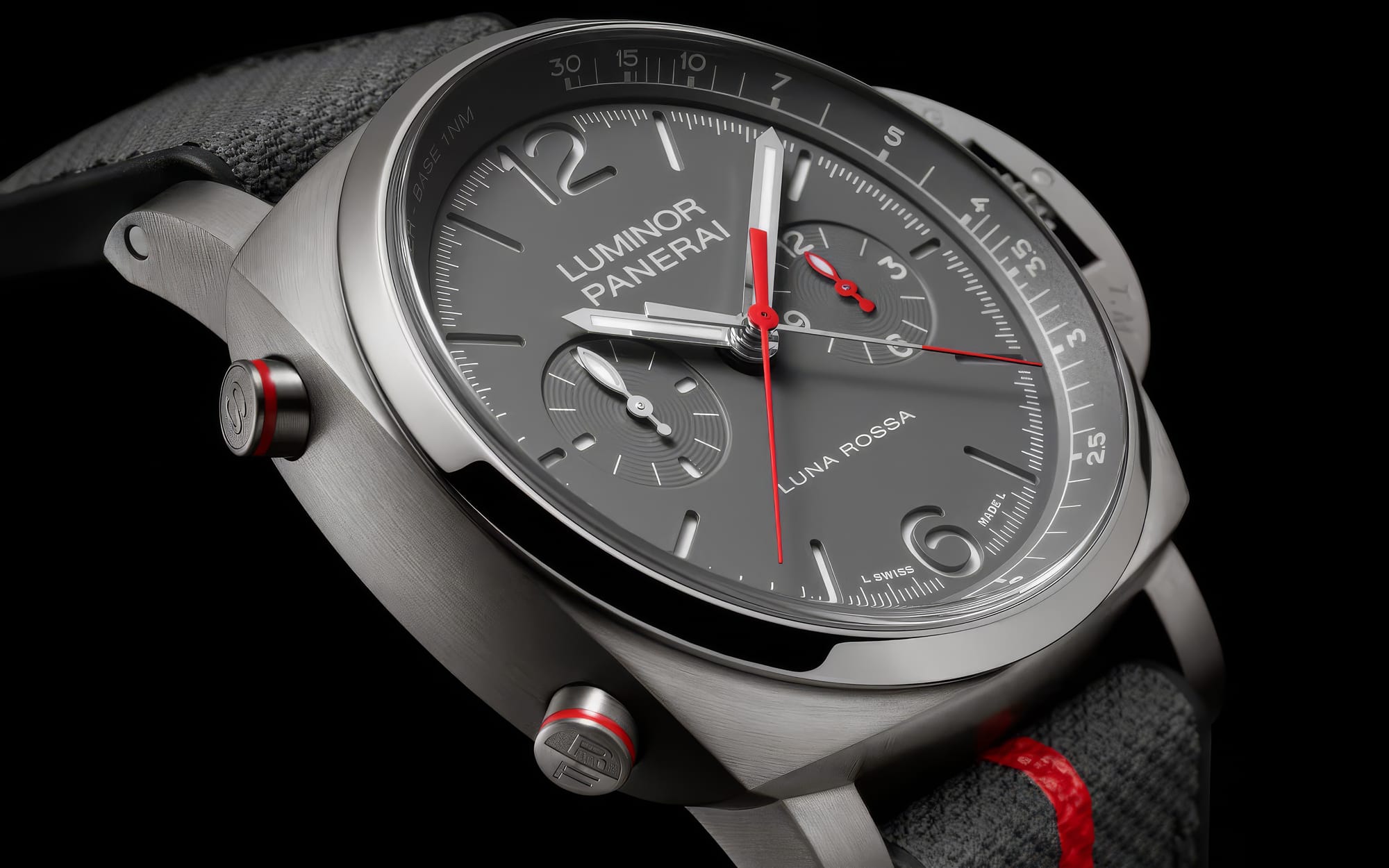
The 44mm case is made entirely from Grade 5 titanium, the same aerospace alloy used in aircraft parts and high-end sporting gear. Titanium weighs about 44% less than stainless steel and resists corrosion well. For a chronograph meant to be worn on deck during a regatta, that weight saving matters. The brushed finish cuts glare on the water instead of throwing it back at you.
The crown-protecting bridge is still the Luminor's defining feature. Panerai patented it in 1955 to fix a specific problem: winding crowns that lost water resistance after repeated use. The lever clamps down over the crown and compresses a gasket to seal it. Seventy years on, it does the same job and still gives the Luminor its lopsided, instantly recognizable profile.
The chronograph pushers sit at 8 and 10 o'clock, opposite their usual spots to make room for the crown guard. Both wear red accent rings, the first of many nods to Luna Rossa's racing livery. Water resistance is 100 meters (10 bar), fine for deck work but not for serious diving. The case is thick, as Luminor chronographs tend to be, but the 44mm diameter and short lugs keep it from wearing unwieldy.
The polished titanium bezel adds a subtle contrast to the brushed case. Through the sapphire caseback, each piece shows its own number in the 150-piece run, engraved around the perimeter.
Movement and performance
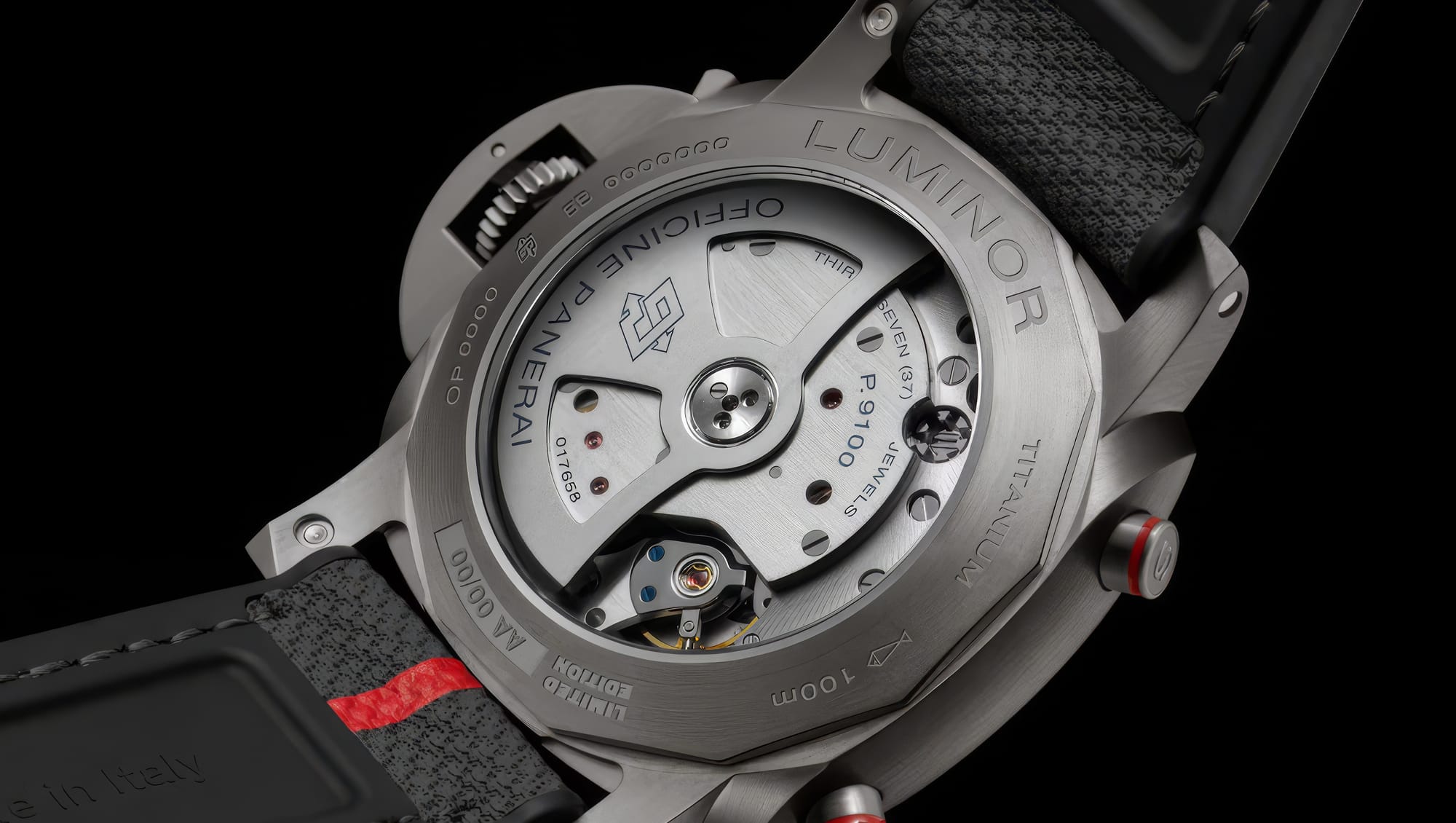
The PAM01654 runs Panerai's in-house calibre P.9100, the first automatic chronograph movement Officine Panerai developed and built entirely at its Neuchâtel manufacture. It uses 302 components and 37 jewels, measures 8.15mm thick at 13¾ lignes, and runs at 28,800 vibrations per hour. A Glucydur balance and Incabloc anti-shock keep it stable under the knocks of active sailing. Two series-linked barrels give a 72-hour power reserve, using thinner mainsprings that release energy more evenly across the three days.
Panerai has spent years getting dogged over its use of third-party movements and a perceived thin in-house bench. An in-house movement is cool, but it also drives up the price. Panerai seems half-forced into the investment because "in-house" has become a real factor in what people buy. Even so, this one strikes a good balance of cost, design, and engineering.
The flyback is genuinely useful for timing back-to-back events. A normal chronograph takes three steps to restart: stop, reset to zero, start again. Flyback does it in one press of the pusher at 8 o'clock. The hands snap back to zero and immediately start timing the next run. It was built for aviation, where pilots timed successive legs of a flight without losing seconds to the reset, and it works just as well on the water. Timing each leg of a race becomes one button press instead of three.
It's an unusual flyback that looks at first like a rattrapante. Two central hands hint at a split-seconds setup, but the second one is actually the chronograph minute counter, jumping forward once a minute to count elapsed minutes up to thirty. It's a clever touch. The hour counter at 3 o'clock handles longer sessions, and small seconds sit at 9 o'clock.
The P.9100 uses a vertical clutch and a column wheel to run the chronograph. The vertical clutch removes the little shudder you sometimes see in a chronograph seconds hand at start-up, which comes from a horizontal clutch engaging. The column wheel makes the pusher action smoother than a cam-actuated setup. These choices change how the chronograph feels to use, not just how the spec sheet reads.
For all the work that went into this in-house movement and the display caseback, there's surprisingly little to look at through the sapphire. It's mostly a big brushed slab. Panerai can do far better. Look at the Luminor Perpetual Calendar GMT: the movement is gorgeous, but the watch also runs well over $70,000, and that's the pattern. You only get that level of finishing and sophistication from Panerai at the very top of the range. Brands like Jaeger-LeCoultre, or even Bulgari, give you stunning movements for a lot less.
Dial and aesthetics
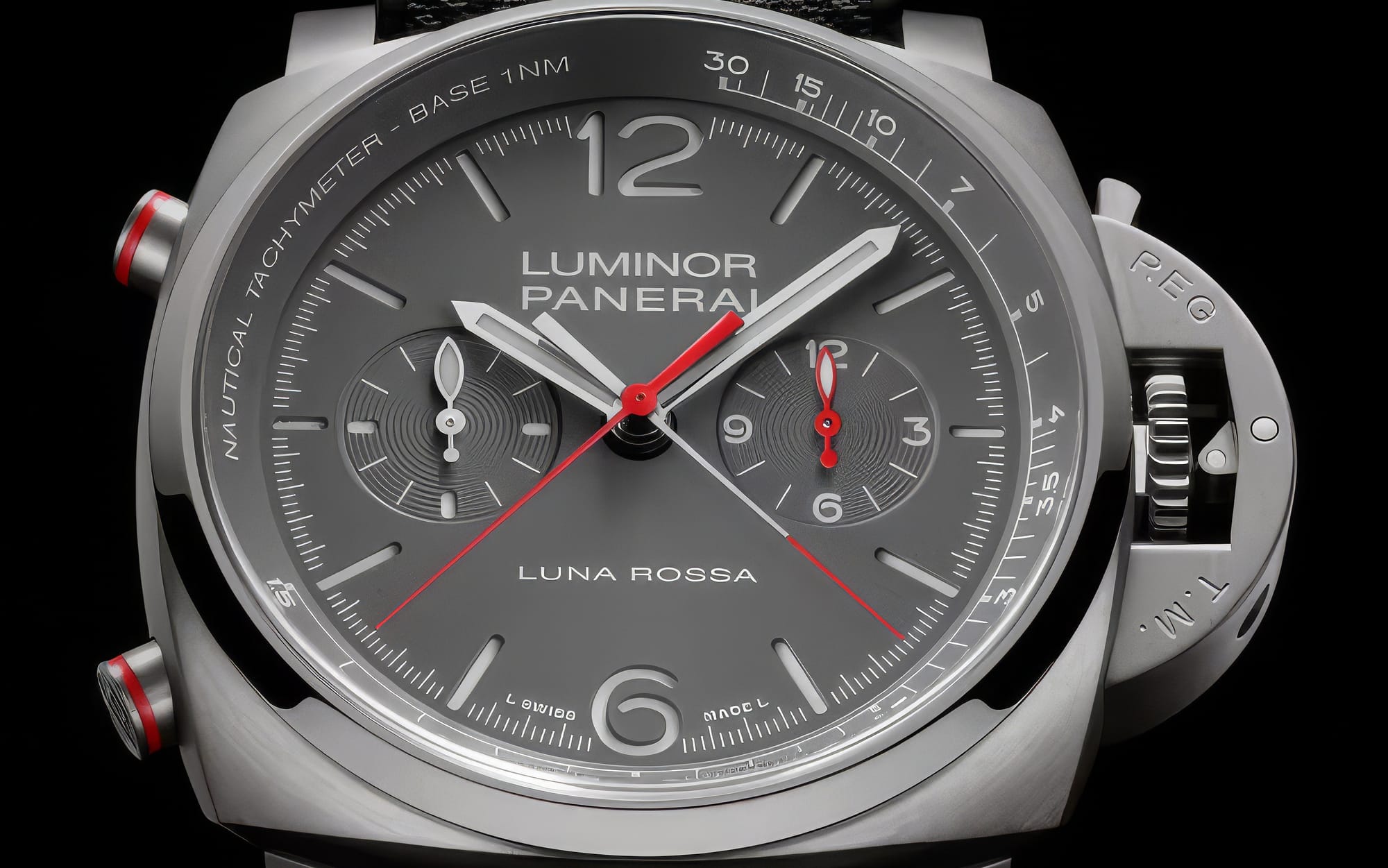
The matte grey sandwich dial follows Panerai's signature build: a lower disc coated with luminous material, under a perforated top layer that lets the glow show through the numerals and markers. Panerai developed this for its early military contracts with the Royal Italian Navy, and it still delivers excellent legibility in low light. Super-LumiNova X1 fills the hour markers, the Arabic numerals at 12, 3, 6, and 9, and the hour and minute hands, glowing green in the dark.
Both of my cars are gray, and both of these Luna Rossa watches have gray dials and straps. I clearly have a thing for gray. What pulls your eye here is the contrast: deep red chronograph hands, the red Luna Rossa stripe down the strap, and the red rings on the pushers. It's visually interesting and well balanced.
The central chronograph hands are red lacquer, as are the small-seconds hand at 9 o'clock and the hour-counter hand at 3 o'clock. "Luna Rossa" sits in red below center, the only explicit partnership branding on the dial. The sub-dials at 3 and 9 have a snailed finish that adds depth without hurting legibility.
An inclined inner flange carries a nautical tachymeter scale calibrated in knots. Most tachymeters assume you're clocking a car and read in km/h; Panerai set this one up for the water instead. It won't matter to most buyers, but for anyone actually timing a race, it's a real, considered touch.
Strap and clasp
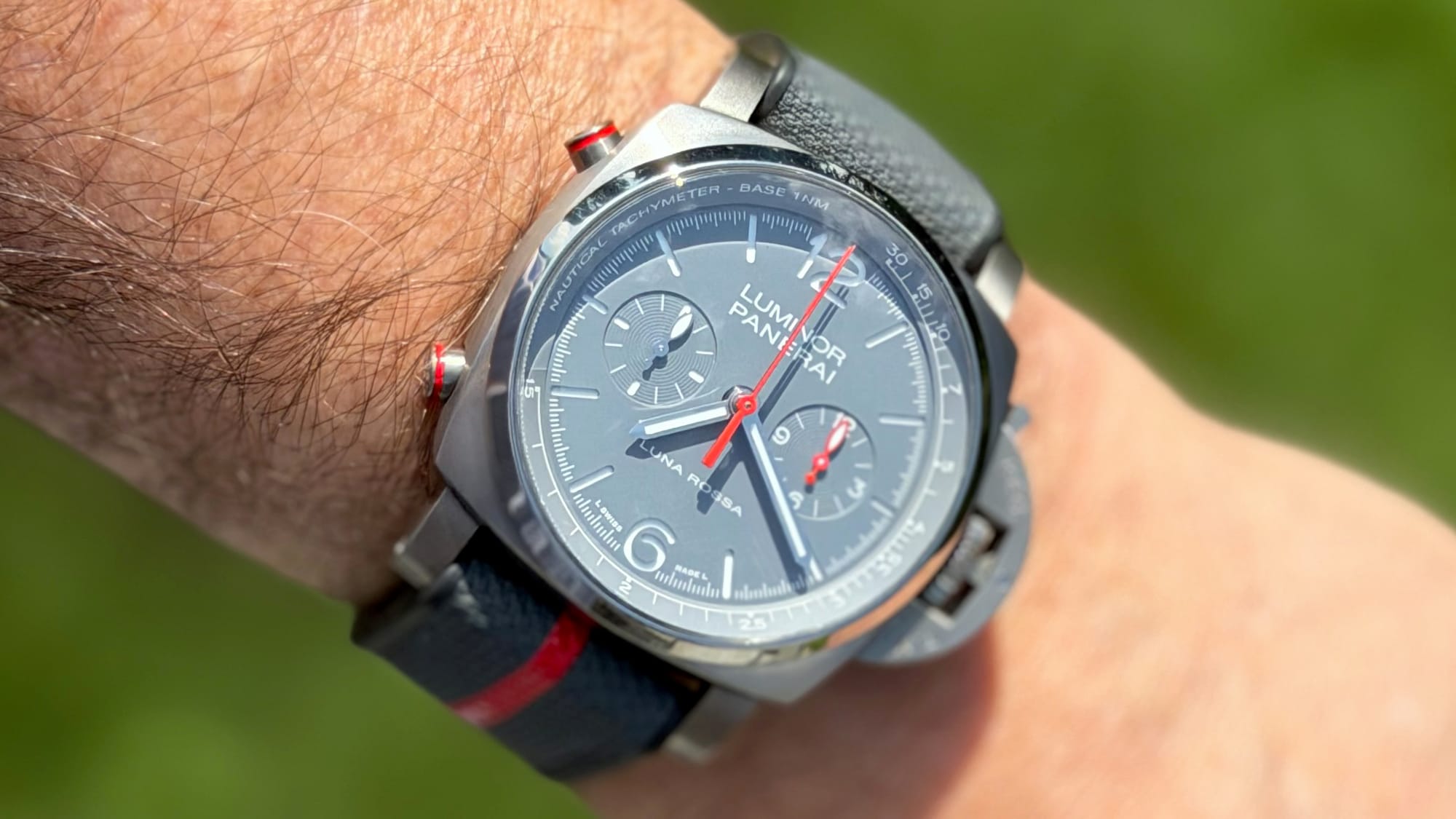
Panerai pairs the PAM01654 with a two-material strap: a black rubber base under a grey technical textile, with a red stripe running its length. It tapers from 24mm at the lugs to 22mm at the Grade 2 titanium trapezoidal buckle. The rubber holds up to water and hard use; the textile adds grip and interest. A second, plain black rubber strap comes in the box for days when the Luna Rossa livery feels like too much.
I'm not in love with these Luna Rossa rubber straps, because they're a pain to get on and off. I've never loved any Panerai strap, mostly because they so rarely use a deployant clasp. If TAG Heuer and Omega can build an excellent deployant, so can Panerai. To be fair, I've never tried a Luminor Marina (Ref. PAM03323) on the bracelet. Maybe someday.
Final thoughts
The Luminor Chrono Flyback Luna Rossa Titanio is the most advanced watch in Panerai's America's Cup partnership. At $16,400, it's a bit more than I'd like to pay, but the money buys real mechanical complexity in purpose-built materials. The 150-piece run keeps it scarce without the manufactured rarity that spoils some limited editions.
What sets it apart from co-branded merchandise is that everything works toward one job. The titanium case, the flyback, the knots tachymeter, the glowing sandwich dial all serve the timing of a sailing race. The Luna Rossa styling rides along on top of that function instead of replacing it.
You'll probably never use it to time an America's Cup leg, and that's fine. It still connects to Panerai's real maritime history, from the Florence workshop that supplied the Royal Italian Navy to today's partnership with one of sailing's most stubborn challengers. But at this price, there are better watches to buy. I'd save this one for the die-hard Paneristi.
References
- Panerai. "Luminor Chrono Flyback Luna Rossa Titanio PAM01654." Official Product Page, 2025.
- Panerai. "Luna Rossa Partnership." Official Partnership Page, 2025.
- Monochrome Watches. "Panerai Luminor Luna Rossa PAM01653 and Luminor Chrono Flyback Luna Rossa PAM01654." 2025.
- Escapement Magazine. "Panerai Luminor Chrono Flyback Luna Rossa PAM01654 Watch Review." 2025.
- Element in Time. "Panerai Luminor Chrono Flyback Luna Rossa PAM01654." 2025.
- aBlogtoWatch. "New Release: Panerai Luminor Chrono Flyback Luna Rossa PAM01654 and Luminor Luna Rossa PAM01653 Watches." 2025.
- Gear Patrol. "Panerai Luminor Chrono Flyback Luna Rossa Titanio." 2025.


