

This watch doesn't get worn often. It lives, most of the time, in a case at home. When I do put it on, the experience is roughly what the photo shows. The lugs come close to the edge of my 7.5-inch wrist but don't quite run past it. The case stands tall. The cuff has to be rolled or the watch has to find its own way under it. The dial, tilted off vertical, takes a moment to read the first time you look at it. After that, your eye stops noticing the angle.
I bought it in August 2025, $2,998 from Delray Watch Supply through a Chrono24 alert that had been running long enough that the listings had a familiar shape: too expensive, too worn, or too thinly documented. (Anyone who's set up a Chrono24 alert and let it run for a few months knows this. Every new match starts to look like the same three red flags by the third week.) The Delray listing was none of those. Inventory 7690, very good condition, no box and papers, originally retailed at $4,975 in 2012. The math was finally simple. Delivered August 11, 2025.
It was the fifth Longines A-7 to come into my collection, after the standard 41mm 1935 in black, the standard 41mm 1935 in white, the 44mm USA Edition limited to one hundred pieces, and the 41mm bronze Hour Glass limited edition in blue. There's still one A-7 missing, the champagne version of the bronze Hour Glass pair. So the collection isn't, in the strict sense, complete. But the L2.779 closed the steel side of the set. That's most of the answer, but not all of it.
How I got here
You accumulate a watch like this one by accumulating the watches that came before it. The 41mm black 1935 is the entry point everyone sensibly recommends, and recommend it I do, especially used. From there it escalates the way these things escalate, and once you read what Specification No. 27748 actually was, you start wanting the version that doesn't split the difference.
Sitting underneath all of this is my Vacheron Constantin Historiques American 1921, which isn't an A-7 but is the watch that first taught me what a tilted dial is for. I've written elsewhere about how the 1921 and the A-7 are basically the same engineering answer to two different problems: racing drivers needed to read the time without taking their hands off the wheel, and pilots needed the same thing without taking their hands off the yoke. Both watches assume your wrist is rotated away from you and that you'd still like to know what time it is. After I'd worn the 1921 for a few months, the A-7 stopped looking strange. By the time the Chrono24 alert pinged, I knew which A-7 was left.
The actual heritage
In a lot of brand storytelling, "heritage" is candle scent: an old logo on a new product and a story you're not really meant to fact-check. Longines aviation isn't that. The paperwork is real.
In 1927 a 25-year-old US Mail pilot named Charles Lindbergh left Roosevelt Field on Long Island and landed at Le Bourget thirty-three hours and thirty minutes later. Longines timed the event. Two years later, US Navy Captain Philip Van Horn Weems brought Longines a problem: at cruising speed a kilometer of ocean disappeared every eleven seconds, and pilots were dead-reckoning across the Atlantic with sextants and nautical tables. Weems wanted a watch whose seconds could be synchronized to a radio time signal so the pilot could measure his longitude against Greenwich without arithmetic. Longines built it. The case was 48 millimeters across.
In 1934 the US Army Air Corps wrote a document called Specification No. 27748. The dial had to be tilted off vertical, so the pilot could read it without taking his hand off the yoke. The pusher had to be integrated into the crown, so it could be operated with one thumb in a glove. The numerals had to be large. The seconds register had to sit at six and the thirty-minute totalizer at twelve. Three companies qualified to build it: Gallet, Meylan, and Longines.
That's the watch we're talking about. The original A-7s ran 48 to 51 millimeters and were issued sparingly between 1935 and 1943. The L2.779.4.53.0, released in 2012, was the first modern reissue. At 49mm it sits at the smaller end of the original size range, and every other modern A-7 (the 41mm 1935 references, the 44mm USA Edition, the 41mm Hour Glass bronzes) has been a compromise with the modern wrist. The L2.779 is the only one that isn't.
The watch itself
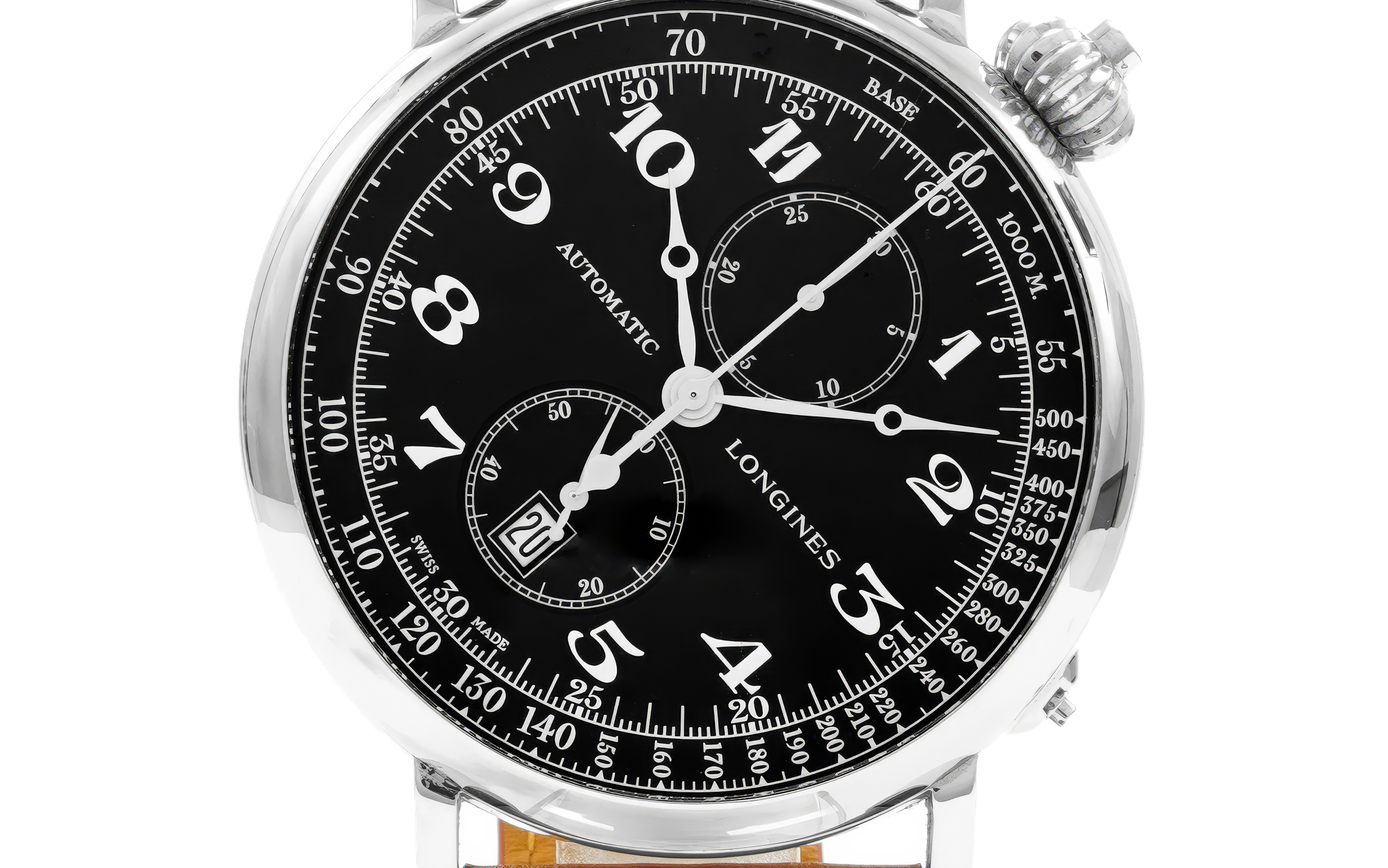
Polished stainless steel case, 49mm in diameter (around 1 15/16 inches across, for those of us who were raised on imperial), about 15mm thick, with a lug-to-lug measurement that doesn't quite run past the edge of my wrist. That's the saving grace of the design, and basically the whole reason this watch is wearable on a 7.5-inch wrist at all. The lugs are short and curve down sharply, and the rounded "pocket watch for the wrist" profile keeps everything visually contained even though the diameter is large.
The dial is matte black, tilted off vertical, with oversized white painted Arabic numerals around the perimeter and a white tachymeter scale on the outer flange. The 30-minute totalizer sits at the original twelve, which under the tilt lives at roughly the modern two. Small seconds at the original six, with a date window inside it. Rhodium-plated Breguet-style hands. No applied indices, no faux patina, no aging treatments: it's the dial the 1934 spec describes, drawn at the scale the spec drew it.
Legibility is the surprise. After about a week of ownership, the off-axis layout stops registering as off-axis and your eye recalibrates. From then on this is a notably easy watch to read, easier than most modern chronographs at any size in any orientation. The numerals are oversized for a reason. At 49mm with a tilted dial, this is a practical tool watch, if an aviator actually wanted to use a mechanical watch.
That conditional haunts every reissue in this category. No pilot in 2026 is timing a navigation leg with a mechanical wristwatch. A Cessna 172 cockpit has more avionics than a 1935 B-17. So what we've got is the only modern A-7 actually scaled for the work, in the orientation the work demands, and there's nobody left who needs to use it that way.
Inside is the Longines L788.2, a self-winding column-wheel monopusher chronograph based on the ETA A08.L11. Twenty-seven jewels, 28,800 vibrations per hour, fifty-four hours of power reserve. Start, stop, and reset all happen through a single button integrated into the onion crown, which is large enough to operate with gloves. I've already caught myself working the pusher for no real reason at all, more than once, just to feel it click.
The caseback
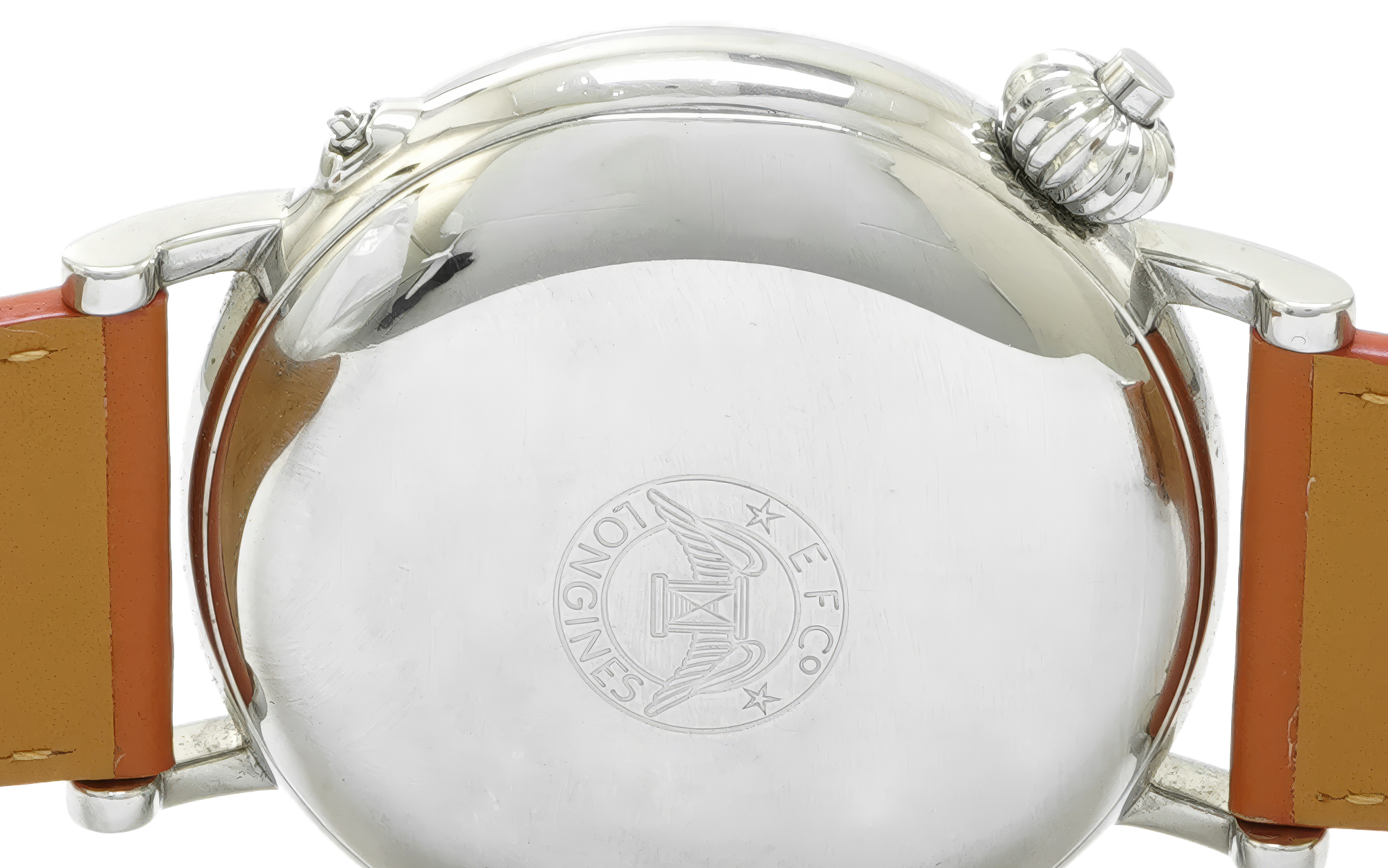
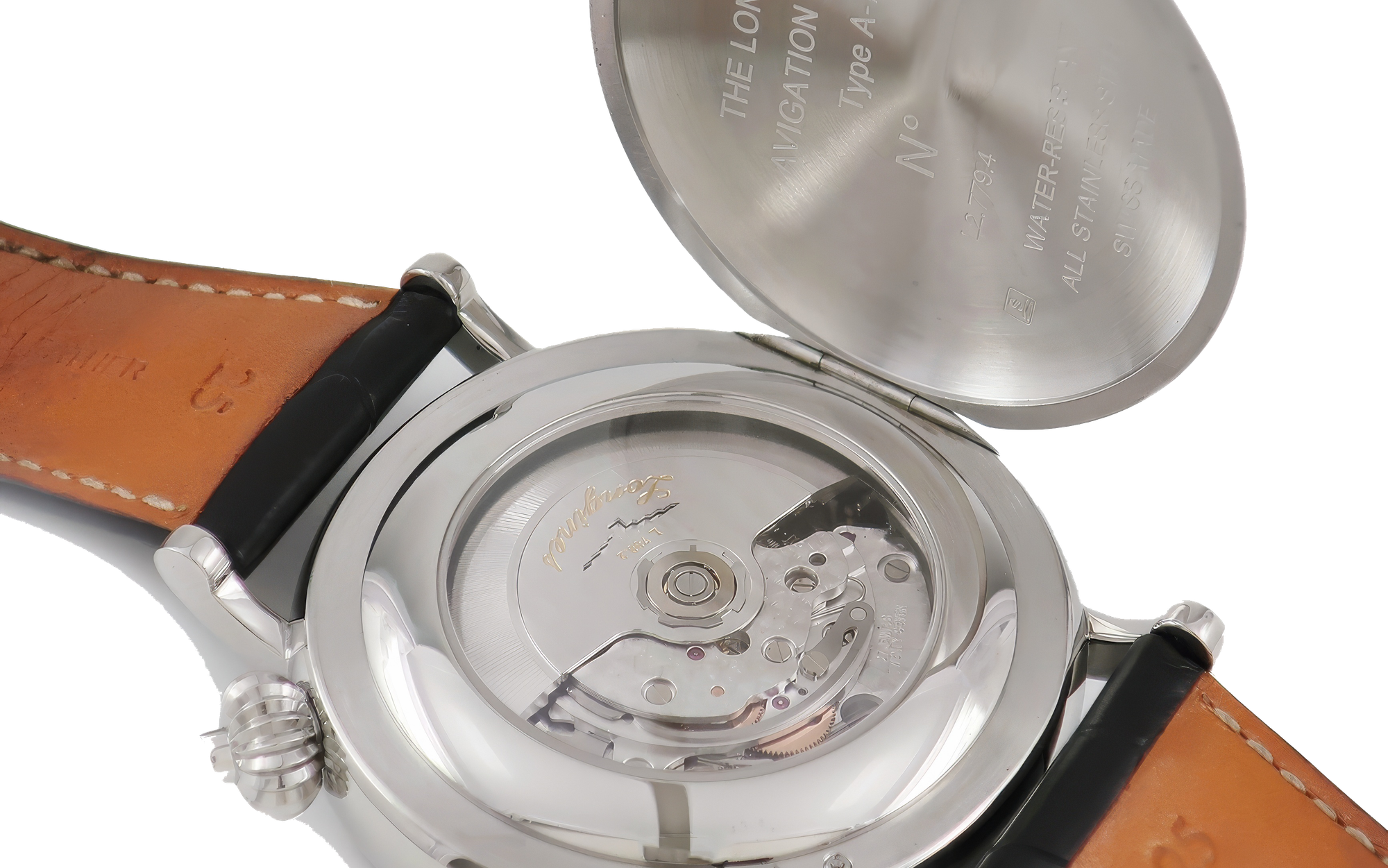
The caseback is a hinged steel hunter-style cover over a sapphire crystal. Flip the steel lid open and you watch the column wheel turn through the sapphire while the chronograph runs. There's no other watch in my collection that lets you do that.
In practice, the assembly is a problem. I have a habit, indulged with most of the watches I own, of removing the caseback to look at the movement under a microscope. With the L2.779 I can't. The way the hinge is integrated into the case and the way the inner sapphire is seated underneath the steel lid combine to make full removal more difficult than I'm willing to risk on a thirteen-year-old discontinued reference. I get the surface view through the sapphire, but not the deeper one I'd actually want.
Not a complaint. The hinged cover is faithful to the early-twentieth-century pocket-watch architecture the A-7 came from, and the sapphire underneath is a generous concession. It's just a quirk worth naming. That's part of what you get with a really faithful reissue: you inherit the original's quirks too, including the ones that get in your way.
Why I keep it
I bought the L2.779 mostly to complete the collection. That's the honest answer, and the answer I gave to friends and family when they asked. Nine months later, I think I can say a lot more about what that answer actually means.
Each modern A-7 is scaled for a different audience: the 41mm 1935s for the everyday wearer, the 44mm USA Edition for the collector who wants provenance with comfort, the bronze Hour Glass for the regional limited-edition buyer who wants something dressier. They're all useful translations of the document, but they're translations, not the thing itself.
The L2.779 is the version that doesn't translate. The 49mm matches what the spec required, the hinged caseback matches the pocket-watch chronograph architecture the spec inherited, the oversized numerals were drawn for a cockpit none of us will ever sit in. So this is the closest a 2026 buyer gets to wearing the actual document, and it happens to be too big to wear comfortably. Including for me. Which is, I think, part of why I wanted it.
If a working pilot in 2026 actually wanted a mechanical chronograph for navigation work, the L2.779 is the watch they'd be reaching for. Of course nobody actually wants that anymore. Avionics ate that job decades ago, and a Garmin G1000 does it better than any column wheel ever could. So the L2.779 sits at home in the case I bought it in. I'm fine with that. I knew what I was buying. Maybe four times a year I'll pull it out, put it on, and after about thirty seconds remember why I also own the 41mm 1935s.


