

In the spring of 1962, on the Rome set of Cleopatra, a publicity photographer took a still of Elizabeth Taylor between takes. Coiled twice around her wrist was a gold Serpenti by Bulgari, its diamond-studded snake head curling against her skin. The photograph went out into the press at the same moment that the tabloids were churning through the Taylor-Burton affair. In a matter of weeks, the most famous actress in the world had become the unpaid global ambassador of a Roman jeweler that, before that moment, almost nobody outside Italy had heard of.
The Serpenti had existed since 1948. Cleopatra made it.
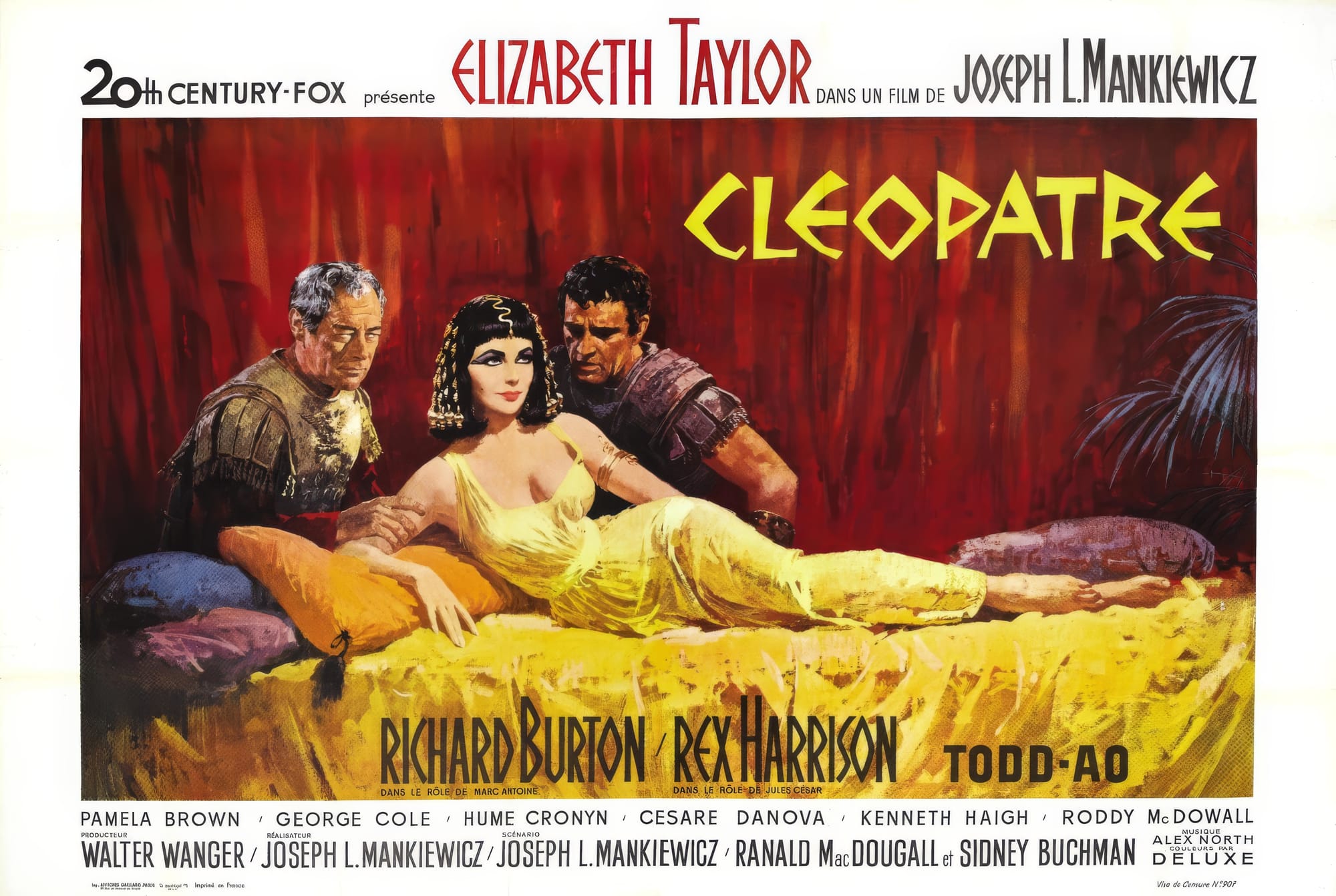
This is the founding scene of Bulgari in cinema. And the strange part is that the brand never quite repeated it. As I wrote in an earlier piece, Cartier's watches travel through Hollywood the way heirlooms travel through families. Valentino refused to take his Tank off in 1926. Cary Grant wore a Tank for the rest of his career. Alan Rickman picked up a Tank to play the villain in Die Hard. Bulgari's path was almost the opposite. After Liz Taylor, the brand went dark on screen for the better part of three decades. When it came back in 1995, it came back as Hollywood's Italian-luxury shorthand, and it came back through one model.
The watch the brand is most proud of, the watch that finally made Bulgari a serious horological house, did not appear on screen until 2024. This is the story between those two moments.
A Greek silversmith in Rome
The brand was founded in 1884 by Sotirios Voulgaris, a Greek silversmith from the Aromanian mountain village of Kalarites. His family had fled Ottoman persecution and settled in Rome in 1881. Three years later, Voulgaris opened a shop at Via Sistina 85, displaying his silver pieces among the wares of a Greek sponge merchant. He Italianized his name to Sotirio Bulgari. By 1905 he had opened the Via dei Condotti flagship that still operates today as the brand's home.
For its first hundred years, Bulgari was a jewelry house first and a watchmaker a distant second. The company sold women's wristwatches as early as 1918, but watches were treated as another category of ornament, not as a horological pursuit. After Sotirio died in 1932, his sons Constantino and Giorgio took over and changed the logo to BVLGARI, using the classical Latin V in place of the U.
The Serpenti debuted in 1948, when the brothers reinterpreted the ancient Roman and Hellenistic symbol of the serpent as a coiled-gold bracelet. From the start, the form lived a double life. Some Serpentis were watches with a small dial hidden inside the snake's head. Others were bracelets without dials, sculptural rather than functional. Taylor's was the second kind. The Tubogas technique, in which bands of gold are wrapped around a steel core without soldering, was Bulgari's own. The Serpenti was elegant and Roman and immediately recognizable. But for fourteen years after its launch, it was a Rome-only phenomenon.
What changed in 1962 was not the watch. What changed was that Liz Taylor wore one on the set of an epic film about the Queen of Egypt, and the affair she was having with her co-star made the photograph travel faster than any advertisement could.
Taylor was a Bulgari obsessive. She and Burton used the back doors of the Via Condotti flagship to escape the paparazzi. She visited the store in the afternoons to sit in what the family called the money room with Gianni Bulgari. Burton told friends, after enough purchases to lose count, that "the only word Elizabeth knows in Italian is Bulgari." When Taylor died in 2011, her Bulgari collection alone auctioned for over $156 million. The actual Serpenti she wore on the Cleopatra set sold at Christie's, by itself, for $974,500. After 1962, the Serpenti and Bulgari went global.
From bracelet to bezel
Bulgari's serious watchmaking ambitions begin in 1975 with a peculiar experiment. The brand commissioned a Geneva-based watch designer named Gérald Genta, the man who in the previous five years had drawn the Audemars Piguet Royal Oak and the Patek Philippe Nautilus, to design a quartz-powered gift watch for one hundred of Bulgari's best clients. Genta delivered a digital piece called the Bulgari Roma. The flat bezel was engraved with the brand name twice, reputedly inspired by the ancient practice of Roman emperors stamping their names around the rim of imperial coins.
The clients loved it. In 1977, Genta updated the design and Bulgari launched the BVLGARI BVLGARI as a full production model. It was the brand's first watch produced on an industrial scale, and the double-engraved bezel became the signature of the house. For the first time on a high-end watch, the maker's logo was not a tasteful detail. It was the design.
The BVLGARI BVLGARI sold well enough that in 1980 Bulgari created a dedicated watch business unit, and in 1982 founded Bulgari Time S.A. in Neuchâtel, Switzerland, to handle production. Bulgari was beginning to think of itself as a watchmaker. In 1988, Genta returned to design Bulgari's first sports watch, the Diagono. The name came from the ancient Greek agon, meaning competition. The Diagono kept the BVLGARI BVLGARI engraving on the bezel but added an integrated bracelet, a chronograph option, and a sportier case. In 1994, Bulgari introduced the Diagono Scuba with 200-meter water resistance. In 1998, the Aluminium followed: a lighter, more affordable take on the same sport-watch DNA, with an aluminum case and a black rubber bezel.
These were the watches Bulgari brought to the early 1990s. Italian design first, Swiss instrument second. Decorative, ornamental, immediately recognizable, and unmistakably the product of a jewelry house. They did not yet have the haute horlogerie pedigree of a Patek or a Vacheron. But they had something the Swiss houses couldn't easily replicate and Hollywood was about to notice.
The Diagono era: 1995 to 2013
The Diagono's cinematic life begins in 1995, Bulgari's first return to screens as a watch rather than a piece of jewelry, and what follows over the next eighteen years is a casting pattern. The Bulgari Diagono becomes the watch Hollywood reaches for when a character's surface exceeds their substance. The Italian-design-first ethos that made the Diagono distinctive on the wrist also made it perfect for characters whose identity is a performance. The gold-engraved bezel announcing the brand name twice. The integrated bracelet that does not pretend to be anything other than ornamental. The chronograph the character will never use to time anything. The Diagono is the Roman tell.
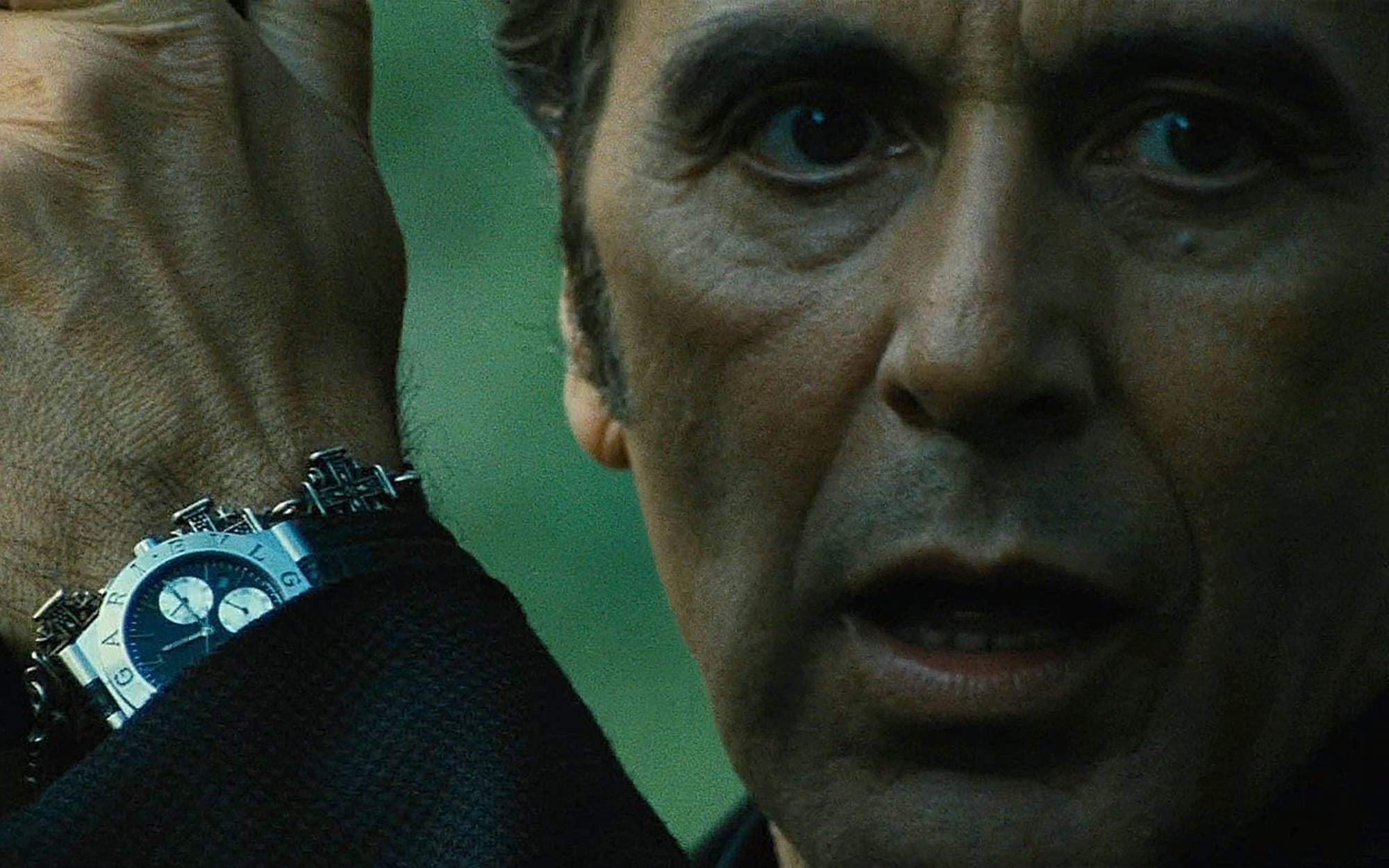
Heat (1995): Pacino's Diagono Chronograph
Michael Mann directed Heat with obsessive attention to procedural detail. The armored car robbery was choreographed by a former SAS operator. The downtown shootout used live ammunition blanks that shattered real car windows. But Lieutenant Vincent Hanna's wardrobe operates on a different logic. Al Pacino plays Hanna as a homicide cop whose personal life is as undisciplined as his professional life is relentless. Three failed marriages. Cocaine on stakeouts. Interrogation monologues delivered at full volume. And on his wrist, a Bulgari Diagono Chronograph.
A homicide lieutenant in 1995 Los Angeles should not be wearing a Bulgari. The Diagono is stainless steel with the BVLGARI BVLGARI engraved around the bezel in capital letters, a detail that is exactly as subtle as Hanna himself. It is a quartz chronograph with an integrated bracelet, Italian fashion-house design rather than Swiss horological tradition. In the mid-1990s, Bulgari was positioning itself between jewelry and watchmaking, and the Diagono was the statement piece. It is not what a real LAPD detective would wear. It is what a detective in a Michael Mann film would wear, which is a different thing entirely. Mann uses the Bulgari the same way he uses Pacino's hair gel and the wide-collared shirts. They are signals from a man who imagines himself in a different movie than the one he is in.
The Diagono belongs to the same era as Hanna himself. Brash, Italian-inflected, and operating at a volume that makes everyone in the room uncomfortable.
Mission: Impossible (1996): Voight's Diagono Professional Scuba Chronograph
A year later, Brian De Palma directed Mission: Impossible, the first film in what would become one of the highest-grossing action franchises in cinema. The film's central betrayal is structural. Jim Phelps was the hero of the 1966 television series, the man who always had the plan, the face on the dossier that read "your mission, should you choose to accept it." De Palma's film turns him into the villain. Phelps fakes his own death and frames Ethan Hunt for the murder of the team. The franchise's father is its first betrayer.
Jon Voight plays Phelps, and on his wrist throughout the film is a Bulgari Diagono Professional Scuba Chronograph. The watch is a sporty dive chronograph with the double BVLGARI engraving on the bezel, unmistakable even in brief screen time. It is also, per WatchSpotting, the product of a placement deal between the production and the Italian brand.
The Bulgari fits the deception. Bulgari is a jeweler that happens to make watches, not the other way around, and Phelps is a man whose surface presentation hides everything underneath. Hunt and Luther wear functional tool watches throughout the film. Phelps wears something from the Via Condotti. The traitor is the one in Italian luxury.
Iron Man (2008) and Iron Man 2 (2010): two Bulgaris, then a Jaeger-LeCoultre
Jon Favreau's Iron Man is the founding film of the Marvel Cinematic Universe, and Robert Downey Jr. wears two distinct Bulgari Diagonos across it. Only one of them appears in the theatrical cut.
The watch on Stark's wrist for most of the film is the Bulgari Diagono Retrograde Moonphase, reference DGP42BGLDMP. It is a 42mm rose gold case housing the BVL 347, an in-house automatic caliber that drives a retrograde day at nine o'clock, a retrograde date at three, and a moonphase at six. Bulgari produced the watch as a limited edition of around three hundred pieces and confirmed the placement on the brand's promotional cycle around the film's 2008 release. The Retrograde Moonphase is a watch that wants you to notice it. It is a watch that announces, on the wrist of a defense contractor, that the wearer is the kind of man who has watches like this.
Pre-Afghanistan Stark is a billionaire arms dealer who flies an Audi R8 across Las Vegas and has women, drinks, and weapon contracts arriving in roughly equal proportion. The Diagono Retrograde Moonphase is what a man in that position buys himself. Italian, geometric, technically complicated in ways that flatter the wearer's self-image, more concerned with looking like a statement than blending into a lineup of Swiss sport watches. The Roman tell dialed up to a limited-edition retrograde.
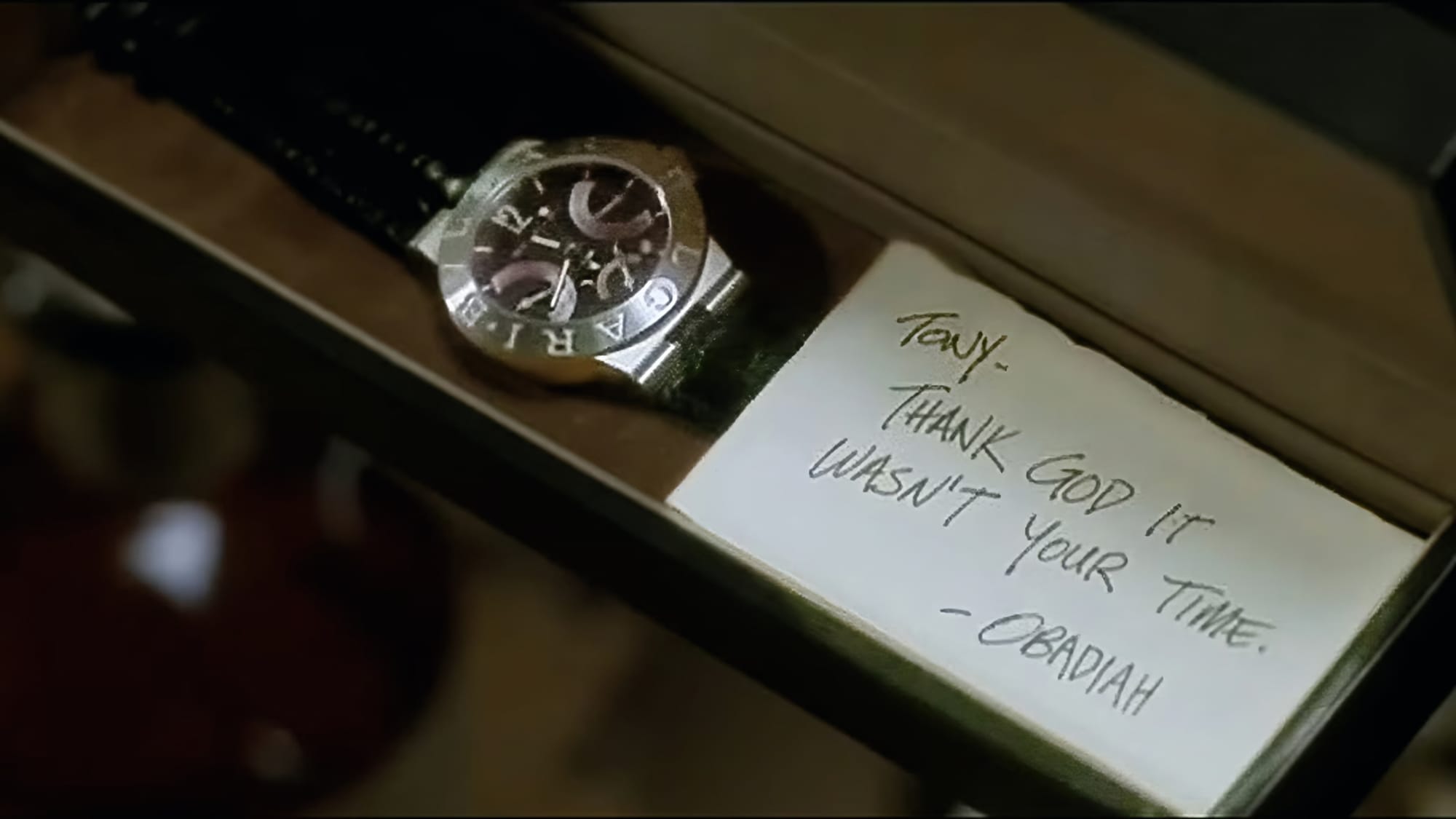
The second Bulgari is the one most people have not seen. In a deleted scene preserved on the Iron Man Blu-Ray and streaming extras, Stark returns to his Malibu mansion after Afghanistan and finds a gift waiting for him from Obadiah Stane. An ornate watch in a presentation case with a note that reads, "Tony, thank God it wasn't your time. Obadiah." The watch in the box is a Bulgari Diagono Sport, an octagonal-bezel piece from the same Genta-designed family as the Retrograde Moonphase but quieter, simpler, more an appreciative gesture than a flex. It is a thoughtful gift, on its face. The audience of the theatrical cut never sees it. Stane has given Stark a watch that, in the only version of the film most viewers ever watched, does not exist.
Then Iron Man 2 arrives in 2010, and Bulgari is gone. Jaeger-LeCoultre's Richemont-backed product placement budget had taken over the franchise. Stark wears three JLCs through the sequel: the AMVOX 3 Tourbillon GMT in platinum and ceramic, a Reverso Grande 985, and a Master Grand Tourbillon 1833. The Master Grand Tourbillon is the watch that matters here. It is the one Stark takes off his wrist, hands to a roadside strawberry vendor on the Pacific Coast Highway, and trades for a box of fruit while driving away in a convertible. The vendor asks if he is Iron Man. Stark says "Sometimes." Then he keeps driving.
The real-world prop is a Jaeger-LeCoultre that retailed for well over $100,000. The in-universe lore is something else. Among viewers, the trade has long been read as Stark discarding the gift from Obadiah Stane, the last memento of the man who tried to kill him, in the casually petty way only Tony Stark would. The fan reading does not survive prop-level scrutiny. The strawberry watch is a JLC, and Stane's gift was a Bulgari Diagono Sport that only existed in a deleted scene anyway. But the symbolism works regardless. Stark trades the most expensive watch on his wrist for a box of fruit, and in doing so makes the smallest, pettiest, most expensive gesture of closure in the franchise.
The watch on his wrist had changed brands between films. The character's relationship to the watch had not.
Transformers: Dark of the Moon (2011): LaBeouf's Diagono Professional GMT Chronograph
By 2011, the Diagono had become a watch the prop department reached for when a character's wardrobe was supposed to outpace their plausibility. Michael Bay directed Transformers: Dark of the Moon as the third entry in his original Transformers trilogy. Shia LaBeouf returns as Sam Witwicky, now a college graduate struggling to find a job despite having saved the world twice. The film's first act plays Sam's post-heroic unemployment for comedy. The second act levels Chicago with alien robots.
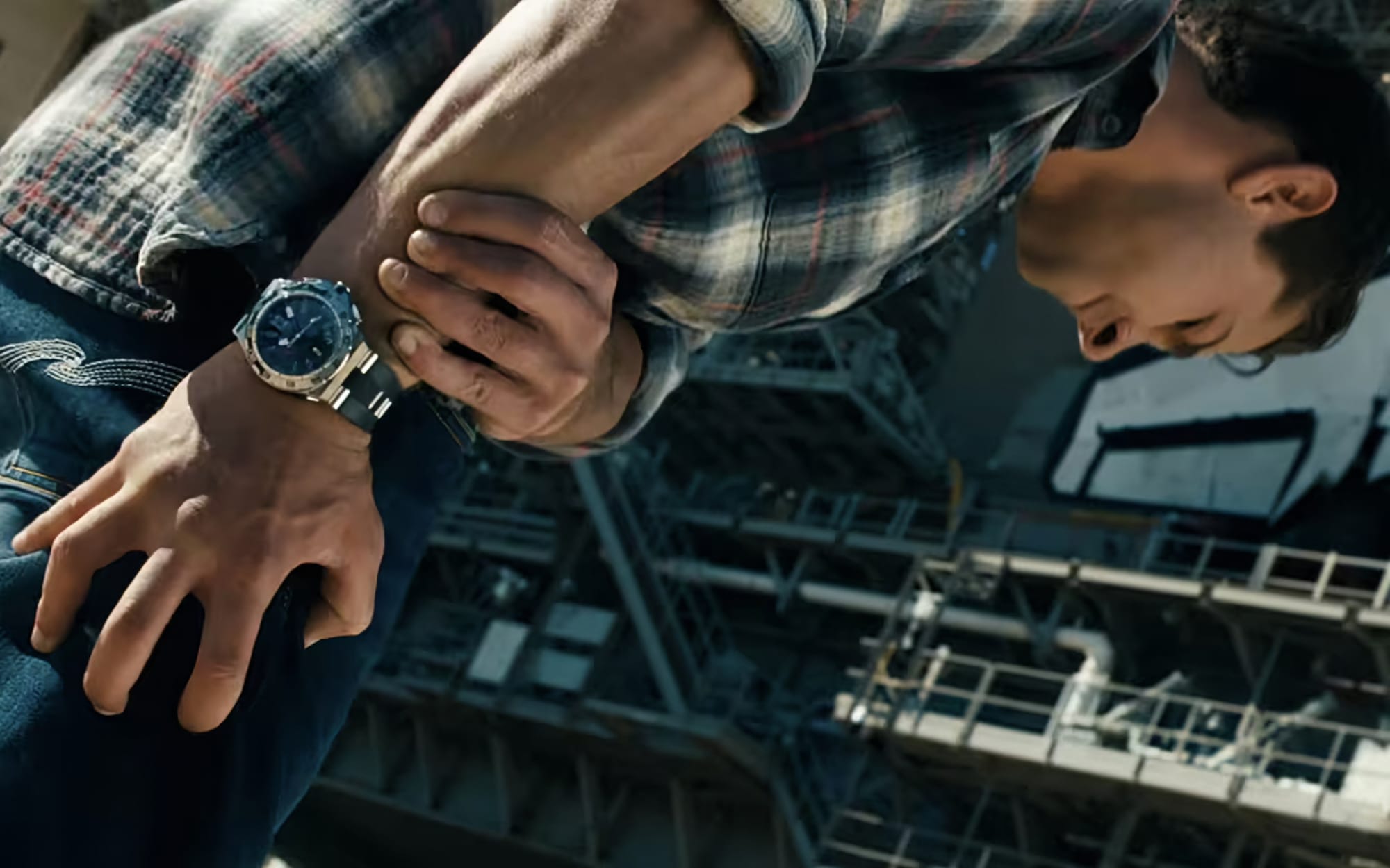
The Bulgari Diagono Professional GMT Chronograph on Sam's wrist is a watch that should not belong to an unemployed twenty-something, and the film never explains how he affords it. The Diagono Professional is Bulgari's most technically ambitious sport watch: titanium case, GMT complication for dual time zones, chronograph function, and the distinctive double-logo bezel that makes every Bulgari immediately identifiable. It is the kind of product placement where the brand pays enough that character logic becomes optional. Witwicky would be wearing a G-Shock or nothing at all. The Bulgari is there because Bulgari wanted it there.
That is the late-period Diagono in cinema. By the time a brand is paying to put a titanium GMT chronograph on the wrist of a recent college graduate, the casting logic that powered Heat and Mission: Impossible has hollowed out. The watch is no longer a tell about the character. It is a tell about the placement budget.
The pattern
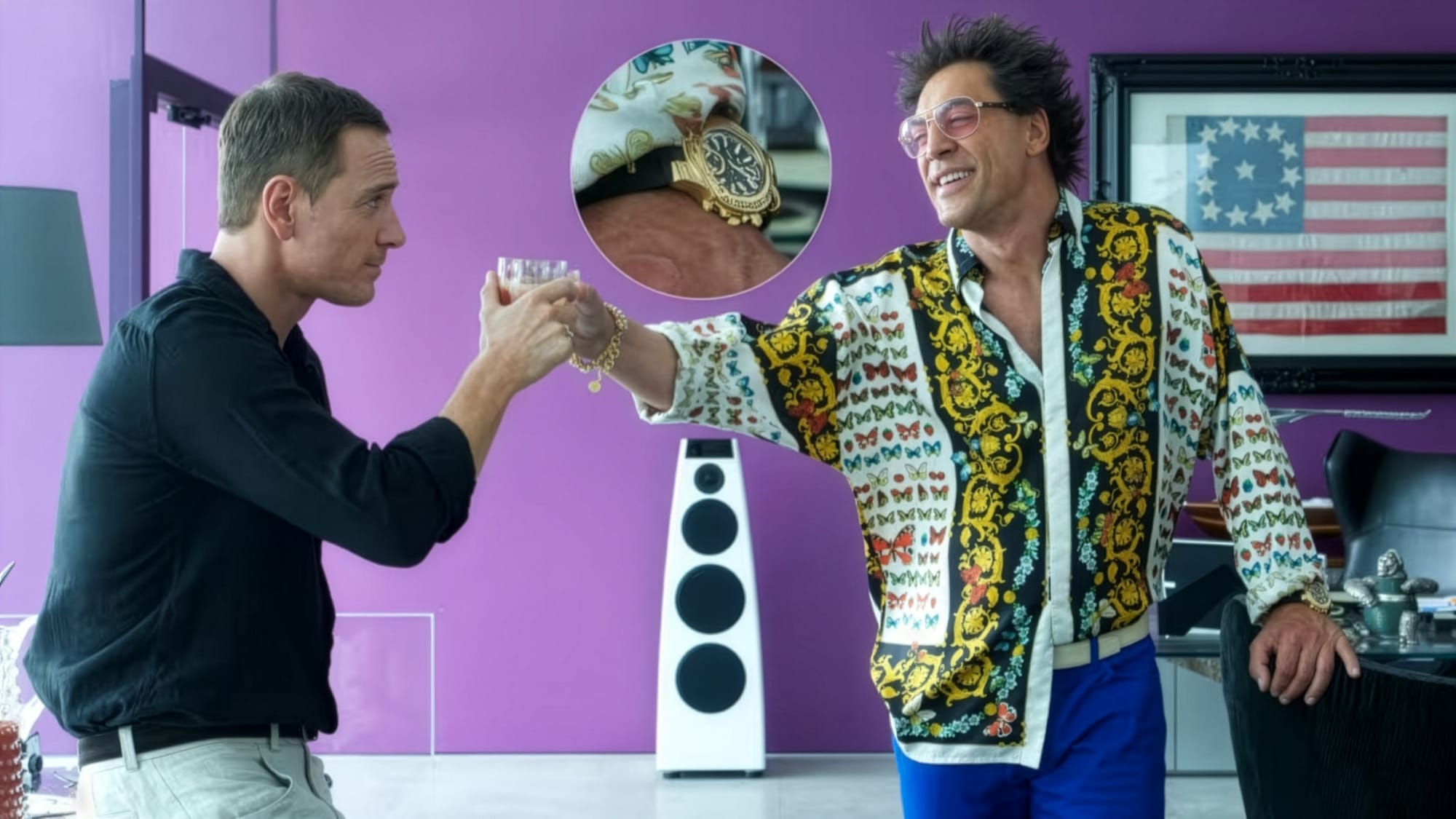
Around the time of these four sightings, the Diagono kept showing up. Val Kilmer wore one as the master-of-disguise thief Simon Templar in Phillip Noyce's The Saint (1997), where the watch fit a character who changed identities the way most people change shirts. Javier Bardem wore a Diagono Chronograph as the cartel-money nightclub owner Reiner in Ridley Scott's The Counselor (2013), paired with a butterfly-print shirt and a spiked hairdo that made the symbolism almost too on-the-nose. Roly Serrano wore a Diagono Chronograph as a heavy, aging Diego Maradona in Paolo Sorrentino's Youth (2015), a body that was a record of past glories and present excess, the watch part of the costume.
There was one notable exception to the casting pattern. Sarah Jessica Parker wore a BVLGARI BVLGARI as Carrie Bradshaw in Sex and the City (2008), not because Carrie was performing, but because Carrie was correct: she would never wear a Cartier. That was Charlotte's territory. Patricia Field, the show's costume designer, gave the Cartier Panthère to the well-bred WASP and the BVLGARI BVLGARI to the writer with rent problems and an instinct for being noticed. The watch was the character, even when the character was using the watch sincerely.
But the dominant pattern of the Diagono era was performance. The Italian watch on the wrist of a character whose identity was on display rather than at rest. After Youth in 2015, the Diagono effectively disappears from major films. By that point, Bulgari was busy becoming a different kind of brand.
The Serpenti returns
While the Diagono was fading from screens, the brand's older identity returned through the other door. The Serpenti, dormant in film since Liz Taylor, came back.
In 2013, Brian De Palma directed Passion, a remake of Alain Corneau's Love Crime. Rachel McAdams plays Christine, an advertising executive who treats fashion as a weapon. On her wrist, coiled twice, was a Serpenti Tubogas. There is no other watch that looks like it. The dial is set into a snake's head; the bracelet wraps around the wrist; the whole piece reads as sculpture more than horology. In 2016, Amy Adams wore a Serpenti as the gallery-owner protagonist of Tom Ford's Nocturnal Animals, where the watch reads as armor for a woman who has stopped wearing things for pleasure. In 2021, Anne Hathaway wore a Serpenti as a fashion CEO trapped in lockdown in Doug Liman's Locked Down. Ford in particular treats the Serpenti the way a stylist would: not as a prop to identify and sell, but as a finishing touch on a silhouette.

These were not Diagono-style cinematic deployments. The Diagono announces itself with a brand name engraved twice on the bezel. The Serpenti announces itself by looking like a snake. Both are unmistakably Bulgari, but they perform different work. The Diagono on a male wrist tells you the character has money. The Serpenti on a female wrist tells you the character has taste, and possibly cruelty.
The brand's on-screen presence has also continued to diversify. Channing Tatum wore a Bulgari Aluminium in The Lost City (2022), the model Bulgari reissued in 2020 as a retro-revival of its 1998 design. Reese Witherspoon wore a slim Bulgari Rettangolo in You're Cordially Invited (2025). Each appearance is correct for its character. None of them was the Octo Finissimo.
The pivot
While the Serpenti was reasserting Bulgari's jewelry identity on screen, a different transformation was underway in the workshops. In July 2000, Bulgari paid 37.6 million Swiss francs to acquire two struggling Swiss watch manufactures from the Hour Glass, a Singaporean retail group. The brands were Gérald Genta SA and Daniel Roth SA. They came with the workshop in Le Sentier, in the Vallée de Joux, that Genta and Roth had shared for years. Bulgari now owned the design name of the man who had created its first major watch in 1977.
This was not a sudden pivot. Genta had been Bulgari's de facto watch designer for twenty-three years by the time the brand acquired his namesake company. The BVLGARI BVLGARI and the Diagono were his work. What changed in 2000 was that Bulgari now owned the production capability and the haute horlogerie pedigree that came with the Genta and Roth brands.
Fabrizio Buonamassa Stigliani is the figure who turned that acquisition into a transformation. An Italian car designer by training, Buonamassa joined Bulgari's watch division in Rome in 2001. One of his first jobs was to design a bracelet for the original Gérald Genta Octo, an octagonal-cased watch Genta had created for his own brand in the late 1980s. The case shape was inspired by the coffered ceilings of the Basilica of Maxentius in Rome. Buonamassa left briefly and returned in 2007 as creative director of the watch division, operating under what would become the defining brief of his career: transform Bulgari into one of the best watchmakers in the world.
In one interview, Buonamassa described a conversation he had with then-CEO Guido Terrini at the start of that mandate. He asked Terrini: tell me, in the next 10 years, where the brand will be. Tell me why in 10 years I would want to buy a Bulgari watch. The brand had no field of its own. It was not close to racing, polo, aviation, sailing. What it had were the Genta and Roth ateliers, and a Roman design heritage. Those would have to be enough.
In March 2011, LVMH acquired Bulgari in a deal valued at over €4 billion, at the time the largest in the conglomerate's history. The acquisition gave Bulgari the resources to compete at the top of the watch industry. In 2012, the brand launched the Octo collection under its own name, adapting Genta's original octagonal case. And in 2014, at Baselworld, Bulgari debuted the Octo Finissimo Tourbillon, which set a world record as the thinnest flying tourbillon ever made.
Then the records kept coming. Thinnest automatic. Thinnest minute repeater. Thinnest chronograph. Thinnest perpetual calendar. By 2022, the Octo Finissimo Ultra reached 1.8mm thick. By 2024, the Ultra Mark II reached 1.7mm. In a decade, Bulgari went from being treated as an ornamental fashion-house watchmaker to holding more thinness records than any other brand in the industry.
The Octo Finissimo earned Bulgari its watchmaking credibility. But the watch did not appear in a major film for another ten years.

The Octo arrives
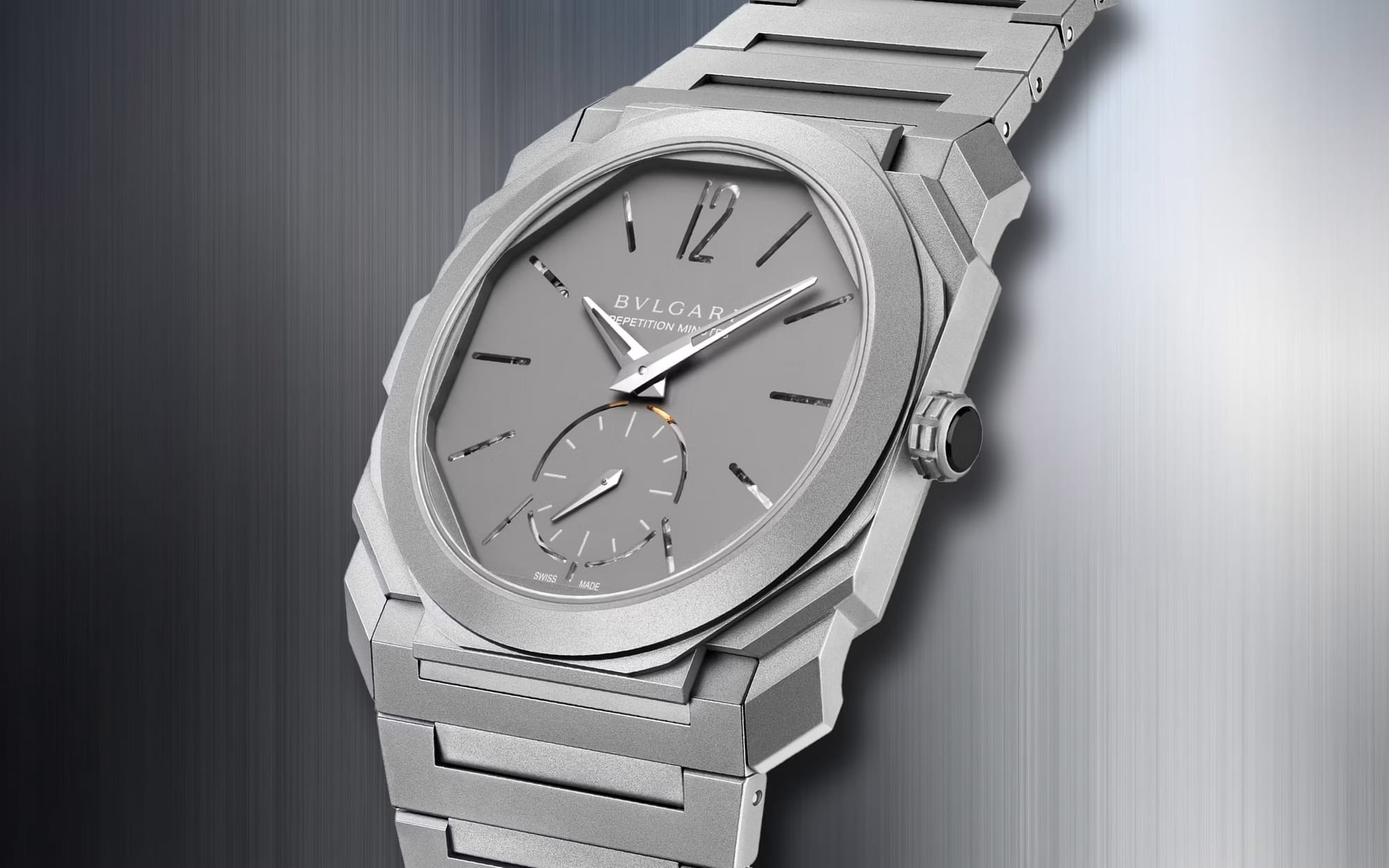
The Octo Finissimo is Bulgari's ultra-thin sport-luxury line, introduced in 2014 with an octagonal sandblasted-titanium case derived from the original Octo that Gérald Genta designed in the 1980s. Between 2014 and 2024 it set nine thinness world records, culminating in the Octo Finissimo Ultra Mark II at 1.7mm. It is the watch that turned a Roman jewelry house into a serious horological one.
In 2024, Steve Yuen Kim-Wai directed The Moon Thieves, a Hong Kong heist film about a crew of thieves who specialize in stealing luxury watches. Edan Lui plays Vincent Ma, the crew's watch specialist, the one who can identify a reference number across a display case. The film gave each of its main characters a different luxury watch, in what is either an exceptionally shrewd act of prop design or an exceptionally well-managed product-placement campaign. Either way, the crew member who knows the most about watches wears a Bulgari Octo Finissimo.
Meaningful here means more than wardrobe. The watch is identified, connected to the character's profession, and serves the scene rather than just appearing in it. As far as I can determine, this is the first time a Bulgari Octo Finissimo has cleared that bar in a major narrative film.
The pairing is not accidental. The Octo Finissimo is a watch that rewards specialized knowledge. To appreciate it, you have to understand what a 2.23mm-thick movement actually requires. You have to know that the original Octo was a Genta design, that Buonamassa redrew it with a sandblasted titanium case, that the brand has set seven thinness records with this line since 2014. You have to be a watch person. Vincent Ma is supposed to be that person. The Octo Finissimo justifies his reputation.
Set this beside Liz Taylor's Serpenti on the Cleopatra set in 1962. The Serpenti was a Roman jewelry house's watch that became famous because the most photographed woman in the world happened to wear it during the world's most public love affair. For the next half-century, the brand stayed famous in cinema mostly as the prop master's Italian-luxury default. The Octo Finissimo is the opposite case. It is the watch Bulgari spent twenty-four years engineering itself into the position to make, and when it finally arrived on screen, it arrived on the wrist of a character who could explain why it mattered. The cinema took sixty-two years to catch up with the watchmaking.
Sixty-two years
The Bulgari story in cinema is shorter than Cartier's and structurally different. Cartier accumulated screen time organically, through actors' personal devotion, across seven decades. Bulgari became famous in a single 1962 publicity shot of a bracelet, not a watch, then faded from screens for three decades, returned through product placement in the mid-1990s, and is only now beginning to see its serious watchmaking presented as serious on screen.
The trajectory mirrors the brand's transformation. For most of its 142-year history, Bulgari was a Roman jewelry house that happened to make watches. The watches it made were ornamental: bracelets that told time, dress watches that fit under a cuff, sport watches like the Diagono that performed Italian-ness rather than mechanical precision. These were the watches that ended up in films. They worked on screen because they did the same thing on a character's wrist that they did in a Bulgari window. They announced presence.
The watches Bulgari has built since 2014 do something else. The Octo Finissimo is not announcing itself. It is the thinnest watch in the world, and the point of its design is that the wearer is the one who knows it, not the room. This is a quieter kind of luxury. It took until 2024 for a director to figure out how to use it.
Whether that figure ends up as a one-off or as the beginning of a new Bulgari era in cinema is the open question. The Octo Finissimo has now been on screen. It will be there again.
But the founding scene of Bulgari in cinema is still Elizabeth Taylor on the Cleopatra set in 1962, with a gold serpent coiled twice around her wrist. The accidental ambassador. A bracelet, not a watch. The moment a Roman jeweler became a global name not by selling anything, but by being photographed. Sixty-two years and one Octo Finissimo later, the brand is finally selling the watch.
All cinematic sightings in this article are catalogued and confirmed at WatchSpotting.


