Before the name Wempe appeared on a watch dial, it was already etched into the history of precision. Founded in 1878, the German retailer became synonymous with chronometric excellence long before it ever made a watch of its own. In 1938, Wempe acquired the Hamburg-based Chronometerwerke, a workshop famed for marine chronometers that guided ships across oceans. Production ceased during the war, but in the early 2000s Wempe revived this legacy, establishing its own manufacture in Glashütte, Saxony, in 2006. Every watch made there passes through the company's observatory, the only official chronometer testing facility in Germany. Each piece is certified for accuracy under standards similar to COSC, but with German thoroughness.
Design and Wearability
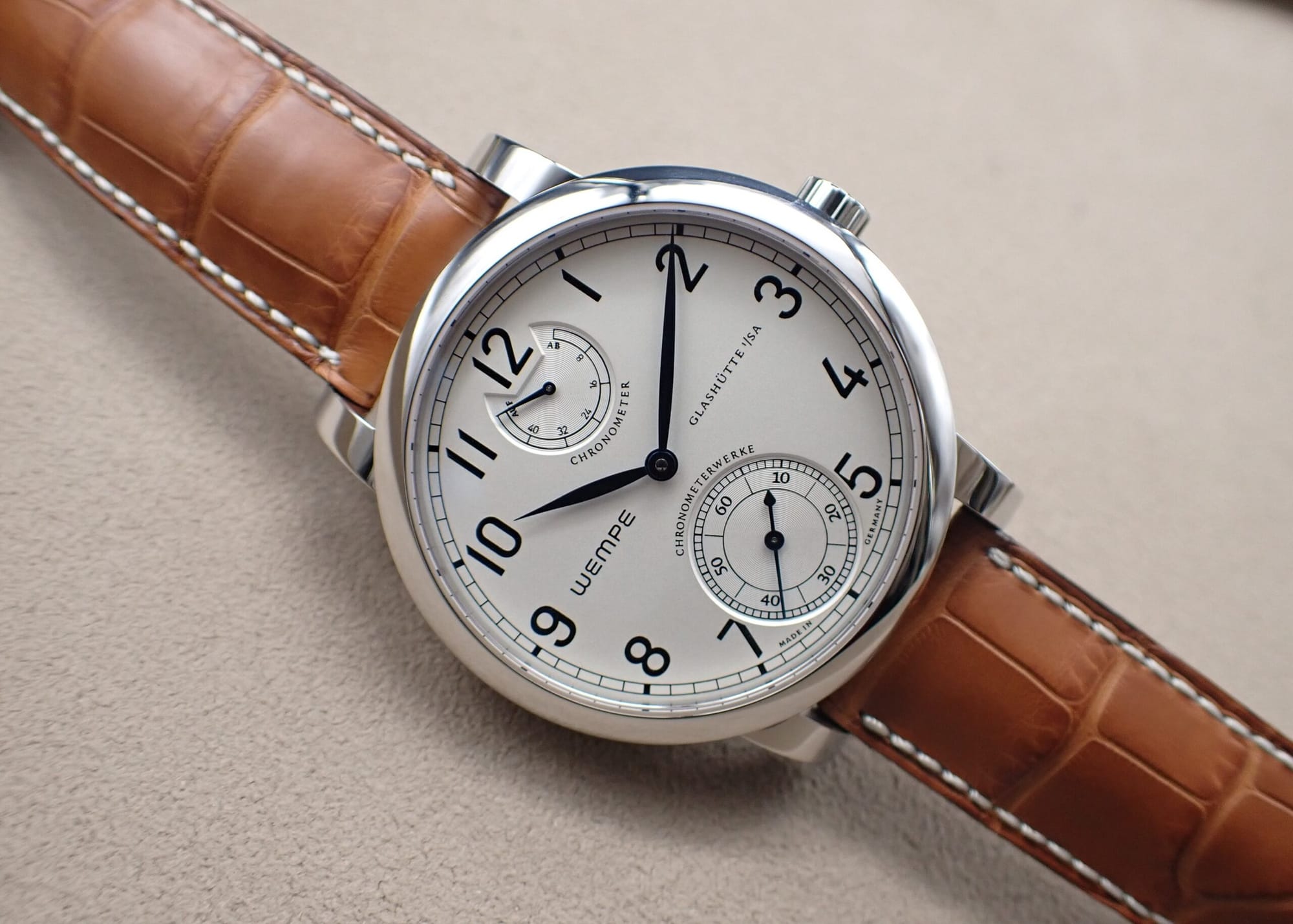
The Chronometerwerke Power Reserve (Ref. WG080003) takes its cues from the world of marine navigation. The dial is clean and functional, with black Arabic numerals and a railroad minute track on a matte white background. At twelve sits the AUF/AB indicator (German for up/down) showing the state of wind, balanced by a small seconds subdial at six. This symmetry is not merely aesthetic; it echoes the layout of 19th century ship chronometers. Blued hands provide crisp contrast, and their long, thin proportions add a sense of precision that feels engineered rather than decorative.
The case is polished stainless steel, 43 mm across and 12.5 mm thick. It is substantial, both visually and physically. On the wrist, the watch feels like an instrument, not oversized for show but unapologetically purposeful. The broad lugs and rounded flanks anchor it well, and a curved leather strap keeps it comfortable for long wear. Still, at 43 mm it will test the limits of smaller wrists. Water resistance is 30 meters, enough for daily wear but not for the rainstorm kind of confidence. In truth, this is a dressy deck watch: something you wear to dinner, not to the sea.
Aesthetically, the Wempe lives in dialogue with history. Its design shares DNA with the classic Ulysse Nardin Marine, and even whispers of the A. Lange & Soehne Richard Lange. It is not avant garde, and it does not try to be. This is an old world watch for people who like the smell of brass and lacquered mahogany. In that honesty lies its charm.
The CW3 Movement
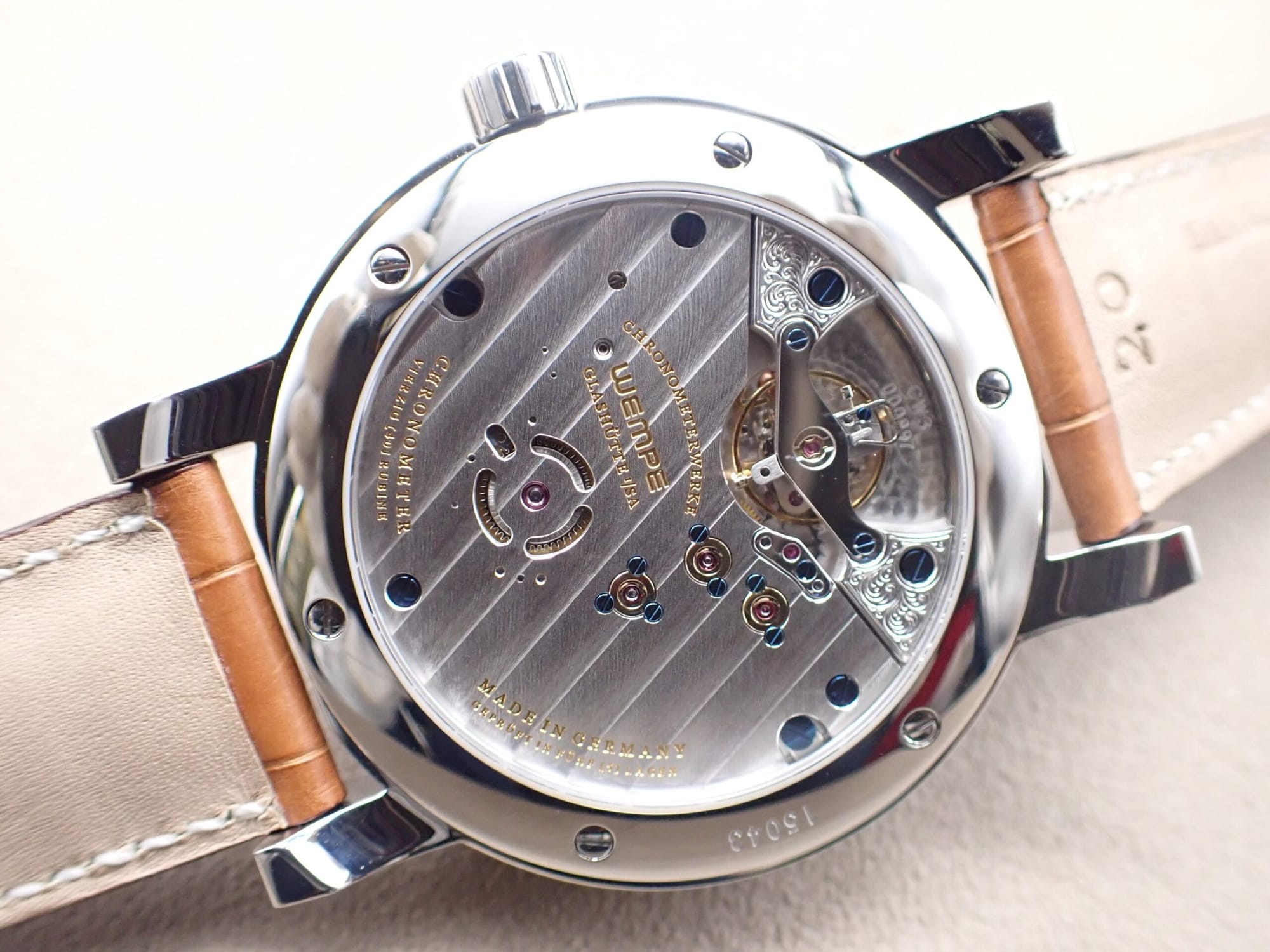
Flip the watch over, and you meet its best argument for existence: the Caliber CW3. The movement is hand wound, well finished, and distinctly Glashütte in architecture. The three quarter plate glows under broad Glashütte stripes, with blued screws and gold chatons holding the jewels. The ratchet wheel carries a sunburst finish, and a swan neck regulator rests above the balance. The engraving "Chronometer Glashütte i/SA" signals both origin and intent.
Mechanically, the CW3 beats at 28,800 vibrations per hour (4 Hz), higher than the traditional 21,600 of many German calibers. To support that speed, Wempe had components like the escapement lever and escape wheel skeletonized by laser to reduce mass, a specific and intentional detail. Power reserve is 42 hours, displayed on the dial, and the movement hacks for precise setting. In daily use, it runs within +2 to +5 seconds per day, meeting chronometer standards.
The CW3s origin tells an interesting story. Wempe calls it a manufacture caliber, and it is exclusive to them, but it was developed in collaboration with Manufacture Horlogere ValFleurier in Switzerland. Wempe oversaw design and finishing in Glashütte, while ValFleurier handled production engineering. Purists might debate its "in house" credentials, but the result is a movement that competes well with peers from Nomos and IWC: high beat, well finished, and mechanically honest.
Comparisons in the 5000 to 7000 USD Range
In its price bracket, the Wempe finds itself surrounded by strong company. Nomos offers the Lambda, smaller at 40.5 mm but boasting an 84 hour reserve and a more avant garde design. Zenith's Captain Power Reserve adds automatic convenience and a date, though it lacks the CW3's handcrafted personality. IWC's Portofino Hand Wound Eight Days delivers massive autonomy and brand prestige, but at a bulkier 45 mm. Against these, the Wempe feels like a collector's choice, a quieter option that trades glamour for depth. It is the kind of watch you explain to people rather than flaunt.
What Enthusiasts Say
Collectors who discover the Chronometerwerke Power Reserve often come away surprised. Reviewers praise its construction and finishing, calling it "a real watchmakers watch." The main critique is size: 43 mm is undeniably large for a dress piece. Some also note that Wempes name, despite its heritage, lacks the glamour of older maisons. Yet once handled in person, skepticism tends to vanish. The dial, the movement, the tactile satisfaction of winding it each morning, it all feels purposeful. Forum comments often read like quiet admiration: "too big, maybe, but too well made to ignore."
Market Value
On the secondary market, it can often be found between $3,000 and $4,000, good value considering its certification, finishing, and limited production. Like most niche brands, Wempe watches depreciate quickly, but that makes them some of the best kept secrets in collecting. A used Chronometerwerke Power Reserve gives you craftsmanship comparable to watches twice its retail.
Final Thoughts
The Wempe Chronometerwerke Power Reserve is not a watch that chases trends or visibility. It is a watch built by engineers who care about precision and by a company that has been timing voyages, races, and chronometer trials for over a century. Its 43 mm case makes a statement, but the tone is measured, not boastful. You wind it, feel the mainspring tighten, and watch the AUF climb. There is something ritualistic about it, a reminder of when knowing the time meant knowing your position on the planet.
If you want something understated but well made, this watch rewards you daily. It is not trying to be rare or expensive; it is trying to be right. In a world of synthetic heritage, that counts for something.