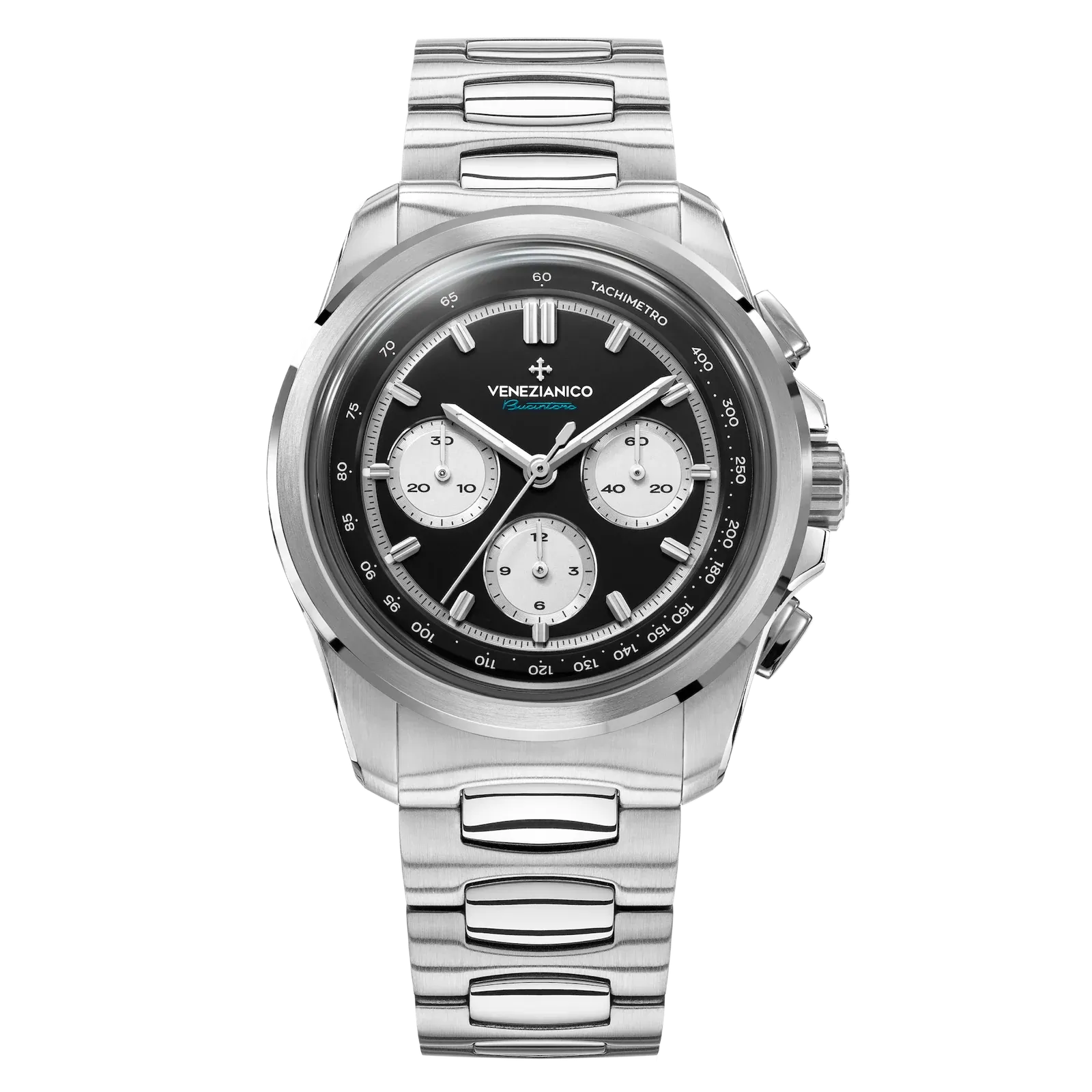
My friends have a standing verdict on my collection. To them it's one watch, purchased again and again. They have a point. There's the ÁIGI Arctic Chrono II. The Hoffman Racing 40. The Brellum Pandials. All of them panda chronographs. And now the Venezianico Bucintoro 42, reference 8221510C, ordered directly from the brand for $1,835 with American duties prepaid. I need another panda chronograph like I need a hole in the head. But here we are.
So this review has to answer two questions instead of the usual one. The first is the normal one: is the Bucintoro any good? The second is the one my friends keep asking, in so many words: why does a man who already owns a shelf of white dials with black counters keep buying white dials with black counters? The answer to the first question is on my wrist. The answer to the second is in a photograph.
Thirty-seven millimeters
The photograph is of a Rolex Cosmograph Daytona with the exotic dial, the one the watch world calls the Paul Newman. Cream face. Three black registers with those art deco numerals. A black tachymeter bezel that reads UNITS PER HOUR. Somewhere early, long before I could have told you what a column wheel does, that watch imprinted on me. Ask me to draw "chronograph" from memory and my hand will produce that dial.
Newman's own example sold at Phillips in October 2017 for $17,752,500, and for the next two years it was the most expensive wristwatch ever sold at auction. That's the famous part of the story. Here's the part that matters for this review: a vintage Daytona measures about 37mm across. I have a 7.5 inch wrist. My sweet spot runs from 42mm to 44mm, and even the modern Daytona, at 40mm, wears small on me. The watch that defined the category for me is a watch I can't wear. Call it the 37-Millimeter Problem: the watch that built your taste doesn't fit the wrist your taste lives on.
Once you name it, the shelf explains itself. Every panda chronograph I've bought is another run at that photograph, scaled up to fit. The attempt can't fully succeed, by definition, which is exactly why it doesn't stop. My friends believe they're describing a blind spot when they say my watches all look alike. They're actually describing the mechanism. They're all the same watch.
I've circled the Daytona from the other side before, too. When I reviewed the Zenith Chronomaster Sport, I told myself I was reviewing an El Primero. I was really reviewing the engine Rolex bought for the Daytona and kept inside it for twelve years. That piece was my answer to the Daytona's movement. This one is my answer to its dial.
The runner-up
In late 2017, two brothers studying at Ca' Foscari University in Venice, Alberto and Alessandro Morelli, started a watch company. The origin story the brand tells involves a walk through St. Mark's Square and the golden Renaissance cross atop the Clock Tower, the symbol that became their logo and now sits applied on my dial. The company launched as Meccaniche Veneziane, raised more than $800,000 across three Kickstarter rounds, and in January 2022 renamed itself Venezianico. The official reason is that the brand outgrew its original idea of celebrating Venice through decorated mechanics. (The unofficial reason, as others have noted, may be that Meccaniche Veneziane is a mouthful outside Italy.)
Italy's watch story has mostly been a design story. The most famous Italian watch brand of them all built its legend on Florentine design wrapped around movements made elsewhere, something I'm reminded of every time I pick up one of my Panerais. Venezianico runs the same play from the Veneto: Italian case and dial design, engines bought in from Japan. It isn't hiding its ambition to change that. By 2023 production had passed 20,000 watches a year, and in 2025 the brand introduced its first proprietary caliber, the V5000, developed over two years with the Italian manufacturer OISA and the engineer Fausto Berizzi, formerly of Lemania and Vaucher. For a company that didn't exist nine years ago, that's a steep trajectory.
The Bucintoro is the brand's chronograph, named for the Doge of Venice's ceremonial barge, and in 2025 Venezianico showed everyone exactly how high it's aiming with this line. It had already honored Apollo 11 with the Bucintoro 1969, 69 pieces built on new old stock Lemania 1873 movements, the same caliber family the Speedmaster Moonwatch calibers descend from. Then came the second chapter. The Bucintoro 1976 honored Concorde: 100 more restored Lemania 1873s, brought back to life by brand watchmaker Daniele Zorzetto, each watch carrying a certified titanium plaque cut from an original Concorde engine blade. They capped the run at 100 pieces as a nod to the Concorde's fuel consumption, roughly 17 liters per 100 passengers per 100 kilometers. That's a number doing narrative work. The watches sold out on preorder at €4,750, and asking prices on the secondary market now run from around $13,000 to more than $20,000 for full sets.
I know all this because I tried to buy one and clicked too slowly.
So I bought the runner-up. That's the honest provenance of the watch in this review: the standard Bucintoro 42, panda dial, steel bracelet, ordered from the brand's own site with no allocation games, no waitlist, and no dealer relationship to maintain. It shipped, it arrived, and unlike the 1976, it was built to be worn rather than flipped. (One footnote for the family historians: Venezianico's journal calls the NE88-powered model its first chronograph, while aBlogtoWatch reviewed the smaller 40mm, NE86-powered Bucintoro in 2023 as the brand's first. I'm documenting the disagreement rather than settling it.)
Forty-two by forty-nine
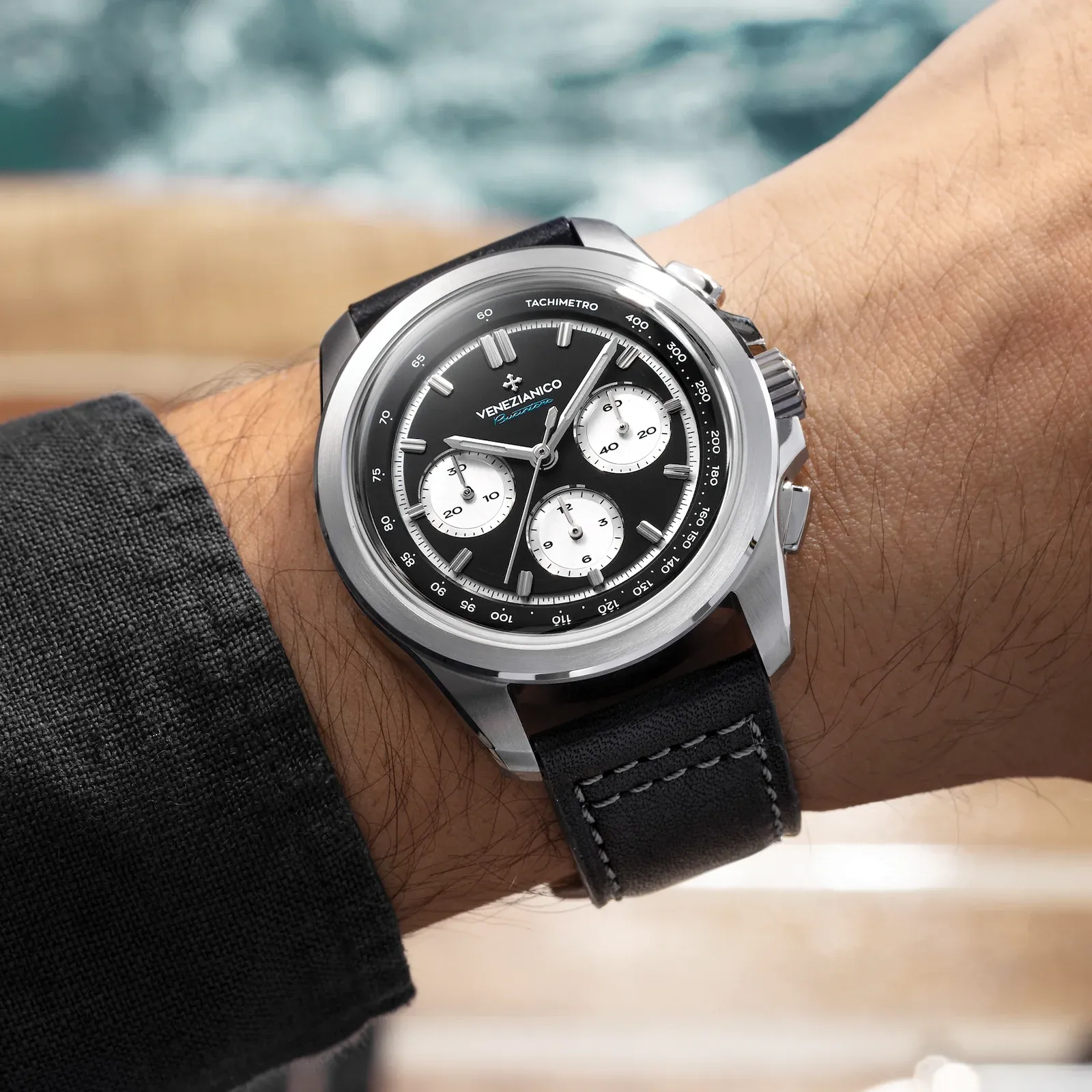
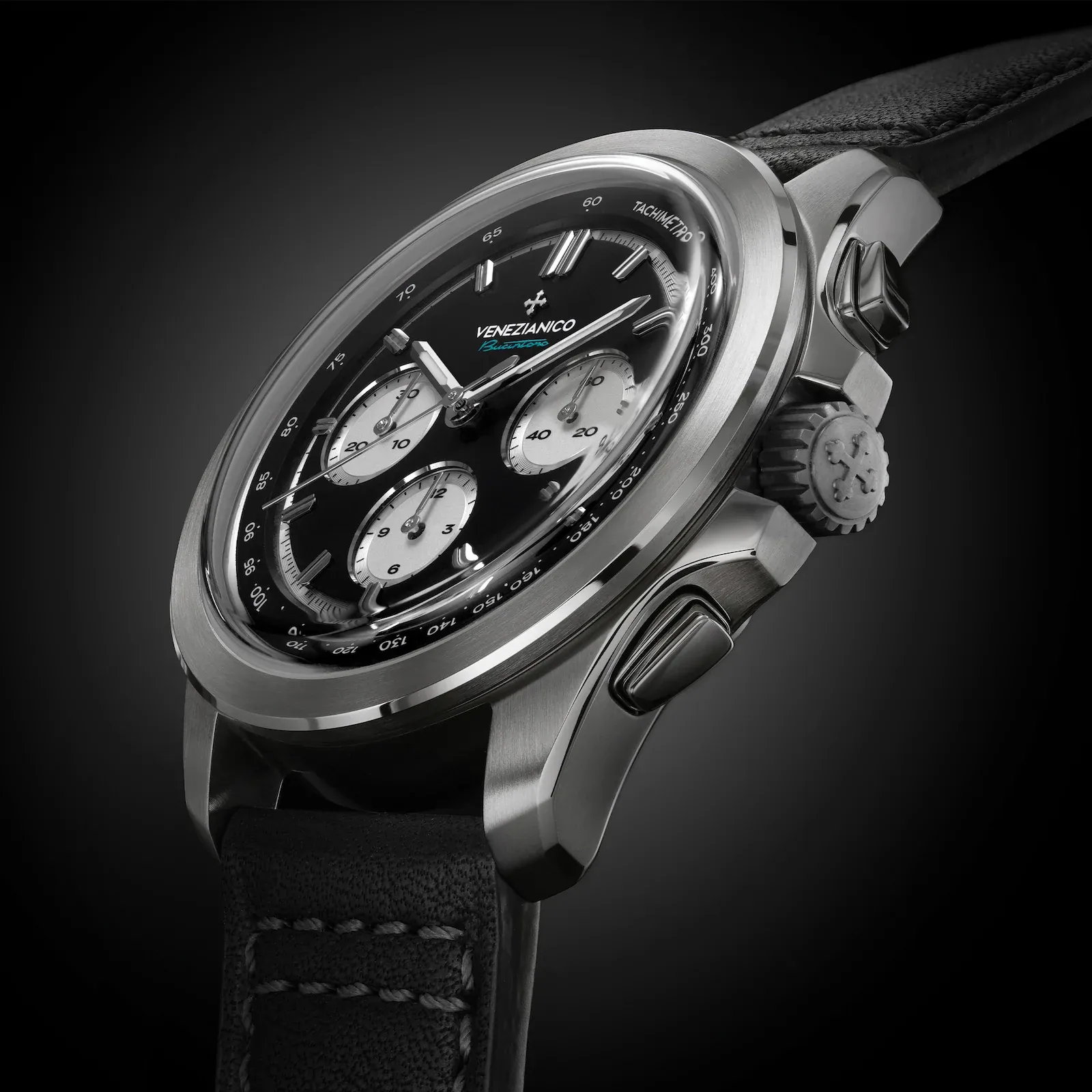
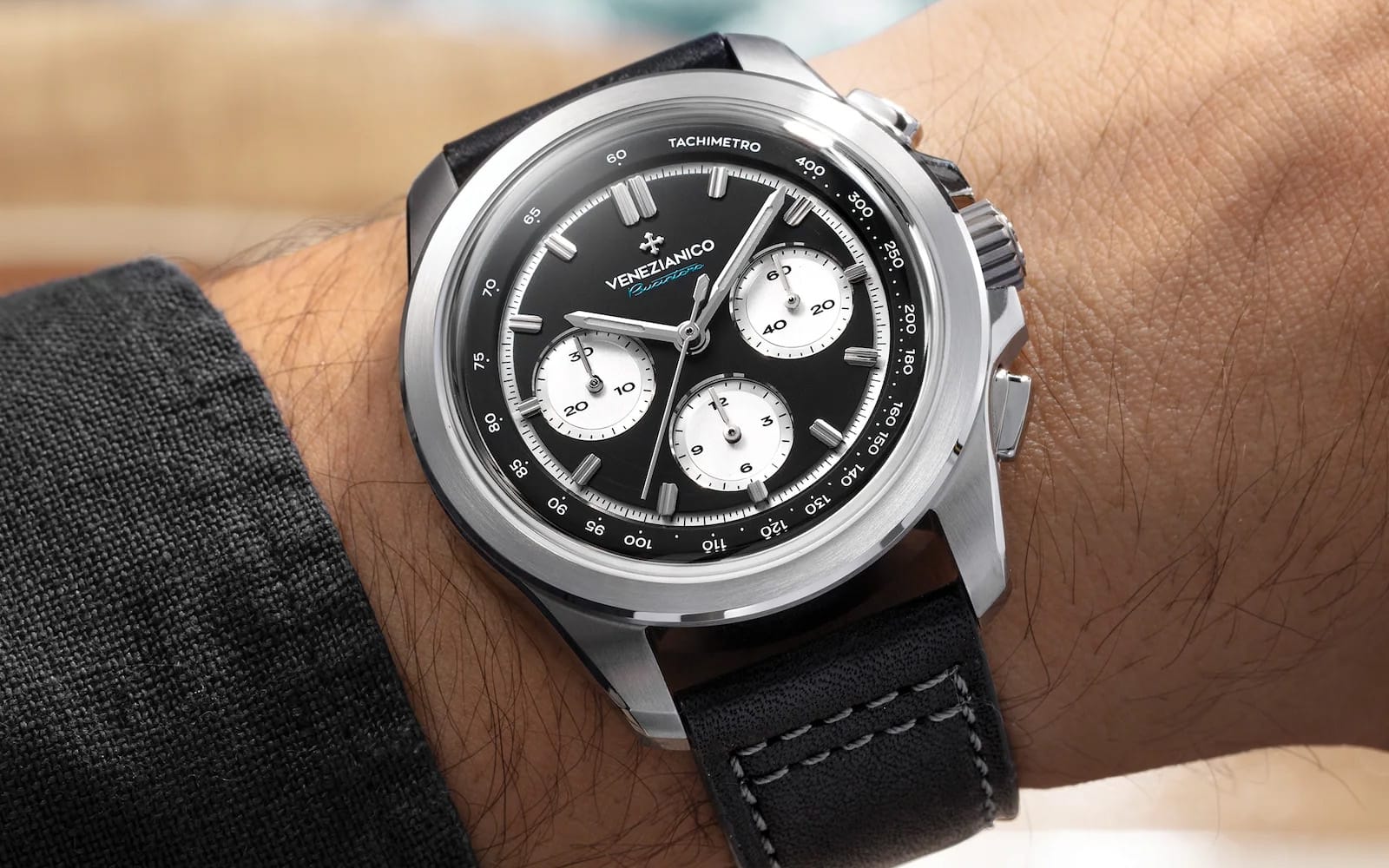
On paper, the Bucintoro 42 lands in the middle of my zone: 42mm across, 49mm lug to lug, 11.7mm thick before the 1.9mm double domed sapphire is counted. The crown screws down, water resistance is 100 meters, and the caseback is solid steel. We'll get to why that back is solid when we get to the movement, because I think the two facts are connected. Then the case does something genuinely odd for this category. Nothing.
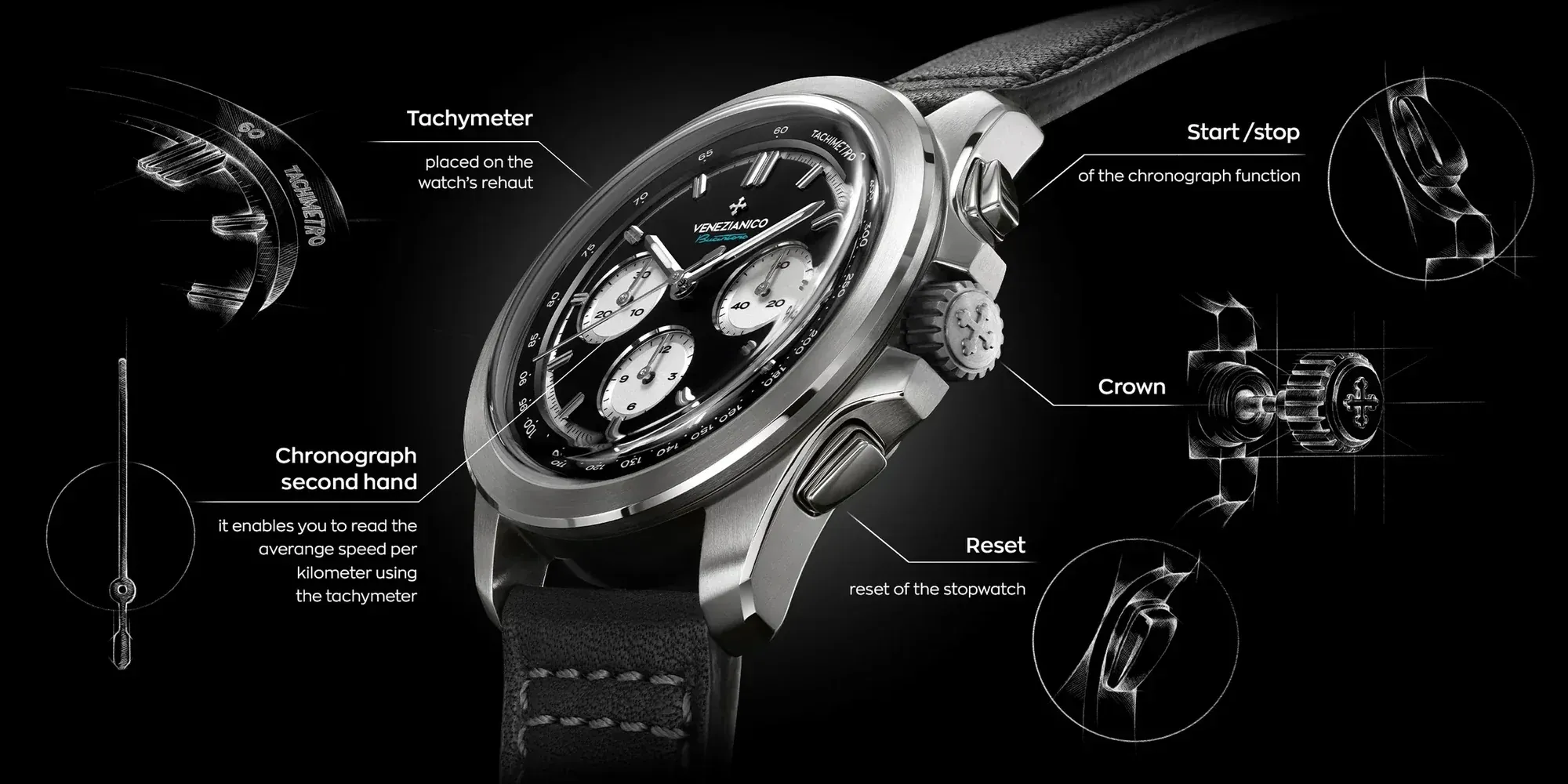
The bezel is bare steel. No tachymeter, no count-up scale, no numerals of any kind. Venezianico moved the tachymeter inside, onto the rehaut, where it rings the dial from under the edge of the crystal. On a panda chronograph, that's close to heresy. This segment runs on Daytona shorthand, and the single loudest piece of that shorthand is a tachymeter bezel, the UNITS PER HOUR ring from the photograph in my head. Venezianico took the one element that would have made the homage unmistakable and deleted it.
I read the blank bezel as a design choice, and it's the reason this case looks like nothing else in the sport chronograph aisle. Strip the scale off the bezel of almost any other panda chronograph and you'd lose its identity; here, the absence is the identity. The cost is practical. A tachymeter down on the rehaut is a scale you consult deliberately, peering past the crystal's edge, rather than one that reads at a glance. I'll take that trade. I time things with the chronograph weekly. I calculate speed over a measured kilometer approximately never.
Steps of depth
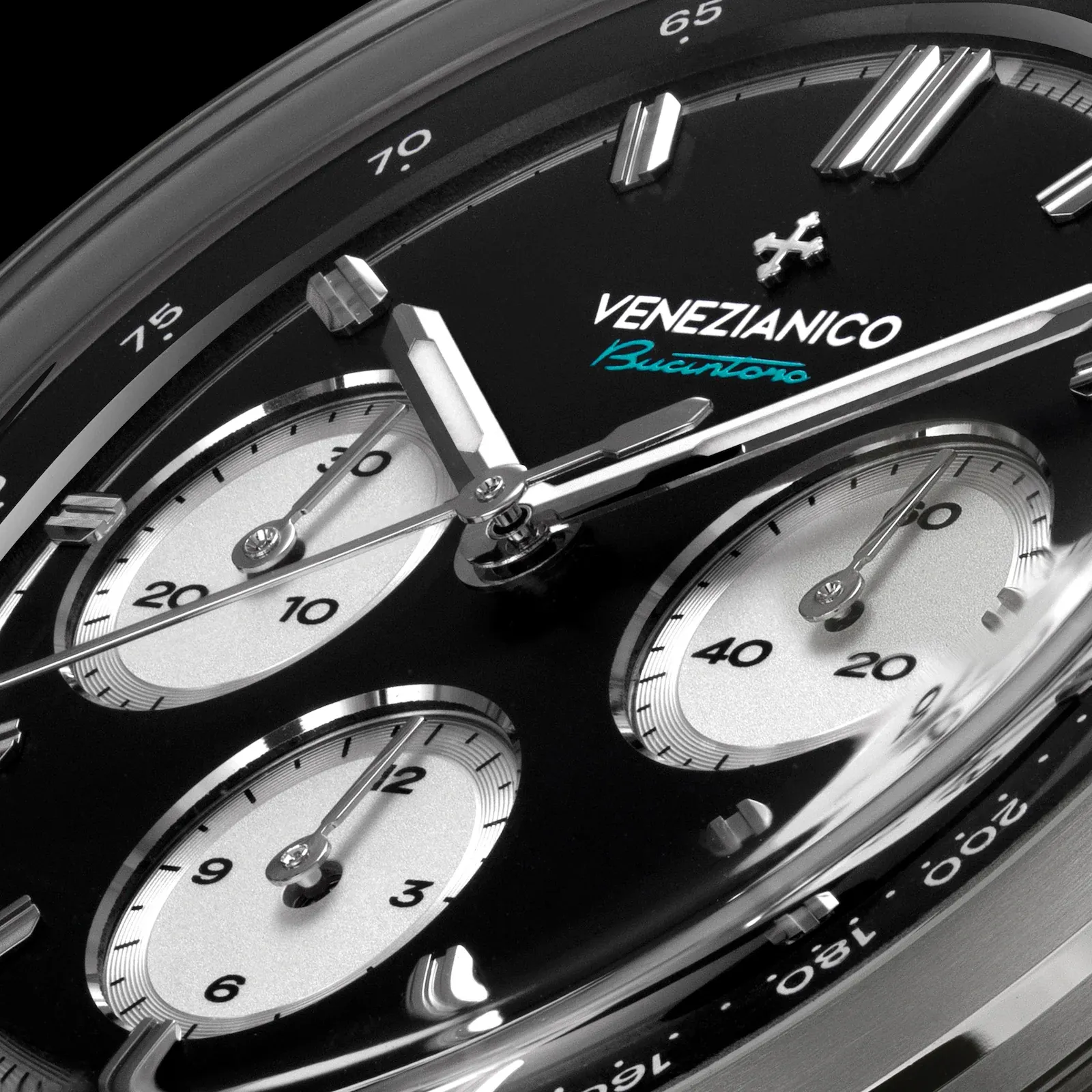
The dial is where the money visibly went. The layout is the NE88's tri-compax: a 30 minute counter at 9 o'clock, running seconds at 3, chronograph hours down at 6, and the chronograph seconds hand on the central shaft. The construction is a sandwich not only printed: an upper plate with real depth, the counters dropped below it, and the indices and that Renaissance cross logo applied on the top deck. The steps of depth are the first thing you notice in the metal, and they're what separate this dial from the flat-printed pandas crowding this price bracket.
Applied indices on a layered dial are also where tolerances go to die, and my example proves the point. My 3 o'clock marker is tilted, very slightly, the kind of thing you catch at certain angles and then can't entirely un-see. I understand why it happens. Perching individual metal markers on the top plate of a stepped dial is precisely the operation that's hard to get perfect every time. If I'd paid more, I'd probably have asked for a replacement. At this price, it's a simple and forgivable flaw, and I'm leaving it at that.
The one splash of color is the model name, printed in teal beneath the brand signature, and it's nearly a secret. The teal is dark enough to read as black until the light catches it, and when it does, it's the best small detail on the dial.
Two absences complete the picture, and both are choices. There's no date window, even though, as we'll see, the movement underneath carries one. And there's no lume verdict in this review, only a first impression: the BGW9 Super-LumiNova on the indices and the hour and minute hands charges to a clean baby blue glow, and mine faded sooner than I'd like. A brief charge by a window isn't a real lume test, so treat that as a note, not a finding.
The click and the ghost
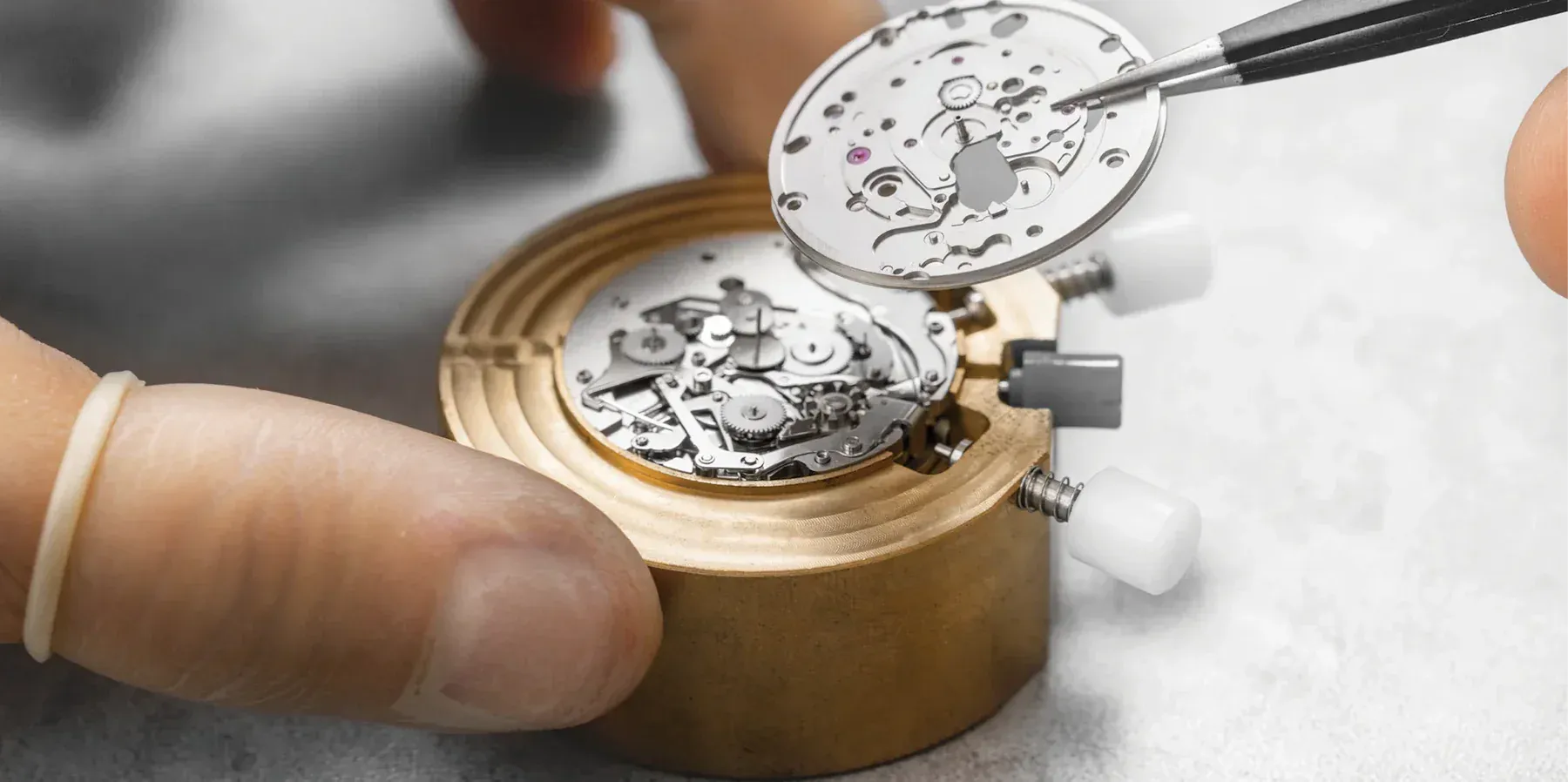
Press the top pusher and the Bucintoro answers with a real click. Press the bottom one and the chronograph seconds hand drops dead onto 12. Exactly onto 12, every time, on my example. That behavior has a name, or rather three: column wheel, vertical clutch, three pointed hammer.
In plain language: the column wheel is the little crenelated tower that sequences the chronograph's start, stop, and reset, and it's the reason the pushers feel crisp instead of crunchy. The vertical clutch couples the timing hand directly rather than through meshing teeth, which is why the seconds hand starts cleanly, without the stutter, the famous jumping hand, that lever-and-cam chronographs are prone to. And the three pointed hammer is why every counter snaps home together at reset. In this architecture, each counter even runs off its own driven wheel, and the chronograph minute hand creeps forward continuously instead of jumping once a minute.
The caliber is the Seiko NE88A, and here the story gets more interesting than the marketing, in both directions. First, the genuinely impressive part. The NE88 comes from Time Module, the Seiko subsidiary that sells the 8R chronograph family to outside brands, and its lineage runs straight back to 1969, when Seiko's caliber 6139 was first to market with exactly this combination, a vertical clutch governed by a column wheel, in the same season the El Primero was making automatic chronograph history. Nearly six decades later, the engine in the modern Daytona uses the same basic architecture. The $1,835 watch chasing the Paul Newman's dial shares its chronograph blueprint with the watch that inherited the name. The movement runs at 28,800 vibrations per hour with a quoted reserve of about 45 hours, and it winds in both directions of rotor swing through Seiko's Magic Lever. That last point is a concrete advantage over the segment's eternal benchmark, the ETA 7750, which winds in one direction only.
Now the deflating part, and regular readers know I don't skip it. Venezianico's copy calls the NE88 the top of Seiko's automatic chronograph range and describes it as hand assembled at the Grand Seiko facilities in Morioka. Read that quickly and you might think you're getting a Grand Seiko caliber. You're not. Grand Seiko's mechanical movements are the 9S family, and the 8R line, for all its cleverness, is generally ranked below even Seiko's own older 6S chronograph in refinement. WatchBase files the NE series under Premium Mechanical, and premium OEM is exactly the right grade: excellent engineering, honest finishing, no pretense of haute horlogerie.
Then there's the question of what this movement is even called. Venezianico labels it NE88 / 8R48, and Caliber Corner maps it the same way. Grail Watch Reference says the NE88 is the OEM version of the 8R39. WatchBase calls it closest to the 8R28. Part of the confusion is chronological, since the NE88 arrived in 2014 and Seiko's own 8R46 and 8R48 designations appeared years later. So I can tell you precisely what's inside my watch. I can't tell you, with certainty, its Seiko street name, and I'd rather document that dispute than pretend to settle it.
All of which explains the solid caseback. Nobody decorates an OEM workhorse for display, and Venezianico clearly knows the difference between an engine you use and an engine you frame. When the brand had restored Lemania 1873s to show off in its limited editions, it fitted exhibition backs. The Bucintoro 42 keeps its steel shut. Honest, if a little unromantic.
One ghost remains. Pull the crown to its first position and turn it, and nothing visible happens. That dead spot is the NE88's native 4:30 date, which Venezianico chose not to cut a window for. Whether the date wheel is still in there, faithfully advancing a number nobody will ever read, or was deleted from the works entirely, I can't say without opening the case. And I'm not opening the case. I like the clean dial enough to live with the mystery.
Two millimeters short
This is a heavy watch. Venezianico doesn't publish a weight and I haven't found one anywhere else, so for now you'll have to take the adjective without a number. For calibration: the lightest panda on my shelf, the Brellum Pandial Bicompax in DLC titanium, weighs 72 grams, and the Bucintoro on its bracelet lives at the opposite end of that spectrum. Whether that mass reads as reassuring or tiring is a personality question, and you already know which kind of person you are.
The bracelet is Venezianico's Canova, and yes, it's the one that makes everybody reach for the same comparison. Even aBlogtoWatch couldn't get through the smaller Bucintoro without addressing the resemblance to a very famous integrated sports watch bracelet. I'll just say what I see: Nautilus-style links on a conventionally lugged case. The links are held together with friction pins, and sizing it was no real trouble.
Then I ran out of millimeters. The clasp offers no micro adjustment, which leaves me choosing between wearing it slightly loose or a bit too tight. One or two more millimeters of adjustment would land it perfectly, and they don't exist. At $1,835, with a movement this serious, a few millimeters of on the fly adjustment is the cheapest meaningful upgrade Venezianico is leaving on the table.
Otherwise, the numbers are the point. At 42 by 49, this is squarely the size I buy on purpose, which, as the first half of this review explains, is precisely why this watch exists in my collection at all.
They're all the same watch
Line my pandas up and my friends' case makes itself. Stand at the shelf a minute longer, though, and the differences become the interesting part, because each one solves a different slice of the 37-Millimeter Problem. The ÁIGI Arctic Chrono II does the look for around $289 with a Seiko VK64 meca-quartz heart and 40.5mm of clean Scandinavian design. The Hoffman Racing 40 runs $269 in quartz and $599 mechanical, and it's the watch that taught me to tolerate 40mm at all. The Brellum Pandials bring Swiss seriousness at 43mm with COSC certificates, one built on a Valjoux 7750 base and one on a La Joux-Perret column wheel caliber, at $3,730 for the titanium Bicompax. The Bucintoro splits the differences: $1,835, 42mm, the only Japanese mechanical in the row, and, under two thousand dollars, the only one with a column wheel and a vertical clutch behind the dial.
It also makes the most direct run at the photograph. Three black counters on a pale field, real depth, no date, nothing on the dial it doesn't need. And then the bezel turns and walks away from the homage entirely. The most faithful dial in my collection sits on the least Daytona case in the category, and I think that specific combination is what made me click buy.
Is it the closest I've gotten to the watch in the photograph, or just the most recent attempt? A week in, I honestly don't know, and I've decided that's the right answer to publish. The 37-Millimeter Problem doesn't have a solution. It has installments.
My friends will see the Bucintoro and tell me it looks exactly like every other watch I own. They're right. They've always been right. They're all the same watch. I've just stopped treating that as criticism, because the repetition was never the flaw in the collection. It's the engine of it. Somewhere in a photograph sits a 37mm Daytona that will never fit my wrist, and every so often a watch arrives at my door to stand in for it. The Bucintoro stands in better than most.