

How did a 1950 tool watch and a 1968 compressor forge a cult line that still lives on?
I stopped into the TAG Heuer boutique in New York City to try the new 39 mm Skipper. Thirty‑nine usually feels small on my wrist, but the glassbox case wears bigger and the color hit was worth the trip. While I was there I saw a 1968 Abercrombie & Fitch Seafarer that was in for service. In the wild, a real one. Clean anthracite dial, blue tide disc, Autavia bezel catching the lights.
Abercrombie & Fitch, back when it outfitted sailors and hunters, asked Heuer in the late 1940s for a wrist instrument that could display tides for people who lived by them. Jack Heuer and his physics teacher, Dr. Heinz Schilt, translated John Alden Knight’s Solunar theory into wheels and gears for the 1949 Solunar, then fused that tide indication to a three‑register chronograph sold through A&F as the Seafarer. That is the root system.
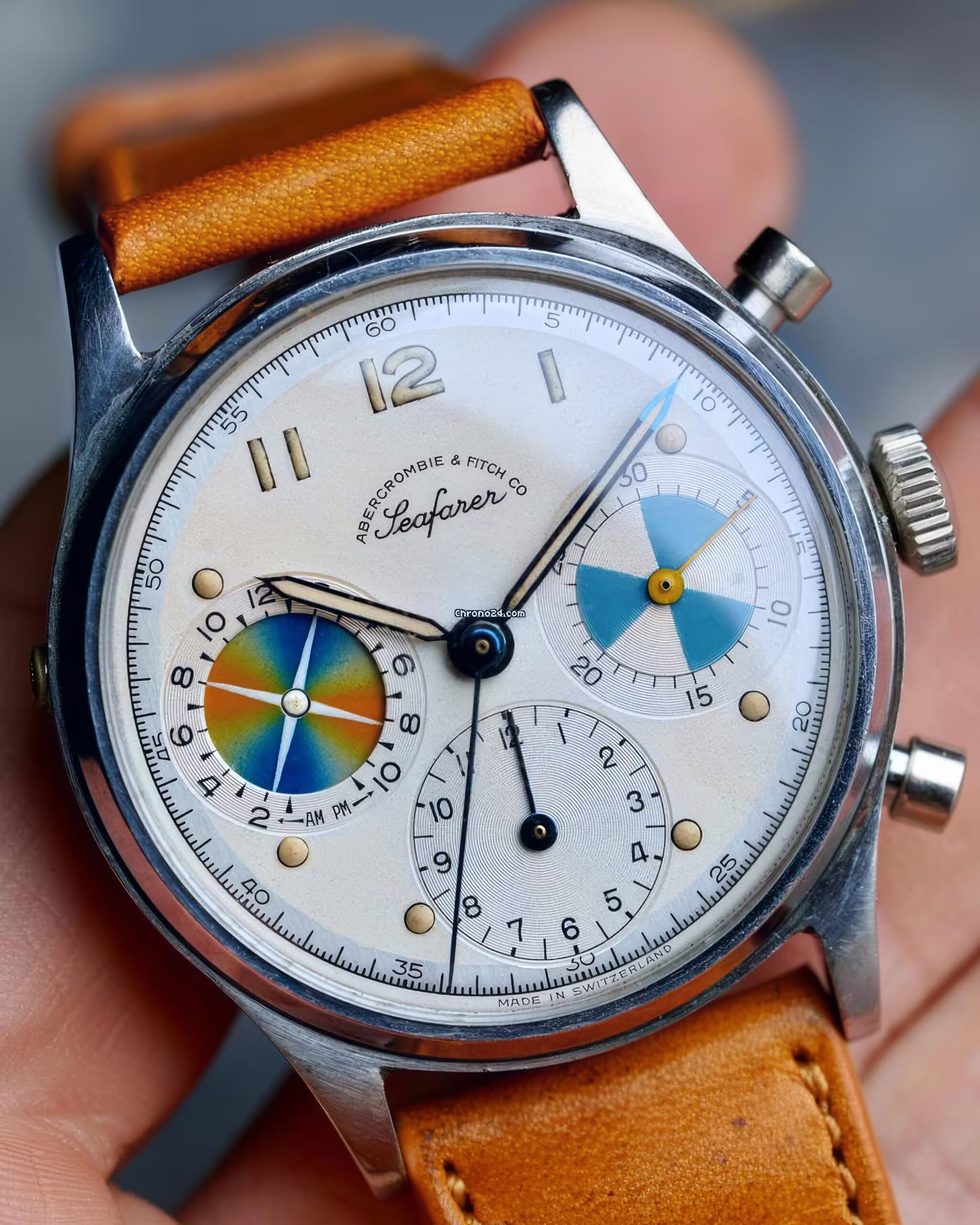
1950 Seafarer, Reference 346 - the launch piece
- Back story. The first Seafarer used Heuer’s Ref. 346, a roughly 37.5 mm steel case with a polygon screw back and large pump pushers, housing a modified Valjoux 71. The first execution shows the tide disc through a 180‑degree cutout and rotates the minute recorder for legibility at sea. This is mid‑century instrument design written for wet decks and cold hands.
- Designers and commissioning. The brief came from A&F. Jack Heuer handled development with Dr. Heinz Schilt, who solved the math for a settable tide display aligned to local tables. That collaboration is documented in Jack Heuer’s memoir and in auction‑house histories of the Solunar and Seafarer.
- Purpose. Marry a waterproof chronograph to a readable tide indicator and a yacht‑timer minute register. Those alternating blue blocks in the 30‑minute counter are not decoration, they are code for a regatta start. Period references and model pages show the layout and colors in detail.
- Production and survival. Heuer never published totals. Serious dealer scholarship pegs Ref. 346 output at roughly 10 to 15 examples across the early executions. That figure is an estimate, not a factory count, but it aligns with how seldom true 346 Seafarers surface publicly. I treat this as a tight, working hypothesis that should be revised if a credible serial‑number census grows.
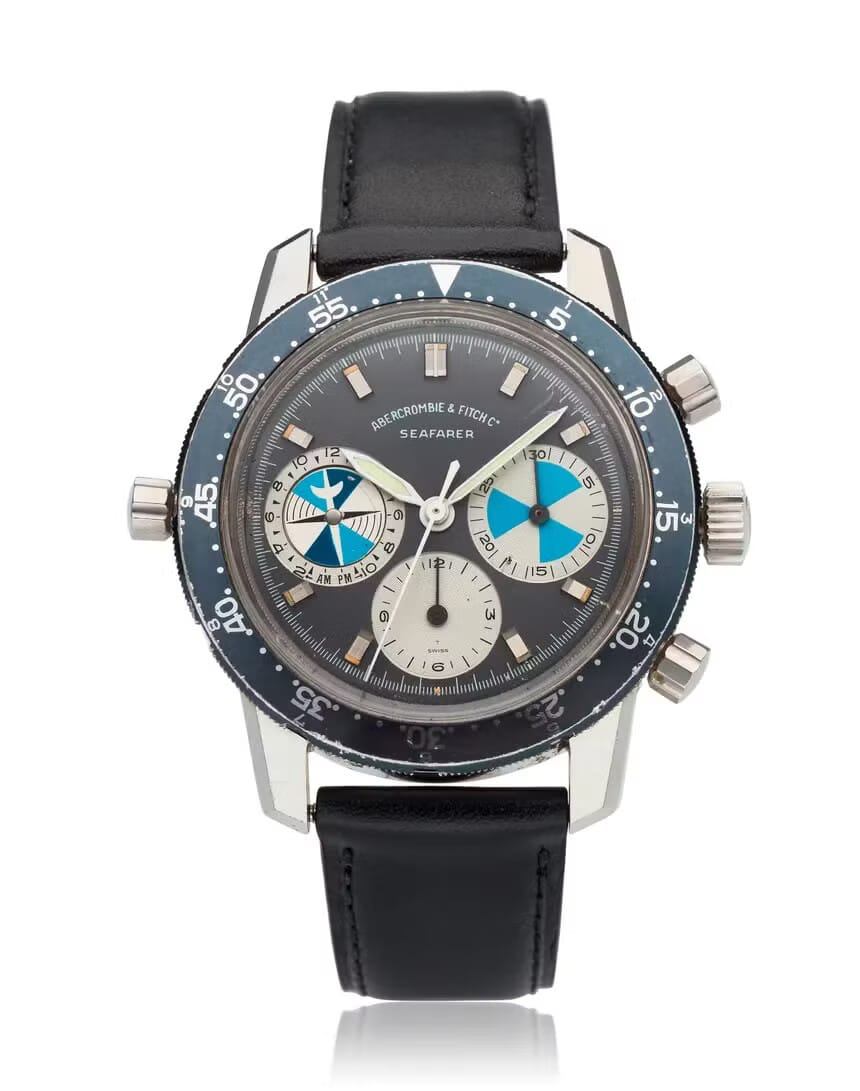
1968 Seafarer, Reference 2446C - the compressor era
- Back story. By 1968 the Seafarer moved into the Autavia 2446C compressor case with a snap‑back architecture rated to 100 meters, a rotating bezel, a darker dial, and the signature sky‑blue tide disc. The movement migrated to a modified Valjoux 72. OnTheDash documents two executions, first with polished steel hands and later with high‑contrast white hands.
- Designers and lineage. Heuer’s product group under Jack Heuer adapted the Autavia platform for derivatives like the Seafarer, keeping the tide module born from the Heuer‑Schilt work. Period guides and brand histories place the Seafarer squarely in this Autavia ecosystem.
- Purpose. Same job, more robustness and more timing options. The rotating bezel adds a second scale; the higher‑contrast hands boost legibility on water. Compressor‑era writeups call out both changes.
- Production and survival. A rarity table compiled from thousands of observed Heuers estimates the 2446C Seafarer at fewer than 300 produced, with fewer than 40 individually documented by serial. That places any sighting in the high‑rarity tier. As with all such reconstructions, treat this as directional rather than gospel.
Two Now Carry the Flame
Ref. CBS2014.FT6293 is the direct descendant in spirit because it brings the tide indication back. It uses the in‑house TH20‑13 with an integrated tide display in a 42 mm Carrera glassbox. Official materials confirm the Seafarer brief and 1968 styling cues; the collaboration release notes an edition of 968 pieces.
Ref. CBN201N.FC6620 reads as a tribute to the launch era rather than a literal remake. It keeps the clean 42 mm Carrera format with TH20‑00 and a dial that nods to the early color story. TAG notes a run of 500 pieces.
The modern Skipper I tried on, the 39 mm glassbox Skipper rides the same architecture and reconnects the brand to its sailing DNA with a contemporary color story. TAG’s release notes the Intrepid link and re‑establishes the Skipper as a core model rather than a one‑off.
Final thoughts
The Seafarer is not just another pretty vintage Heuer. It is a retailer’s practical request turned into a real nautical complication that solved a real problem. It starts as a 1950 instrument in a Ref. 346 case with a modified Valjoux 71, matures through the early 1960s cases, and arrives in a 1968 compressor Autavia with a modified Valjoux 72 and a rotating bezel. The numbers stay small and the documentation stays strong, which is why most encounters happen behind a bench light rather than under a showroom spotlight. My two modern Carreras keep that story wearable. One carries the function forward. The other carries the look. Put them beside a Skipper and Heuer’s seagoing argument resolves into three distinct shapes that share a single purpose.
Skipping Down the Rabbit Hole
If the Seafarer is the origin story, the Skipperera is the rabbit hole. It is the rarest and most prized Skipper reference. Collectors debate the numbers. HeuerChrono’s long‑running census has tracked fewer than 20 known survivors, while Jeff Stein’s Hodinkee research suggests a small 1968 run with several public sales and an estimate that a few hundred may have been produced originally. Either way, it is a tiny pool.
The back story begins with Emil “Bus” Mosbacher’s 1967 America’s Cup win aboard Intrepid with Heuer timing on board, and a celebratory Skipper built on a 36 mm Carrera case that collectors later nicknamed Skipperera. The metallic blue dial with mint‑green running seconds and the 15‑minute regatta recorder in green‑green‑orange are straight out of the late 1960s and echo Intrepid’s livery. That 15‑minute scale maps the classic start sequence. Put all of it together and you have a legendary tool watch that almost never appears for sale. I did find one this morning on Chrono24 for $119,495. Get it while you can!
Sources
- OnTheDash, “The Definitive History of the Abercrombie & Fitch Seafarer” and model pages for Ref. 346 and Ref. 2446C, including first and second executions. (OnTheDash)
- Heuer Price Guide rarity table for serial‑based estimates on the 2446C Seafarer. (Heuer Price Guide)
- Christie's and OnTheDash records for the 346 that realized 60,000 dollars on June 21, 2017. (Christie's, OnTheDash)
- Wind Vintage scholarship on the 346 production estimate. Treat as a dealer estimate with uncertainty. (Wind Vintage)
- TAG Heuer official pages for CBS2014.FT6293 and CBN201N.FC6620, plus TAG’s 39 mm Skipper announcement. (TAG Heuer, TAG Heuer Official Magazine)
- OnTheDash and Hodinkee for the Skipperera origin and rarity discussion. (OnTheDash, Hodinkee)
