

Show this watch to someone who knows watches and you can see their face run a small program. First the appraisal: titanium, a clean sweep of brushed and polished surfaces, a reverse-panda dial, an exhibition caseback with a decorated rotor turning behind it. Then the verdict assembling itself, the one that says this is a real watch, a couple of thousand dollars of one. Then they read the dial, and the program stalls. The name at twelve o'clock is TIMEX.
I've handed it to a few people now, and the stall is the same every time. Timex is the company that taught America a wristwatch could be cheap and good and basically disposable, a thing you bought at a drugstore and replaced without grief. Founded in 1854 as the Waterbury Clock Company in Connecticut, the brand built its name on the Weekender and the Ironman and a midcentury slogan about taking a licking and keeping on ticking. Nobody does a double-take at a Weekender. And yet here is a Timex that costs $2,250.
The man responsible is Giorgio Galli, a Milan-based designer who became Timex Group's global creative director in 2016 after a career drawing watches for Swatch, Seiko, and Citizen. Galli spent years testing whether anyone wanted a more expensive Timex. He did it under his own name first: the Giorgio Galli S1 in 2019, a $450 automatic, then the S2, which arrived in 2022 billed as the first Swiss-made Timex in four decades, then a limited titanium S2Ti with a tool-free bracelet system he called I-Size. The eponymous line was a proving ground. The real move came in 2025, when Galli launched Timex Atelier, a Swiss-made sub-brand, with the Marine M1a diver, a watch Timex called its first luxury piece and pointed squarely at Hamilton and Tissot. A GMT followed. Now come the chronographs, and the titanium one in front of me is the most expensive Atelier yet, the first to push the line past $2,000.
That's the bet behind the whole line: a company that built its name on $40 watches now wants you to pay luxury money for one and take it seriously. Quality isn't the problem. Plenty of $2,250 watches are well made, and this is one of them. The harder bar is being worth that, with TIMEX on the dial.
Case and dimensions
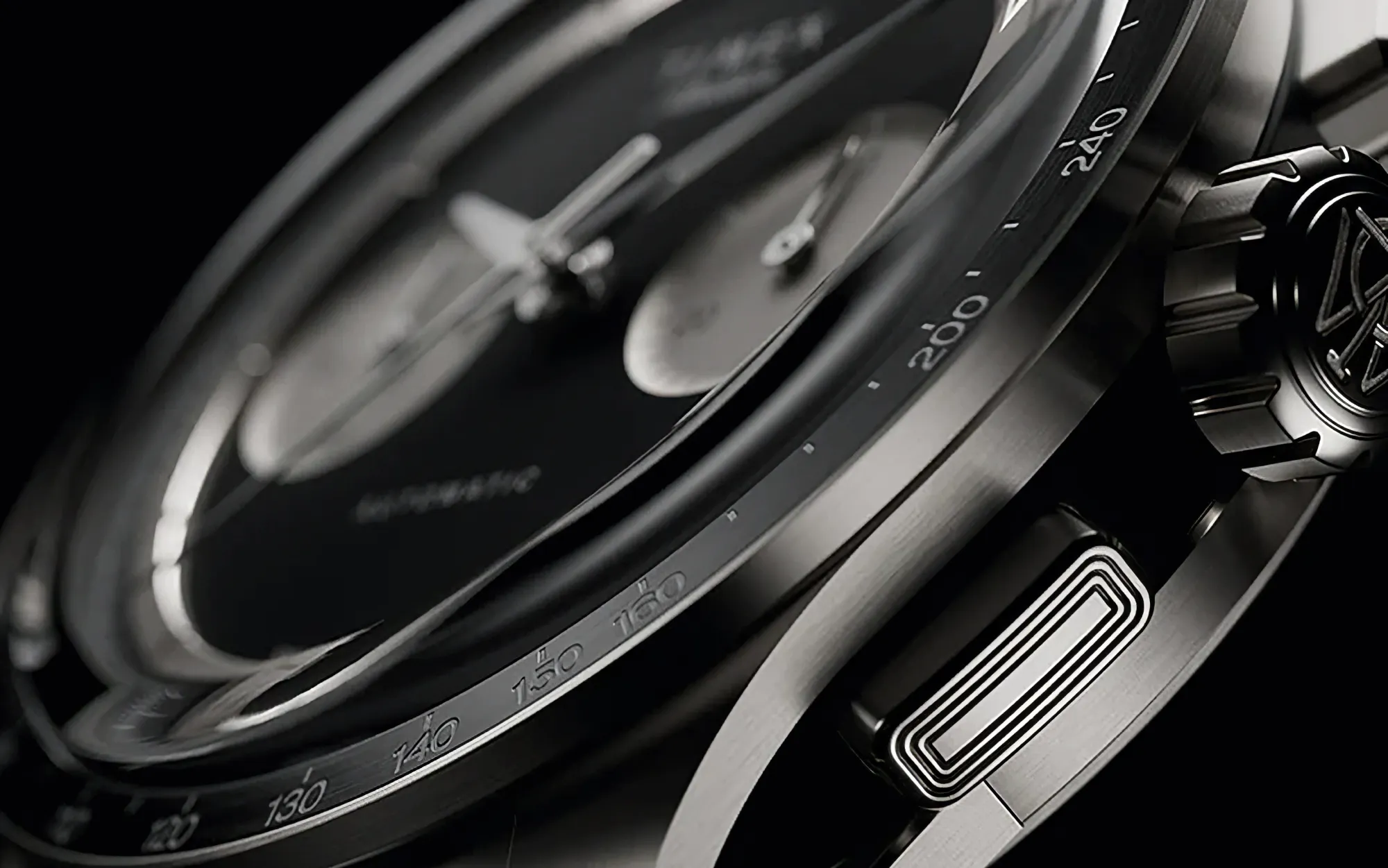
The case is 42mm across, 49.30mm lug-to-lug, and 15.75mm thick. That last number is the one to sit with. 15.75mm is not a dress-watch figure, and even one reviewer who likes the watch called it "genuinely chunky". On a 7.5-inch wrist it wears, but it wears as a substantial thing, a chronograph that announces a thickness budget the moment you pick it up. A fixed titanium bezel carries a black-IP stainless-steel insert with a tachymeter scale. The crown is titanium. The crystal is a double-domed sapphire. Water resistance is 50 meters, which is to say splashes and a careful swim, not much more.
The watch is titanium the way a sandwich is the bread: the outer case is titanium, but the middle case is black-IP-coated stainless steel. Steel weighs about three-quarters more than titanium for the same volume, so that core puts weight back into a watch the marketing wants you to think of as feather-light. If you're coming off a steel bracelet, the first time you strap on a titanium watch the lightness can be disorienting, a kind of is-this-thing-even-on confusion. This one gives you a softened version of that. It's light, but it isn't the near-weightless feel of full titanium, because half the structure isn't titanium at all.
Then the crown, and a real ergonomic miss. The bezel overhangs the crown enough to get in the way when you wind. You find yourself working around the lip of the bezel to get a grip on a crown that wants more room than it's been given. On a watch with a 43-hour reserve, this matters more than it would on a three-day movement. Take this off on Friday and it's dead by Sunday, which means you're hand-winding it on Monday, fighting that bezel every week.
And the crystal. Timex specs a double-domed sapphire with a triple-layer anti-reflective coating, and so does the press, which repeats the triple-layer claim. The wrist tells a different story. This crystal is reflective enough to work as a mirror. In ordinary light it throws back the room, and photographing it is a job for a polarizing filter. The likely explanation is that the coating sits on the underside of the crystal only, leaving the outer surface bare, which is a common way to protect a soft coating from scratches at the cost of the very glare it's supposed to kill. Whatever the cause, the gap between the claim and the experience is wide, on a watch whose entire pitch is clarity.
The bracelet is the redemption, and it's a big one. Adjusting a bracelet is usually where these reviews turn into complaints. Not here. The links come out with no tools at all. Timex calls them self-adjustable; in practice you pull on the link and it releases, a descendant of the I-Size system Galli first put on the S2Ti. I stared at it perplexed for a minute, looking for a screw or a pin, before I remembered the watch has its own method. It's close to the SmartLink system Cartier uses on the Santos, the one I praised in the titanium Santos review, and it's the rare bracelet I sized at home, alone, on the first try, in under a minute. The bracelet also carries quick-release spring bars, so swapping to a strap takes seconds. For a feature most brands either bungle or charge a fortune for, Timex built one of the better ones in the business and put it on a watch cheaper than the ones it embarrasses.
The dial, bezel, and lume
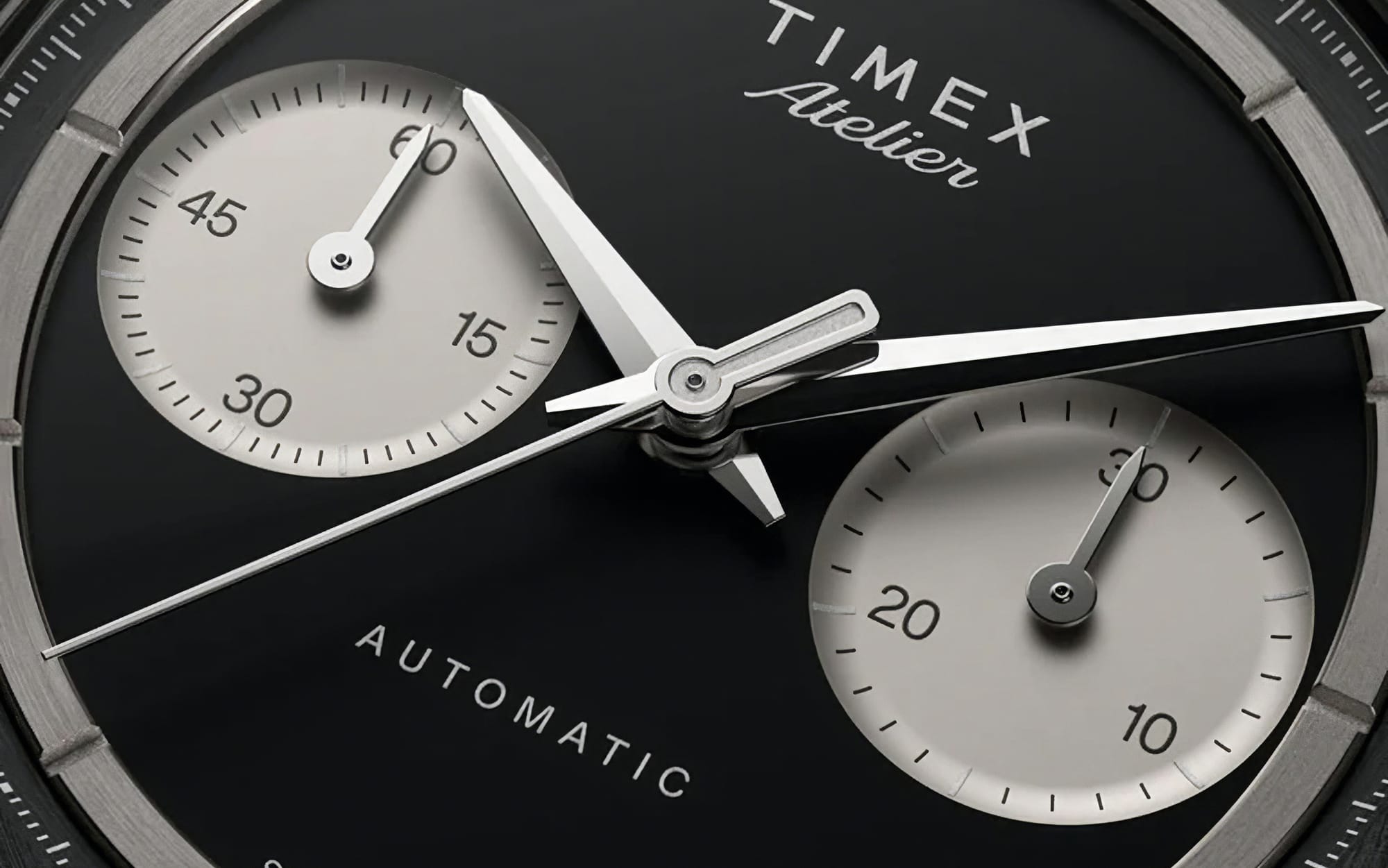
The dial is matte black with two subdials in pale grey, a reverse-panda layout with a 30-minute counter at 3 o'clock and a running-seconds register at 9, the chronograph timed on the central seconds hand. The hands are faceted dauphines that read a touch dressier than the case around them. As a composition it's clean and competent and, by my eye, a little inert. There's no real depth to it, nothing that catches the light and gives the eye something to do.
The trouble is what sits one shelf down in the same family. Timex also released a quartz version, the M1q, at $800 on a bracelet, and gave it a guilloché dial and a date window. Guilloché is engine-turned engraving, the kind of textured dialwork you almost never see at that price, and it's on the cheap one. I keep wishing this mechanical watch had come with the quartz watch's dial. That's a strange thing to want, and it points at something awkward about how this watch was costed: the more interesting face went on the less expensive model, and the $2,250 buyer gets the flat one and the automatic movement, while the $800 buyer gets the textured one and a battery. The dial is the part of a watch you look at all day, and here the cheaper one wins it.
The L72 is built to carry a date. This dial has no window. So where does the date go? Caliber Corner asked Timex directly, and Timex confirmed the watch has a phantom date: the date mechanism is in there, turning, with nothing on the dial to show it.
The chronograph itself works well, and it starts with a nice click, the small mechanical satisfaction you want from a pusher. The one flaw is one of my standing pet peeves: the chronograph seconds hand doesn't snap back to exactly twelve o'clock on reset. Getting that perfect takes care when the hand is fitted, and very often it isn't perfect. This one is barely off, the kind of thing you'd only catch if you went looking, but once you've seen it you keep seeing it. It's a small failure of assembly on a watch asking to be judged where assembly is supposed to be exact.
Lume isn't really the story here because there is no lume. Timex says nothing about it, and I was a little surprised there was zero effort here.
The movement
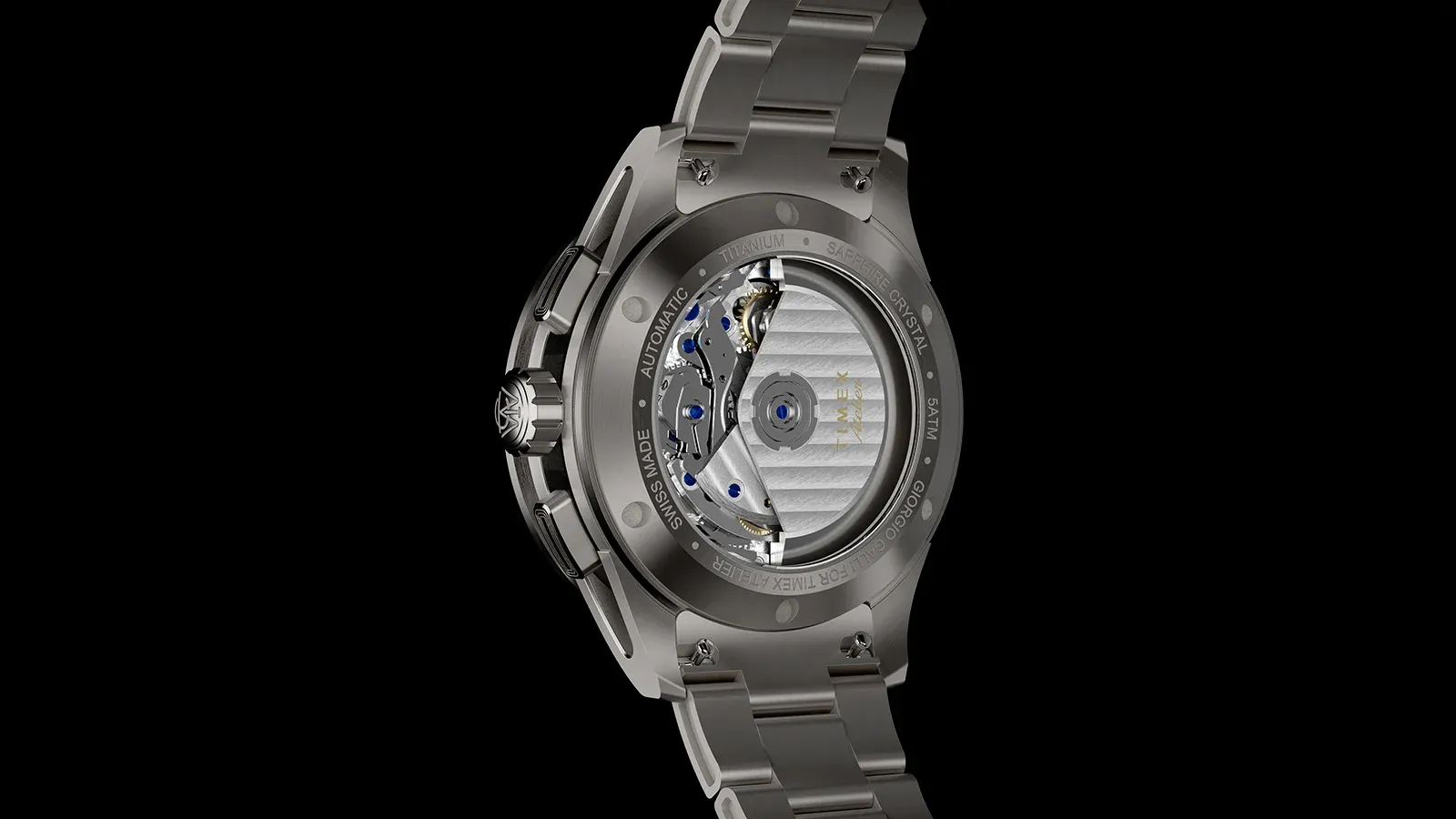
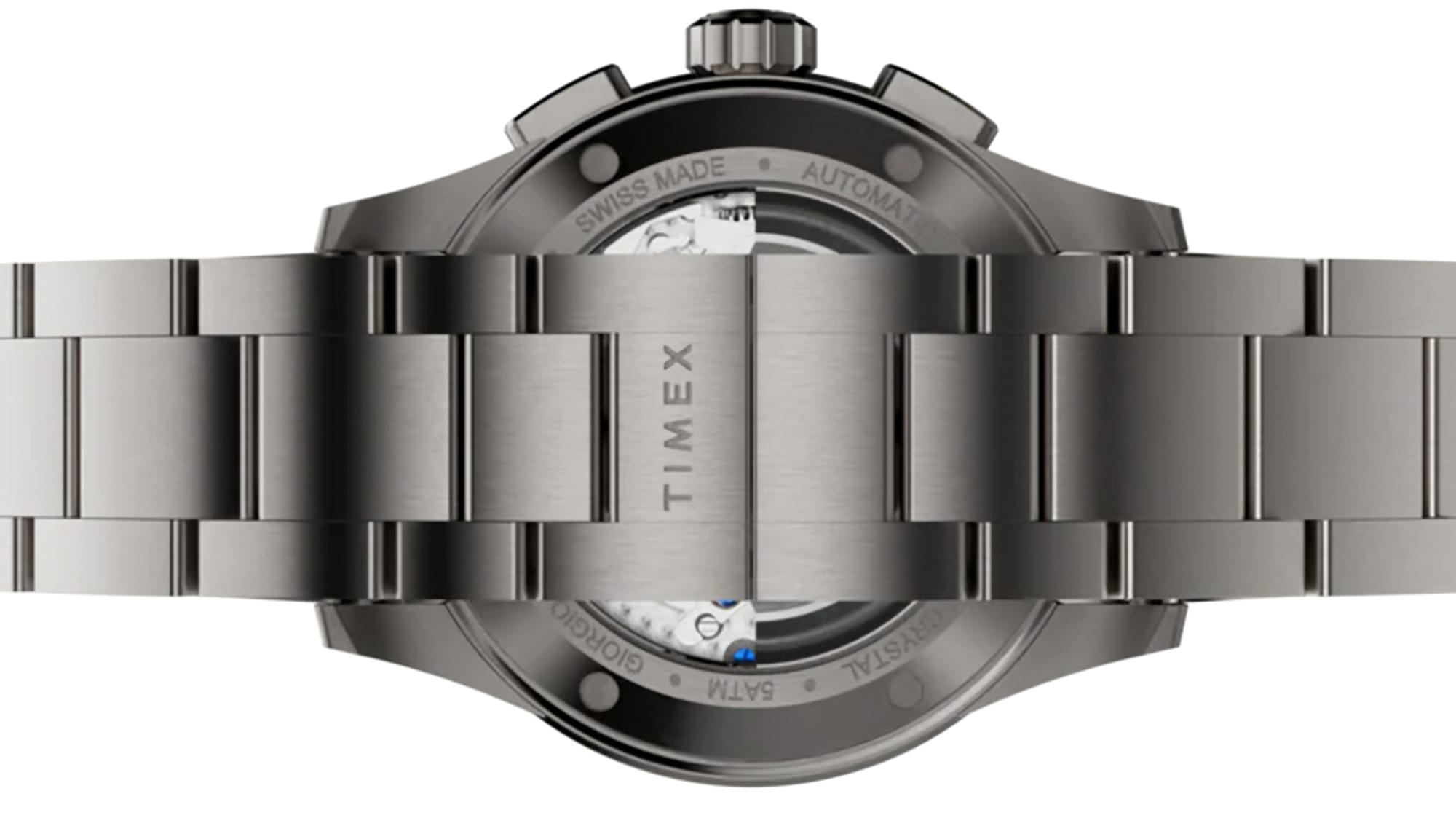
I didn't expect to be praising a Timex movement. Turn the watch over and the movement is finished to be looked at. The decoration is clean, the rotor is nicely done, and the whole thing has clearly been built with the exhibition caseback in mind. This is not a given. Plenty of watches at this price, and well above it, throw a movement together on the assumption that nobody will ever see it, then hide it behind a solid back. Timex did the opposite. Somebody at Atelier decided this caliber should be seen, and then made it worth seeing.
So what is it? The dial and the caseback say Landeron L72, a Swiss automatic chronograph running at 28,800 vibrations per hour, 28 jewels, a 43-hour reserve, and a quoted accuracy of +10/-18 seconds a day. And the name is where the watch tips its hand.
Landeron is one of the great names in chronograph history. The original company, founded in the 1870s in the Swiss town of Le Landeron, was a leading maker of column-wheel and cam-actuated chronograph movements through the middle of the twentieth century, and the original Landeron 72, from the 1950s, was a manual-wind column-wheel chronograph with real standing. That's the heritage the name on this rotor reaches for.
It isn't the heritage the movement actually has. The rights to the Landeron name were acquired in 2015 and the modern company became Landeron Swiss Movements in 2022, and the new L72, by the same source's reckoning, has nothing to do with the original 7X chronographs beyond the name and the number. It's based on the ETA/Valjoux 7753, the 3-6-9 variant of the 7750 family, run here with the twelve-hour counter dropped for a two-register look. That family is the workhorse that beats inside a large share of the genuine mid-range Swiss chronograph industry. It's a good, reliable, serviceable movement. Any competent watchmaker can open it, a real long-term virtue that an obscure in-house caliber can't offer. But it's a workhorse wearing an heirloom's name.
Which is the whole watch in miniature. The movement is doing exactly what the brand is doing. It takes a sound everyday engine and sells it under a name with a history the movement doesn't actually have. The bet is that the name covers what the engineering doesn't. The phantom date is the corroborating detail: a caliber designed for this watch wouldn't carry a date it can't show. And the specs sit where a standard-grade 7753 sits. The +10/-18 accuracy is workhorse tolerance, not chronometer tolerance. The 43-hour reserve is short by modern standards, the kind of figure the rest of the industry has been pushing past for years.
And yet. The finishing is better than it has any right to be at this money, and a decorated movement you can watch through the back is a more honest pleasure than a hidden one. I keep coming back to it, because it's the place where Atelier spent effort instead of marketing.
On the wrist
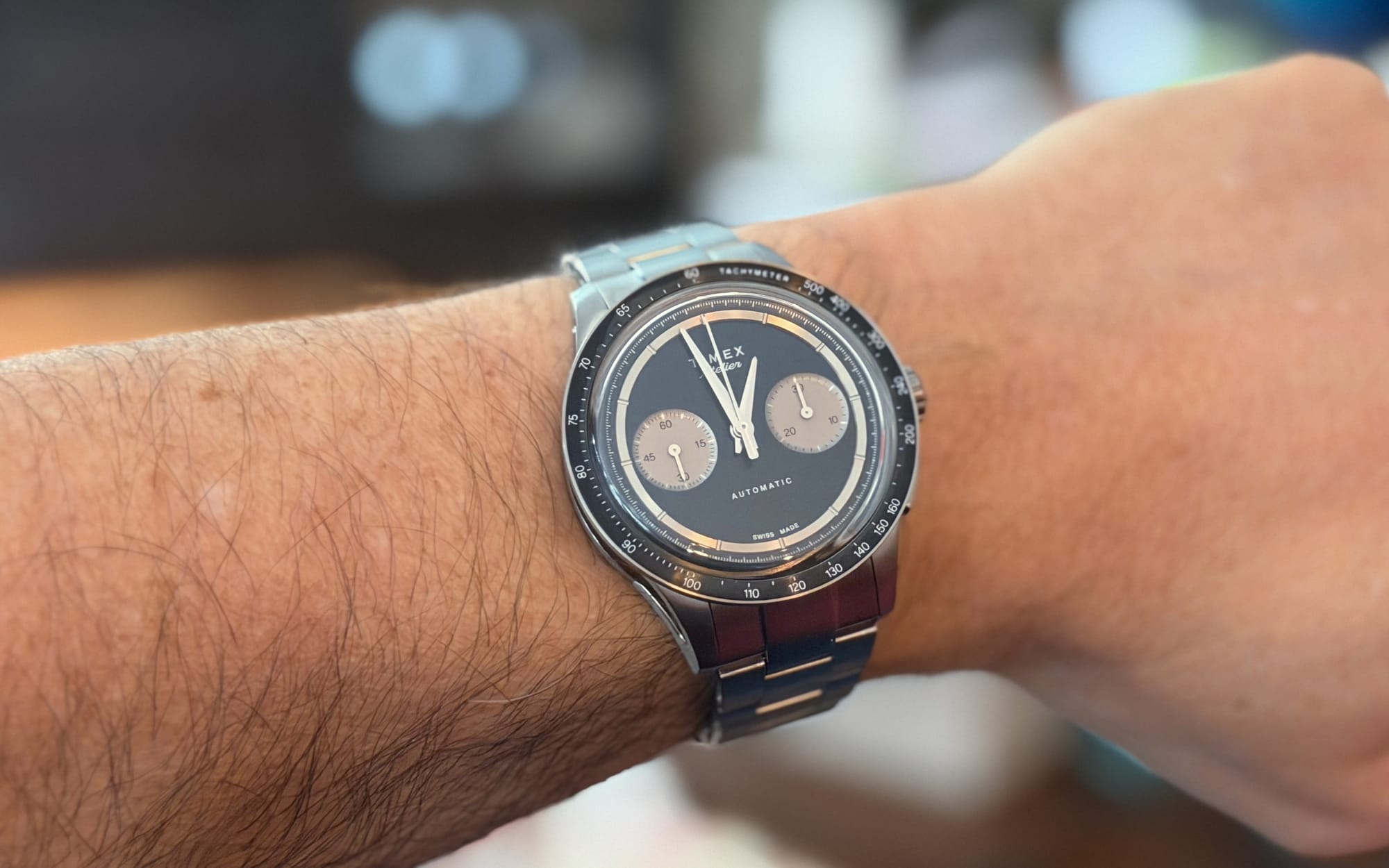
The watch is new to my wrist, so this is a first read rather than a verdict earned over months. The first thing you notice putting it on is the weight, or the lack of the weight you expected, that titanium disorientation softened by the steel core. The second thing you notice is how little ceremony it took to get here. The tool-free links meant I had it sized in minutes without a spring-bar tool or a trip to a watchmaker, and the quick-release bars mean I can put it on a strap and back on the bracelet in the time it takes to think about it. This is the watch at its best, and the bracelet is good, full stop, not just good for a Timex.
The clasp divides opinion, and I land on the wrong side of it for my own taste. It's a butterfly deployant, stamped Timex, and it has no release mechanism. Your finger is the release mechanism. You pry it open. People either love these clasps or hate them, and the love camp is real, but JLC uses clasps in this spirit and I've never gotten used to them there either. It's secure and it's clean and every time I take the watch off I wish there were a button.
The winding is the other daily cost. With a 43-hour reserve and a crown the bezel keeps crowding, a watch that sits in the box over a weekend turns Monday morning into a small chore. I find myself hoping I don't have to wind this one often, which isn't a thing you want to be hoping about an automatic you're meant to reach for.
And the double-take, lived. It happens. Your watch-geek friends clock the titanium and the dial and the movement, start to file it somewhere serious, and then read the logo and reset. The watch wants that double-take to resolve into admiration, into a this-is-secretly-great nod. Sometimes it does. Sometimes it resolves the other way, into a you-paid-what-for-a-Timex squint. The watch can't control which way the second beat breaks.
I bought this one myself, no gifts and no loaners. The irony is that buying a Timex involves none of the allocation theater I tolerate for a handful of brands. No waiting list, no relationship to cultivate, no boutique choreography. I'll play that game for a Panerai limited edition, for a Konstantin Chaykin, probably for the Universal Geneve reissues that are coming. For a Timex you click a button and it arrives. After years of the dance, that plainness is almost a relief, and it's part of the watch's character that you can't pay for status you have to queue for.
Comparisons
The M1a Ti's biggest problem is its own cheaper sibling. The quartz M1q costs $800 on a bracelet, has the guilloché dial this watch should have had, and carries an actual date instead of a hidden one. What the M1a Ti adds for its roughly $1,450 premium is the automatic movement, the titanium, and the exhibition back. That's a real list. It's just worth being clear-eyed about what you're paying for, because you are paying a large multiple to move from a more interesting dial with a battery to a flatter dial with a mechanical heart. If your reason for buying a watch is the thing on your wrist that you look at, the cheaper Atelier may be the more satisfying object.
Step outside the family and the cross-shop is the Hamilton Intra-Matic Auto Chrono. Its 42mm reverse-panda listed at $2,195 before Hamilton retired it, and the current 40mm runs about the same, right at the Timex's $2,250 or a touch under. The Hamilton runs the caliber H-31, also based on the ETA/Valjoux 7753. Same family of movement. Same beat rate. But Hamilton reworked its 7753 for a 60-hour reserve, gave it a real date you can see, and put it behind a crisp reverse-panda dial. And Hamilton has the heritage the Timex's movement name only pretends to. The Intra-Matic is a modern reworking of a Hamilton chronograph from 1968, and the brand, through Hamilton-Buren, was one of the partners in the 1969 Caliber 11 project with Heuer and Breitling. That was one entry in a contested race for the first automatic chronograph, a 1969 sprint that Zenith, Seiko, and the Caliber 11 group all still claim. So at the same money you can have a 7753-based chronograph from a brand that earned its place in chronograph history, or a 7753-based chronograph from a brand renting the name of one.
What the Timex has over the Hamilton is the hardware. The titanium case, the skeletonized architecture, and that excellent tool-free bracelet are more interesting than the Hamilton's steel case and leather strap. So the choice is unusually clean. The Timex wins on the case and the bracelet. The Hamilton wins on the movement spec, the dial, the date, and the heritage.
Spend more, and the point sharpens. About three times the money, around $6,900, buys a Tudor Black Bay Chrono, with a manufacture-grade chronometer movement and real heritage, and you stop arguing about borrowed names entirely. A Longines column-wheel chronograph, a brand I've spent a lot of time with, offers real column-wheel architecture and a deep chronograph pedigree near this tier. The Timex isn't trying to beat those watches on movement, and it doesn't. It's trying to give you titanium and a clever clasp for less, and it does.
Final thoughts
Most famous watches pay a Recognition Tax: because a convincing fake exists, every time the watch is seen in the wild the first thought isn't admiration but calculation, is it real. The Zenith Chronomaster Sport doesn't pay it, because its movement can't be faked, and what you get instead is the absence of doubt.
This Timex pays a different tax, and it runs in the opposite direction. Call it the Logo Tax. Nobody is faking a Timex; that's not the problem. The problem is that the name on the dial argues against the price before the watch gets to make its case. Every dollar of the $2,250 has to overcome a century of the brand meaning cheap. The Zenith fights counterfeiters. This watch fights its own logo.
The accounting is that the watch pays the Logo Tax and comes up just short. The bracelet is excellent. The movement finishing is a surprise. The titanium architecture is distinctive, and the tool-free sizing is the kind of thing that should make more expensive brands embarrassed. But the dial is flat and beaten by its own cheaper sibling, the crystal mirrors despite the spec, the winding fights you, and the movement is a capable 7753 under a name it didn't earn, over a date it has to hide. At a price where the Hamilton next to it offers the same engine with a better dial, more reserve, and a heritage it actually owns, the Timex needs to win on more than hardware, and it's clear that they are on their way. In the end, Timex may need to spin this work out into its own brand, like Grand Seiko did.
This is a watch I admire in pieces and can't defend as a whole. I bought it to understand what Galli is building, and the bracelet alone almost justifies the curiosity. The next person who sees it will still do a double-take. Whether it becomes a watch I reach for, or one I keep for a season just to know what a $2,250 Timex feels like on the wrist, I can't say yet.
