

My interest in the Omega Speedmaster started the way it does for most people: I saw one, and I wanted it. The problem is that Omega makes a lot of Speedmasters. Too many, probably.
When I started looking, I counted:
- 21 Moonwatch Professional references
- 15 Heritage references
- 9 Dark Side of the Moon references
- 28 Speedmaster 38mm references
- 36 Two-Counter references
- 2 Instruments references
That's just what's currently in production. Omega also just released a Speedmaster Pilot (Ref. 332.10.41.51.01.002) that I keep thinking about. So the question became: which one?
Brand and history
Omega introduced the Speedmaster in 1957 as reference CK2915. It was one of the first chronographs with a tachymeter on the bezel instead of the dial. Two years later, in 1959, the CK2998 arrived as the second generation. It refined the case and switched to alpha-style hands. Most of the Speedmaster's DNA traces back to this reference, including the watches NASA chose for the Gemini and Apollo programs.
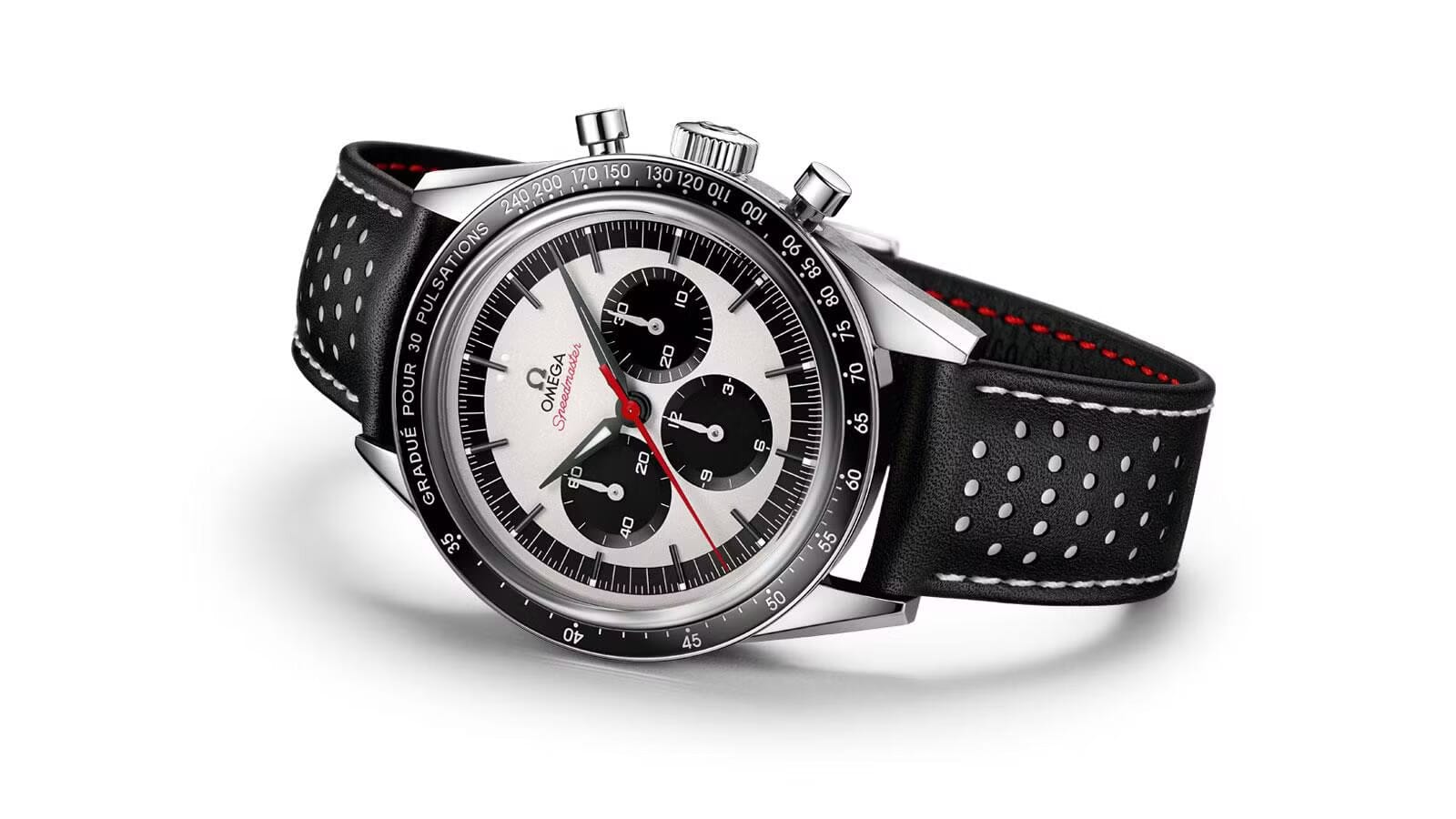
The original CK2998 is one of the most collectible vintage Speedmasters. Good examples sell for five figures, and the best ones go much higher. In 2015, Omega released the CK2998 Anniversary Series (Ref. 311.32.40.30.02.001) as a modern tribute, limited to 2,998 pieces, each numbered on the caseback.
After wading through all those references, I kept coming back to this one. The 1959 connection cuts through the noise. When you're staring at a hundred current Speedmaster variants and trying to justify one over another, having a clear historical anchor helps. The CK2998 Anniversary points to a specific moment — the second generation, before NASA, before the Moon — and that gave me a reason to stop shopping.
Case and dimensions
The case is 316L stainless steel:
- 39.7mm diameter
- 47mm lug to lug
- 14.4mm thick
- 19mm lug width
- 50m water resistance
The 39.7mm diameter is smaller than the 42mm Moonwatch Professional, which I prefer. It fits under a shirt cuff without bunching the fabric and doesn't feel like a hockey puck on the wrist. The 14.4mm thickness is real — this is a manually wound chronograph with a domed caseback, so it sits taller than a time-only watch — but the compact diameter keeps it from feeling top-heavy.
The bezel is black ceramic with a white enamel pulsometer scale. Most Speedmasters use a tachymeter, which measures speed over a known distance. The pulsometer measures heart rate: start the chronograph, count fifteen pulse beats, and the seconds hand points to the beats-per-minute value on the scale. Doctors used this in the field before digital monitors existed. On the CK2998 it's more of a design feature than a practical tool, but it sets the watch apart from every other Speedmaster on the shelf.
The caseback is solid steel, engraved with the limited edition number and the Speedmaster seahorse medallion. No display window for the movement.
The dial
This is what sold me on the CK2998 over everything else in the lineup.
The main surface is sand-blasted silver with a black minute track around the perimeter. Three black subdials sit at the standard chronograph positions: running seconds at nine, thirty-minute counter at three, twelve-hour counter at six. The subdial hands are rhodium-plated. The hour and minute hands are blackened and filled with Super-LumiNova.
Then there's the red chronograph seconds hand. It sweeps around the main dial against that silver background, and the contrast is immediate. That single red hand against silver and black is what first caught my attention and kept bringing me back to this reference whenever I wandered toward other options.
The color scheme is balanced in a way most Speedmaster dials aren't. The standard Moonwatch is black on black, which looks fine but goes flat in low light. The racing dials add color but can get busy. The CK2998 has enough contrast to hold your eye without fighting itself. It reads clean at arm's length, and up close the sand-blasted texture gives the silver some depth as the light moves.
No date window. On a three-register chronograph dial, a date aperture would just add clutter.
The movement
The CK2998 uses Omega's Calibre 1861:
- Manual winding
- 3 Hz (21,600 vibrations per hour)
- 48-hour power reserve
- Cam-actuated chronograph
The 1861 descends from the Lemania 1873, which evolved from the calibres that went to the Moon. The lineage runs: Calibre 321 (the original Moon watch movement), to Calibre 861 (its replacement in 1968), to Calibre 1861 (the current version with rhodium-plated finishing). It's not the same movement that Buzz Aldrin wore on the lunar surface, but the basic cam-lever architecture hasn't changed in sixty years.
Omega now puts co-axial Master Chronometer movements in newer Speedmasters — higher accuracy, magnetic resistance to 15,000 gauss, METAS certification. The 1861 has none of that. It's a simpler machine with a straight line back to 1957. It winds by hand, it runs a chronograph, and that's about it.
I like winding it every couple of days. The crown action is smooth and the chronograph pushers click cleanly. Forty-eight hours of reserve means you can set it down Friday night and pick it up Sunday morning.
On the wrist
The strap is perforated leather with a white rubber interior. The perforations help with airflow in warmer weather, and the white rubber lining matches the pulsometer scale and dial accents. Comfortable from day one without a break-in period. The 19mm lug width is narrower than the 20mm standard on most Moonwatches, which limits aftermarket strap options slightly, but any 19mm strap or NATO will fit.
There is no bracelet option for this reference. If you need a steel bracelet on your Speedmaster, the CK2998 is not your watch.
The 39.7mm case and 47mm lug-to-lug work well on a range of wrist sizes. It's a chronograph that doesn't feel oversized. The silver, black, and red combination goes with most things. Jeans and a t-shirt, business casual, a sport coat. In bright light the sand-blasted dial catches and reflects. The lume is strong enough to check the time at night, though not as aggressive as what you'd find on a dive watch.
After several months of daily wear, the polished case surfaces have picked up fine scratches. The ceramic bezel, by contrast, is untouched. That's the advantage of ceramic: it holds up where steel does not.
Final thoughts
If you want a Speedmaster but feel overwhelmed by the lineup, the CK2998 Anniversary is where I'd point you. It has the 1959 original behind it, modern materials where they count, and the 39.7mm case fits more wrists than the 42mm Moonwatch.
The dial is the best-looking I've seen on a Speedmaster. The pulsometer bezel sets it apart from the standard tachymeter. And the 1861, for all its age, still feels right here. Manual winding, Moon-race lineage, no attempt to be something it isn't.
I still think about the Speedmaster Pilot sometimes. But the CK2998 was the right call.
References
- Omega Speedmaster CK2998 Anniversary Series, Ref. 311.32.40.30.02.001. Limited to 2,998 pieces, released 2015.
- The original Omega CK2998 was produced from 1959 to 1963, preceding NASA's selection of the Speedmaster for the Gemini program.
- Calibre 1861 lineage: Cal. 321 (1957) → Cal. 861 (1968) → Cal. 1861 (1996–present).


