

This is my second Panerai from the Luna Rossa partnership. The first was the Submersible QuarantaQuattro Luna Rossa (Ref. PAM01681), a time-only diver that I reviewed previously. Both watches look striking but serve different purposes. The PAM01681 is a Submersible built for depth; the PAM01654 is a flyback chronograph built for timing competitive sailing. Limited to 150 pieces worldwide, it arrived in 2024 as the flagship of Panerai's third consecutive America's Cup campaign with Luna Rossa Prada Pirelli. I was on the waitlist for about nine months before getting a call.
Brand context
Panerai's involvement with competitive sailing began in 2017 when the brand entered America's Cup racing as an Official Partner, sponsoring Oracle Team USA and Softbank Team Japan during the 35th Cup in Bermuda. But the relationship found its natural home in 2019, when Panerai became the Official Sponsor of Luna Rossa Prada Pirelli for the 36th America's Cup in Auckland.
The pairing was inevitable. Luna Rossa, Italian for "Red Moon," was born one February evening in 1997 near Milan's Duomo, when Prada CEO Patrizio Bertelli and Argentine yacht designer German Frers decided to challenge for sailing's oldest trophy. Since then, the team has won the Louis Vuitton Cup in 2000, the Prada Cup in 2021, and took three regatta victories against Emirates Team New Zealand that same year—the best result ever achieved by an Italian syndicate. Panerai CEO Jean-Marc Pontroue has said there was no Plan B, no survey of hundreds of potential partners. There was one race, the America's Cup, and one team, Luna Rossa.
The PAM01654 arrived ahead of the 37th America's Cup in Barcelona, where Luna Rossa fell to INEOS Britannia 7-4 in the Louis Vuitton Cup final in October 2024. The team will return for the 38th America's Cup in Naples in 2027. Despite the Barcelona result, the watch itself is the most technically advanced Luna Rossa timepiece Panerai has produced: an in-house flyback chronograph in a titanium case, with a nautical tachymeter calibrated for measuring speed in knots rather than miles per hour. This is not collaboration merchandise. It is a functional instrument designed for timing sailing events.
I was late to the Panerai party and did not really discover the brand until after the paneristi.com meltdown. An online community can be a double-edged sword for a brand. Think Star Wars or Star Trek. The most zealous communities can turn on their favorite products during a crisis. The new paneristi.com has been slow to get rolling but there is still enough interest to fuel growth in the community. I am a sucker for a good origin story and Panerai has one that is hard to beat, so even if there comes a time I do not have a Panerai in my collection, I will appreciate the history. With six Panerai now, I have enough experience with the brand to have something credible to say.
Case and wearability
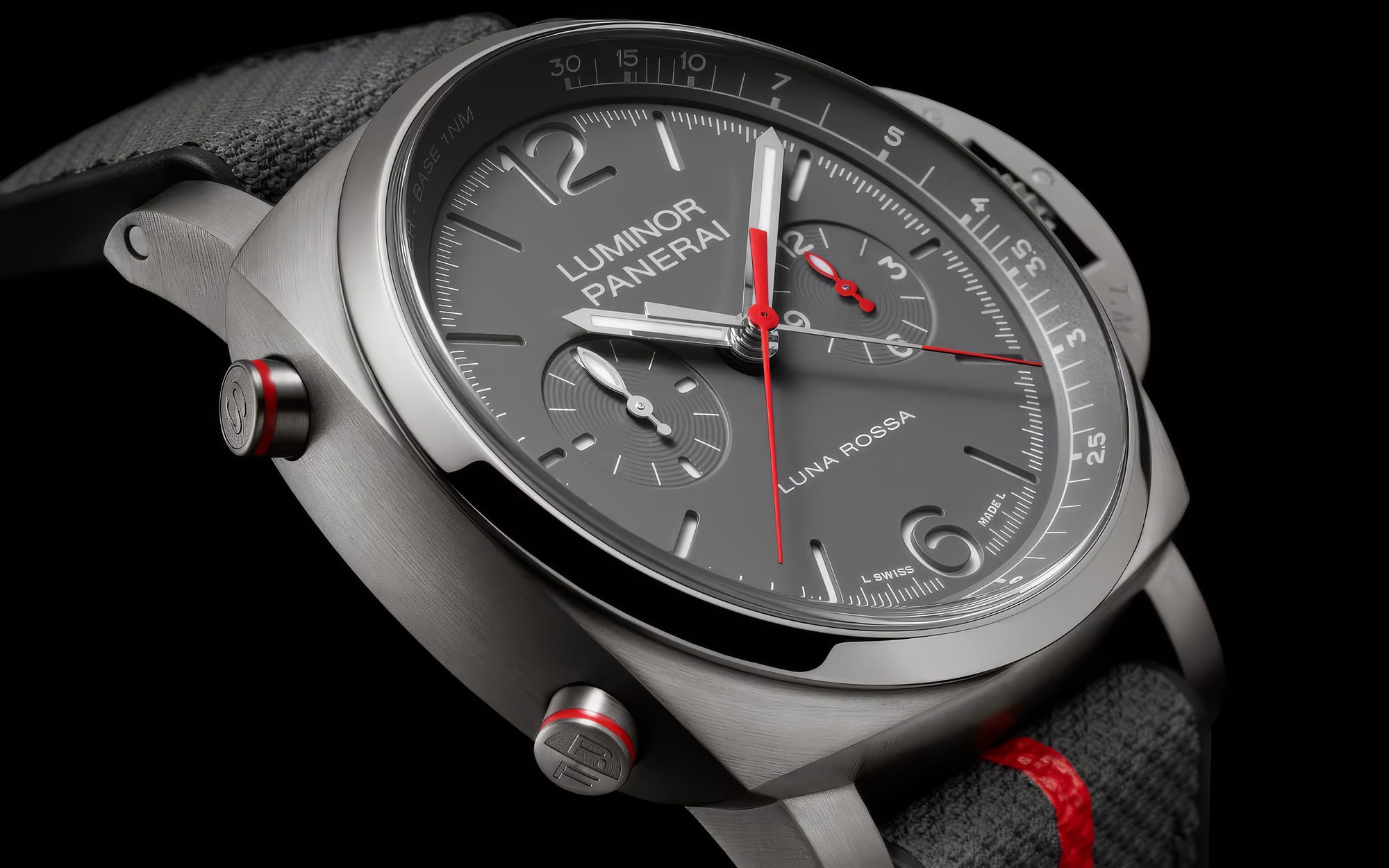
The 44mm case is Grade 5 titanium, the same aerospace-grade alloy used in aircraft components and high-performance sporting equipment. Titanium weighs about 44% less than stainless steel while offering better strength and corrosion resistance. For a sailing chronograph intended to be worn on deck during regattas, this weight reduction matters. The brushed finish absorbs light rather than reflecting it, reducing glare on the water.
The Luminor's signature crown-protecting bridge device remains the watch's defining visual element. Panerai patented this mechanism in 1955 to address a fundamental problem: winding crowns that compromised water resistance after repeated use. The lever locks down over the crown, compressing an internal gasket to achieve water resistance. Seventy years later, it still serves both functional and aesthetic purposes, giving the Luminor its distinctive asymmetrical profile.
The chronograph pushers sit at 8 and 10 o'clock, positioned opposite their conventional locations to accommodate the crown guard. Both feature red accent rings—thin pinstripes that provide the first of many visual references to Luna Rossa's racing livery. Water resistance reaches 100 meters (10 bar), adequate for deck work though not intended for serious diving. Case thickness measures about 16mm including the domed sapphire crystal, substantial but not unwieldy given the 44mm diameter and short lug profile.
The polished titanium bezel provides subtle contrast against the brushed case surfaces. Through the sapphire exhibition caseback, each piece displays its individual number within the 150-piece limitation engraved around the perimeter.
Movement and performance
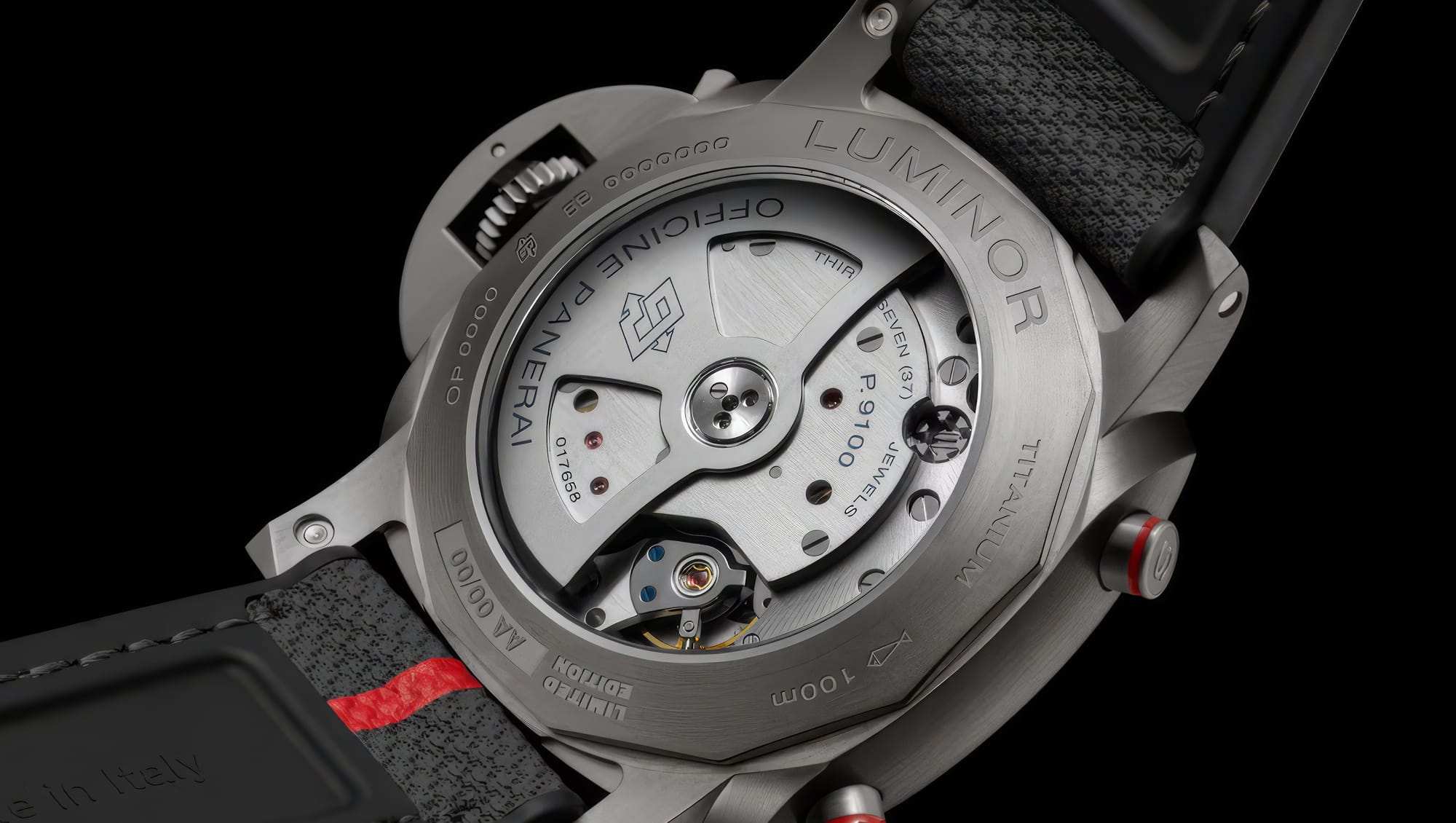
Inside beats Panerai's in-house calibre P.9100, the first automatic movement with chronograph functions developed by Officine Panerai and produced entirely in their Neuchatel manufacture. The movement has 302 components including 37 jewels, measures 8.15mm thick at 13 3/4 lignes, and runs at 28,800 vibrations per hour. A Glucydur balance and Incabloc anti-shock device ensure stability under the physical demands of active sailing. Two series-linked barrels provide a 72-hour power reserve through the use of thinner mainsprings that deliver energy more evenly over the three-day duration.
In recent years, Panerai has been dogged by complaints about reusing third-party movements and lacking rigorous in-house capabilities. In reality, having an in-house movement is cool but also increases cost. Panerai seems forced into this investment because "in-house" has become a real deciding factor for buyers. Despite that, this feels like a good balance of cost, design, and engineering.
The flyback function is genuinely useful for timing sequential events. A conventional chronograph requires three operations to restart timing: stop the hands, reset to zero, restart. The flyback mechanism accomplishes this in a single pusher press at 8 o'clock. The chronograph hands instantaneously return to zero and immediately begin measuring a new event. Originally developed for aviation applications where pilots needed to time successive legs of flight without losing seconds to the reset procedure, the flyback complication proves equally practical for racing. Timing leg transitions during a regatta becomes a single-button operation rather than a three-step process.
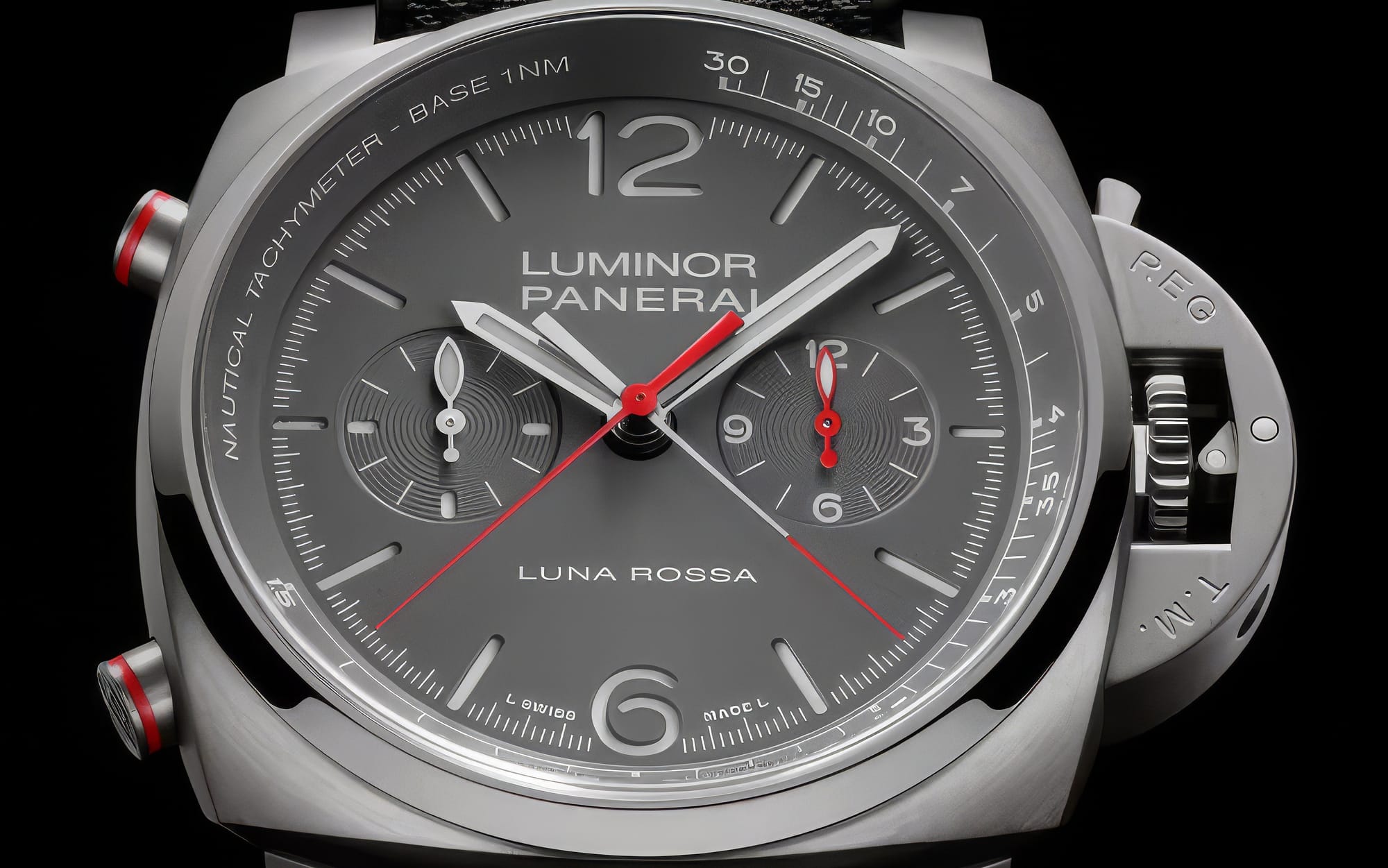
This is a unique flyback that at first appears to be a rattrapante. Two central seconds hands suggest a split-seconds complication, but the second hand actually tracks elapsed minutes for the chronograph, jumping forward every sixty seconds to indicate elapsed minutes up to thirty. It is pretty cool. The 12-hour totalizer at 3 o'clock tracks longer timing sessions. Small seconds appear at 9 o'clock.
The P.9100 uses a vertical clutch and column wheel for chronograph actuation. The vertical clutch eliminates the shudder sometimes visible in chronograph seconds hands at start-up, caused by the engagement of traditional horizontal clutch systems. The column wheel provides smoother pusher action compared to cam-actuated systems. These are refined mechanical choices that affect the feel of operating the chronograph rather than merely adding expense to the specification sheet.
Despite the time and effort put into this new in-house movement and the exhibition caseback, there is actually very little to see through the sapphire. It is mostly just a big brushed block of steel. Panerai is capable of more. Just look at the Luminor Perpetual Calendar GMT. The movement is a beauty but it is also $70,200 USD, and that tends to be the trend: you only get this level of finishing and movement sophistication at very high price points with Panerai. This contrasts with brands like Jaeger-LeCoultre or even Bulgari that offer stunning movements at much lower cost.
Dial and aesthetics
The matte grey sandwich dial continues Panerai's signature construction: a lower layer with luminous material applied to recessed areas, covered by a perforated upper layer that allows light through the numerals and markers. This technique, developed for Panerai's original military contracts with the Royal Italian Navy, produces excellent legibility in low-light conditions. Super-LumiNova X1 fills the hour markers, Arabic numerals at 12, 3, 6, and 9, and the hour and minute hands, producing a green glow in darkness.
Both of my cars are gray and both of these Luna Rossa references have gray dials and straps. I clearly have a thing for gray. This watch grabs attention because of the deep contrasting red chronograph hands, the red Luna Rossa stripe on the band, and the pinstripe of red on the chronograph pushers. It is visually interesting and well balanced.
The central chronograph seconds and minutes hands are red lacquer, as is the hand indicating small seconds at 9 o'clock and the 12-hour totalizer hand at 3 o'clock. "Luna Rossa" appears in red text below center, the only explicit partnership branding on the dial face. The sub-dials at 3 and 9 o'clock feature snailed decoration, adding visual depth without compromising legibility.
An inclined inner flange carries a nautical tachymeter scale calibrated for measuring speed in knots. Where conventional tachymeters assume automotive applications and display km/h graduations, Panerai has adapted the scale for its intended nautical context. This is not a detail that will matter to most buyers, but for anyone actually timing sailing events, it is a thoughtful functional choice.
Strap and clasp
Panerai supplies the PAM01654 with a bi-material strap combining a black rubber base with grey technical textile, accented by a red stripe running the strap's length. The strap tapers from 24mm at the lugs to 22mm at the Grade 2 titanium trapezoidal buckle. The rubber base ensures durability and water resistance during active use; the textile overlay provides grip and visual interest. A secondary black rubber strap accompanies the watch, offering a more understated alternative for occasions when the Luna Rossa livery feels too assertive.
I am not in love with these Luna Rossa rubber straps because they are such a pain to put on and take off. I have never loved any Panerai strap, mostly because they rarely use deployant buckles. If Tag Heuer and Omega can figure out how to make an excellent deployment clasp, so can Panerai. To be fair, I have never tried out something like a Luminor Marina (Ref. PAM03323) with a bracelet. Maybe someday.
Final thoughts
The Luminor Chrono Flyback Luna Rossa Titanio occupies a specific position in Panerai's catalog: the most technically advanced expression of the brand's ongoing America's Cup partnership. At $16,400 USD, it is a little more than I would like to pay and represents a significant investment, though one that buys genuine mechanical complexity wrapped in purpose-built materials. The 150-piece limitation ensures scarcity without venturing into the artificial rarification that plagues some limited editions.
What distinguishes this piece from brand collaboration merchandise is its functional coherence. Every element—the titanium case, the flyback mechanism, the nautical tachymeter scale, the luminescent sandwich dial—serves the stated purpose of timing sailing events. The Luna Rossa aesthetics enhance rather than obscure this utility.
Whether you will ever use it to time an America's Cup regatta is beside the point. The watch carries the accumulated knowledge of Panerai's maritime heritage, from its Florentine origins supplying the Royal Italian Navy through its current partnership with one of competitive sailing's most persistent challengers. That history lives in the object, waiting to tell its story to whoever wears it next. But at this price point, there are better watches available. I would reserve this one for the die-hard Paneristi.
References
- Panerai. "Luminor Chrono Flyback Luna Rossa Titanio PAM01654." Official Product Page, 2024.
- Panerai. "Luna Rossa Partnership." Official Partnership Page, 2024.
- Monochrome Watches. "Panerai Luminor Luna Rossa PAM01653 and Luminor Chrono Flyback Luna Rossa PAM01654." 2024.
- Escapement Magazine. "Panerai Luminor Chrono Flyback Luna Rossa PAM01654 Watch Review." 2024.
- Element in Time. "Panerai Luminor Chrono Flyback Luna Rossa PAM01654." 2024.
- aBlogtoWatch. "New Release: Panerai Luminor Chrono Flyback Luna Rossa PAM01654 and Luminor Luna Rossa PAM01653 Watches." 2024.
- Gear Patrol. "Panerai Luminor Chrono Flyback Luna Rossa Titanio." 2024.


