I keep a tab open on WatchSpotting, the archive that catalogs what watches turn up in films, and the same three letters kept surfacing. MTM. Twenty-four sightings, mostly in the kind of movie where someone jumps off something exploding. Arnold Schwarzenegger wears an MTM Cobra 47 in Sabotage. Dwayne Johnson straps on a Black 3-GER in Skyscraper and a Cobra in Rampage. Jake Gyllenhaal wears a Vulture in The Covenant. Josh Stewart wears a Black Patriot in The Dark Knight Rises. 50 Cent and Randy Couture both turn up in Expend4bles wearing different MTMs. The list runs back to 2007 and it leans hard military, with the occasional comedy outlier like Ride Along 2 and Paul.
How exactly the watches get onto those wrists is something I cannot tell you, and I went looking. MTM does not disclose it, no trade outlet documents it, and the costume departments aren't talking. It is the way most watches reach the screen, through the loan-and-visibility arrangements that are standard to the business. (The opposite model exists: a brand like Micromilspec, which builds for actual military units first and opens only a tiny civilian window each year, has no celebrity machine at all, and you've almost certainly never caught one on a screen.) The visibility sells watches, or at the very least it manufactures recognition, and recognition is the long fuse on a sale.
The Hypertec is MTM's entry point, not its movie star. The watches Hollywood actually reaches for sit higher up the line. But if you want to understand a brand, the smart move is rarely to start with its halo piece. It's to start with the watch that has to earn its keep on price alone.
Where the line goes from here
A word on what "higher up the line" means, so the $500 sticker has a frame. MTM, which stands for Multi Time Machine and operates out of downtown Los Angeles, will happily sell you something with a great deal more pedigree. The top of the catalog is the Sherman 3-GER, a collection of twelve listings running from $10,350 to $13,950. That money buys a COSC-certified Swiss chronometer, the Valjoux/ETA Caliber 7750, with a day-date complication, a 46mm grade-2 titanium case, a proprietary ball-bearing bracelet, and on at least some references a sapphire exhibition caseback so you can watch the rotor spin. It is the watch Dwayne Johnson wore in Skyscraper, and it is roughly twenty-five times the price of the one on my wrist.
What MTM has done at this price, which I did not expect, is keep the sense of play. This is a company whose entire identity is mil-spec seriousness, blood-detecting UV lights and radiation sensors on the flagship models, and yet here on the Hypertec they've put orange numerals and offer a turquoise dial for no functional reason at all. I asked myself whether that was a contradiction, the toy color on the tough-guy watch, and decided it isn't. A company can build serious instruments and still want a wider room than just operators and cops. The orange is MTM reading a bigger audience.
A field watch with diver's bones
MTM files the Hypertec under field watch, and the company's own marketing gamely suggests it can pull dress, sport, and everyday-carry duty too. I'll let the dress-watch claim sit there without comment, except to say I doubt many of these are getting worn under a French cuff. But the more interesting mislabel is the field-watch part, because on the wrist this thing feels like a diver.
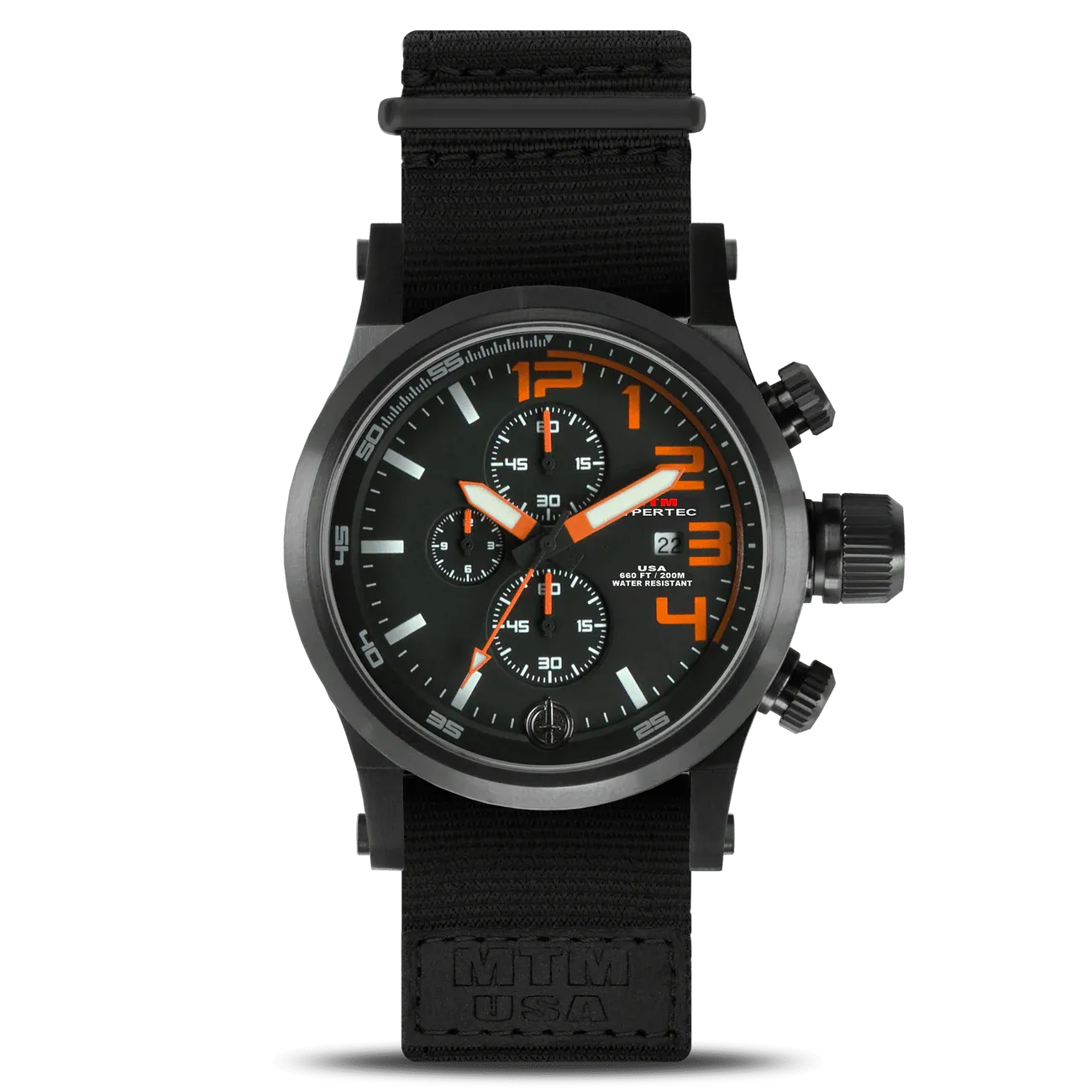
The bones explain why. The case is 44mm across without the crown and a full 15mm thick, finished in black DLC over solid 316L stainless steel. The crown is a large, locking, screw-down unit with a double O-ring seal, the kind of crown you associate with watches meant to go underwater, not watches meant to cross a parade ground. And the water resistance settles it. This is rated to 200 meters.
The dial of my watch is printed, in plain white, 660 FT / 200M WATER RESISTANT. The product page's spec table, meanwhile, lists 600 feet. Two hundred meters converts to 656 feet, so the dial and the description are right and the spec table dropped a digit. I mention it not to be pedantic but because it's the watch itself, the words physically on the dial, that settle the matter.
Either way, 200 meters of water resistance plus a screw-down crown plus a 15mm case is not field-watch arithmetic. It's diver arithmetic wearing a field watch's clothes. It means the Hypertec is overbuilt for the role it advertises, and overbuilt is exactly what you want from something at this price meant to take a beating.
The strap MTM ships it on is a substantial nylon affair, a serious piece of webbing that feels like it could spend a few years in the jungle, in the mud, in the water, and come out asking for more. (MTM's catalog calls it a nylon band; you may also hear it described as a NATO depending on configuration, since the brand offers several straps.) It suits the watch. A thin leather strap on a case this size would look like a joke.
The dial, the orange, and a small mystery solved
The dial is where the Hypertec gets genuinely interesting, and where I had a question I couldn't answer until I sat down and really looked at it. MTM has highlighted the numerals in orange, but only some of them. Twelve, one, two, three, and four are printed in bright orange Arabic numerals. Everything from five around to eleven is a plain white luminous baton.
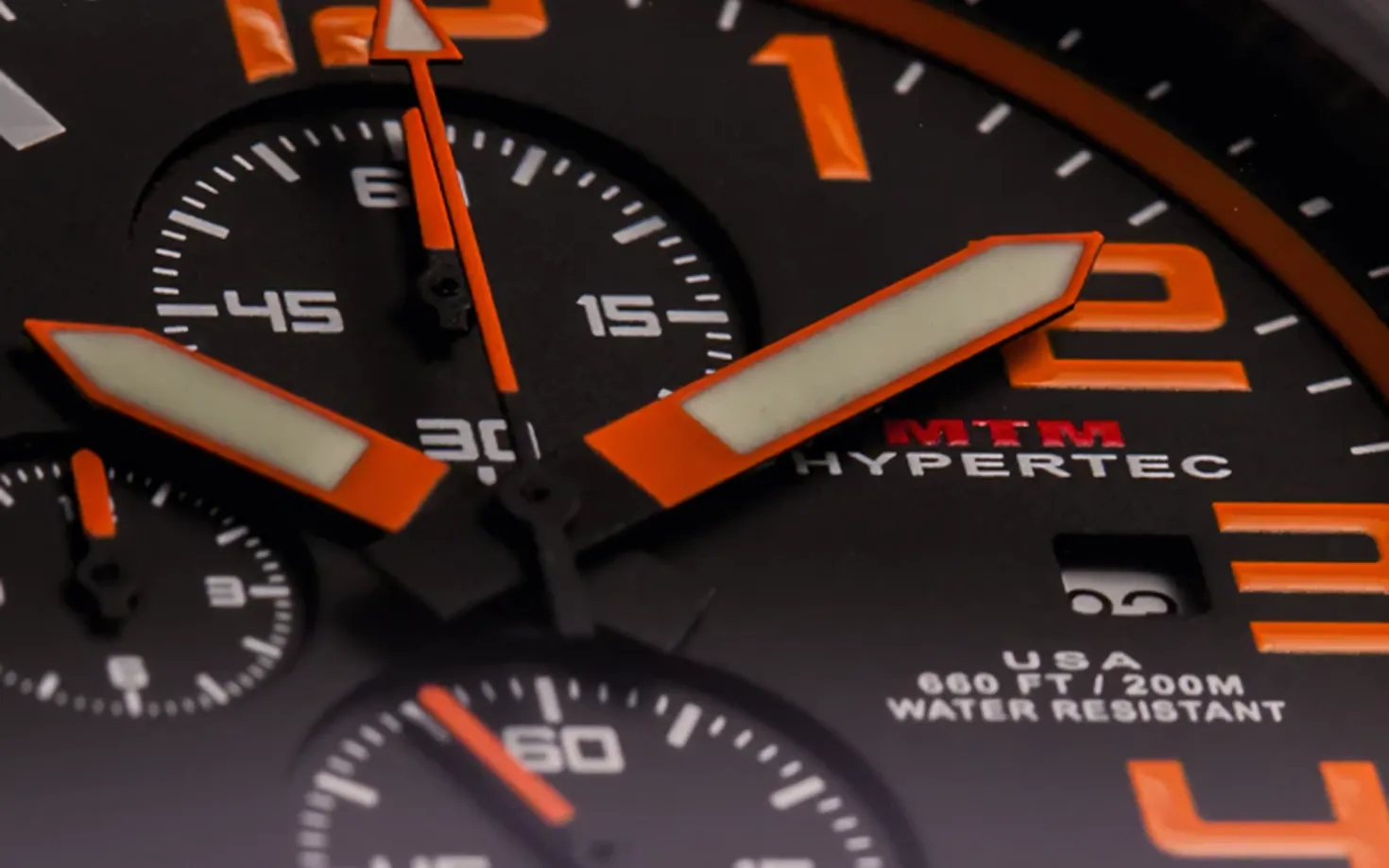
The Hypertec runs a Miyota 0S10 chronograph movement, and in its base form that caliber puts its registers at twelve, six, and nine with a date at three. On my dial the running seconds sit at nine, a counter sits at twelve, and a third register sits at six, with the date window tucked in at three, just inside the orange three. There's a small MTM dagger emblem down near six o'clock and a stack of text, USA, 660 FT, 200M, WATER RESISTANT, climbing up the right side above the four. It's a busy dial. On a smaller watch it would be a mess. At 44mm it has room to breathe.
The lume is used with restraint, and used well. It's on the hour and minute hands, on the markers, and MTM even lumed the very tip of the central chronograph hand, a nice touch for a feature most brands leave dark. The compound is Super-LumiNova, and a brief charge seems to hold a long time. It comes up bright. For a watch whose whole pitch is readiness in bad conditions, the lume earns its place.
The crystal is K1 tempered glass, scratch-resistant and, more to the point, anti-reflective coated, and the coating is the single most impressive thing about the watch's appearance. At certain angles the glass simply vanishes. There's no veil, no sheen, just the dial sitting there as if uncovered. You do not usually see anti-reflective work this good at $500. It's the kind of detail that costs real money to do right and is the first thing value brands skip. MTM didn't skip it. (One small inconsistency worth flagging for the record: MTM's longer "Design & Quality" blurb calls the crystal mineral, while the spec table says K1 tempered glass. K1 is a tempered mineral glass, so these aren't quite contradictory, but the looser "mineral crystal" phrasing undersells what the spec sheet claims.)
The movement, and the honest math of $500
The Miyota 0S10 is a bought-in Japanese caliber made by the Miyota division of Citizen. It is not exclusive to MTM, not modified by MTM, and not, by any stretch, rare. It turns up in chronographs from a range of brands, Laco among them. It keeps time to about plus or minus twenty seconds a month, which is ordinary quartz accuracy, and a replacement unit can be had for somewhere in the neighborhood of twenty to thirty-five dollars. That last figure is not a knock. It's a fact you should hold in your head, because it reframes the whole watch. If the engine costs the brand a few tens of dollars, then almost none of your $500 is going into the movement. It's going into the case, the DLC, that excellent crystal coating, the strap, the serialization, and the box.
That's not a scandal. It's just what a $500 quartz tool watch is, and pretending otherwise would be dishonest. You are not buying this watch for its movement. You are buying it for everything built around the movement. Where a watch like the Sherman justifies its price through the caliber inside it, the Hypertec has to justify itself through everything else, and mostly it does.
The chronograph works exactly as advertised, with one caveat that's worth more than its size suggests. If you've spent time with mechanical chronographs, you'll catch yourself pressing the pushers harder than you need to. The reason is feel, or the lack of it. The stop action doesn't click. There's no tactile confirmation that you've actually halted the timer. You have to look at the dial to know whether it stopped. This is genuinely the watch's weakest point in daily use, and what makes it slightly maddening is that Miyota itself markets this caliber on the "satisfying click feel of the push button." So the deadness isn't the movement's fault. It's almost certainly MTM's case-to-movement linkage, the pushers reaching the caliber through 15mm of DLC-coated steel, swallowing the click on the way. A pusher you could feel stop would make this a meaningfully better watch. It's the difference between an instrument and an instrument you trust without looking, and right now it asks you to look.
The screw-down crown, by contrast, is a pleasure. Large, grippy, easy to unlock and set even with the case's heft working against you. Setting the time is a non-event, which is exactly what you want.
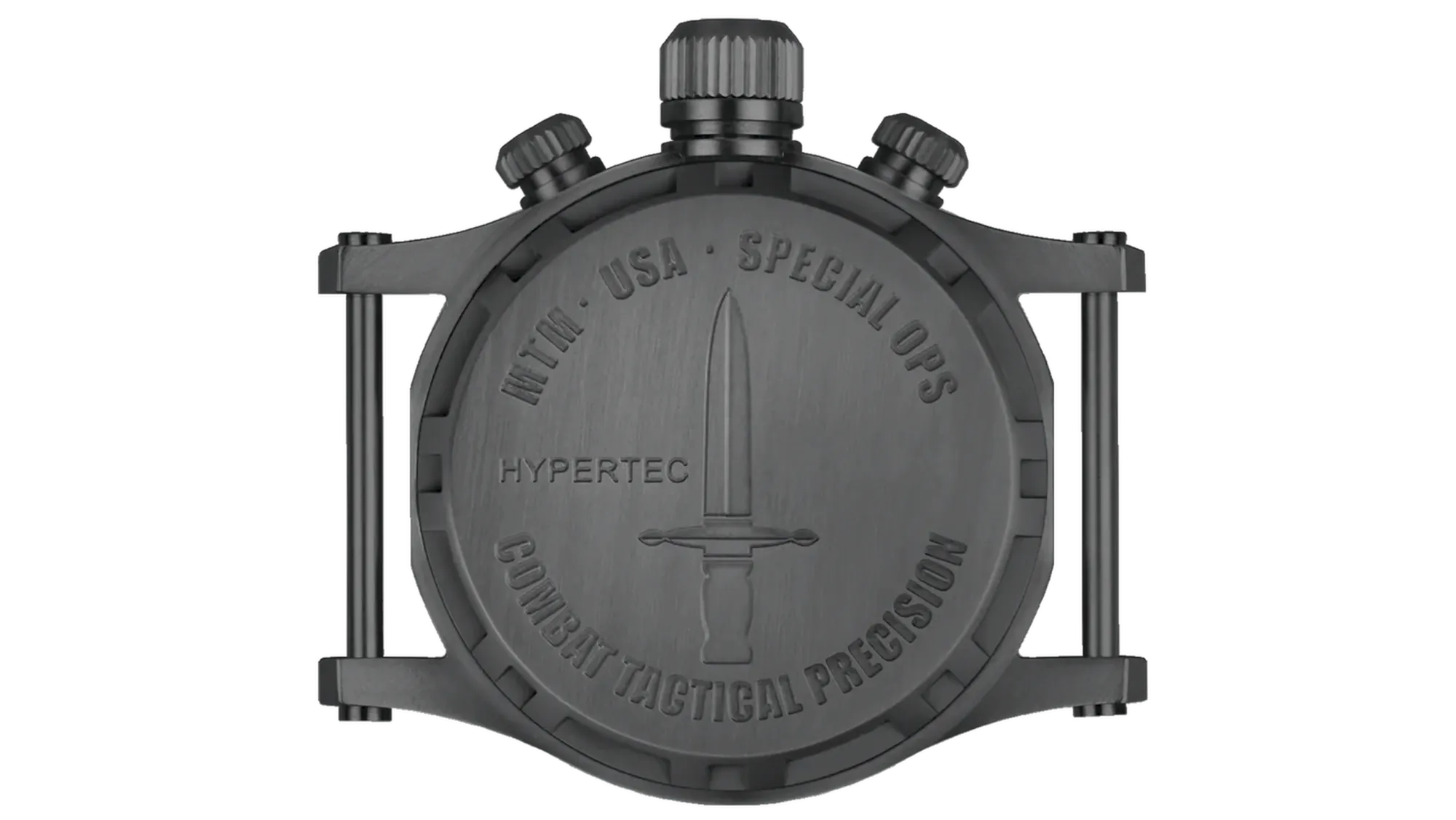
Around the back there's not much to see, which is appropriate. The caseback carries the MTM logo and "USA Special Ops," and, the detail I like best on the whole watch, each one is etched with its own unique serial number. The watch is individually numbered. It ships, with a slightly absurd but entirely welcome seriousness, in its own watertight tactical case rather than a cardboard sleeve. The battery is a silver-oxide cell rated for four years. The warranty runs three. The whole thing weighs 4.8 ounces.
Where it sits, and who it's for
Put the Hypertec next to the company it keeps and the picture sharpens. Against its own stablemate, the comparison is stark and useful: the Sherman 3-GER gives you Swiss mechanical chronometry, titanium, and a movement you can watch through the back, for the price of a used car. The Hypertec gives you Japanese quartz, steel, and a closed caseback, for the price of a nice dinner for four. They are not competing for the same buyer.
Against the broader field of $500 quartz tool chronographs, the Hypertec's case for itself is the build, not the engine, and that build is genuinely good. The DLC, the 200-meter rating, the screw-down crown, the strap, and above all that disappearing anti-reflective crystal add up to a watch that punches above its number in materials and finish, even as the shared movement keeps it honest about what it is.
So would I take it outdoors? Yes. That's the cleanest way I can put it. If I genuinely needed one watch for a long stretch away from comfort, somewhere I'd be hard on it and far from a service center, this would now be near the front of the line, in the same company as the Hestur Military Tactical Titanium, the other unbothered sub-$500 quartz tool I keep reaching for when the day is going to be hard on a watch. It's tough, it's legible, it's overbuilt for water, it shrugs off glare, and if anything goes wrong with the movement the fix costs less than the strap. The mushy pushers are the one real flaw. At this price, against this build, it's one I can live with.
I came to MTM as a result of someone else's marketing, a name I'd absorbed from a dozen action movies without ever choosing to. I left understanding why the costume departments keep reaching for the brand.