

A package arrived from Western North Carolina yesterday, the day after Monterey Watch Co. said it would. Inside, wrapped in a small box with a black beaded bracelet, was the Celestium. It cost $499. The brand is six months old to me: run by a sixty-three-year-old retired marketing executive who started building watches at sixty because his wife gave him a DIY kit for Christmas.
The whole time I was unboxing it, I was thinking about another watch. The Laurent Ferrier Sport Auto Blue, reference LCF040.T1.C1GC5: a Swiss independent's integrated-bracelet sport watch in a rounded cushion case, around 51,000 CHF as launched. The Celestium's case and bracelet silhouette is, within a millimeter or two in every dimension, the same silhouette. That's where the resemblance ends, though. The bezel on the Celestium is octagonal where the LF's is cushion-shaped. The dial is centered on four cardinal markers and compass lines, more in the Universal Genève Polerouter tradition than anything on the LF. The seconds hand is centered rather than tucked into a sub-dial. The materials are commodity rather than exotic. But the cushion-case-with-integrated-bracelet idiom, the part the eye registers from across a room, is what these two watches have in common.
So why was I thinking about a 51,000 CHF watch while I unboxed a $499 one? Because something has happened in the microbrand market over the last few years, and the Celestium illustrates it as cleanly as anything I've seen. This isn't really an LF homage. It's a stack of borrowed silhouettes: the cushion case and integrated bracelet from the LF Sport Auto, the octagonal bezel from the Royal Oak family, the four-cardinal-with-compass-lines dial from the Universal Genève Polerouter, all dropped into one watch at $499. A watch at this price can't reach the manufacturing standards of any of those references. Of course it can't. The bracelet finishing won't be the same, the clasp won't be the same, the dial won't be enameled the same way. What I didn't expect, and what this watch taught me on the wrist, is how close $499 can get to the design vocabulary of pieces costing well over a hundred times more. The silhouettes are now within reach for what a long lunch in Geneva would cost. The materials and the finishing... well, those are still going to cost what they cost.
Brand context
Tim Hermes isn't the kind of founder you usually meet in watchmaking. He's not a great-grandson of a Swiss horologist, he didn't raise a Series A, and he didn't run a Kickstarter. On Christmas Day 2021, his wife gave him a DIY watch kit. He was sixty years old and had just retired from a thirty-year career in media. He built the kit, then decided he wanted to know how the gears actually turned, so he walked into a watch repair shop in Arlington, Virginia and asked for a job. He spent hundreds of hours there, elbow-deep in movements, listening to customers describe what they loved and what they were terrified of breaking. In 2022 he founded Monterey Watch Co. out of his condo in Northern Virginia. He moved the business to Western North Carolina in May 2023, transitioned manufacturing to partners in Asia the same year, and three and a half years in, the company's sold roughly four thousand watches with a ninety-eight-percent five-star review rate.
He's also a straight shooter. Asked by an interviewer in 2022 why his watches are inexpensive, he answered without hedging: "We don't design our dials. We pre-select from various vendors." Asked about manufacturing: "Most microbrands do at least part of their acquisition and assembly in Asia. I just don't see a need to hide it." The company calls itself "an Independent Watch Studio" and, in its FAQ, asks that you not call it a microbrand. The phrase Hermes prefers is "Designed in NC, Built Globally." Final regulation and QC happen in North Carolina, by him, before each watch ships.
(Quick disclosure: I bought this watch myself, as I do every watch I review.)
So the brand story here isn't romantic, but it's honest. The watch in your hand was designed by someone in North Carolina, built by someone in Asia, and regulated by Tim before he wrote your name on the card. Most brands at this price are doing roughly the same thing: sourcing components, finishing in low-cost regions, designing centrally. The reason Hermes will say so is that he doesn't seem embarrassed by the model.
Case and bezel
The case is a 40mm rounded cushion in 316L stainless steel, 13mm thick, 48.5mm lug-to-lug. The bezel sits on top of it as an octagon, polished along its top edge, brushed everywhere else. The lugs are integrated, meaning the bracelet flows directly out of the case rather than attaching by spring bars. There's no transition. That's the central conceit of the integrated-bracelet sport watch as a category: the case and bracelet are conceived as a single object, the way the Royal Oak was conceived as a single object in 1972, the Nautilus in 1976, the Aquanaut in 1997.
The proportions point somewhere specific. The Laurent Ferrier Sport Auto is 41.5mm by 12.7mm. The Celestium is 40mm by 13mm. They're within a millimeter of each other in every dimension, which can't be an accident. Whoever spec'd this watch was looking at the LF.
The integration on the Celestium is more competent than I expected at $499. The lines are clean, the bezel-to-case transition is crisp, and the polished top of the bezel against the brushed flanks gives the case the kind of visual variety that usually costs real money to engineer. What doesn't quite work, at least not on me, is the size. My wrist is 7.5 inches and most of what I wear is 42-45mm. At 40mm, the Celestium reads like a dress piece. Is that a problem? It depends what you came here for. Monterey markets this watch as a power watch, a boardroom watch, a black-tie watch, and at 40mm and 13mm thick, that's the role it actually fits. If Monterey ever does a 43mm or 44mm version of this case, I'll buy it.
Dial and lume
Monterey's product page calls the dial "enamel with refined finishing." In hand, I can't tell if it's enamel or not. It's a deep matte black, perfectly solid, with no texture and no color variation under any light I've tried. If it's enamel, it doesn't behave the way enamel usually does: there's no depth, no gloss, no fired-glass character. The dial looks more like a printed surface, which it might well be. And this is the first real place where the watch shows the gap between what the marketing claims and what the execution delivers. A sunray would have done it. A fumé would have done it. Even a fine grain would have given the dial the kind of life its layout deserves.
The crystal's similarly under-described. The product page doesn't specify what it's made of. On the wrist it doesn't have the optical clarity I associate with sapphire under serious anti-reflective coating, which makes me think Monterey's gone with a less expensive mineral, or with a sapphire without much AR. Either way, it's the kind of detail they should specify, and easily could.
The layout, though, is the dial's saving grace. There are no numerals. The hour markers are applied batons at the four cardinal positions, printed at the others, with thin compass lines running from the center to north, south, east, and west. It's the layout Universal Genève used on the Polerouter in the 1950s, and it's a layout that has aged well: quiet, geometric, the kind that rewards a long look. Silver arrow hands sit on top of it, and a central seconds hand sweeps across the whole thing. After years of wearing chronographs whose central sweep is most of the visual character of the dial, I've gotten used to dials that move. The Celestium's seconds hand glides quietly across the compass lines all day, and the dial never quite goes still on you.
A date window sits at six o'clock. The date wheel is color-matched to the dial in matte black with white text, which sounds like a tiny detail, but it's one that brands at every price point routinely get wrong. Color-matched date wheels mean an extra production step and a higher unit cost, which is why most brands at $499 skip them and assume nobody will care. Somebody at Monterey cared.
The lume is BGW9 Super-LumiNova on the hands and indices. RC Tritec AG claims six to eight hours of glow off a full charge. I haven't tested it. I wouldn't bet on it.
Bracelet and clasp
The bracelet is a brushed three-link, tapered slightly toward the clasp, integrated to the case with no visible seam. The links are screwed in rather than held together with pin-and-collar construction, and I want to spend a beat on this, because most watches don't have screwed links even at multiples of $499. They're easier to size, more secure, and they reflect a small but real commitment to long-term ownership. Plenty of watches over $2,000 still ship with friction pins. The Celestium doesn't. I sized it down six links in a few minutes with a single screwdriver and put it on.
After a day of wear, the bracelet is where the watch's price shows. The links are a little loose against each other: more space between them than there should be, and the articulation has the slight rattle of components that have been individually well-made but assembled with tolerances that could be tighter. It isn't catastrophic and it isn't uncomfortable. But it isn't the way a Cartier or a Bvlgari bracelet feels on the wrist, either.
The clasp is the worst-finished part of the watch. It's a push-button deployment with a micro-adjustment that lets you change the bracelet's length without tools, an excellent feature, and one I'd now expect on any modern bracelet at any price. But the way it closes leaves a small gap that catches skin if you're not careful, and the corners haven't been finished smoothly. I've got a small red mark on my wrist this morning that I didn't have yesterday. A few minutes with a fine file would round those corners. I shouldn't have to take a file to a $499 watch on day one.
Movement
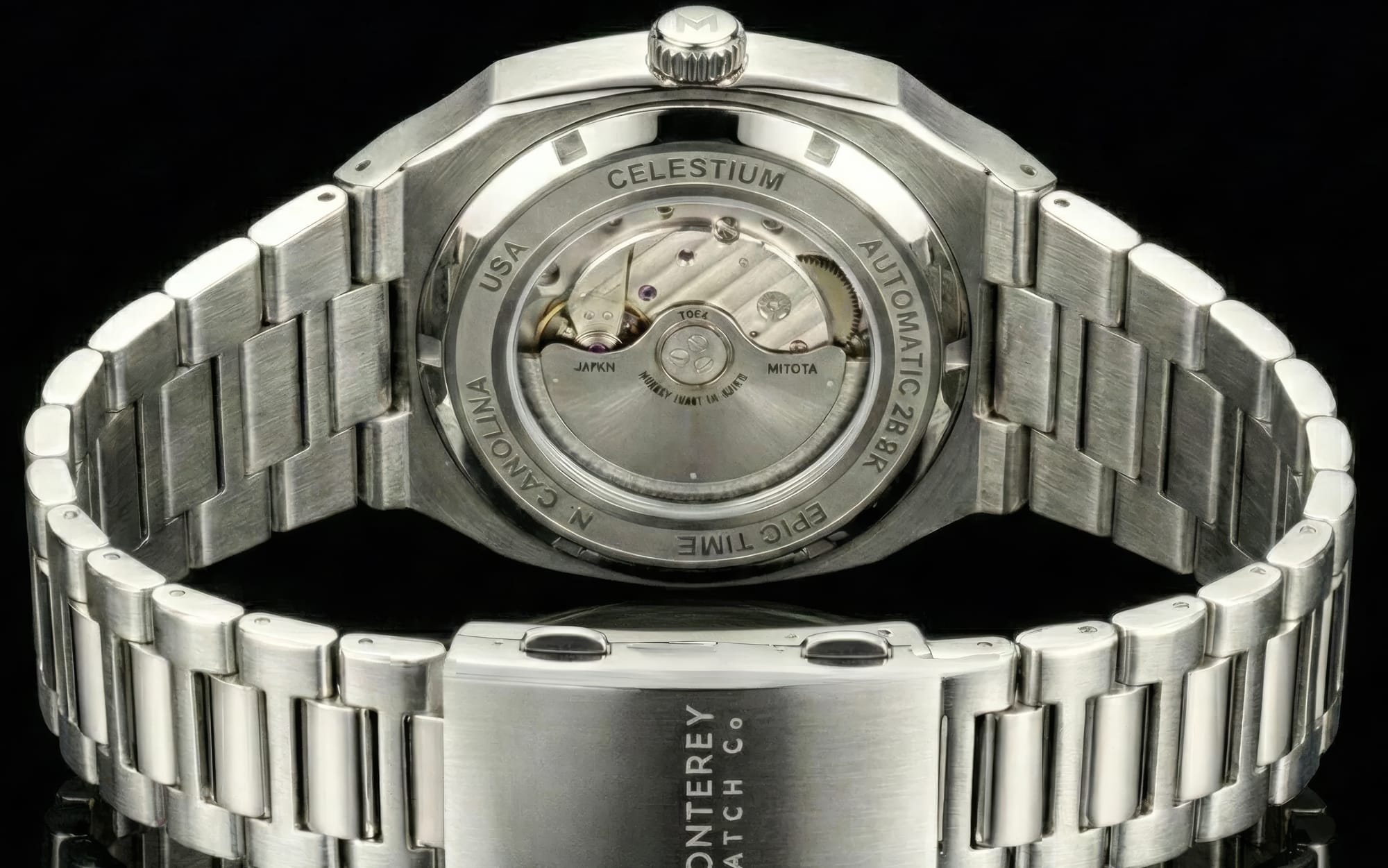
The movement is the Miyota 9015, the high-beat 28,800-vph automatic that's become the workhorse upgrade for serious microbrands. It's a step above the ubiquitous Seiko NH35 (which runs slower and louder) and several steps below the in-house calibers in the Cartiers and Ulysse Nardins on the other end of my watch box. Hermes has been clear about his movement budget in past interviews: total cost, all in, never more than $200. The Celestium's 9015 is the upper end of what that budget allows. In absolute terms it's still an inexpensive Japanese movement.
And on the wrist, that shows. The rotor is noticeably noisier than the Swiss movements I'm used to. The seconds-hand sweep is clean and the date change is crisp, but the power reserve is only about forty-two hours, which is short by modern standards, meaning a watch left in the rotation for the weekend is dead by Monday morning. It isn't a deal-breaker for the price, but it isn't impressive on its own merits either.
So would I have paid $1,000 for this watch if Monterey had used a Sellita SW200 or an ETA equivalent? Honestly, no. The trade Monterey has made is the right one for what they're trying to build. A more expensive movement would have pushed the Celestium into a price band where it'd be competing directly with brands that have more developed manufacturing and better finishing, and it would lose. Keeping the price at $499 forces the comparison set down to other watches at $499, and inside that set, the Miyota 9015 is a defensible call. Just don't go in expecting Swiss feel: it's a Japanese movement and a relatively inexpensive one, and that's what it sounds like on the wrist.
On the wrist
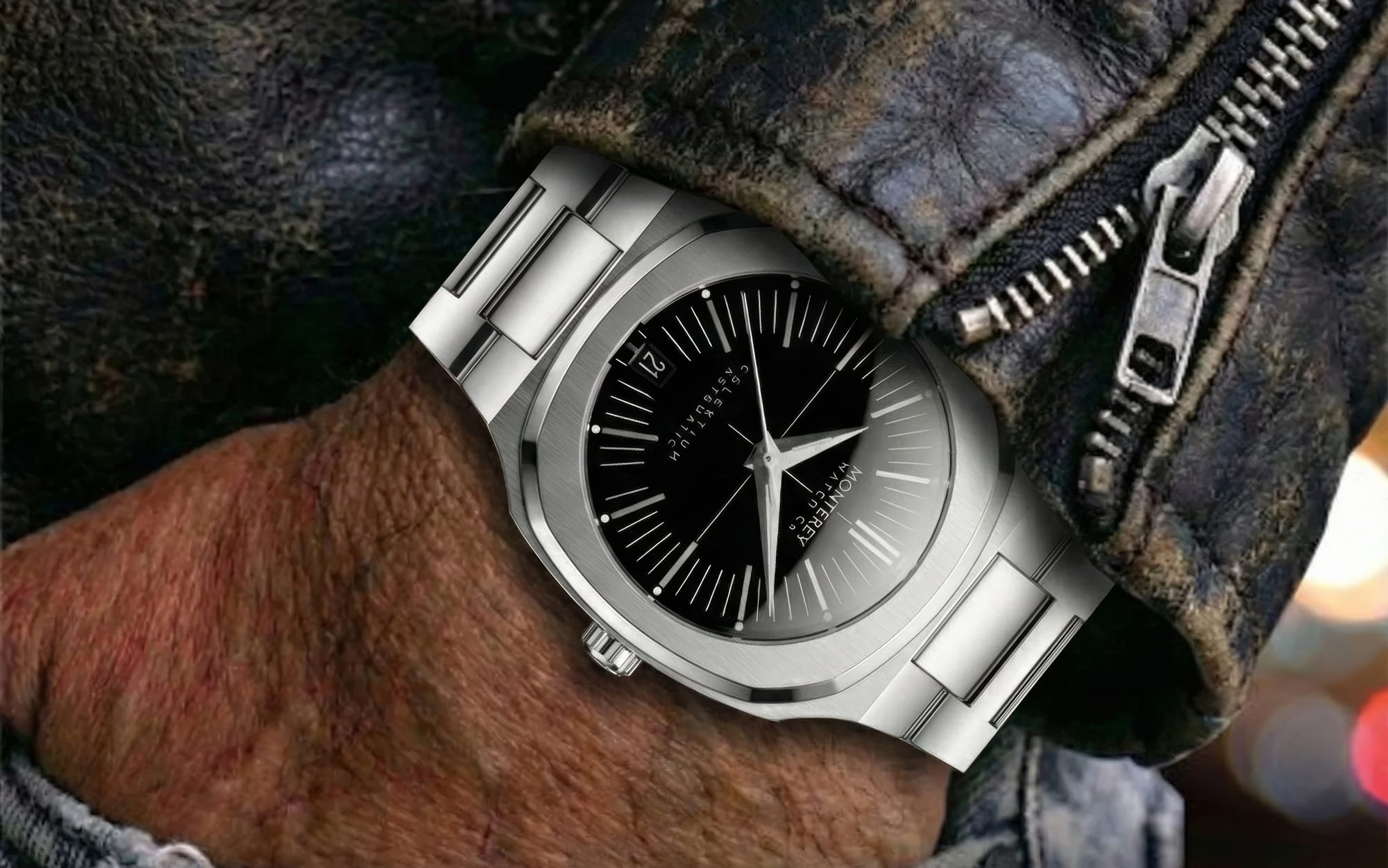
I've only spent a day with the watch, which isn't enough to form a final view but is enough to form an early one. It wears light. It wears small. It hides scratches because of the matte finish, which makes me less precious about wearing it than I am with the Cartier Santos or the Vacheron Overseas. I'd happily wear it on a weekend, on a flight, to an evening dinner where I didn't want to risk something more expensive. It's not a beater and it's not a tool: it's a dressy weekender that gestures at something much more expensive than it is when the light catches it right.
So what's it actually have going for it that nothing else in my collection does? It doesn't look like any of the obvious choices. It looks novel, vaguely European, vaguely independent. People who know watches will look at it and not immediately know what it is. I get a small but real kick out of that.
Comparisons
The obvious comparison is the Tissot PRX 80. Same price range. Integrated bracelet. Chasing the same high-end sport-luxe genre. And it's being worn by approximately every other person in every American airport at the moment. The PRX has become the Submariner of this price band, and being everywhere isn't what I want from a watch I'm paying for myself.
I looked at a few others before pre-ordering. The Revelot Mecadromo, a Singaporean microbrand sport piece. The Brew Metric, with its more whimsical chronograph dial. The Timex Snoopy Q, a different proposition entirely, but it lives in the same impulse-buy mental category for a collector trying to broaden a collection's price range. None of them gave me what the Celestium did, which was the quiet thrill of recognition: the cushion case, the compass lines, the silhouette of something I can't afford. The Maen and Baltic pieces in my collection have the same independent spirit but they're doing different things.
The PRX is the watch the guy across from you on the plane is also wearing. The Celestium is the one you'll have to explain when somebody asks. Given the choice, I'd rather explain.
Final thoughts
I can't recommend this watch yet, and that's the hard part to write, because I want to. The clasp bites. The bracelet has the kind of looseness between links that pushes the watch out of the league it's reaching for. The dial, marketed as enamel, doesn't have the depth its layout deserves. The crystal isn't specified. These are all fixable problems: a better-finished clasp, tighter tolerances on the articulation, a sunray or grained treatment on the dial, an honest spec sheet on the crystal, and, for the people whose wrists are bigger than mine, a 43 or 44mm version of the case. If Monterey ships any of those in a v2, I'll tell people to buy it.
So why didn't I cancel the pre-order? Because this watch has the design ambition of pieces costing well over a hundred times what I paid for it, and almost no one at $499 is even trying that. Tim Hermes isn't designing dials from scratch: he's curating them, putting them into cases that approximate the silhouette of high-end sport-luxe watchmaking, and selling them at a price that puts the borrowed elegance of those silhouettes within reach of someone like me. Someone who isn't going to spend $60,000 on a Swiss independent. The Celestium proves the formula works on paper. I'm betting the next version, or the one after, will be the one that proves it works on the wrist.
