

Micromilspec calls the Field Testing Unit "a modern beater." I'd call it a nice beater. It's nice enough to wear anywhere, and I wouldn't lose a minute of sleep scratching it. But I'm not going to scratch it, and neither, I suspect, is almost anyone else who buys one.
Mine is #002. It's a stripped-down field watch, genuinely designed for field testing, with none of the usual bells and whistles. And almost none of them will ever be tested in a field. The buyers are the most committed Micromilspec fans, not soldiers.
Video credit: Micromilspec
Where a watch like this comes from
Start in Oslo. Micromilspec runs its design studio on Akersgata, in the center of the Norwegian capital, and if you've got a mental file marked "another Scandinavian microbrand," set it aside. The company didn't begin as a lifestyle label that later borrowed a military accent. It began the other way around. Founded in 2019, it started by building custom, Swiss-made mechanical watches for people who wear uniforms for a living: the Royal Norwegian Air Force, the King's Guard, French combat swimmers, Swedish paratroopers, even the U.S. Space Force. The civilian watches, the ones you and I can actually order, are a small annual window onto that work. They aren't the work itself.
I've given so much money to Swiss watch companies over the years that I'll admit a certain pleasure in watching a country that isn't Switzerland show up and compete in earnest. Norway's an unlikely entrant, and on this evidence a serious one.
Sometimes it's important to give back. I had the pleasure of not only attending the Model S and X send-off event, but also presenting Elon with this custom made watch as a thank you from the Norwegian Tesla Team for all he's done to enable a better future for us all. pic.twitter.com/JRoTR0Lhxw
— Axel Tangen (@axeltangen) May 22, 2026
The brand's having a moment, and not a small one. In late May 2026, a custom Micromilspec chronograph turned up on Elon Musk's wrist, in a photo shared on X and picked up by Italian Watch Spotter and others. That watch isn't this one. It was a separate piece, made in a run of four, with an octagonal case in the Milgraph mold, a La Joux-Perret movement, and the word "Elon" engraved on the back, reportedly commissioned by Tesla's Norwegian team as a tribute. My guess is that other famous people will now want one too, and that the company's about to find out what demand really looks like.
It's already overwhelmed, in the good way. I've traded a fair number of emails with their support team, and the impression I came away with is of a young company straining to keep up with its own success. They were unfailingly friendly, and the products kept arriving solid, well designed, and genuinely novel. For a watchmaker only a few years old, that's a real story.
There's a strategic puzzle buried in all this, and it's the most interesting thing about the brand right now. To take Micromilspec to the next level, the obvious move is an in-house movement of its own. Before that can happen, they'd need to ramp up production. And yet the very thing that makes the watches feel special is the scarcity that comes from tiny runs. For now, that scarcity isn't a problem to solve but the strategy itself.
The catalog around the FTU has filled out fast: a new Pilot series, an expanded Milgraph line including the sharper Milgraph T5, and a run of Declassified editions. The Field Testing Unit is the plain one. In a lineup that keeps adding, it's the watch defined by what it leaves out.
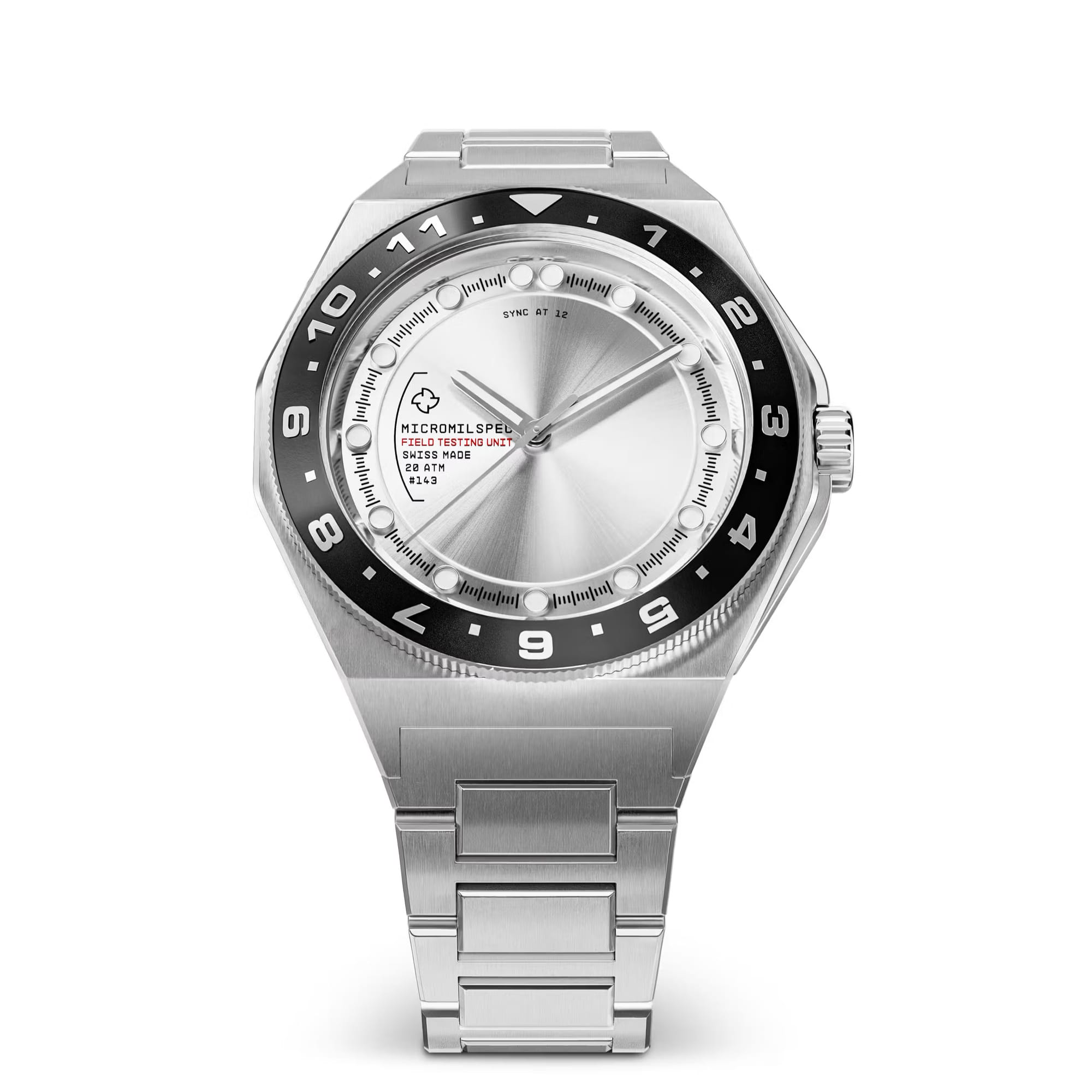
A modern beater
The case is Micromilspec's signature octagon, cut from 316L surgical-grade stainless steel and finished in a unidirectional satin brush. It measures 42mm across and a slim 12mm tall, with a lug-to-lug of 50.3mm, a domed sapphire crystal with anti-reflective coating, a screw-in crown flanked by a chamfered guard, and a unidirectional bezel. Water resistance is 200 meters, or as the dial itself puts it, 20 ATM.
Two things stand out before you even fasten it. The first is the crown. It sits on the right, where a crown belongs, and after a year of wrestling with the left-hand crown on my destro Milgraph, I appreciate that more than I expected to. The Milgraph's case has real reasons for putting the controls at nine o'clock, and I respect them, but I'm still not used to it. The FTU asks nothing of me. I reach for it the way I reach for every other watch I own.
The second is the weight, or the strange honesty of it. On the steel bracelet the FTU is very light, lighter than a chunk of steel this size has any business being, and yet heavy enough that you always know you're wearing one.
At 42mm it's just about the perfect diameter, at least for me. I'll go further. This case design could scale to 44 or even 46mm without losing its proportions, and I wouldn't be surprised to see a jumbo version turn up at some point. The octagon's got the bones for it.
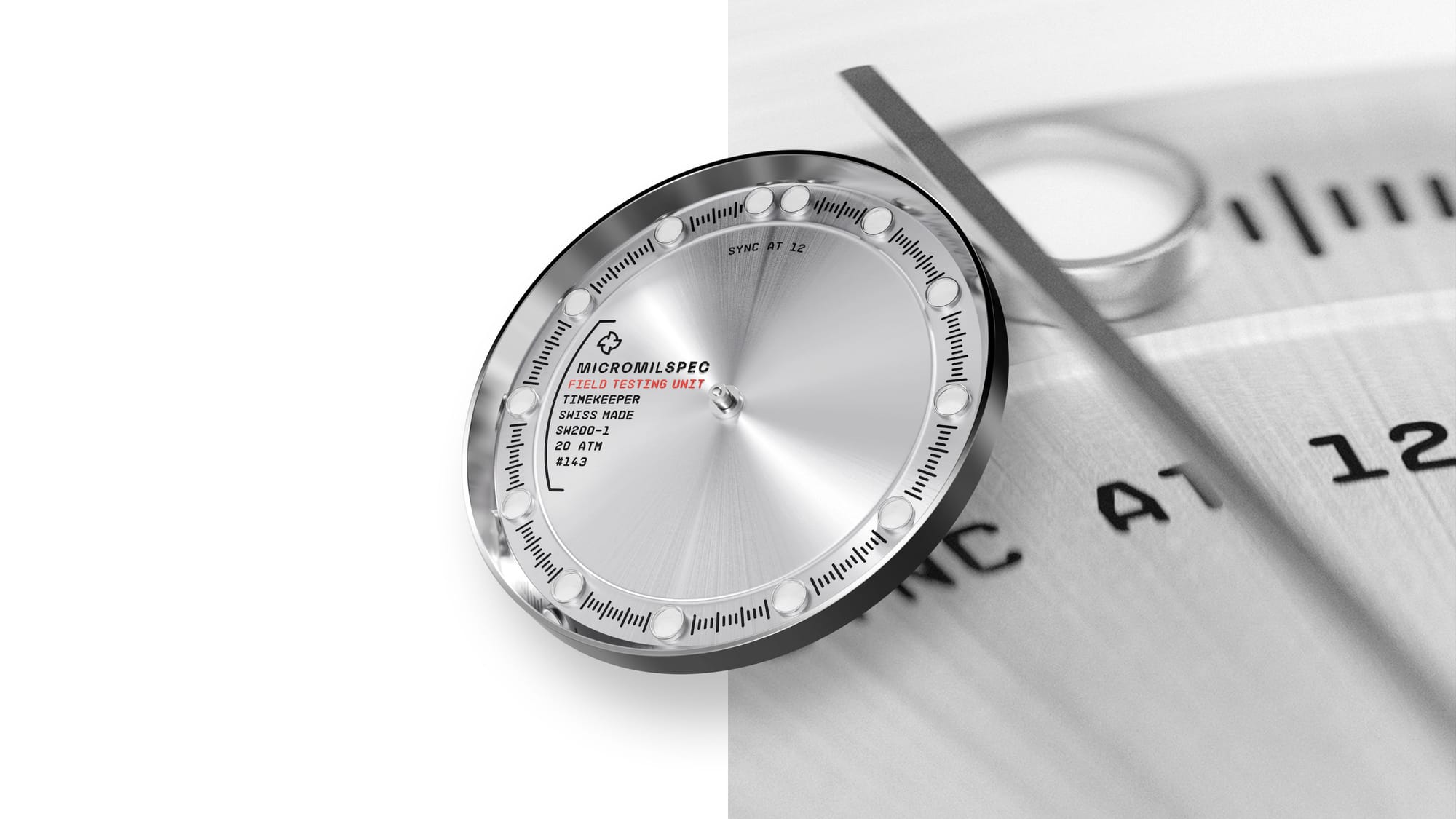
The dial, and the noon photograph
Here's where the watch tells on itself. The dial is silver, with a fine sunburst finish and applied round markers. The hands are the cleanest upgrade over my Milgraph, whose hands have always felt a little plastic to me. These are metal, and I prefer metal hands, and the difference is the kind of thing you stop noticing only because it stops bothering you.
What's printed on the dial is the part that matters. In a small block sit the Micromilspec logo, then FIELD TESTING UNIT in red, then SWISS MADE, then 20 ATM, then the serial: on my watch, #002. Up near twelve is the SYNC AT 12 line. There's no date. The face is, in the most literal sense, a spec sheet.
Now hold that next to where the dial came from. This face was developed so test units could be photographed at noon and their accuracy logged against the field. It's a watch designed to be documented in use. And it's become a 25-piece annual collectible, photographed at noon for entirely different reasons, by people documenting it instead of using it.
The MicroGMT bezel is the one functional flourish on the whole watch. It's a 12-hour unidirectional bezel that displays a second time zone, and it's got real lineage: Micromilspec traces the design to the Royal Norwegian Air Force's Search and Rescue Squadron, for missions that crossed several time zones close together. You rotate it, you read a second zone off the hour hand, and that's the complication.
I haven't been traveling much lately, and when I do it's rarely more than six hours away, which isn't the kind of math that needs a bezel or a fourth hand. The GMT has always seemed like a pretty lame complication on a 12-hour watch, though I know plenty of people love it, so take that as one collector's opinion and not a verdict. What I do love is the sound. I love the sound of a good bezel click, and this one has it: crisp, positive, deliberate. Its one feature exists to track time zones, I bought it, and I use it for the noise it makes.
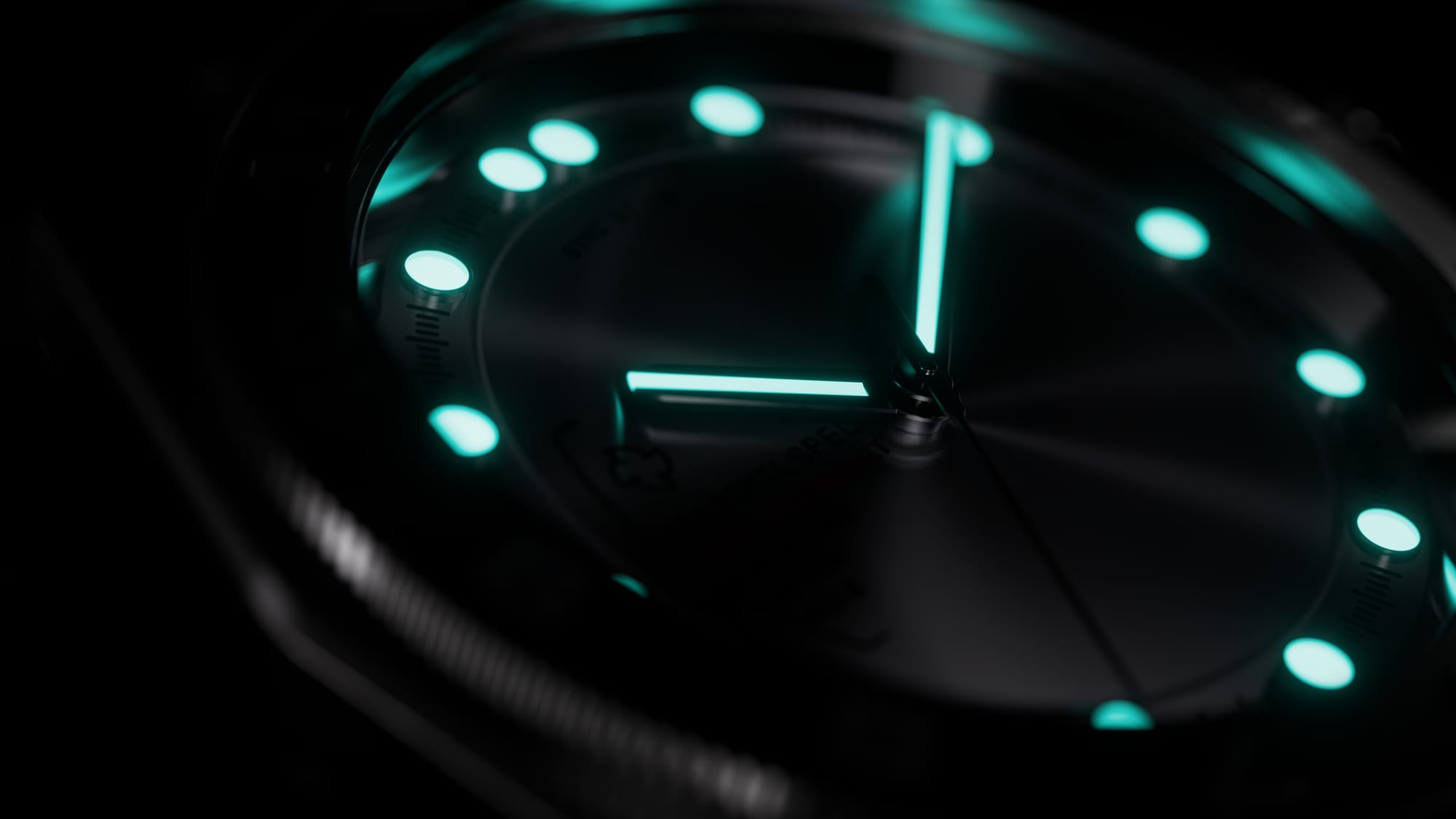
On lume: I haven't run it through a proper full charge, so I can't tell you how long it holds. In genuinely dark conditions it reads well. Beyond that, I'm not going to invent a number for how long it glows, because I don't have one.
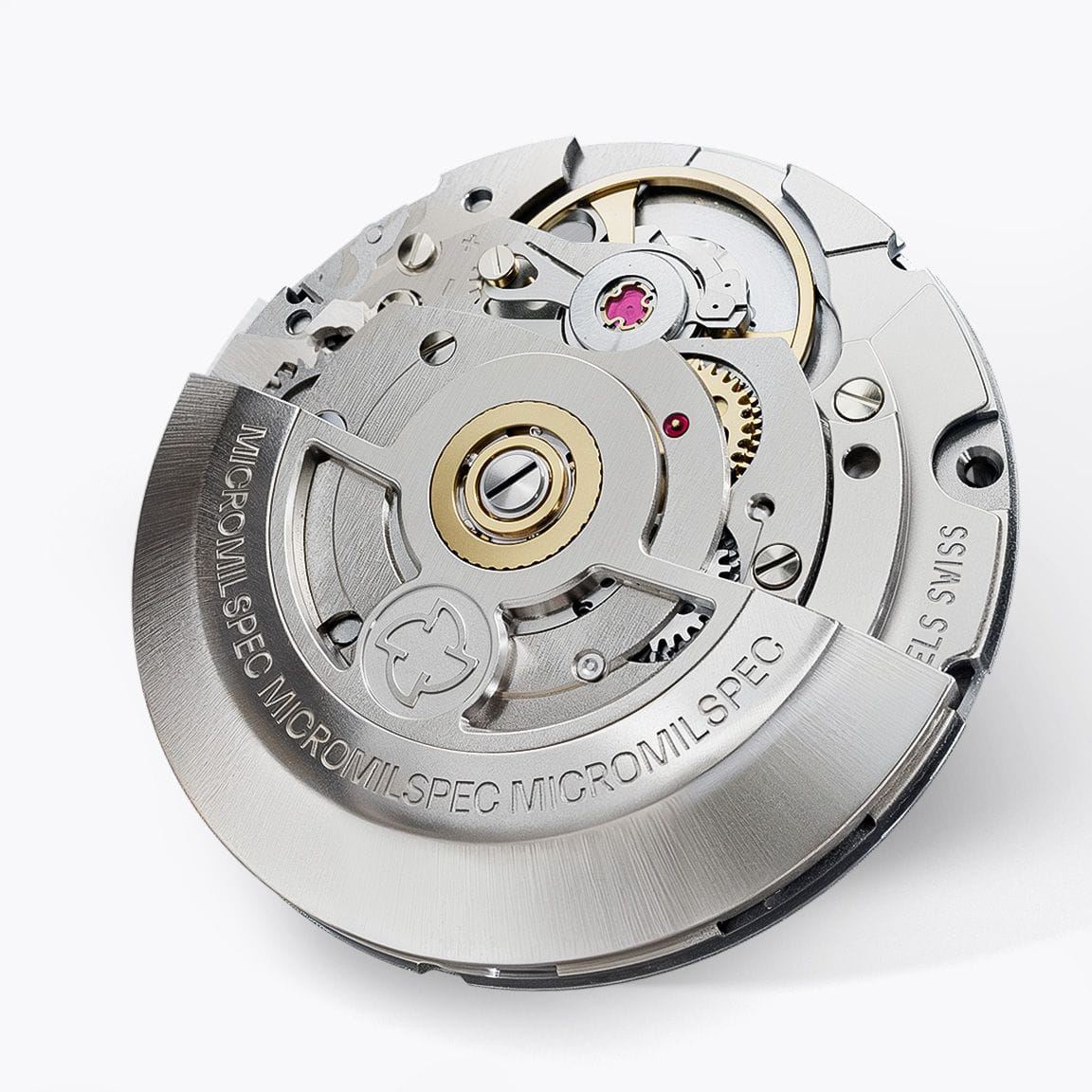
The movement is enough
Inside is a Swiss-made Sellita SW200-1, in the Special (Élaboré) grade, adjusted by Micromilspec and fitted with the brand's own rotor. It's an automatic, running at 28,800 vph, with 26 jewels and a 38-hour power reserve, made in La Chaux-de-Fonds. I haven't put #002 on a timing machine, so I won't quote you a rate. It tells the time, and it does so with Swiss precision, and that's the honest extent of what I can claim.
This is the workhorse half the microbrand world leans on, and you can read its presence here two ways. Set against the wider watch world, it's a modest movement, especially when you notice that Micromilspec's own siblings, the Milgraph, the Dualtimer, and the Worldtimer, all get the upmarket La Joux-Perret column wheel instead. But for a three-hand field watch, a Sellita may even be more than necessary. There's nothing here to time, nothing to wind a complication for, nothing that demands a finer caliber.
An in-house movement would be the next rung, the thing that turns a serious microbrand into a serious manufacture. But the Sellita is what you fit while you're still small enough to make only a couple dozen of these a year, and the day they outgrow it is the day they have to outgrow the scarcity too. I'm not sure that trade's as obvious as it looks.
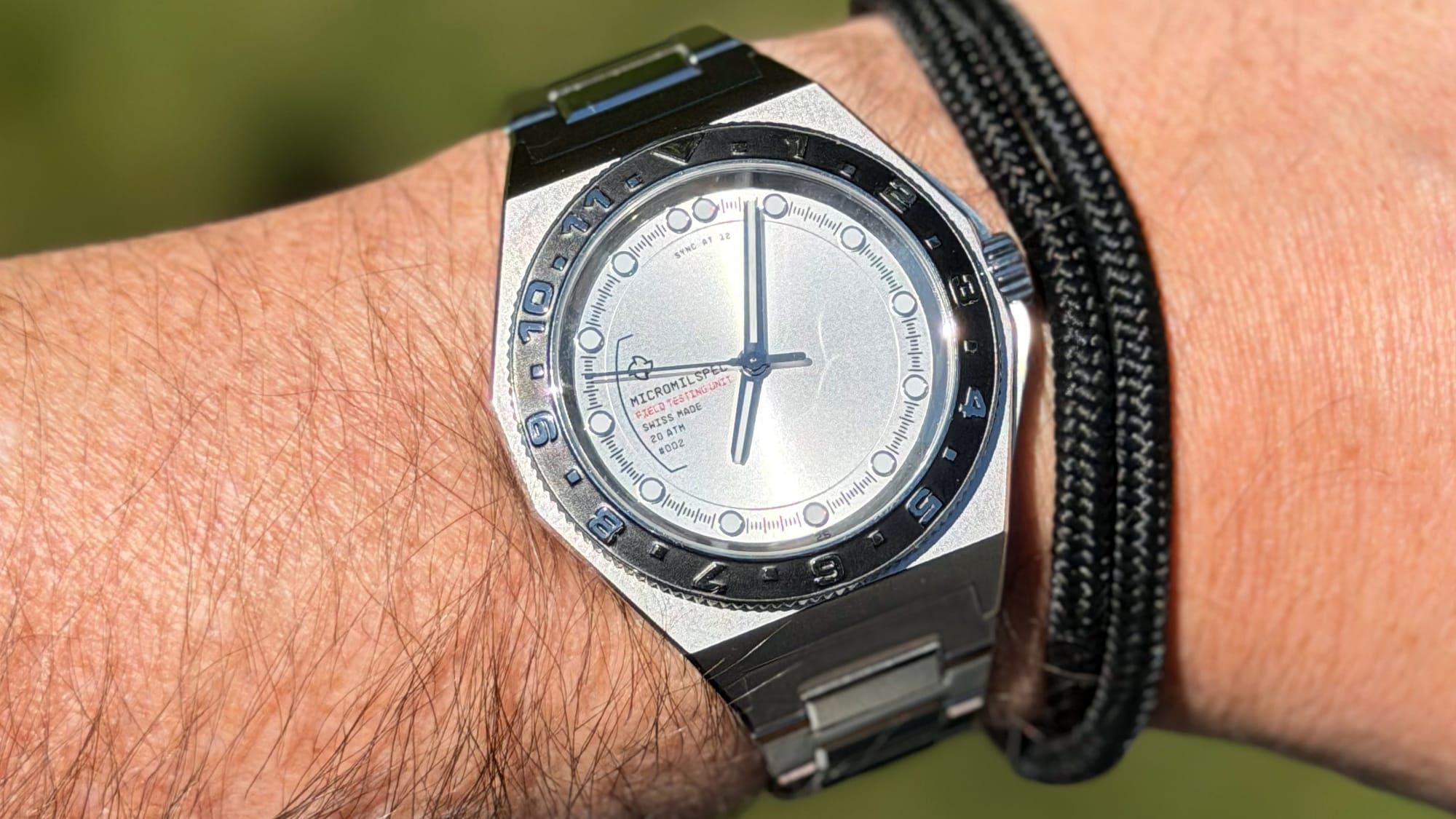
On the wrist
I've already given away most of the verdict: 42mm of perfect diameter, light but present, a crown where I want it. The rest is about the bracelet, and the bracelet deserves the attention.
This is the bracelet I wished the original Milgraph had come with. It's that good. It's an integrated, 20mm, satin-brushed steel design, sized to me before it shipped, because I just gave Micromilspec my wrist measurement and they sized it and tucked the spare links into the box. That saved me the usual sizing ritual, which I appreciated. The flip side is that I'm not certain how easy it is to adjust now, because it runs a pin-and-collar friction system that needs a tool to push the pins out. I'd prefer screws on the links. It's not a dealbreaker. The clasp is a nicely etched double clasp, nothing ostentatious, and it's got two small graces: it doesn't make you close one side before the other, and it snaps shut flush, with no overlap. There's no micro-adjust, but the links are small enough that you can land on a good fit anyway.
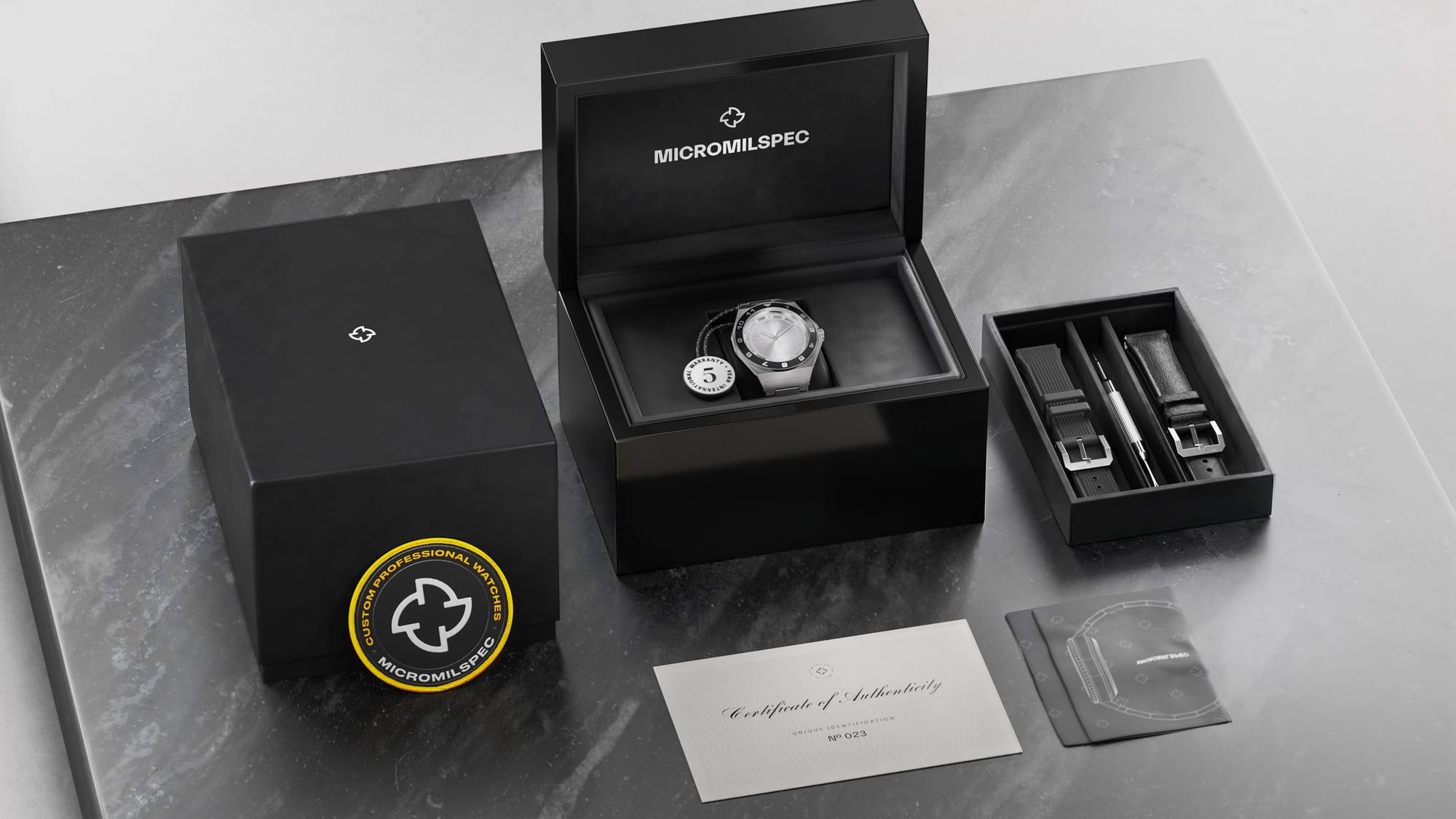
The honest consequence of loving this bracelet is that I now need to buy the titanium Milgraph bracelet to bring my flagship up to the same standard. And despite being a bare-bones watch, the FTU still arrives packaged like everything else in the collection: a proper display box with a high-gloss shell and a soft-touch interior, three compartments for spare straps, the strap tool, and the certificate of authenticity, plus a military patch and a cleaning cloth.
The colorful siblings, and a Swiss coincidence
The most useful comparisons for the FTU don't leave the building. They're the watches Micromilspec sells right alongside it, because they show you exactly what the FTU chose not to be.
Start with the Dualtimer, which is basically the FTU with everything bolted back on. Same brushed stainless steel, near-identical dimensions at 42mm by 12.5mm, same 200 meters. But it adds a central GMT hand, a date at three, a ceramic 24-hour bezel, and a clever two-color lume scheme, blue for the bezel and GMT hand, green for the dial, so home and local time stay separate in the dark. It comes in loud, look-at-me colors: Sand, Green, Blue. And here's the part that should sting if you're an FTU buyer. Micromilspec lists the Dualtimer at roughly the same money as the FTU. You're not paying less for the plain watch. You're paying the same for less.
Then there's the Worldtimer, the maxed-out traveler of the family: grade-5 titanium, a black ceramic bezel engraved with 24 cities in relief, the La Joux-Perret L122 caller-GMT chronograph inside, a date, and a white dial. It costs roughly USD 3,850 and runs to 75 pieces per reference. It's the maximalist opposite of the FTU, and it's a lovely thing.
Now look at the colors those travel watches come in. White on the Worldtimer. Sand, green, and blue on the Dualtimer. Hold that palette up against the watch the whole luxury world was talking about this spring, the Vacheron Constantin Overseas Dual Time "Cardinal Points," released at Watches and Wonders 2026, which assigns four dial colors to the four points of the compass: white for the frozen North, brown for the South, green for the West, blue for the East. And the Cardinal Points is, by Vacheron's own framing, the successor to the Overseas Dual Time "Everest" of 2021, the very watch I compared my Milgraph to in an earlier review.
So the upstart and the establishment have, in the same season, landed on the same four-color compass palette for their travel watches. I want to be precise about what is and isn't happening here, because it's easy to overstate. Vacheron deliberately badges its colors as the cardinal directions. Micromilspec doesn't. Nobody in Oslo is calling these North, South, East, and West. The directions are my reading, not their marketing. The colors just rhyme. But they do rhyme, a CHF 33,700 titanium GMT and a stainless-steel beater reaching for the same symbolism of the open horizon.
The Dualtimer and the Worldtimer wear their travel functions on their sleeves: the GMT hands, the world cities, the dates, the bright colors that say I go places, I do things. They're the watches people buy to look the part. The Field Testing Unit strips all of that away, down to a bezel and three hands, and in doing so becomes the most purely "field" watch in the catalog. And it's the one least likely to ever see a field.
Final thoughts
The Field Testing Unit is a genuinely good object. The case is distinctive and beautifully made, the dial is the most honest piece of design Micromilspec has put its name to, the bracelet's better than its price has any right to be, and the metal hands quietly out-class the ones on a watch that costs more than twice as much. I like it a great deal. I will reach for it but I'm not going to recommend it.
That's not a contradiction, and it isn't a knock on the watch. It's a statement about fit. The FTU is a deliberately narrow instrument, sold in tiny numbers at near-Dualtimer money, with a movement that's plain by design and a complication its likely owner will use for its click. It'll mostly be bought by the most committed Micromilspec fans, and now, maybe, by people who saw a name on Elon Musk's wrist and wanted in. For almost everyone else, the more versatile Dualtimer is the smarter buy, or a watch whose features you'll actually use. You should want this one specifically, or not at all.
Micromilspec built an instrument and the market turned it into a collectible. The brand's whole trajectory, the military contracts, the four-piece tribute on a billionaire's wrist, the runs so small they're nearly theoretical, says this will only intensify, and I expect their success to continue.
But I keep coming back to the dial, and to SYNC AT 12. It was an instruction once, for testers logging how the watch held up in the field. Almost no one who owns one now will ever use it that way.

