

I'd never seen a MeisterSinger with two hands. That's what caught my attention. The brand has built its identity around the single-hand concept. One hand, twelve hours, five-minute precision, a philosophical argument for slowing down. The Chronoskop ignores all of that. It has an hour hand and a minute hand, a chronograph, two subdials stacked vertically, and a reverse panda dial in black and white. It's the MeisterSinger that doesn't behave like a MeisterSinger.
I'm always looking for something different, and this qualified. Vertical reverse panda layouts are rare. Most chronographs arrange their subdials horizontally or in a triangular configuration dictated by the movement. The Chronoskop stacks them top to bottom. White subdials on a black dial, clean white hands, and the brand's two-digit Arabic hour markers (01, 02, 03) running around the perimeter. I had to try it.
I bought the MM202 in June 2024 at WWJD di Alessandro Soave, a dealer in Verona, Italy. I paid $2,415 on the secondary market.
The brand
The name references the medieval Meistersinger tradition, master singers who brought new melodic elements to their art. The brand's logo is a fermata, the pause symbol in musical notation. Founder Manfred Brassler's new element was the single hand. Before the mid-18th century, most timepieces displayed hours with one hand. Sundials, medieval clock towers like Westminster Abbey. The minute hand didn't become standard until the 1700s. MeisterSinger revived that and built a brand around it: time read to the nearest five minutes is precise enough. The tagline: "German Design. Swiss Made. Single-hand."
The N01 won the Red Dot Design Award, the iF Design Award, and the Netherlands Watch of the Year, all in 2004. Over two decades the brand has collected more than 35 design awards. Brassler also composes orchestral music and produces ink drawings. He has said the creative process is the same regardless of medium.
MeisterSinger is still privately held. Brassler's daughter Tanja is co-CEO alongside Rainer Eckert, a former Longines brand manager. Manfred remains Creative Director. The company has about 20 employees in Münster and produces around 10,000 watches per year, Swiss-made to German designs. Prices run from EUR 800 for the entry-level Neo to EUR 7,990 for the new Panthero Jumping Hour guilloché limited edition.
In 2014 the brand introduced its first in-house movement, the hand-wound MSH01, followed by the automatic MSA01 in 2016. Both deliver 120-hour power reserves. The Chronoskop predates those developments. It belongs to an earlier period when MeisterSinger was willing to set aside the single-hand concept and see what a chronograph could look like through their design language.
The Chronoskop collection had three known references: the MM201, a Juventus-branded edition for the football club; the MM202; and the MM203, a different dial color. Production ran from approximately 2005 to 2012, when MeisterSinger introduced the Singular chronograph as a replacement. The Singular carried over the same specifications (43mm case, Valjoux 7750, 14.8mm thickness) with redesigned dials. MeisterSinger has since moved away from chronographs entirely. The current collection has none.
Case and dimensions
The case is 43mm stainless steel, 14.8mm thick. Not slim, but 15mm is where most Valjoux 7750 chronographs land. The movement isn't thin and neither is any watch that uses it. At 82 grams the watch sits lighter than the dimensions suggest. On my 7.5-inch wrist, 43mm is a good size.
Polished finish. Domed sapphire crystal over the dial. Sapphire exhibition caseback secured by seven screws. One auction source lists the diameter at 42.5mm rather than 43. The difference is academic. Crown and pushers sit at the standard 2, 3, and 4 o'clock positions. Water resistance is 5 ATM. Keep it away from the pool.
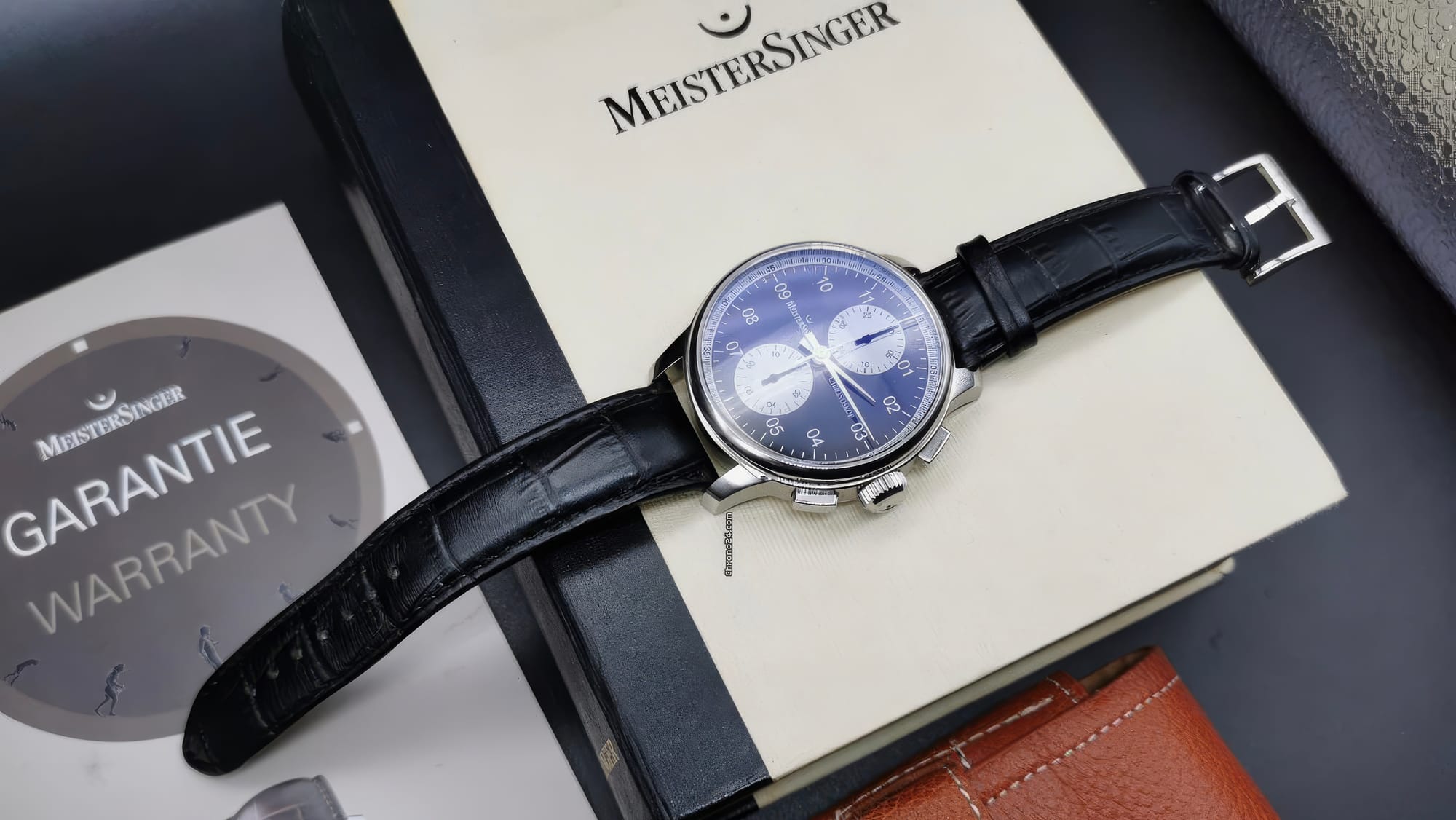
The dial
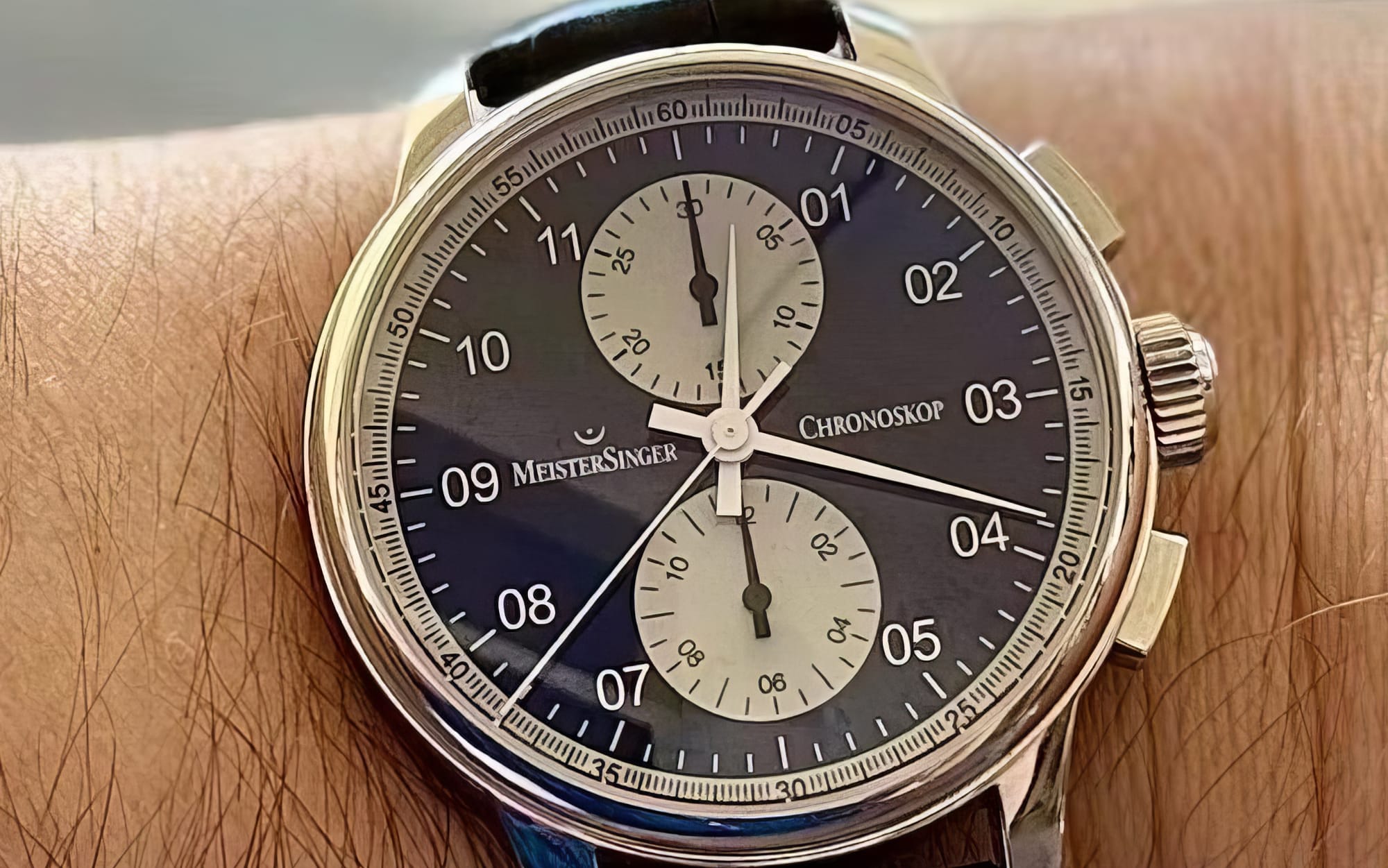
Reverse panda (black dial, white subdials) is common enough in chronograph design. The vertical arrangement isn't. Two subdials stacked at 12, 9, and 6 o'clock give the dial a symmetry that most 7750-based chronographs cannot achieve. The standard 7750 pushes its registers into an asymmetric cluster.
MeisterSinger reorganized the layout to suit their own priorities, and the result is a dial that reads as designed rather than dictated by the movement underneath.
Hour markers are the brand's two-digit Arabic numerals, 01 through 12, single digits prefixed with a zero for visual balance. White on black, evenly spaced, slightly formal. Graduated indices mark five-minute increments between the hours, a carryover from the single-hand dial where those markers are how you read the time. On a two-hand watch they are not strictly necessary, but they are what make this dial recognizably MeisterSinger.
The hands are solid white, which is unusual. Most chronographs use polished steel, blued hands, or luminous fills. These are flat white on black, and the contrast hits you immediately. Legibility is excellent. MeisterSinger and "Chronoskop" are printed at 9 o'clock without crowding the dial.
The movement
The ETA Valjoux 7750. Cam-lever chronograph, 25 jewels, 28,800 vph, 48-hour power reserve. It hacks, it hand-winds, and it has been in production since 1974. Nearly every watchmaker at this price point has put one in something.
The 7750 is proven and serviceable. Parts are everywhere. Any competent watchmaker can work on it. The downside is the unidirectional rotor, which winds in one direction and freewheels in the other. This produces a wobble that some people notice and some do not. I notice it. I've never liked unidirectional rotors, and this one does what they all do. You feel it shift when you move your arm.
Accuracy has been good. The watch keeps time and has never needed service. Through the caseback, the movement is visible with fausses cotes striped decoration. It's not exciting to look at, but it works.
On the wrist
At 43mm and 14.8mm thick, the Chronoskop won't tuck under a dress shirt cuff. It sits well under a sweater or jacket. The 82 grams distribute evenly across the case, so there is no top-heaviness.
The original black leather strap suits the watch. I haven't replaced it and don't plan to. It's clean and simple, which is what the dial needs.
The chronograph pushers are firm with a satisfying click. I rarely use the chronograph for anything practical. It's more something to fidget with. But the action is crisp and the reset snaps cleanly. The pushers feel deliberate.
Comparisons
At $2,000-2,500 on the secondary market, the Chronoskop sits alongside chronographs from Sinn, Junghans, and Hamilton. The Sinn 356 and Hamilton Intra-Matic are the obvious comparisons. Both use 7750 derivatives, both are well regarded, and both are easier to find.
The Singular, MeisterSinger's direct successor to the Chronoskop, trades on Chrono24 between $2,000 and $3,300 with identical specs and better availability. None of these alternatives have this dial. The vertical reverse panda with MeisterSinger's typography doesn't exist anywhere else. That's either the reason to buy it or irrelevant to you, and there's no middle ground.
Final thoughts
The Chronoskop is a contradiction. MeisterSinger's philosophy is about slowing down. Reading time to the nearest five minutes. Marking the hours with a single hand. Using a pause symbol as a logo. The Chronoskop puts a stopwatch on that philosophy. It measures elapsed time to the second, on a dial designed by people who think seconds don't matter. I suspect that tension is part of why MeisterSinger walked away from chronographs.
I don't wear it often, though I like it when I do. It rewards the few people who recognize what it is. A MeisterSinger that broke its own rules. Most watch collectors assume the brand only makes single-hand watches. This one surprises them.
It's likely on its way out of my collection to make room for something new. That's not a criticism. I buy watches to see what they are about, and when I know, I tend to let them go. The Chronoskop did what I needed it to do. It looked different from everything else in the case and reminded me that even brands with a rigid philosophy sometimes step outside it.
