

Some watches exist because people needed them to survive. The Longines Type A-7 is one. Before it became a reissue or a collectible, it lived inside cockpit turbulence, strapped to the wrists of pilots who flew with one hand on the control stick and the other occupied by survival.
Longines had been building precision timing instruments since 1832. By the early twentieth century, the brand had earned trust among aviators and record-setters by producing chronographs and navigation timers that were judged by outcome. The winged hourglass marked the tools used by the first generation of men and women who believed the sky could be measured.
The golden age
Between the two World Wars, flying became a household topic. Planes delivered the mail. Veterans became barnstormers, touring the country with daredevil stunts and offering the public rides. Crop dusting, aerial surveying, and corporate aviation all came into being in the mid-1920s. The airplane had entered the culture. And Longines was there for almost all of it, primarily because of one man.
In 1927, a 25-year-old US Mail pilot named Charles Lindbergh left Roosevelt Field in Long Island and landed at Le Bourget Field in Paris 33 hours and 30 minutes later. First solo nonstop crossing of the Atlantic. Longines timed the event. An American Longines executive named John P.V. Heinmuller, who was also a pilot, officially timed Lindbergh's landing. The media frenzy that followed made Lindbergh an international sensation, and the Longines-Wittnauer connection became inseparable from aviation's most celebrated moment.
Navigation remained the problem. At 200 miles an hour, a kilometer disappears in eleven seconds. Countries and island fuel stops fly past. Pilots needed precision instruments. In 1929, US Navy Captain Philip Van Horn Weems worked with Longines and their American agent Wittnauer to develop the Weems Second-Setting Watch. Given the turbulent cockpits and the thick gloves needed for altitude flying, the Weems was typically oversized at 48mm. Its defining feature was a rotating center seconds dial that allowed pilots to synchronize their timepiece with radio signals, maintaining accuracy even when radio beacons were in their infancy.
Lindbergh took the concept further. Drawing on his experience crossing the Atlantic, he brought a design to Heinmuller for a watch that could calculate longitude using the Greenwich Hour Angle. The Lindbergh Hour Angle Watch appeared in 1931, about 2,000 pieces produced with a 47.5mm diameter and the Longines 18.69 N.S.C. caliber, a pocket watch movement housed in a sterling silver case. These were navigational instruments, not fashion accessories.
Lindbergh himself put it plainly: "Accuracy means something to me. It's vital to my sense of values. I've learned not to trust people who are inaccurate. Every aviator knows that if mechanics are inaccurate, aircraft crash. If pilots are inaccurate, they get lost—sometimes killed. In my profession life itself depends on accuracy."
A Longines-Wittnauer shop display from the late 1930s put it another way: "The Heroes of Aviation and Exploration use Longines-Wittnauer watches for navigating and timing world records." In 1938, when billionaire aviator Howard Hughes flew around the world in four days, his plane was equipped with Longines chronographs and chronometers.
Specification no. 27748
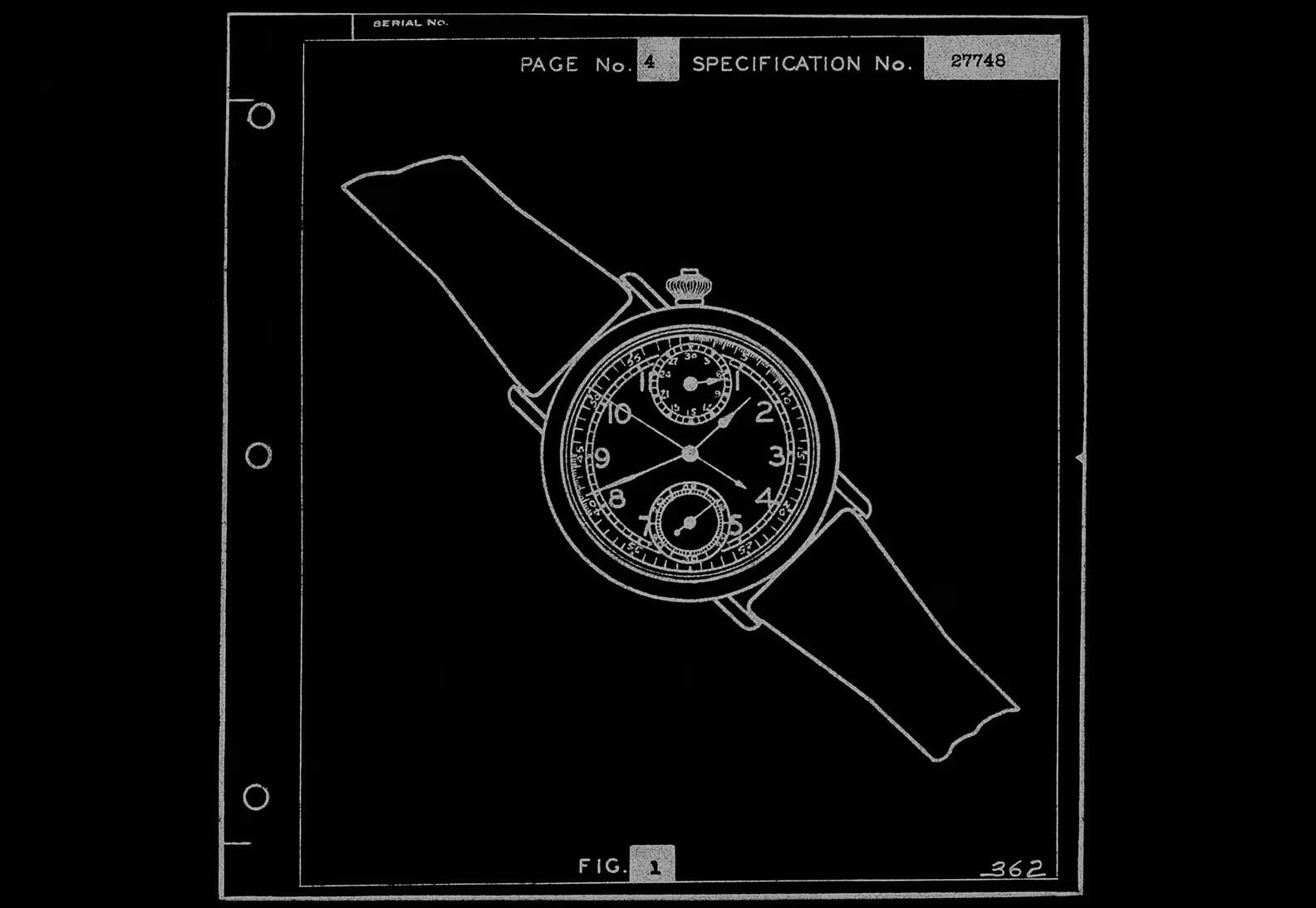
On October 10, 1934, the U.S. Army Air Corps released a detailed document describing a new kind of pilot chronograph. Military Specification No. 27748 asked for something unusual: a dial rotated off-axis so pilots could read the time without removing their hands from the controls. The idea sounds obvious now, but at the time it required a complete reconsideration of wristwatch ergonomics.
The specification was explicit. The watch needed a 40-degree offset from vertical. It needed a co-axial monopusher integrated into an onion-shaped crown, large Arabic numerals for legibility, a 30-minute register at 12 o'clock, and constant running seconds at 6 o'clock. These design elements allowed pilots to read the dial, activate, stop, and restart the chronograph without twisting their forearm or releasing the yoke. The large crown could be operated with thick pilot gloves, essential in unheated cockpits where altitude meant freezing temperatures.
The Army called these "Avigation" watches, a contemporary shortening of "aerial navigation" that Longines and Wittnauer had been using in connection with their Weems instruments. Due to the specification's strict requirements, only three manufacturers qualified: Longines produced black dials, Gallet produced white dials, and Meylan produced black dials. Chrome-plated cases went to the military. Stainless steel versions, produced briefly after the war, went to civilians.
The first procurement
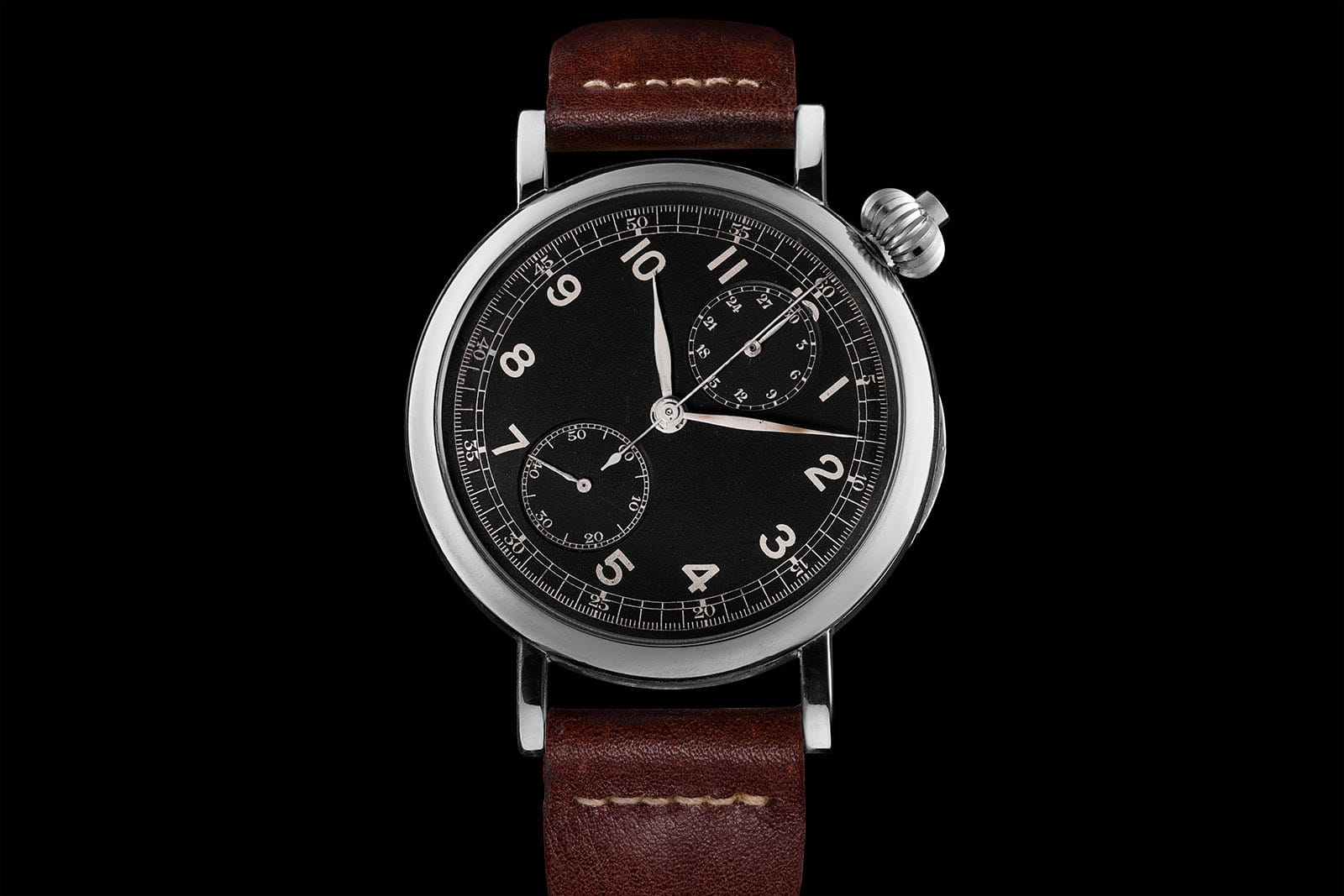
Seven months after the specification was released, the Army Air Corps placed an initial order for 175 watches through Wittnauer. The movements on military examples read "U.S. ARMY A.C." and feature the manual-wind caliber 18.72 with a single-button chronograph complication. The Army Air Corps, which operated from 1926 to 1941, was the predecessor to the current U.S. Air Force.
Bonhams later auctioned an original A-7 invoiced to A. Wittnauer Co. on September 4, 1935. The case measured 48.5mm, sometimes reaching 51mm depending on the example. These were pocket watch movements adapted for the wrist, massive enough to be worn on the outside of a flight jacket or around the leg for maximum legibility.
The Type A-7 was essentially a pocket watch chronograph strapped to the arm. The watches had fixed bars and were mostly fitted with two-piece straps sewn in place. Collector examples show serial numbers like AC-35-171 on the caseback, dating the watch to 1935 issuance. One Meylan example bears the serial AC-37-77, dating it to 1937.
An interesting footnote: the Gallet MultiChron 30M, first issued in 1914, is almost identical to the A-7 except for the offset dial. Gallet's early chronographs used 12 or 13 ligne Valjoux movements modified and signed by Electa, featuring a 30-minute counter at 3 o'clock. This gave rise to the model name MultiChron 30, which became Gallet's signature chronograph line. The A-7 specification essentially took this proven architecture and rotated it for cockpit ergonomics.
Service and replacement
The A-7 served as the standard navigation hack watch for Army Air Corps pilots from 1935 until November 1943, when it was replaced by the smaller A-11. The A-11 was standardized in May 1940, a more compact navigation hack wristwatch with at least fifteen jewels and a sweep second hand. Early 1940-1941 A-11 watches had white dials, and some had Weems bezels, while the later versions from 1942 onward had black dials.
Elgin, Waltham, and Bulova manufactured A-11s in numbers large enough to equip the entire Air Force, Navy, Marine Corps, and even Allied forces under various designations. The RAF used them under the 6B/234 designation. The RCAF and Soviet Air Force received them as well. The A-11 became so ubiquitous that collectors call it "The Watch That Won The War."
The A-7 never achieved those numbers. Its massive size, complex monopusher chronograph movement, and limited production kept it a specialist's tool. Original examples were issued selectively to pilots and navigators. Today, with their 51mm cases, offset dials, and clear military provenance, they remain trophies for collectors. The design is instantly identifiable.
The USA edition
I discovered the Longines A-7 collection years ago, long before I expected to find one of the rare limited editions. The tilted dial was the entry point. You find a design that interrupts your expectations, and that interruption becomes fascination.
The Longines Avigation Watch Type A-7 USA, Ref. L2.823.4.53.2, appeared in 2018. Only 100 units were produced for the United States market. On November 7, Longines unveiled the watch at an event in New York City, partnering with Hodinkee for the launch. They brought historic pieces from the museum at Saint-Imier to display alongside the new release, each with special ties to the United States.
I spent more than two years looking for one in mint condition. When you chase a watch that long, you grow around its absence. Desire makes space. Eventually I found it. The wait shaped the experience of owning it. The A-7 USA feels like a watch I arrived at slowly, at the pace of its history.
Case and construction
The modern A-7 USA uses a 44mm stainless steel case, smaller than the original 51mm pieces but large enough to maintain presence. Longines had previously reissued the A-7 in 2012 at 47mm and $4,900. At that size and price, it was a tougher sell. The 2016 standard A-7 1935 scaled down to 41mm. The USA Edition splits the difference at 44mm.
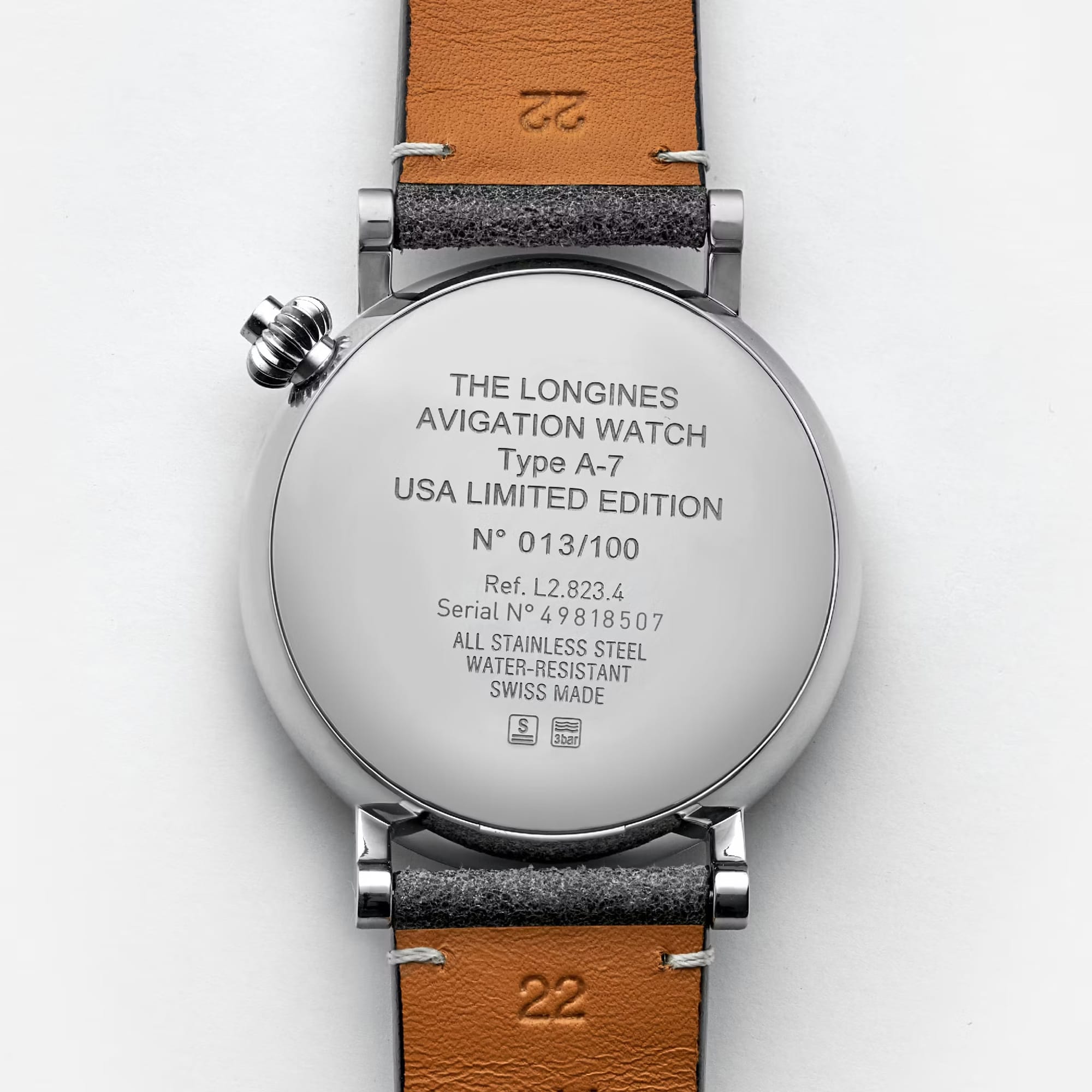
The case is round and polished, fitted with a sapphire crystal on the front with several layers of anti-reflective treatment. Unlike some modern reissues with display casebacks, the A-7 USA has a solid steel caseback with a commemorative engraving. The originals were sealed and opaque. This one honors that. The case measures about 15mm thick with a 51.6mm lug-to-lug distance and 22mm lug width. Water resistance is 30 meters, appropriate for an aviation chronograph that was never meant to see water.
The dial
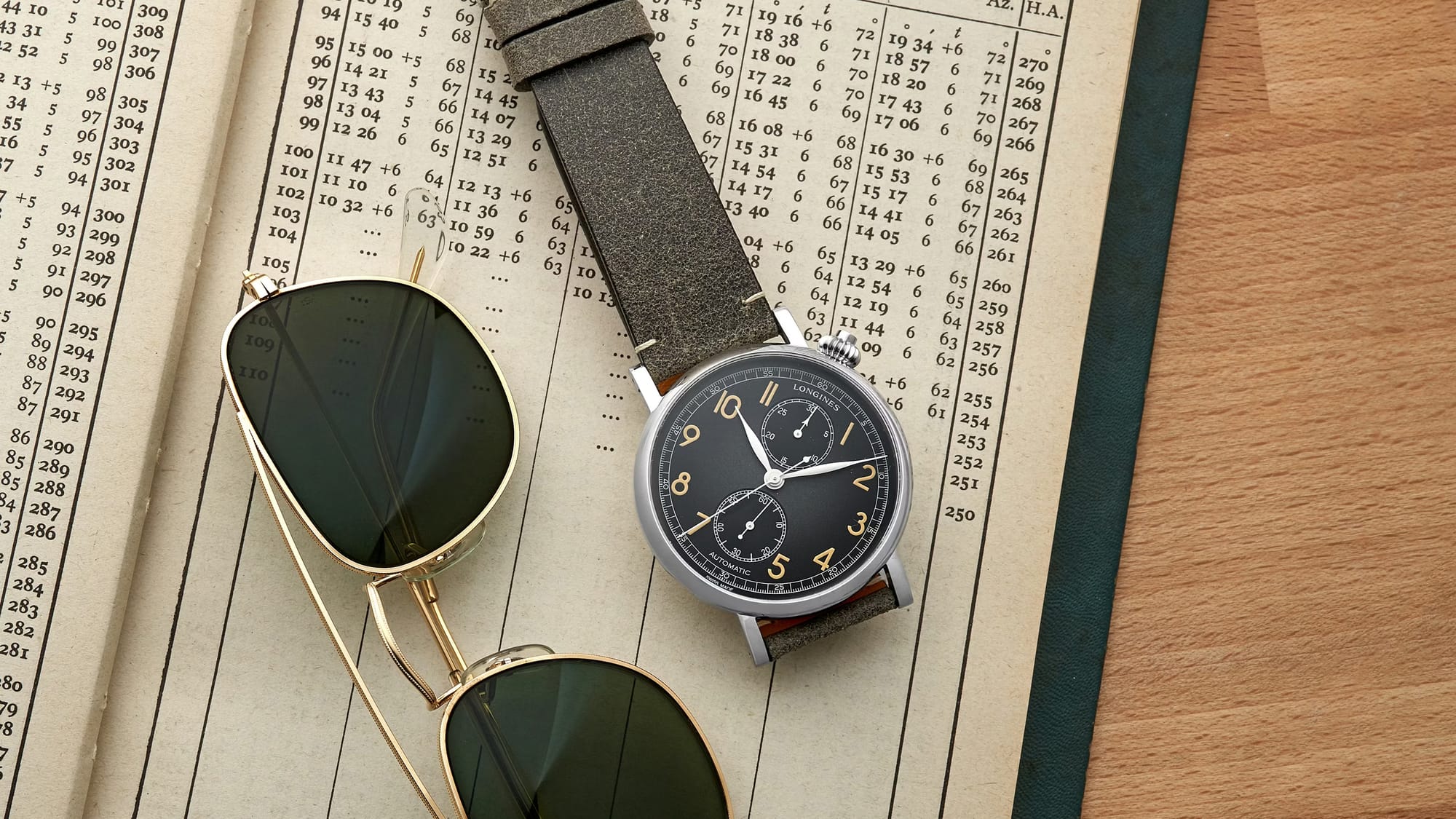
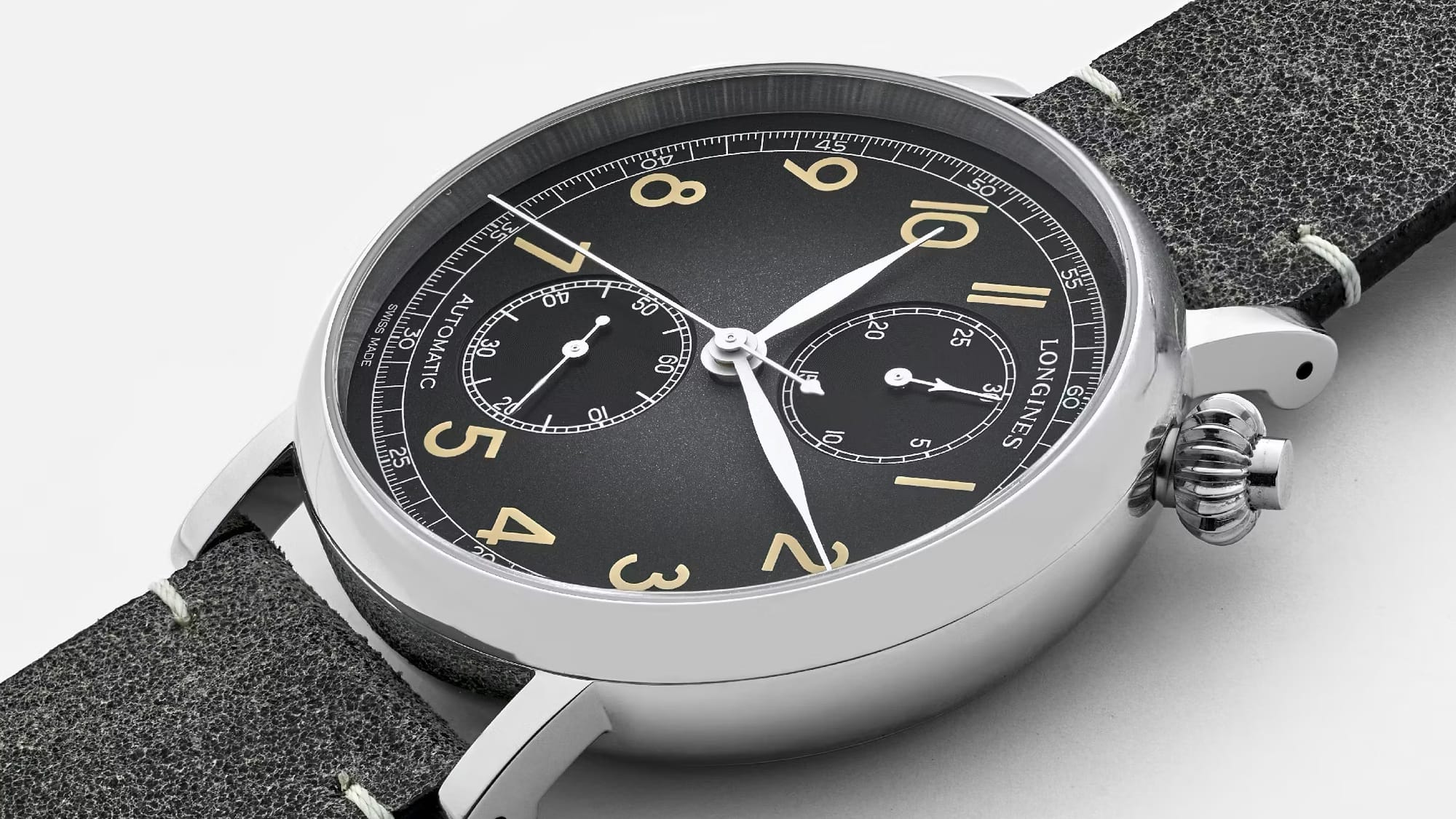
The dial sits cocked 40 degrees to one side. The original Type A-7 was meant to be worn on the inside of the wrist so it would align with an aircraft's instrumentation, allowing pilots to check the time without removing their hands from the yoke. This offset design sometimes appears on driver's watches, but Longines makes clear in every detail that this is a pilot's watch.
Longines describes the modern dial as grained with graduated shading. The gradient moves from dark to light. Honey-colored Arabic numerals give the piece warmth, connecting it to the sepia tones of early cockpit gauges without feeling faux-aged. Two recessed subsidiary dials sit at 12 and 6 o'clock, with a 30-minute chronograph totalizer at the top and running small seconds at the bottom.
The diagonal layout still catches me. Every glance requires a moment of recalibration. Then your eye adjusts. The rotation stops being a novelty and becomes the normal way you read this watch. The USA Edition features sandblasted rhodium-plated hands and omits the date window found on the standard A-7 1935 reissue. Cleaner execution.
The movement
Inside is the Longines caliber L788.2, based on the ETA A08.L11. Column-wheel monopusher chronograph. 27 jewels, 28,800 vibrations per hour, 54-hour power reserve. Start, stop, and reset all execute through a single button integrated into the onion crown. The chronograph times events up to 30 minutes.
Single-button column-wheel chronographs are the earliest type of chronograph movement. Vacheron Constantin, IWC, and Montblanc have brought the complication back through high-end releases, but Longines has been backing an affordable version since 2012. Activating the chronograph produces a confident click. You feel the movement respond. The original Longines caliber 18.72 in the 1935 pieces was manual-wind. The modern L788.2 is automatic, part of ETA's Valgranges family derived from the Valjoux 7750 but substantially upgraded with a mono-pusher mechanism and column wheel replacing the standard cam.
On the wrist
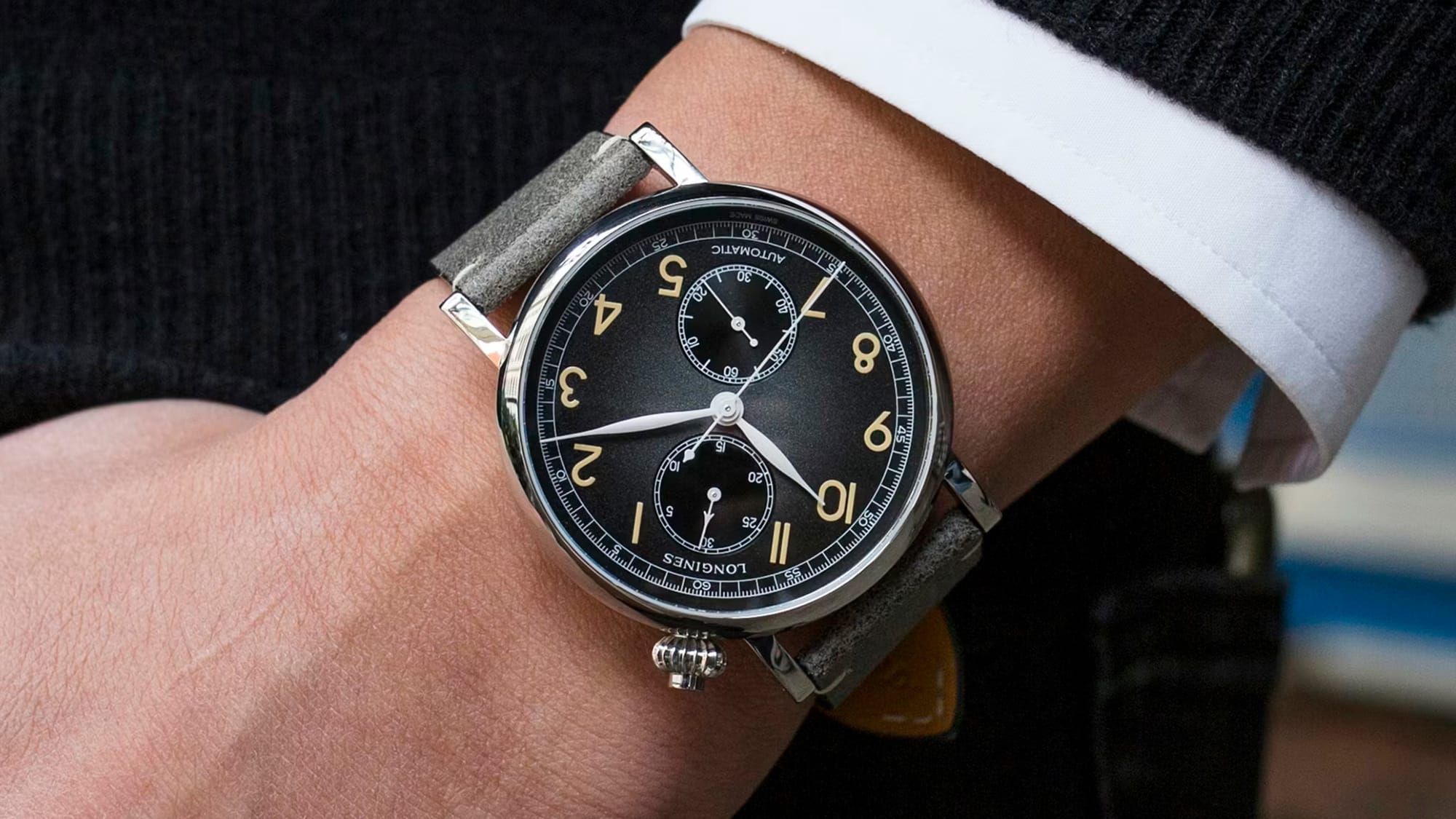
The watch wears differently from anything else in my collection. The tilted dial creates a subtle sense of rotation against the wrist. Even after years of collecting, I still pause when I look at it. The diagonal layout pulls you slightly off-axis.
At 44mm and 15mm thick, the watch is assertive. It came on a black distressed leather strap with a buckle and extension designed for wearing over a flight jacket. The original military A-7s had fixed bars and were mostly fitted with two-piece straps sewn in place. I find it comfortable, though the watch would feel even more historically faithful on a thick leather aviation strap, the kind used over flight jackets in the 1930s.
Rarity
Only 100 units were produced for the U.S. market. It sold out almost instantly in 2018 at $4,250. The A-7 story remains relatively unknown outside military watch circles, which means these pieces are still undervalued.
Original A-7 chronographs from the 1930s are extremely scarce. They were produced for a short period in limited quantities, issued selectively to pilots and navigators. When Bonhams sold a 1935 example, it confirmed the direct connection to U.S. military procurement through the invoice to Wittnauer. The modern USA edition connects to that story through design and specification. The lineage is real.
Why it matters
The A-7 USA preserves the rotated dial from a specification written for survival. The monopusher chronograph carries lineage from the same engineering culture that produced the Lindbergh Hour Angle and the Weems Second-Setting Watch. These were instruments developed when avigation meant dead reckoning over open ocean, when navigation required sextants and nautical tables, when a pilot's timepiece could mean the difference between reaching a destination and disappearing into the Atlantic.
Weems went on to have a long career, serving as a Vice Admiral in World War II and even helping develop space navigation methods for NASA in the early 1960s. The SR-71 Blackbird spy plane used an automated celestial navigation system whose principles Lindbergh and Weems would have understood immediately. That says something about where this technology led.
I chased this watch for two years. When I found one in mint condition, it felt like receiving a missing piece. I have other watches with more complications, more prestige, stronger market recognition. Few carry the same weight.
References
- Bonhams. "Longines Type A-7, Avigation, Ref: 27748, Purchased 4th September, 1935." bonhams.com
- AF0210 Strap. "A-7 Hack Watch." af0210strap.com
- AF0210 Strap. "The NATO Strap During WWII." af0210strap.com
- Worn & Wound. "Military Watches Of The World: U.S.A. Part 1." wornandwound.com
- aBlogtoWatch. "Longines Avigation Watch Type A-7 USA Limited Edition." ablogtowatch.com
- Hodinkee. "The Longines Avigation Type A-7 1935." hodinkee.com
- Hodinkee. "The Longines Lindbergh Hour Angle Watch." hodinkee.com
- Longines. "Avigation Watch Type A-7 USA Limited Edition Launch." longines.com
- Gear Patrol. "The Longines A-7 U.S.A. Exclusive Edition." gearpatrol.com
- European Watch Co. "Longines L2.823.4.53.2 Avigation Watch Type A-7 USA Edition." europeanwatch.com
- Master Horologer. "Longines Avigation Watch Type A-7 U.S.A. Limited Edition." masterhorologer.com
- Time and Watches. "Longines Avigation Watch Type A-7 U.S.A. Limited Edition." timeandwatches.com
- Monochrome Watches. "The History of the Pilot Watch Part Four: Longines and Lindbergh." monochrome-watches.com
- Smithsonian National Air and Space Museum. "Longines Lindbergh Hour Angle Watch." airandspace.si.edu


