

I somehow stumbled onto Kieser Design in 2024 and decided to pick up a Purple Signature Edition. I just received my second Kieser, the Blue Tragwerk. I love watches that are different, and this one scratches that itch.
Kieser Design is a small family business founded in 2019 by Matthias Kieser, from Frankfurt, Germany. Matthias is not a traditional watchmaker. He is self-taught. He holds a degree in industrial engineering from the Technical University of Munich and previously worked in finance. But he kept collecting watchmaking tools and creating watch designs in his free time. As his wife Sandra Reitz eventually asked him: are you sure this is still a hobby? He founded his own brand in 2019. Sandra left her own career in banking and finance in 2024 to handle the business side. The first tragwerk.T was released in October 2021, after three years of development.
Matthias is 35. He grew up watching his father, a door-to-door salesman in Munich, build furniture in his spare time. That is where he says he first learned to value craftsmanship. When his father let him choose a watch as a confirmation gift, the obsession started.
When Kieser Design showed up in the New York Times in September 2025, I was excited to see this small brand covered by the Times. It was a nice moment of recognition for a company that still makes roughly 50 watches a year from a converted 1890 railway keeper's brick building just outside Frankfurt. The workshop is 80 square meters. Matthias, Sandra, and three employees work out of it. Rather than spending on marketing campaigns, they hired a videographer to document their manufacturing processes for their YouTube channel, which now has over 10,000 subscribers. That is their marketing budget.
Brand and history
In German, "tragwerk" means "structural framework." It is an architectural term for load-bearing parts of a structure. The name is also a play on words: "Trag" means to carry or wear, and "Werk" means movement. So you are literally wearing a movement on your arm. Matthias liked that.
The core value proposition of this microbrand is its case construction. Matthias first learned about bionics in university lectures and became fixated on the idea of applying functional principles found in nature to technical problems. He chose the dragonfly as his model. The dragonfly's exoskeleton is an extremely lightweight structure that protects the internal organs. Matthias wanted to replicate that concept in a watch case: a skeletal outer frame, made entirely from Grade 5 titanium, surrounding and shielding an inner case that houses the movement. The case took him nearly a decade to develop.
The original tragwerk.T used an exoskeleton milled from a solid block of titanium. Every case component, dial, index, handset, rotor, and buckle was produced in-house at the Frankfurt workshop. That approach has not changed. Carolin, their master goldsmith, hand-deburrs and polishes every component. Matthias himself designed, built, or refurbished almost all the workshop's tools and machines, including a restored 50-year-old Swiss offset printing unit. About 50 watches leave the workshop per year.
What has changed with the tragwerk2.0 is the manufacturing method. The exoskeleton is now 3D-printed in titanium rather than machined from a solid block. The 3D printing itself is outsourced to a British firm that specializes in medical components. Matthias declined to identify them in the NYT interview. The cases were initially printed in several pieces and assembled at the Kieser workshop, but they can now be printed as a single unit. The result is a structure that is lighter and more geometrically complex than what CNC milling can achieve. As Matthias put it: "strength through geometry, not mass." The case design has been patented.
Case and dimensions
The tragwerk2.0 Navy Blue is limited to 25 pieces and priced at €4,950 through the brand's website. In the US, it sells for $5,500 through Martin Pulli Fine Jewelry and Watches in Philadelphia, Kieser's sole American sales representative.
The case is Grade 5 titanium throughout. The raw titanium is imported from the Netherlands. The 3D-printed exoskeleton wraps around the inner case and doubles as the watch's lugs. On the top and visible surfaces, the exoskeleton is finished by hand. The interior of the cage is left in its raw 3D-printed state, which creates a nice contrast between polished and industrial textures.
Officially, the watch measures 42.0mm in diameter, 43.0mm lug-to-lug, and 11.2mm in height. Those lug-to-lug numbers deserve an asterisk. The 43mm measurement is taken from the underside of the case where the straps attach. From a top-down perspective, the visual footprint is closer to 50-53mm depending on the angle. This discrepancy exists because the exoskeleton curves dramatically downward at the lug ends. So while it looks larger on paper (or on the wrist), the curve means it sits comfortably even on smaller wrists. The case itself weighs just 47 grams without the strap, which is absurdly light.
The caseback is screw-down Grade 5 titanium with a 3D dragonfly engraving. The crown is also screw-down titanium with a dragonfly motif. Water resistance is rated to 100 meters (10 bar), which means daily wear and swimming are fine. Anti-reflective sapphire crystal is used on the front.
One new addition with the 2.0 is a quick-change strap system built into the integrated lugs. The lug width is 22mm, but the strap flares to roughly 27mm where it meets the exoskeleton before tapering to 20mm at the buckle. The titanium buckle is also 3D-printed and finished to match the case.
The dial
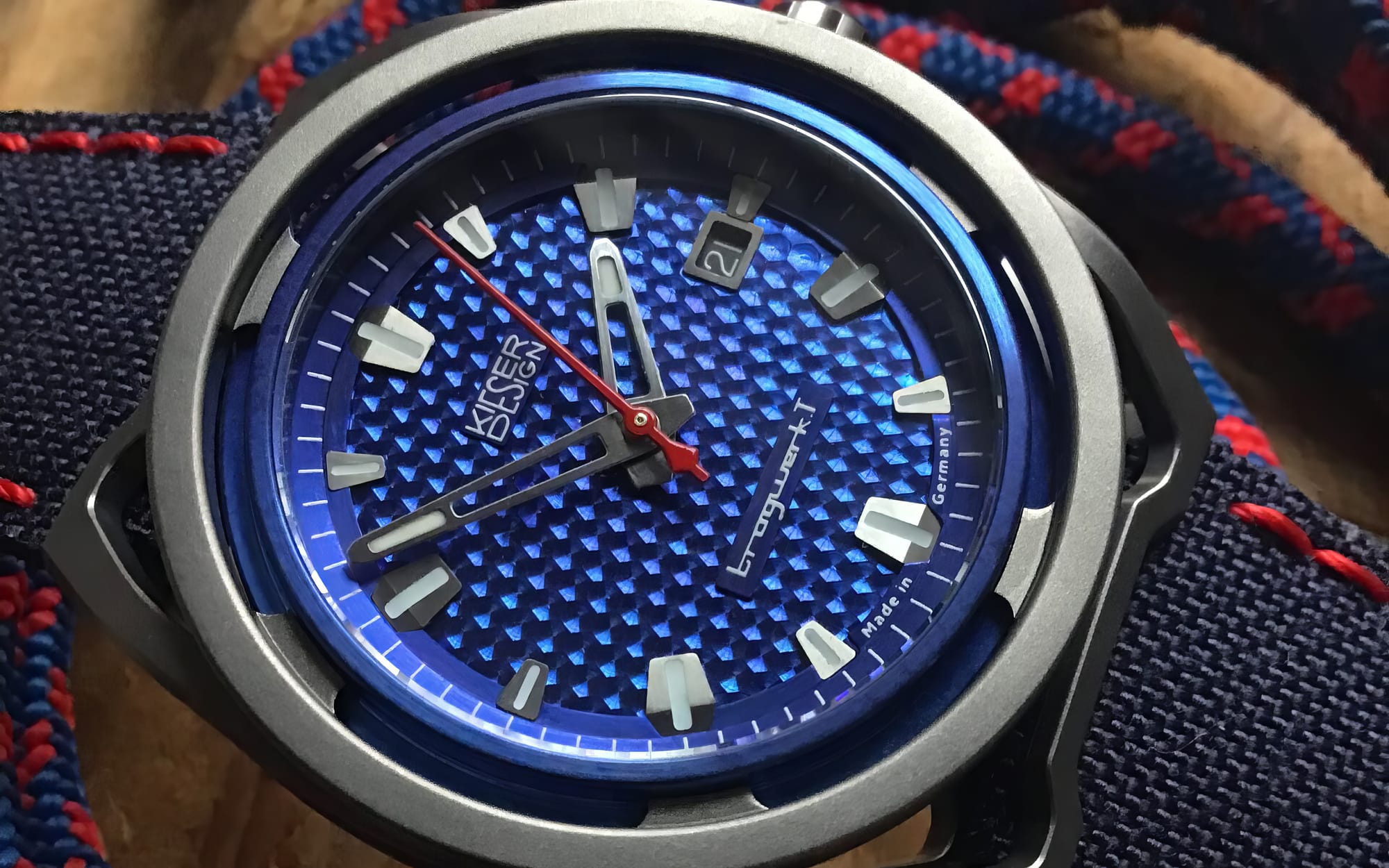
The dial is where the dragonfly concept gets literal. Matthias was fascinated by the compound eye of the dragonfly, where thousands of individual facets reflect light in all directions. He translated that into over 250 individually milled hexagonal cells in a titanium dial blank. Each hexagon is cut with extremely sharp tooling to maximize light reflection.
On the Navy Blue, the titanium dial has been anodized to a deep blue. Anodization is an electrochemical process that produces the metallic hues you see across the Kieser lineup. Matthias has refined this technique to the point where other watch brands have been asking him to anodize parts for them. He has been declining. The color on the Navy Blue shifts depending on the angle and the lighting, sometimes appearing almost purple, other times a dark navy. The honeycomb pattern creates an iridescent quality that photographs do not fully capture. It is one of those dials that you have to see in person to appreciate.
Stainless steel hands sit above the dial with a straight-grained finish. The applied hour indices are hand-finished Grade 2 titanium, individually shaped and polished with a line of Super-LumiNova Grade X1 down their centers for maximum brightness in the dark. Even-hour markers are slightly larger than odd-hour markers.
There is a date window at 3 o'clock with a polished frame. The "Kieser Design" logo sits centered on the upper half of the dial, and "tragwerk" appears centered on the lower half, both printed in white. "Made in Germany" is split on either side of the 6 o'clock index.
The movement
The tragwerk2.0 is powered by the Kieser Design KD21-01, which is based on the Sellita SW200-1. Sellita is a Swiss movement manufacturer, and the SW200 is their workhorse automatic caliber. It is essentially the Sellita equivalent of the ETA 2824-2, and it is used across hundreds of brands at every price point.
Kieser uses the Top Premium grade, which is rated to -4/+4 seconds per day. The movement beats at 28,800 vibrations per hour (4 Hz) with 26 jewels and provides approximately 38 hours of power reserve. Functions include hours, minutes, central seconds, and a quick-set date.
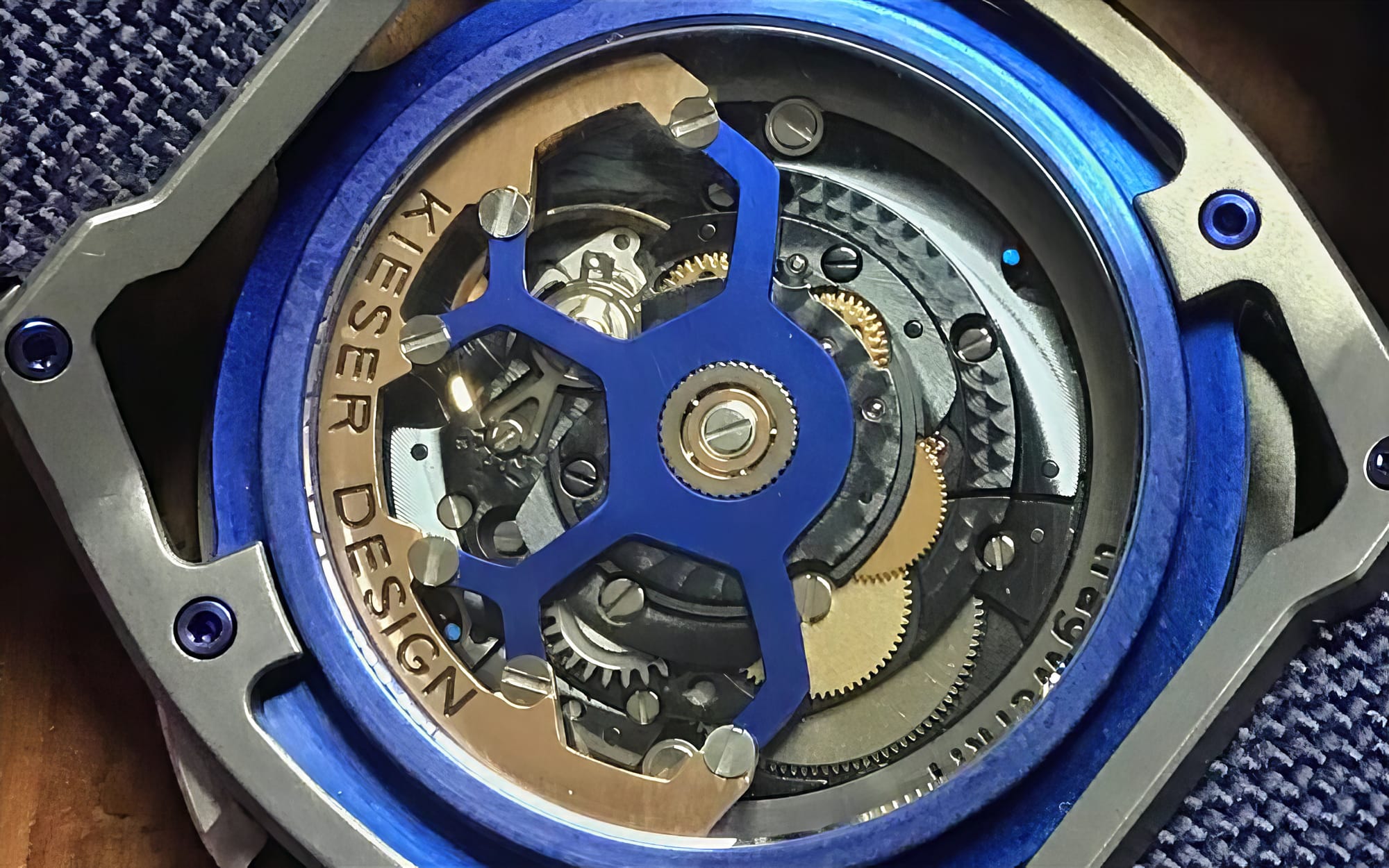
The modifications Kieser makes to the base movement are where things get more interesting. The bridges and plates are decorated with perlage and snailing, then ruthenium-plated for a black finish. Matthias designed and produces his own skeletonized rotor in-house using anodized titanium and an 18-karat gold weight. The custom rotor weighs roughly 25% less than the stock Sellita rotor while maintaining proper winding torque. The gold weight compensates for the reduced mass of the skeletonized titanium carrier.
The original tragwerk.T had a sapphire caseback that showed off all this finishing. The 2.0 does not. You get the solid titanium caseback with the dragonfly engraving instead. That is a trade-off. All that movement decoration is hidden, which is a shame, but the closed caseback probably contributes to the watch feeling more like a proper tool piece.
Some reviewers have noted they would prefer an SW300 base (a thinner movement) over the SW200. That is a fair point, though at 11.2mm case height, thickness is not an issue here.
On the wrist
This is my second Kieser, so I knew what to expect with the weight. Or rather, the lack of it. At 47 grams the watch barely registers on the wrist. My first reaction picking up the Purple Signature Edition was that it felt like a toy. That feeling goes away once you see the finishing up close, but it never stops being surprising how light titanium can be when someone removes most of the material.
I ordered mine with a custom strap: a dark navy canvas textile with a red accent stitch running through the weave. Kieser will do special requests like this, which is one of the advantages of buying from a five-person workshop. The red stitch picks up the orange-red seconds hand and gives the watch a bit more personality than the standard option. I also received the dark blue FKM rubber strap with the honeycomb ventilation pattern, which is comfortable out of the box with no break-in period. The quick-release system makes swapping between the two easy, though the integrated lug shape means any aftermarket strap is going to look like an afterthought. The way the strap flares from 20mm at the buckle to 27mm where it meets the exoskeleton is part of the design language. A generic 22mm NATO or leather strap would look wrong here.
The visual footprint is worth mentioning again. On paper this is a 42mm watch with a 43mm lug-to-lug. On the wrist, the exoskeleton makes the watch look larger than those numbers suggest. If someone saw this on my wrist and guessed the diameter, they would probably say 44 or 45mm. Whether that is a problem depends on your wrist size and your tolerance for presence. I do not mind it. The whole point of this watch is to look different.
The screw-down crown operates smoothly and sits protected between the exoskeleton's titanium crown guards. Water resistance at 100 meters means I do not think twice about wearing this in the rain or washing dishes. I would not take it diving, but that is not what it is for.
The exoskeleton does introduce extra surfaces and angles that could make sliding under a dress shirt cuff a bit of a wrestle. This is not a dress watch and it does not pretend to be one.
Final thoughts
I bought my first Kieser because I wanted something nobody else at a watch meetup would be wearing. I bought my second because the first one proved the concept. This is not a brand that relies on heritage or name recognition. It relies on the fact that Matthias Kieser, a self-taught watchmaker working out of an 80 square meter workshop in Frankfurt, is making almost every component of his watches by hand. The dials, the indices, the hands, the rotors, the buckles. The only things he does not make are the base movement and the 3D-printed exoskeleton shell, and even that shell is his design.
At €4,950, the tragwerk2.0 sits in a competitive space. You could buy a Tudor, a Longines, or a well-specced Oris for similar money. Those brands come with established service networks and resale markets. Kieser does not have that yet. What Kieser has is a patented case design that nobody else is doing, a level of in-house production that most brands ten times its size cannot match, and a direct line to the person who actually makes your watch. For some buyers that matters more than a logo.
The SW200 movement is the weakest part of the package. It is reliable and well-finished by Kieser, but it is still a workhorse caliber found in watches at a fraction of this price. The custom rotor and ruthenium plating help justify the cost, but you cannot see any of it through the closed caseback. That is the one thing I miss from the original tragwerk.T.
The Navy Blue dial is the reason I ordered this specific model. The honeycomb pattern combined with the anodized titanium produces something that changes character depending on the light. Flat indoor lighting makes it look dark and subdued. Direct sunlight makes it come alive. I have caught myself tilting my wrist just to watch the hexagons shift.
This watch is not for everyone. The exoskeleton design is polarizing. Some people will see it and think it looks like a sci-fi prop. Others will appreciate the engineering and the craft behind it. I fall into the second camp. Kieser Design is doing something I have not seen anywhere else in watchmaking, and they are doing it from a tiny brick building with five people. That is worth supporting.
References
- Kieser Design. tragwerk2.0 Navy Blue. Official product page.
- New York Times. A Watch Design Inspired by a Dragonfly. Penelope Colston, September 30, 2025.
- aBlogtoWatch. Watch Review: The Striking and Customizable Kieser Design tragwerk.T. May 26, 2023.
- About Timepieces. Kieser Design Tragwerk.T (Unique Piece) Review. Gavin McKenzie, January 14, 2024.
- Fifth Wrist. Owner Review: Kieser Design Tragwerk 2.0 Purple Piece Unique. @watchsymmetry, December 16, 2025.
- WATCHDAVID. Kieser Design Tragwerk.T Review. David Drilling, May 6, 2023.
- Oracle of Time. How Kieser Design's Matthias Kieser Adds Patterns of Nature to Horology. January 30, 2024.
- Martin Pulli (Authorized Retailer). Kieser Design.
- Kieser Design YouTube Channel.
