

The Santos 100 XL Chronograph is an artifact from a specific moment in watchmaking. The mid-2000s saw a race toward maximum wrist presence, and this watch won. At 41 x 54mm and 16mm thick, it remains the largest steel Santos ever made. The modern Santos de Cartier line has moved in the opposite direction, thinner and smaller. The Ref. 2740 is a reminder of what Cartier was willing to build when bigger was considered better. Side note: The biggest Santos ever made was the Cartier Santos 100 XL Flying Tourbillon - a giant at 46.5mm x 54.9mm x 16.5mm.
I picked this one up on the secondary market. Now is a good time for watches like this. They exist in a pricing valley between "current" and "vintage," no longer contemporary enough for boutique appeal but not yet old enough for collector premiums. I got a good deal. Whether I will actually wear it is another question.
Brand context
The original Santos was designed by Louis Cartier in 1904 for Alberto Santos-Dumont, a Brazilian aviator who needed to check the time without removing his hands from the aircraft controls. Pocket watches were impractical for this. Cartier's solution was a square-cased wristwatch with a leather strap, one of the first purpose-built wristwatches for men. Santos-Dumont wore it during the first official public motorized flight in 1906. Series production began in 1911.
The Santos 100 collection launched in 2004 to commemorate the centennial of that original design. Cartier marked the occasion by scaling up. Where the Santos had always been relatively refined, the Santos 100 pushed toward sport-watch proportions. The XL Chronograph took this furthest. Early 2004 examples carry "1904-2004" engravings on the caseback.
Cartier discontinued the Santos 100 line in 2017. The replacement Santos de Cartier arrived in 2018 with the QuickSwitch strap system, SmartLink bracelet adjustment, and a more modern movement. The Santos 100 XL Chronograph, with its ETA-based movement and strap-only configuration, belongs to the era before Cartier's in-house manufacturing push.
Case and dimensions
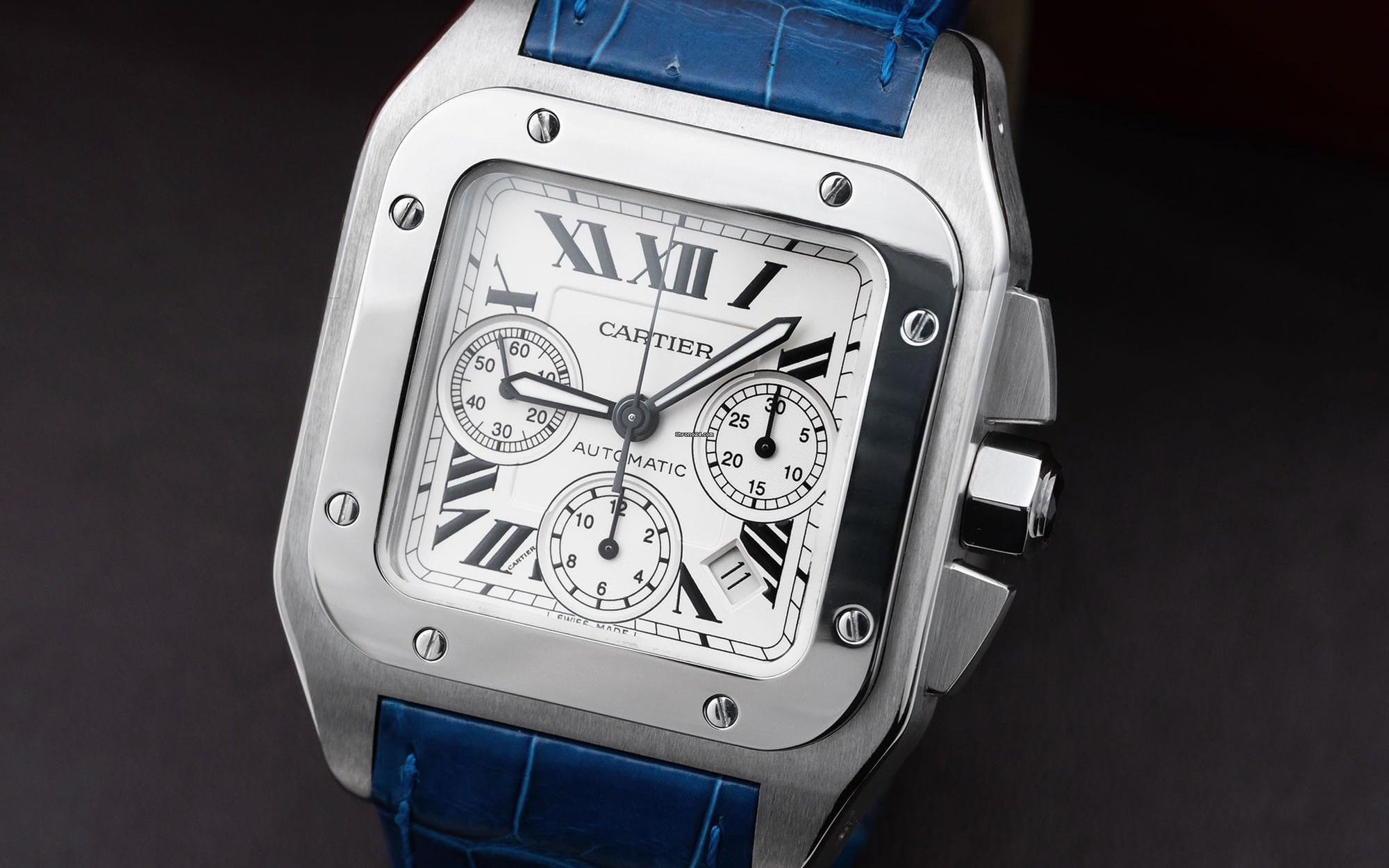
The case measures 41mm wide and 54mm lug-to-lug. At 16mm thick, it sits high on the wrist. The steel construction uses polished and brushed surfaces in alternation: brushed case flanks, polished bezel with eight visible screws, brushed crown guard. The screws are functional references to the original Santos design.
The sapphire-cabochon crown is oversized to match the case proportions. Chronograph pushers at 2 and 4 o'clock are round and polished. The caseback is solid steel.
Water resistance is 100 meters. Fine for washing your hands. I would not swim in this, given the leather strap situation.
The lug width is 24.5mm. This is an unusual measurement. Combined with the curved lugs, it makes aftermarket strap options limited. I searched. There are no steel bracelets available for this reference. Not from Cartier, not aftermarket. Never were. There are a few rubber options on eBay.
Dial and legibility
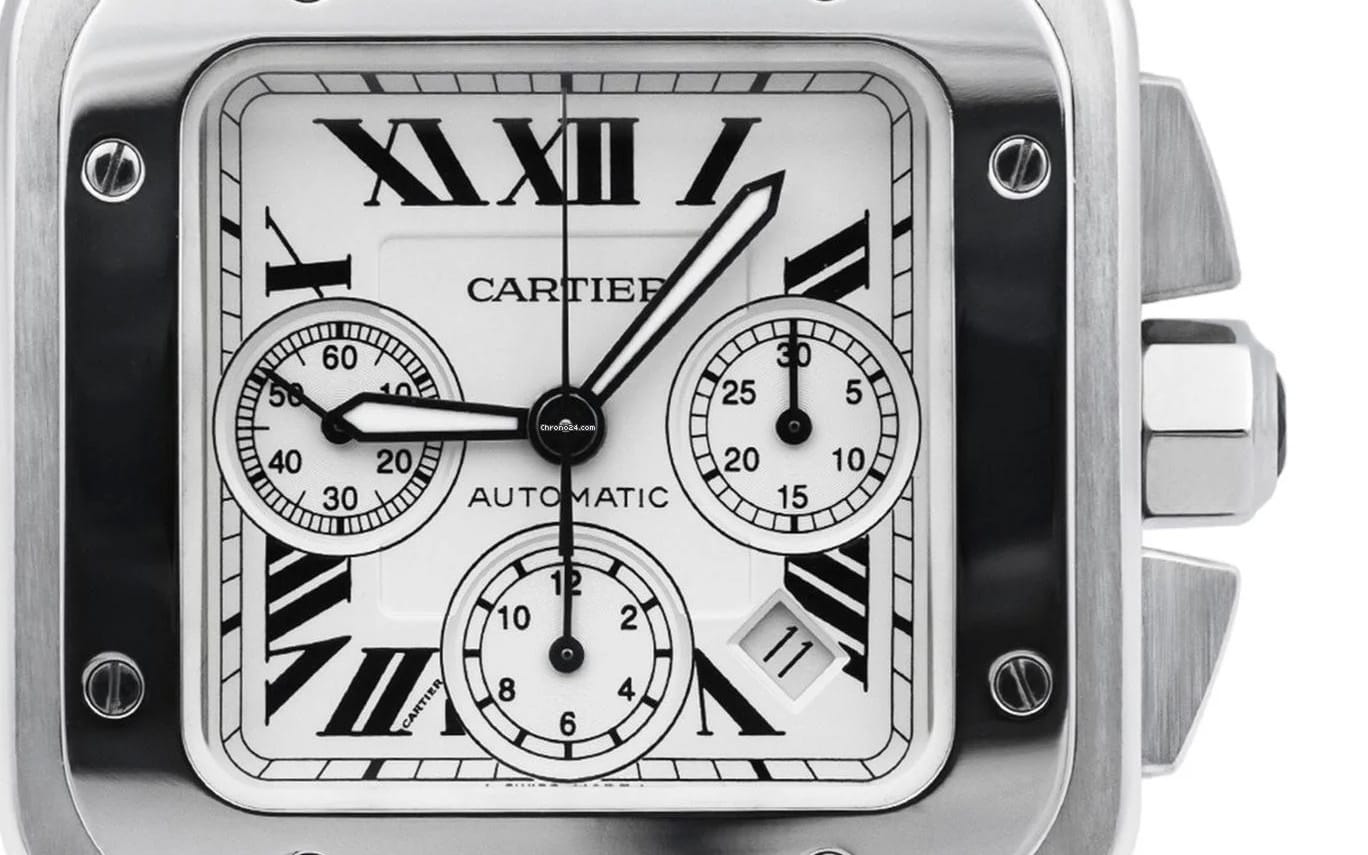
The dial is standard Santos: silvered surface, black Roman numerals, railroad minute track, blued steel sword hands. The chronograph adds three subdials. Thirty-minute counter at 3 o'clock, 12-hour counter at 6, small seconds at 9. A date window sits between 4 and 5 o'clock.
The Roman numerals are oversized to fill the larger dial. The numerals at 3, 6, and 9 get partially eaten by the subdials. This is a design compromise. Cartier was putting a chronograph on a dial originally conceived for time-only display. It works, but you notice it.
Lume is minimal. The sword hands have luminous fill, but the dial goes dark in low light. If you need to time something at night, this is the wrong watch.
The movement
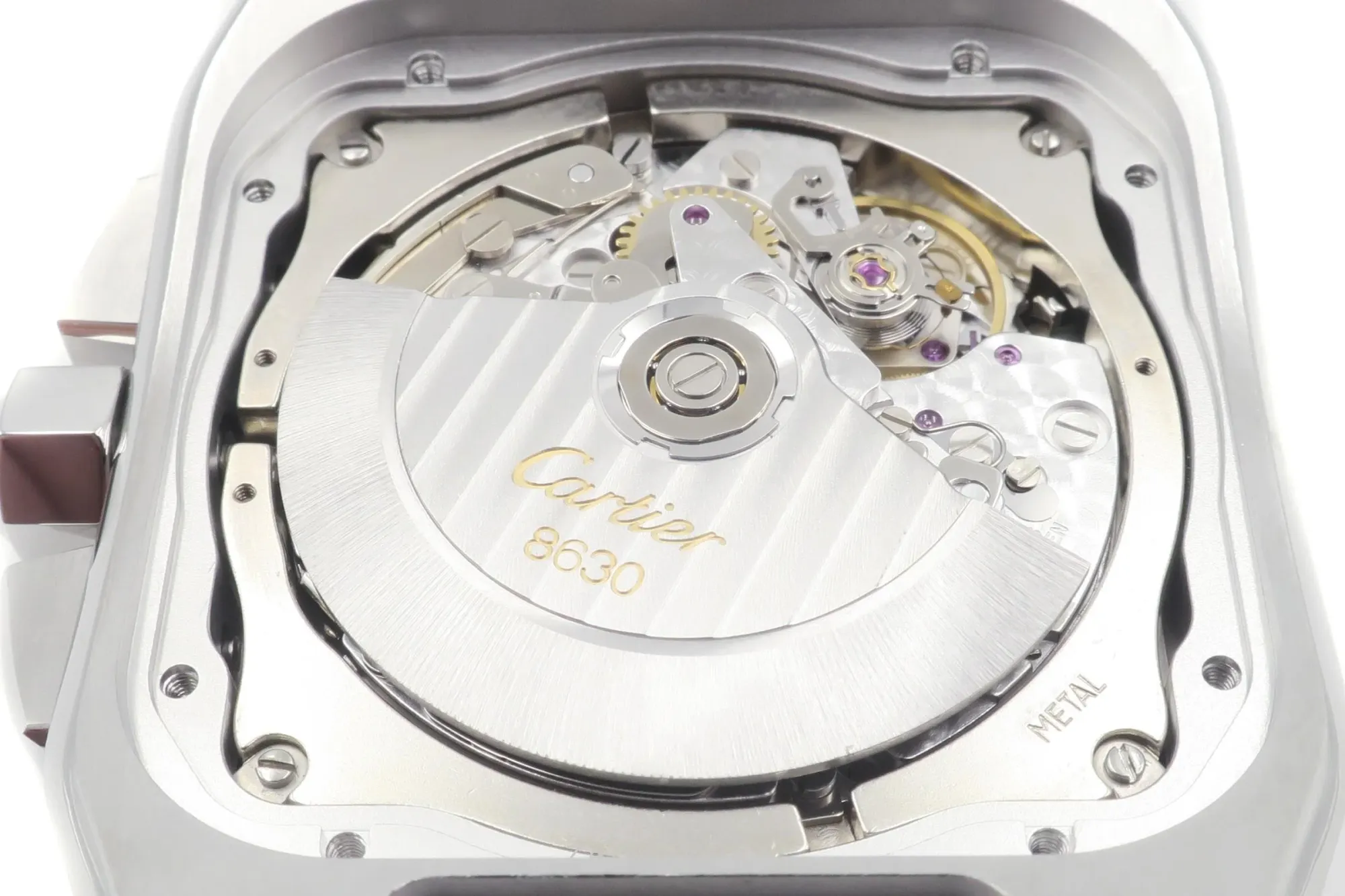
The Ref. 2740 uses the Cartier Calibre 8630 MC. This is the brand's designation for a modified ETA Valjoux 7753. The 7753 is related to the ubiquitous 7750 but repositions the minute counter to 3 o'clock instead of 12 o'clock, which gives you the more symmetrical dial layout. It is a cam-actuated chronograph, not a column wheel design.
The movement runs at 28,800 vibrations per hour with 27 jewels and about 48 to 54 hours of power reserve. Date correction is via a pusher at 10 o'clock rather than the crown, which takes some getting used to if you have not owned a 7753-based watch before.
The 7753 family has been around for decades. Parts are available. Any competent watchmaker can service it. This is not a movement that will impress anyone at a watch meetup, but it is also why a 15-year-old chronograph from the secondary market remains a viable daily option rather than a service nightmare waiting to happen.
Strap
The watch came on an alligator strap. Cartier offered leather and alligator options when new. Most original straps are worn out by now, which is normal after nearly two decades of use.
Cartier still supplies replacement straps for this reference. This matters more than it might for other watches. The 24.5mm lug width limits third-party options severely. I looked. If you buy this watch, budget for a Cartier strap order eventually. They are not cheap, but they exist. The deployant clasp is brushed steel with a twin-trigger release.
On the wrist
I like big watches. This one surprised me anyway. The 54mm lug-to-lug is manageable on larger wrists, but the 16mm thickness is the real story. The watch sits high. The crown guard adds visual mass. On a leather strap with no bracelet option to distribute weight, it pulls toward the outside of the wrist over the course of a day.
The weight itself is not excessive for steel. Titanium versions exist in the Santos 100 line, but not this chronograph reference. Still, the combination of height and strap-only mounting makes the watch feel heavier than its spec sheet suggests.
I am still adjusting to it. Some days it feels like exactly what I wanted. Other days I wonder if I should have bought the non-chrono Santos 100 XL, which is a few millimeters thinner. But then I would not have the chronograph. These are the calculations you make after the purchase, not before.
Final thoughts
The Santos 100 XL Chronograph exists at the intersection of two things Cartier no longer does: oversized cases and sourced movements. The brand's current Santos de Cartier line uses the in-house 1847 MC calibre. Case thicknesses have come down. The QuickSwitch system assumes you want multiple straps and a bracelet. The market has moved.
This does not make the Ref. 2740 worse. It makes it specific. If you want Santos design language at maximum scale, this is the watch that delivered it. If you want a chronograph that does not pretend to be something it is not, this does that too.
The secondary market pricing reflects the watch's current status: no longer fashionable, not yet collectible. That valley will not last forever.
I am still getting used to the size and weight. Whether this becomes a regular rotation piece or an occasional indulgence depends on how the next few months of wearing go. But I am glad I bought it now, while the market undervalues what the watch actually is.
References
- WatchBase. "Cartier caliber 8630 MC." Accessed January 2026.
- Chrono24. "Cartier Santos 100." Accessed January 2026.
- ETA SA. "ETA 7753 Valjoux." Official specifications.
- Caliber Corner. "ETA/Valjoux Caliber 7753 Watch Movement." Accessed January 2026.
- Luxury Bazaar. "Cartier Santos History: Evolution of the Cartier Santos, 1904 - Now." July 2025.


