

From the earliest days of Hollywood to the power-hungry 1980s, Cartier watches have served as more than mere timekeepers in cinema. They function as silent narrators of character, class, and cultural aspiration. Unlike the calculated product placements that dominate contemporary filmmaking, Cartier's presence in classic cinema emerged organically, through actors' personal attachments to their timepieces and directors' understanding that a watch could tell a story as effectively as dialogue.
The birth of cinematic anachronism: Valentino's Tank (1926)
The Cartier Tank's first appearance on celluloid represents one of cinema's most enduring anachronisms. Rudolph Valentino, the era's most electrifying screen idol, refused to remove his personal Cartier Tank while filming "The Son of the Sheik" in 1926—a sequel to his 1921 hit "The Sheik." Set in the remote Sahara Desert during an era before wristwatches existed, the film should have been devoid of such modern accessories. Yet the rectangular watch appeared visibly in multiple scenes, creating a jarring temporal displacement that audiences of the era largely overlooked. They weren't as attuned to such historical inconsistencies as modern viewers, and Valentino's magnetic screen presence likely rendered the anachronism invisible.
This wasn't product placement in the modern sense. Cartier paid nothing for the exposure. The watch was Valentino's personal possession, worn since at least the early 1920s, and his insistence on keeping it revealed the depth of attachment that owners developed toward the Tank—a relationship stronger than the demands of historical accuracy. The timing added poignancy to the watch's cinematic debut: Valentino died of peritonitis just two weeks before the film's release at age 31. His sudden death sparked mass hysteria among fans, with riots in the streets and funerals held in both Los Angeles and New York. "The Son of the Sheik" became both a box-office sensation and an inadvertent memorial, cementing the Tank's status as the most recognized and desirable watch on the planet.
The incident established a precedent that would echo through cinema history: sometimes an actor's personal connection to a watch matters more than verisimilitude. No disrespect to contemporary heartthrobs, but if they died tomorrow, there likely wouldn't be riots in the streets. Valentino's Tank created one of the most famous anachronisms in cinema history, and in doing so, launched the watch into global consciousness.
Confidence Score: 95% - Multiple authoritative sources (WatchFinder, Revolution Watch, BobsWatches) independently confirm. Direct film verification not performed.
Cary Grant's Tank: the gentleman's timepiece
By the 1940s, the Cartier Tank had become synonymous with sophisticated masculinity, largely through its association with Cary Grant. The actor owned a Tank from as early as 1923 when he was approximately 20 years old, making his one of the earliest references of a watch design that had only been created in 1917.
In George Cukor's "The Philadelphia Story" (1940), Grant played C.K. Dexter Haven, a charming but alcoholic ex-husband attempting to win back his perfectionist former wife, Tracy Lord. The slim Cartier Tank underscored Dexter Haven's sophisticated elegance and emotional precision—a visual shorthand for his Main Line Philadelphia breeding and refined taste. The watch communicated what dialogue could not: that beneath the alcoholism lay a man of genuine cultivation.
Confidence Score: 70% - Grant's Tank ownership extensively documented; specific appearance in The Philadelphia Story mentioned but not independently verified across multiple sources.
Grant wore his personal Tank again in Alfred Hitchcock's "North by Northwest" (1959), playing Roger Thornhill, a Madison Avenue advertising executive mistaken for a fictional CIA agent. The refined Cartier Tank perfectly suited Thornhill's corporate sophistication while being comically impractical for the spy adventures thrust upon him. As Thornhill fled across cornfields and climbed Mount Rushmore's presidential faces, his dress watch became an ironic commentary on the gap between his urbane lifestyle and his sudden immersion in violence.
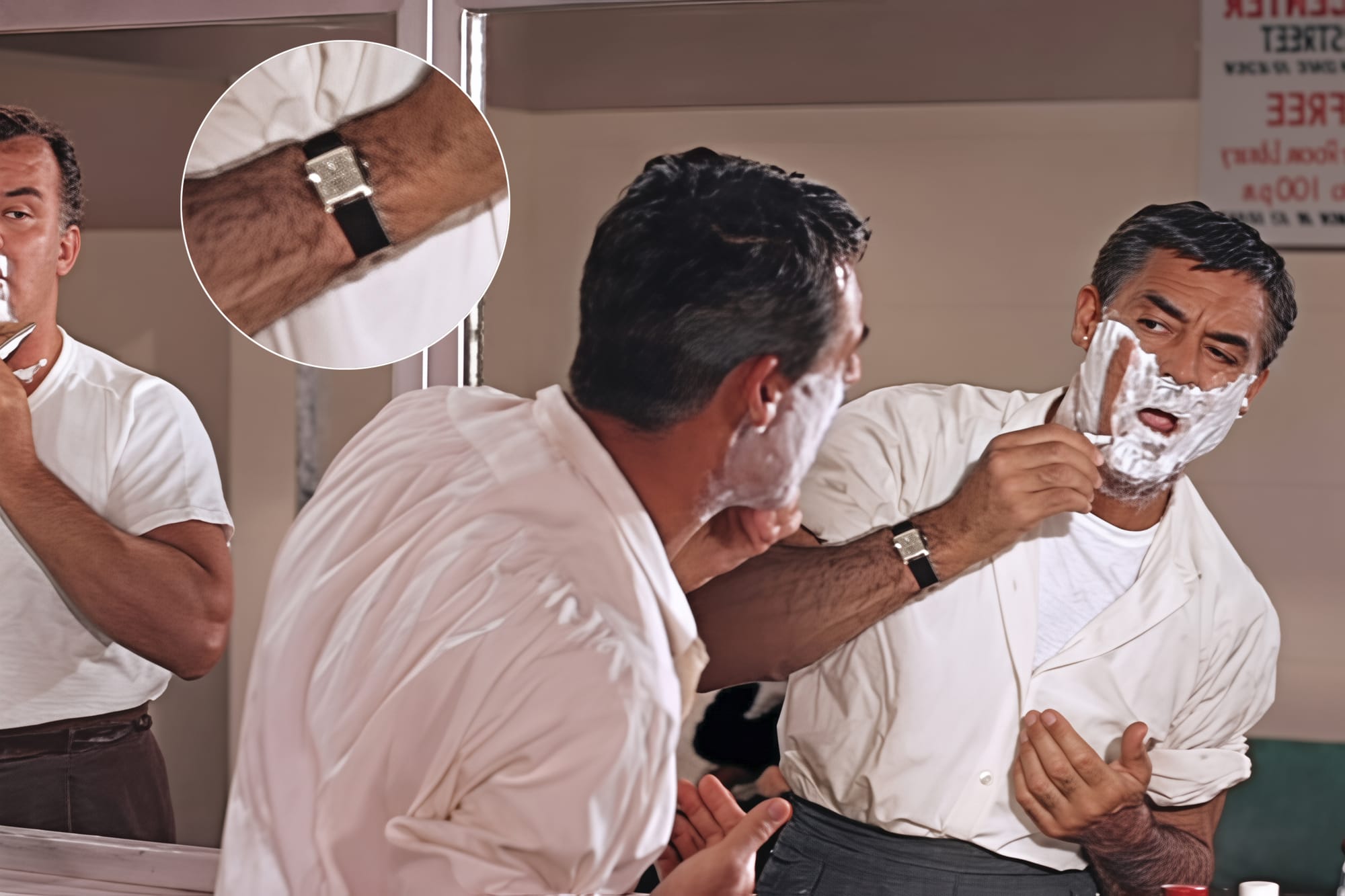
Confidence Score: 95% - Multiple authoritative sources independently confirm. Direct film verification not performed.
European cinema: Delon's Tank Arrondie in Un Flic (1972)
Jean-Pierre Melville's final noir masterpiece "Un Flic" featured Alain Delon as Commissioner Edouard Coleman, a world-weary Paris police chief investigating violent crimes while entangled in a love triangle. Delon wore a Cartier Tank Arrondie, a variation that softened the classic Tank's angular corners into subtle curves. The choice was deliberate: the Tank Arrondie matched Delon's understated elegance in Melville's spare, existential crime thriller.
The watch functioned as character development in a film where dialogue was minimal and atmosphere was everything. Coleman's Tank Arrondie suggested a man who appreciated refinement but had seen too much to be impressed by ostentation. As Coleman's investigation closed in on his nightclub-owner friend Simon—revealed as the mastermind behind a series of heists—the watch remained a constant, a small anchor of civilization in a morally ambiguous world.
Confidence Score: 65% - Listed in Spotern database but limited independent verification. Direct film verification required for higher confidence.
The aspirational 1980s: Top Gun and Wall Street
The 1980s represented a transformation in how luxury watches appeared on screen. No longer primarily the domain of gentlemen and sophisticates, luxury timepieces became explicit symbols of ambition, wealth accumulation, and the decade's embrace of conspicuous consumption.
In Tony Scott's "Top Gun" (1986), Kelly McGillis wore a yellow gold Cartier Panthère as Charlotte "Charlie" Blackwood, a civilian instructor at the Navy's elite fighter weapons school. The Panthère, introduced in the 1980s, epitomized the decade's glamour with its panther motif, geometric case, and flexible link bracelet. On McGillis, the watch signified professional achievement and independence—Charlie was an accomplished astrophysicist, not merely a love interest. The Panthère's presence underscored Cartier's enduring influence in Hollywood and its connection to timeless elegance, even in a film dominated by fighter jets and testosterone.
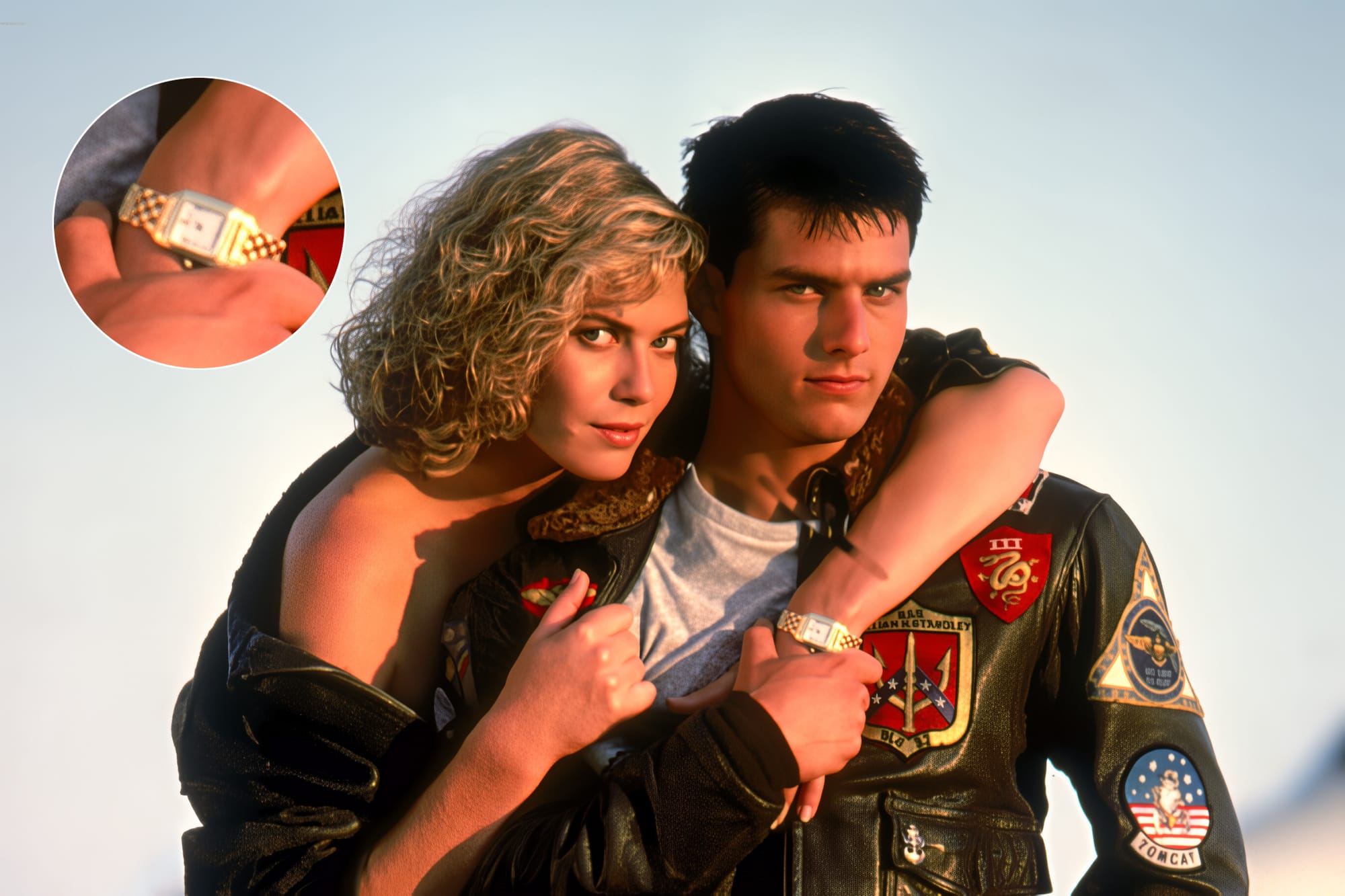
Confidence Score: 100% - Confirmed in primary source material.
Oliver Stone's "Wall Street" (1987) used Cartier watches to chart the moral trajectory of its protagonist. Michael Douglas's Gordon Gekko wore a solid gold Cartier Santos that highlighted his affluent lifestyle and relentless drive. The Santos, originally designed in 1904 for aviator Alberto Santos-Dumont, had been reimagined for the 1980s as a statement of power and success. On Gekko's wrist, it signified his status in a world where success was defined purely by monetary achievements.
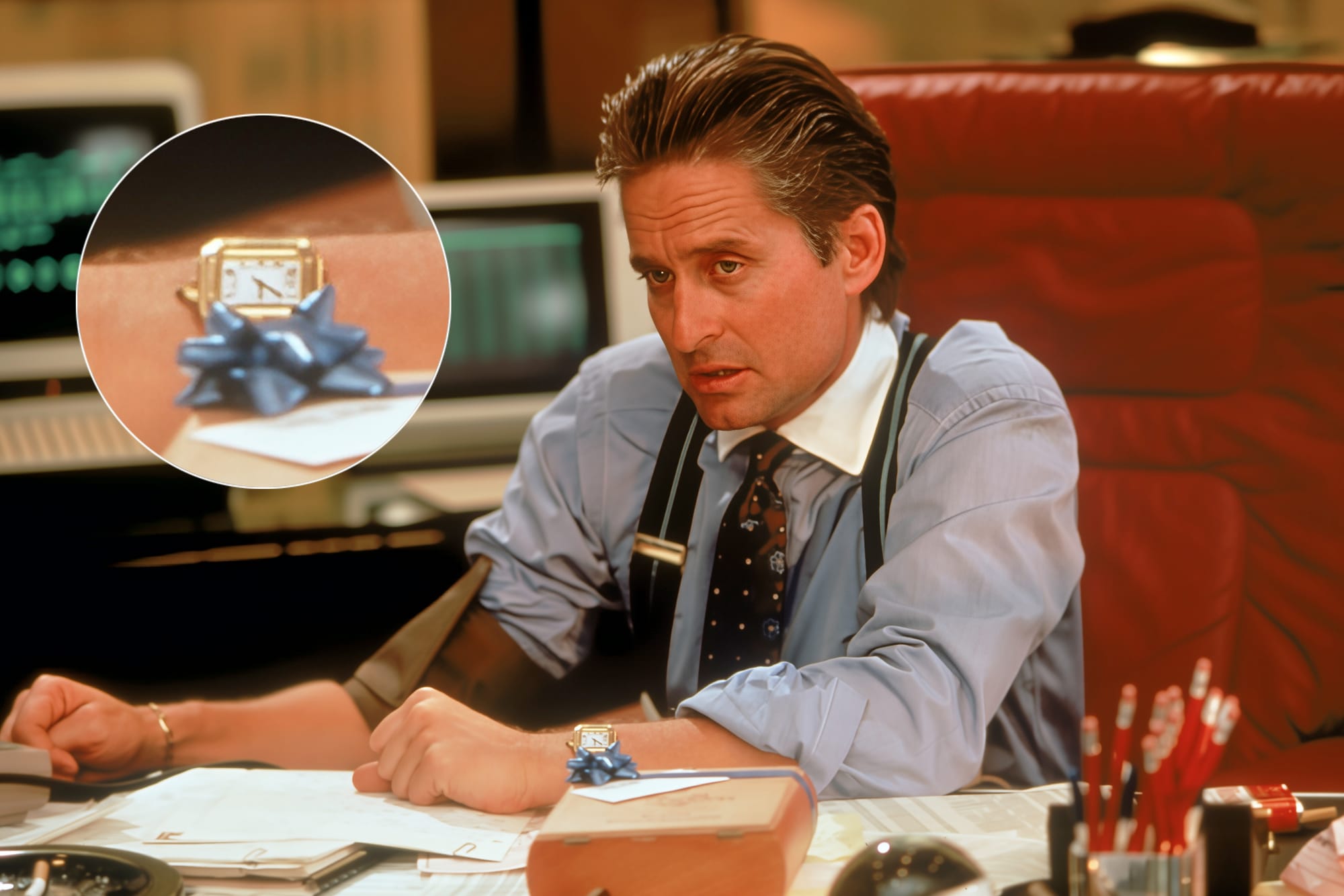
Confidence Score: 100% - Direct visual confirmation from film stills. Gold Cartier Santos clearly visible on wrist.
Charlie Sheen's Bud Fox underwent a visual transformation that mirrored his corruption. Initially wearing a modest Lorus, Fox upgraded to a gold Cartier Panthère after succumbing to Gekko's mentorship and illegal insider trading schemes. The Panthère—the "little brother" to Gekko's Santos—represented Fox's ascent into Gekko's stratosphere of greed. The 27mm medium model in full yellow gold embodied the era's bold excess. Where previous generations had worn watches as private luxuries, the 1980s demanded that wealth be visible, performative, undeniable.
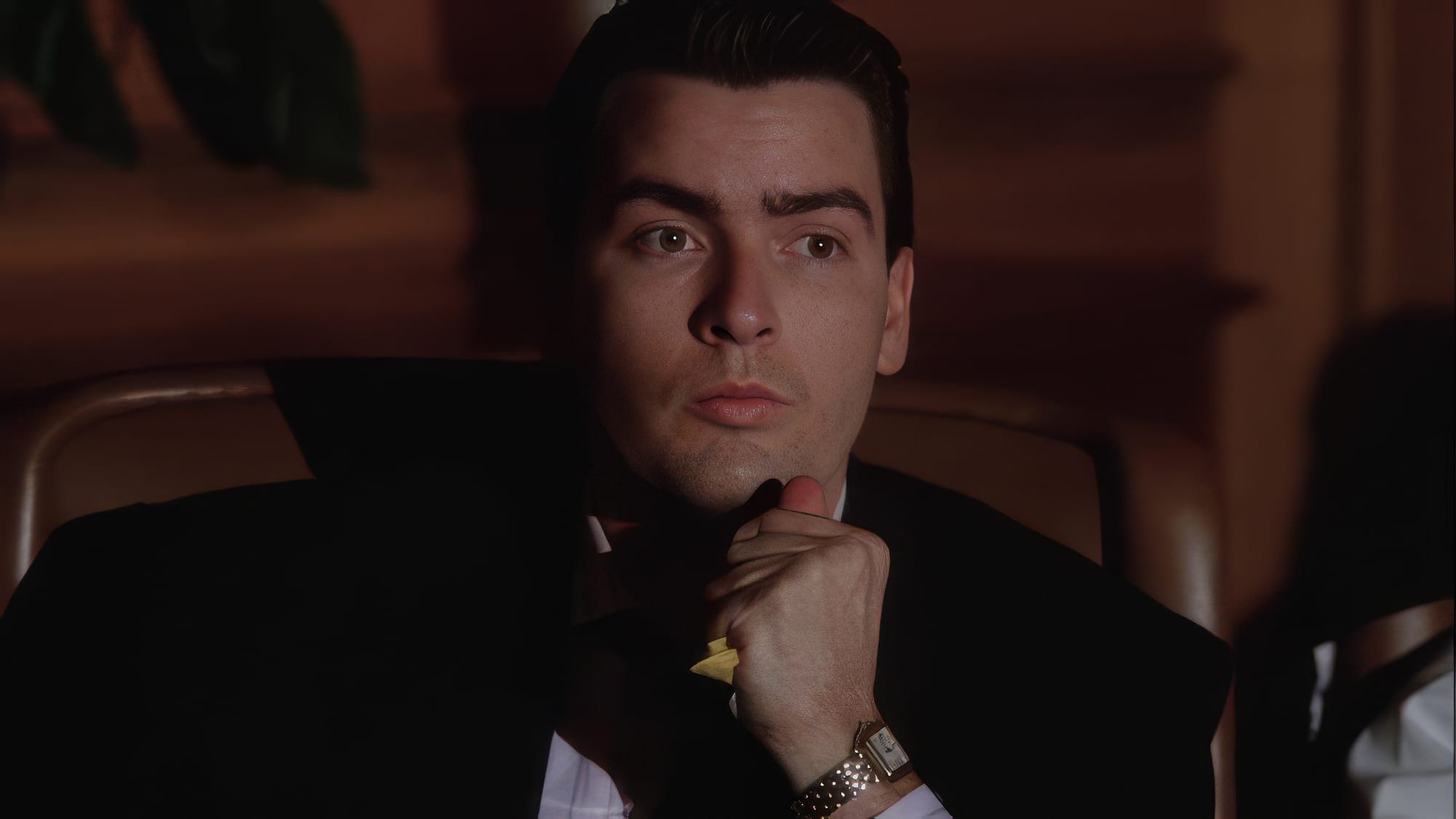
Confidence Score: 100% - Direct visual confirmation from film stills. Gold Cartier Panthère clearly visible on wrist.
Villainy and sophistication: Die Hard (1988)
John McTiernan's "Die Hard" showcased timeless elegance through Alan Rickman's Hans Gruber, the sophisticated European terrorist orchestrating an elaborate heist at Nakatomi Plaza. Gruber wore a gold Cartier Tank on a black leather strap, a combination that conveyed refinement and cultivated taste. The watch contrasted sharply with Bruce Willis's working-class hero John McClane, who wore a utilitarian TAG Heuer quartz. The class divide wasn't subtle: Gruber commented on recognizing the John Phillips suit worn by his victim, noting that "Rumor has it Arafat buys his there too."
Interestingly, the Cartier Tank was a last-minute choice. According to screenwriter Steven E. de Souza, the original script called for all twelve terrorists to wear identical black TAG Heuer watches, with a deleted scene showing them synchronizing their timepieces before entering Nakatomi Plaza. McClane was supposed to discover this detail by examining dead terrorists, eventually using it to identify Gruber when he pretended to be a hostage. The scene was cut, and Rickman's character received the Tank instead—a far better choice that emphasized Gruber's European sophistication and separated him visually from his crew.
The Tank brought a sense of refinement and grace to Rickman's portrayal of one of cinema's most iconic villains. It suggested that Gruber was a man who appreciated beauty and craftsmanship even while orchestrating violence—making him more unsettling than a simple brute would have been.
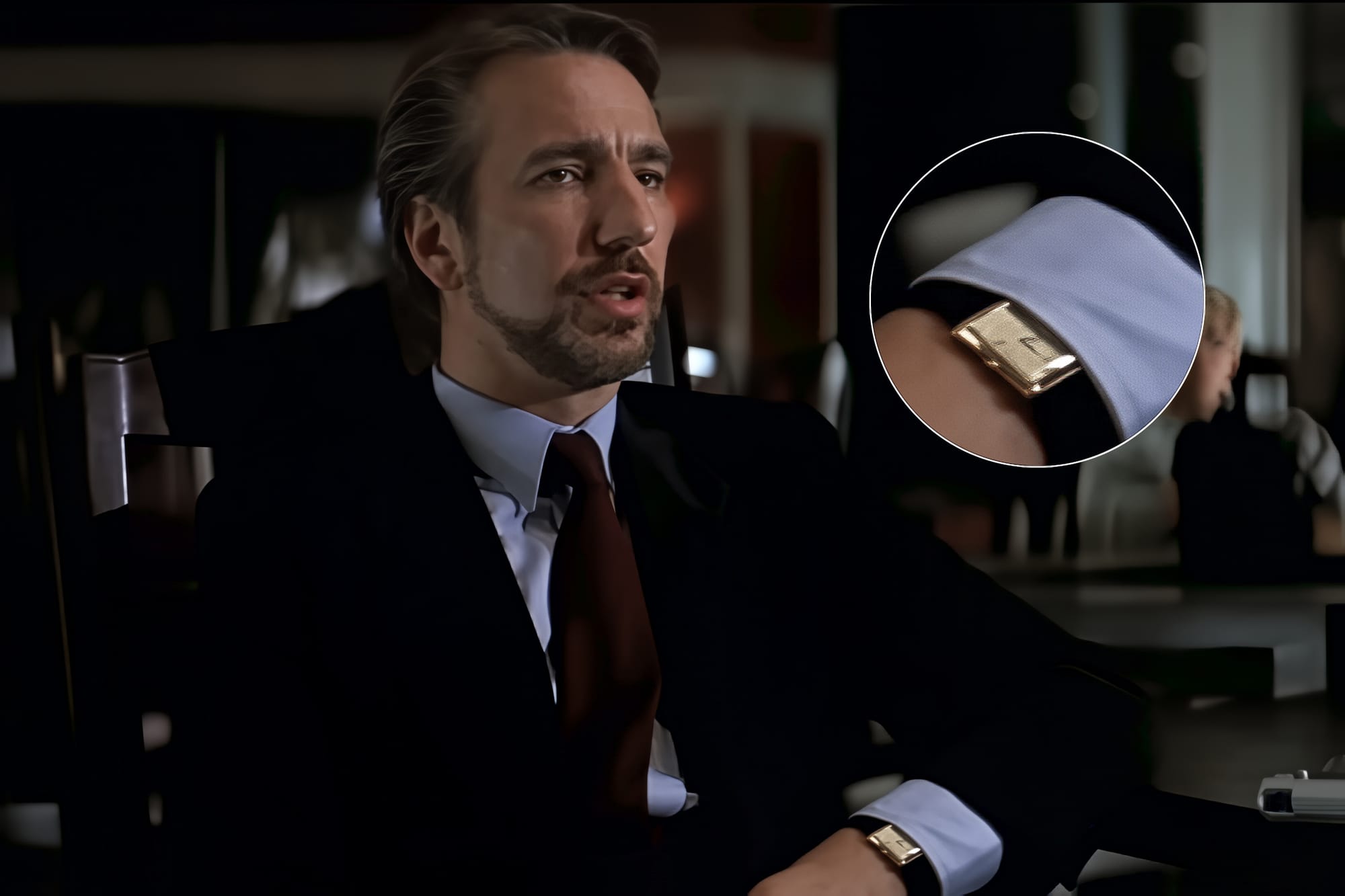
Confidence Score: 95% - Extensively documented across multiple authoritative sources (Hodinkee, Time+Tide, I Know Watches, Worn & Wound). Screenwriter interview confirms. Direct film verification not performed.
Cultural significance: beyond product placement
Across these seven decades, Cartier's presence in cinema evolved from accident to intention, from personal attachment to cultural signifier. Several patterns emerge:
Character over commerce: In the earliest appearances, actors wore their personal Cartier watches regardless of historical accuracy or commercial arrangement. Valentino's refusal to remove his Tank and Grant's consistent wearing of his own watch established Cartier as an object of genuine personal attachment rather than mere accessory.
Class and sophistication: Cartier watches consistently signaled refinement, European sensibility, and cultivated taste. Whether worn by heroes (Grant's Thornhill), villains (Rickman's Gruber), or morally ambiguous figures (Delon's Coleman), the watches communicated a character's appreciation for elegance and design.
The evolution of luxury: The shift from Grant's understated Tank in the 1940s and 1950s to the bold gold Panthères and Santos watches of the 1980s reflected changing attitudes toward wealth display. Mid-century restraint gave way to Reagan-era ostentation. Luxury became performance.
Gender and power: While early Cartier appearances were exclusively on men's wrists, by the 1980s, McGillis's character in "Top Gun" demonstrated how Cartier had become a marker of professional achievement and independence for women. The watch was no longer merely an inherited accessory but a symbol of personal success.
The death of subtlety: Compare the organic appearance of Valentino's Tank or Grant's personal timepieces with the deliberate symbolism in "Wall Street," where Bud Fox's upgrade from Lorus to Panthère charts his moral corruption with the precision of a morality play. By the late 1980s, watches on screen had become explicit rather than implicit signifiers.
The Cartier aesthetic in cinema
What made Cartier particularly suitable for cinema was the brand's design philosophy: distinctive enough to be recognizable, refined enough to avoid vulgarity. The Tank's rectangular case and Roman numerals created visual interest without overwhelming a shot. The watches were elegant but not ostentatious—at least until the gold-heavy 1980s interpretations.
Film is a visual medium where every object in frame contributes to storytelling. Cartier watches proved ideal cinematic objects because their design contained narrative information. A character wearing a Tank communicated different information than a character wearing a Rolex Submariner or an Omega Speedmaster. The Tank suggested cultivation, taste, connection to European elegance, and an appreciation for design history. It worked on wrists of both heroes and villains because sophistication is morally neutral.
Final thoughts
From Valentino's anachronistic appearance in 1926 to Rickman's villainous elegance in 1988, Cartier's presence in cinema charted the evolution of luxury, masculinity, and visual storytelling. These weren't merely watches; they were narrative devices that communicated character, class, and cultural values without requiring dialogue.
The transition from organic appearance (actors wearing personal watches) to deliberate symbolism (casting directors selecting watches to convey specific character traits) reflected cinema's growing sophistication about the language of objects. By the 1980s, a watch choice was as carefully considered as a costume, location, or line of dialogue.
Cartier succeeded in cinema not through aggressive product placement but through authentic cultural presence. The watches appeared because they belonged—on the wrists of sophisticated characters, in the hands of style-conscious actors, in frames where elegance mattered. That organic integration created something more valuable than mere advertising: cultural legitimacy that transcended any single film or era.
The Cartier Tank that Rudolph Valentino refused to remove in 1926 had, by 1988, become such an established signifier of sophistication that it could define a villain's character with no dialogue required. That journey from personal accessory to cultural shorthand represents one of the most successful integrations of luxury goods into cinematic language—achieved not through payment or placement, but through genuine affinity between object and image.


