

I don't like boring watches. This might sound obvious coming from a geek who writes watch reviews, but I mean it in a specific way. What draws me to this Bamford-customized Carrera is its refusal to play nice. Subdials colors don't match. On any other chronograph they would, same color, same finish, that's the convention. Bamford threw that out. Three registers, three treatments. The layout is textbook Carrera. The palette isn't.
Finding asymmetrical chronographs requires patience. Brand seems to trust balance more than tension. A couple of recent Tag Heuer exceptions have given me hope: the limited edition Carrera Chronograph ref. CBN201N.FC6620, with its Seafarer-inspired dial in blues and teals, limited to 500 pieces and sold only in France. And the just-released Carrera Chronograph Seafarer ref. CBS2016.EB0430, which goes further with an actual tide indicator complication at nine o'clock, a functional callback to those mid-century Heuer pieces made for Abercrombie & Fitch. Both are 42mm. Both have that lopsided charm I keep chasing.
But neither offered exactly what I wanted. So I went to Bamford and they customized a CBN2011.BA0642.
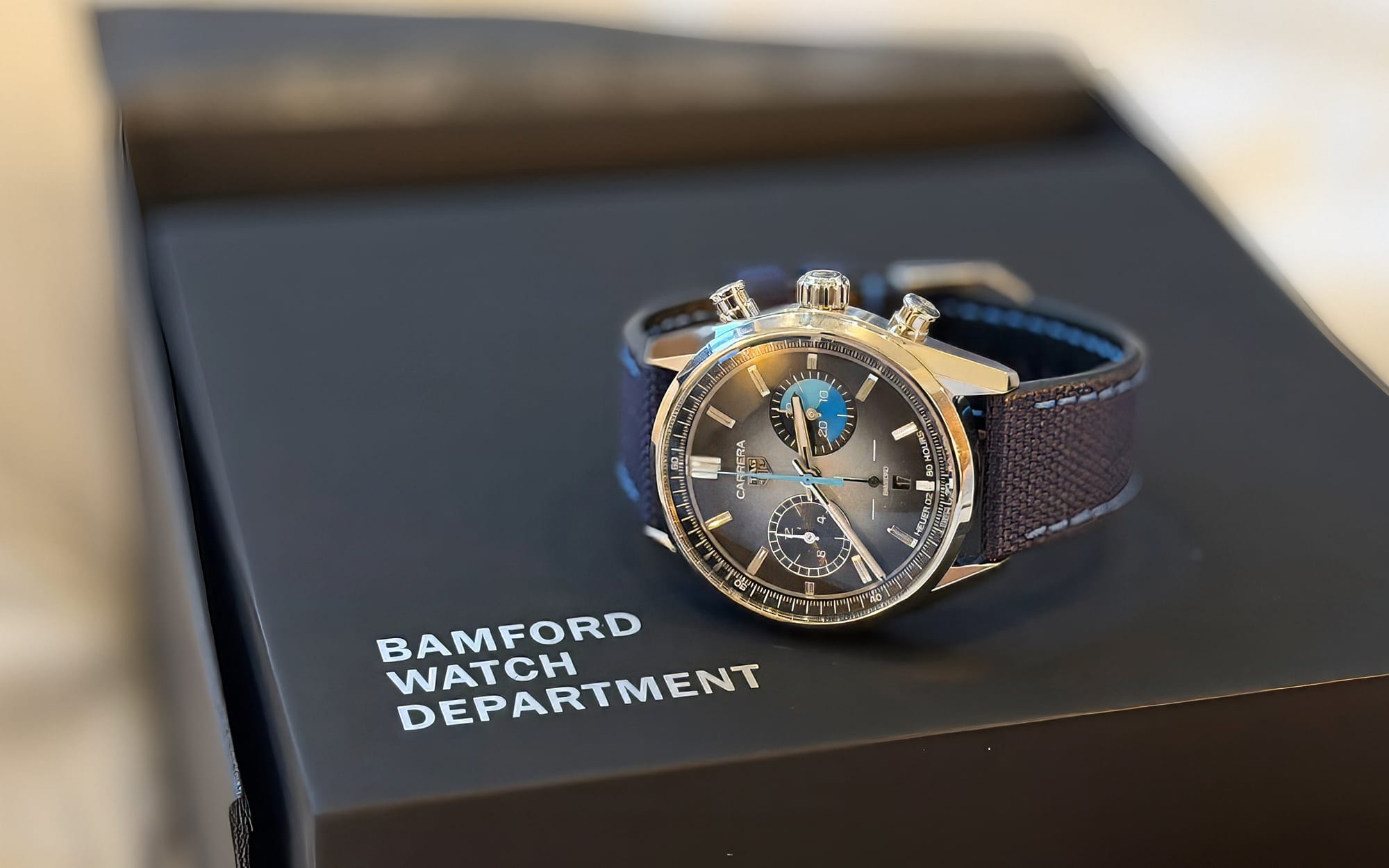
Bamford Watch Department
The Bamford origin story goes like this: for his eighteenth birthday, George Bamford (founder and CEO), received a Rolex Daytona. Then he attended a dinner party where half the guests wore the same watch. Something about that bothered him enough to have the Daytona DLC-coated in France. He returned home with 25 orders from people who'd seen it.
By 2004, he'd turned that impulse into the Bamford Watch Department. The company operates from a five-story townhouse on South Audley Street in Mayfair. The only distinguishing feature is apparently a black door handle shaped like a watch crown. Their motto: "If you can imagine it, we can create it for you."
For years, Bamford occupied that uncomfortable space customizers often do: beloved by collectors who wanted something different, distrusted by purists who saw modification as desecration, and completely ignored by the brands themselves. Customization voided warranties. It was an underground economy.
Then Jean-Claude Biver called.
In 2017, Biver was running LVMH's watch division. As he later told interviewers, he'd been watching Bamford for years. "He can make a boring watch sexy without changing too much," Biver said. The partnership made Bamford the official customizer for TAG Heuer, Zenith, and Bulgari. Later came Girard-Perregaux, Chopard, Franck Muller, Bremont, even Casio G-Shock.
The significance of that deal was less about legitimacy than about warranty. When you customize through Bamford now, you don't void the original manufacturer's coverage. Bamford offers an identical warranty for the same duration. In this case, five years. This was my first Bamford order and it's a bit of a leap of faith.
The Heuer brand
Edouard Heuer was twenty years old in 1860 when he founded his watchmaking company in St-Imier, Switzerland. Over the next decades, Heuer developed patents that still shape chronograph making: a keyless winding system in 1869, and in 1887, the oscillating pinion that allows smooth start-stop operation without affecting timekeeping. Major manufacturers still use that system.
Edouard died in 1892. His sons took over. The company built dashboard chronographs for automobiles and aircraft. In 1933, they introduced the Autavia timer, the name combining "automobiles" and "aviation." During the 1930s and 1940s, they manufactured chronographs for the German Luftwaffe. History rarely stays clean.
In the 1950s, Heuer produced watches for Abercrombie & Fitch, including the Seafarer with its tide indicator. Jack Heuer, the founder's great-grandson, took over in 1958 at age twenty-six. Five years later, he introduced the Carrera, named after the Carrera Panamericana road race that ran through Mexico from 1950 to 1954.
Then 1969: Heuer unveiled the Calibre 11, one of the first automatic chronograph movements. The Monaco, the Carrera, the Autavia. Steve McQueen wore the Monaco in Le Mans. The 1970s were good.
The 1980s were not. In 1985, the TAG Group acquired Heuer. TAG stood for Techniques d'Avant Garde, a Luxembourg holding company founded by Syrian businessman Akram Ojjeh in 1977. The shield logo appeared in green and red with white lettering. On January 1, 1986, the company officially became TAG Heuer.
In 1999, LVMH acquired TAG Heuer for $740 million. Two years later, Jack Heuer returned as Honorary Chairman. The family name had been merged with a corporate acronym, bought, and sold, but it never disappeared.
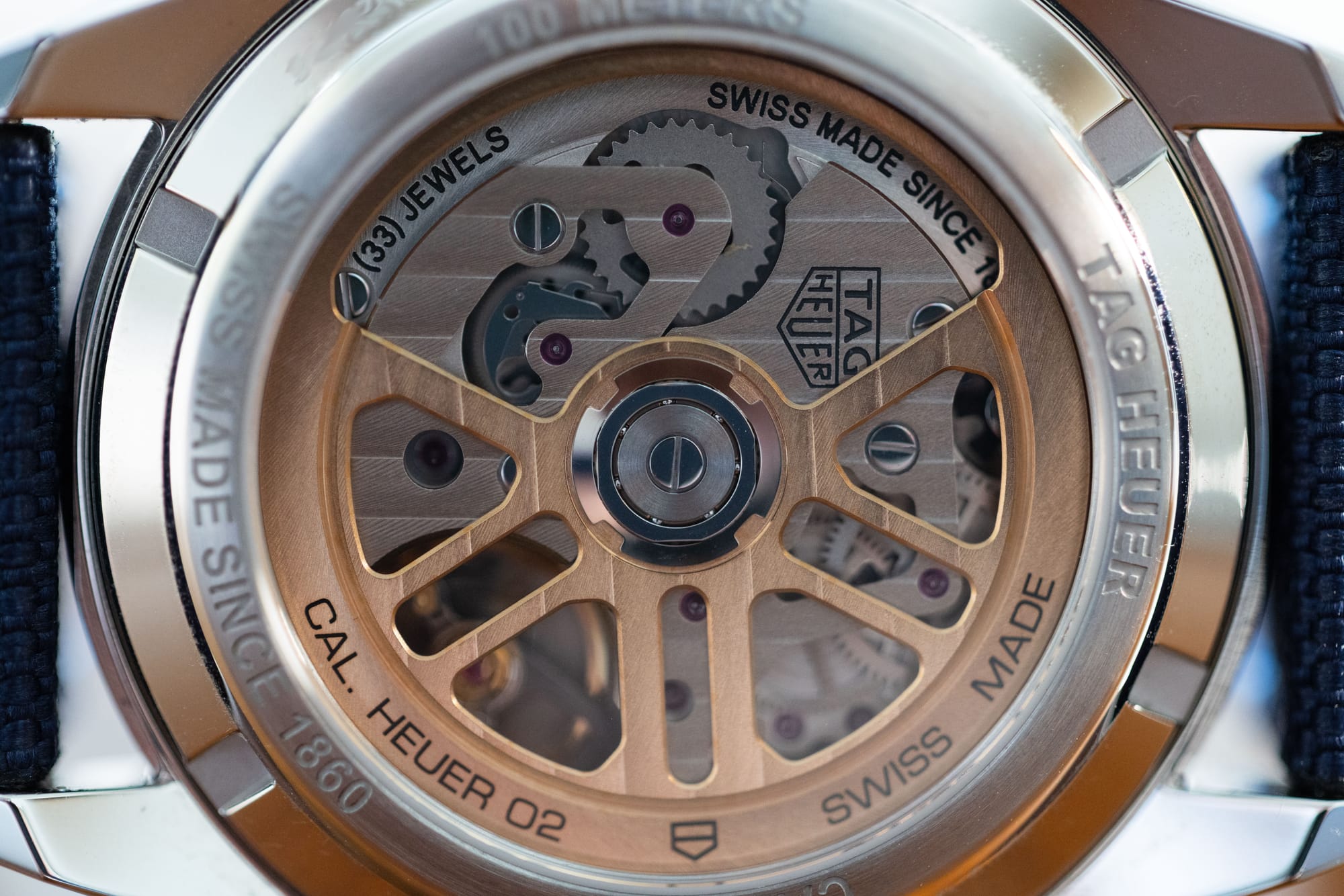
The movement
This custom Carrera runs the Calibre Heuer 02, introduced in 2017 as an evolution of the Heuer 01. The numbers tell the story. Power reserve jumped from 50 hours to 80. Thickness dropped from 7.30mm to 6.95mm. The movement comprises 168 components, 33 jewels, and operates at 28,800 vibrations per hour.
Two features matter most in a chronograph movement: how it starts the timing function and how it couples the chronograph gear train to the main movement. Cheap movements use cam switching and horizontal clutches. The Heuer 02 uses a column wheel for switching and a vertical clutch for engagement. The difference shows in feel. The pushers click with precision. The chronograph second hand doesn't stutter when you start it.
TAG Heuer assembles the movement entirely at their Chevenez manufacture in Switzerland. They've received COSC certification, which means each movement keeps time within -4/+6 seconds per day. Through the sapphire caseback, you can see Côtes de Genève decoration on the bridges.
The case
Forty-two millimeters in brushed and polished steel. The case thickness runs 14.4mm, which sounds substantial but wears less bulky than the number suggests. Lugs curve downward. A sapphire crystal covers the dial. The caseback is also sapphire.
Water resistance is 100 meters. Fine for a splash, probably fine for a swim, not what I'd choose for diving. The crown screws down but the pushers don't.
The dial
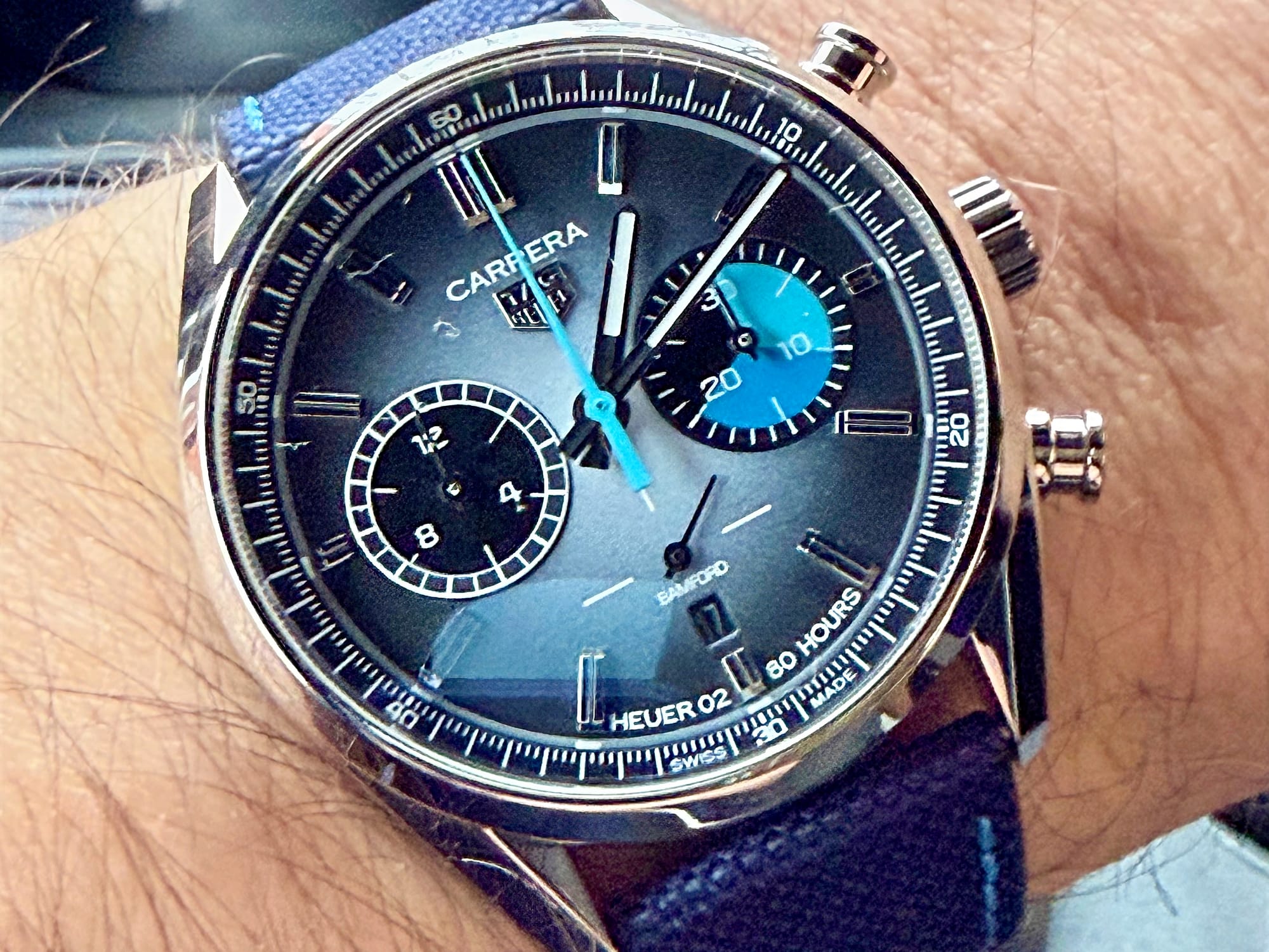
This is where Bamford earned the customization costs. TAG Heuer doesn't typically offer gradient dials like this one. The color shifts from blue at the edges to gray at the center, a transition so gradual you almost miss it until light hits at certain angles.
The subdials maintain the asymmetrical layout I described earlier. Date at six. Minute counter at three. Running seconds and twelve-hour register on the left. Applied indices. Luminous hands. The overall effect is busier than a standard Carrera but never illegible.
The strap matches the customization. Blue-gray leather with blue stitching in what Bamford calls their signature color. It took them six months to develop that particular shade of blue, apparently. The color coordination between dial and strap is precise.
On the wrist
The watch arrived beautifully. Then I noticed the chronograph hand. At rest, the chronograph seconds hand on any properly assembled watch should point to twelve o'clock. This one points to 11:59. The watch somehow left the bench with a misaligned chronograph hand that doesn't point to 12:00.
I've been collecting watches for long enough to know that QC failures happen at every price point. But they happen less often as prices rise. At £6,500, this counts as a significant error. I've seen this kind of misalignment on watches costing a tenth as much. It bothers me. Not constantly, not even often. But it bothers me.
One more complaint: the strap runs shorter than TAG Heuer's standard length. My wrists are average (7.5 in). The strap fits, but only just. Anyone with larger wrists will struggle.
Despite these issues, I wear it often. The gradient catches light differently depending on the hour. The asymmetry still pleases me every time I glance down. The movement runs smoothly. The chronograph feels solid.
Verdict
The Bamford x TAG Heuer Carrera Chronograph represents what I want from customization: something the original manufacturer wouldn't quite make, executed with materials and movement quality the aftermarket couldn't match. The gradient dial and asymmetrical layout justify the price premium for anyone who shares my distaste for boring watches.
The QC issue is harder to reconcile. One misaligned hand on a watch costing this much feels like a betrayal of the reason for a chronograph. Part of Bamford's value proposition depends on attention to detail. This detail got missed. I took a leap of faith. I'll follow up after I need my first servicing.
Sources
- Revolution Watch - Interview with George Bamford on LVMH partnership and Jean-Claude Biver collaboration
- WatchPro - Bamford Watch Department comes blinking into the light
- Spears WMS - George Bamford's custom watch revolution
- English Cut / The Cork - George Bamford profile
- Global Watch Shop - TAG Heuer history and information
- Watchonista - Introducing TAG Heuer's In-House Chronograph Movement: The Calibre Heuer 02
- Caliber Corner - TAG Heuer Caliber Heuer 02 specifications
- aBlogtoWatch - TAG Heuer Autavia Calibre Heuer 02 long-term review
- Watch I Love - TAG Heuer Carrera Chronograph Limited Edition CBN201N.FC6620
- TAG Heuer official - Carrera Chronograph Seafarer CBS2016.EB0430

