

In the autumn of 1975, in the attic of a factory in the Swiss town of Le Locle, a man named Charles Vermot was committing an act of insubordination that would, half a century later, end up on a wrist in Kentucky.
Vermot was the foreman of Workshop 4 at Zenith, the manufacture founded in 1865 by a 22-year-old watchmaker named Georges Favre-Jacot. The American conglomerate that owned Zenith at the time, an unrelated company called the Zenith Radio Corporation, had decided that the future of timekeeping was quartz. Mechanical chronographs were over. The order came down from corporate to scrap the tooling for Zenith's flagship chronograph movement, the El Primero, and sell the metal presses by the ton.
Vermot didn't scrap the tooling. Working with his brother, often at night, he hauled the equipment up to the attic of Workshop 4. The cams, the cutting tools, the swages, the steel presses; 150 components in all. He catalogued them. He labeled them. He hid the blueprints in a separate spot. And then he waited. It would take nine years.
In 1984, with new owners and a softening interest in mechanical watches creeping back into the industry, Vermot took someone upstairs and opened the tarps: piece by piece, an entire production line that the previous regime believed had been melted down a decade earlier.
The El Primero had been launched on January 10, 1969, the day a three-way race ended. Zenith, in partnership with Movado, beat the Chrono-Matic consortium (Breitling, Heuer, Hamilton-Büren, Dubois-Dépraz) by exactly two months. Seiko's Caliber 6139 arrived in May. All three contenders were trying to build the same thing: the world's first self-winding chronograph. Zenith announced first. The name was the claim. El Primero. The First.
What Vermot saved in 1975 was the only one of those three contenders that would, eventually, become a continuous fifty-year story. Seiko's 6139 had its run and faded. The Chrono-Matic became a footnote. The El Primero kept going, and in the years after Vermot's rescue, it became something stranger: a movement that was more famous than the watches it powered.
Consider the catalogue. Rolex came to Zenith in 1988 asking for a chronograph caliber to put inside the new automatic Cosmograph Daytona. The result was the reference 16520, the so-called Zenith Daytona, which ran from 1988 to 2000 on a modified El Primero called the caliber 4030. Rolex dialed the frequency down from 5 Hz to 4 Hz because they worried, perhaps unfairly, about wear at the higher beat rate. They stripped out the date. They re-finished the escapement to their own standards. But the engine was Zenith's. The Daytona's modern mythology, the wait-lists and the auction records and the secondary-market hysteria, was built on a movement designed in Le Locle and saved in an attic.
Rolex wasn't the only customer. Panerai used the El Primero as the base for its OP IV and OP VI chronograph calibers. Ebel, TAG Heuer, Cartier, Bulgari, Daniel Roth, Boucheron, Parmigiani, all of them at various points relied on El Primeros built in the same workshop that Vermot had stocked from the attic. By the late nineties, Zenith had quietly become one of the largest chronograph producers in the world, supplying the engines for some of the most prestigious watches in Switzerland while remaining, on its own dial, an under-the-radar brand.
The auctioneer Aurel Bacs has called this period the moment Zenith was "thrown" into chronograph production at industrial scale. The pattern only ended when LVMH bought Zenith in 1999 and decided to reserve the El Primero for in-house use. Rolex went and built its own caliber. Panerai migrated to other movements. And Zenith, for the first time in its post-revival life, had to figure out how to be a destination brand rather than a hidden supplier.
The Chronomaster Sport, launched in 2021, is the answer to that question. It's the El Primero with a watch finally built around it instead of vice versa.
The most interesting thing about Zenith isn't what it has done but what it has survived. Three coalitions raced to make the first automatic chronograph in 1969. Only one of them is still running, fifty-seven years later, in a production watch you can buy today. And the only reason that's true is because a foreman in his fifties, working in the dark, refused to do what he was told.
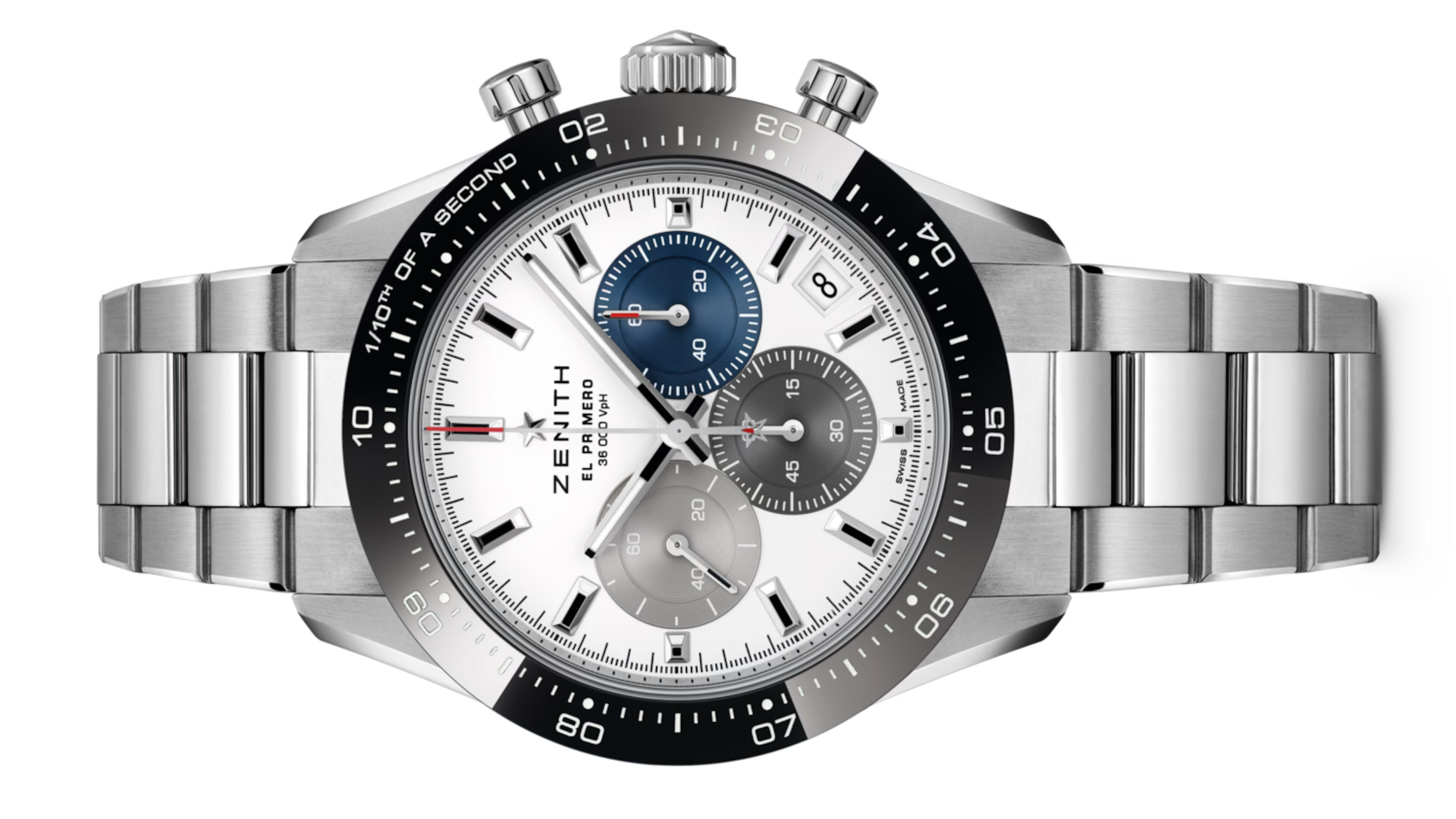
Case and dimensions
The case is 41mm across, 13.6mm thick, and 46.2mm lug-to-lug. The bezel is fixed black ceramic with a 1/10th-of-a-second scale engraved around it. The pushers are pump-style. The crown is signed with the Zenith star. Water resistance is 10 ATM, which is to say 100 meters, which is to say you can shower in it and swim in it and stop worrying about it.
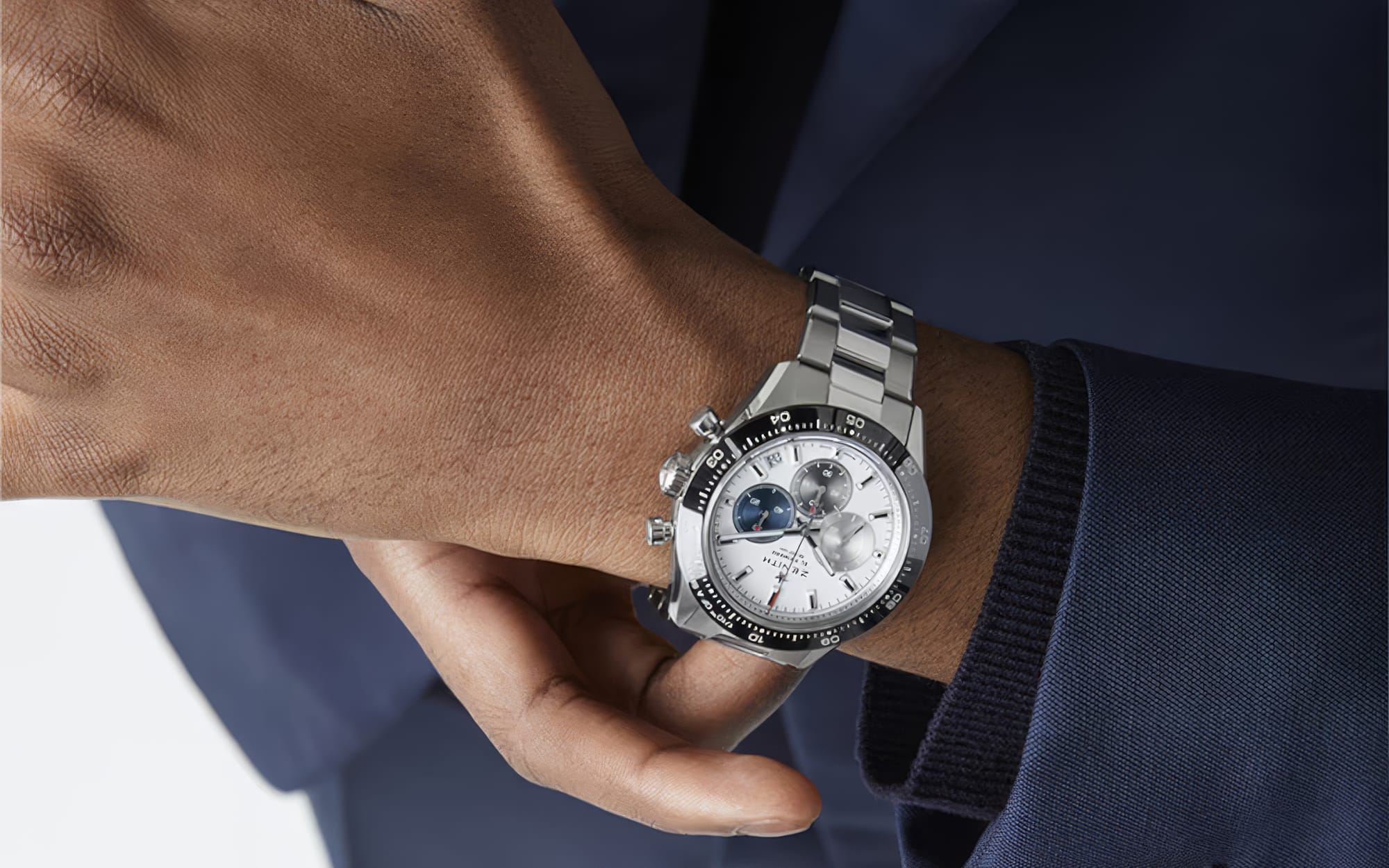
On the wrist, the watch wears slightly larger than a Rolex Daytona. I prefer it that way. The Daytona's 40mm case has always felt, to me, like a watch trying to disappear into a cuff. The Chronomaster Sport sits up. The bracelet is integrated in the sense that it tapers cleanly off the case, but the lugs are conventional, which means there are strap options if you want them.
Adjusting the bracelet took longer than it should have, because Zenith has built what may be the most user-hostile link system in modern watchmaking. The links aren't held by pins. They're held by screws. That sounds like good news. It isn't. Each link has a screw on both sides, and the two screws meet in the middle at a third screw, a kind of internal cap. Put a screwdriver on one side and turn, and the entire assembly rotates in place. Nothing comes apart. You have to hold one screwdriver still on the far side of the link while turning the other from the near side. Two screwdrivers. Two hands. One link.
I've removed pins from a Panerai Pre-Vendôme Mare Nostrum bracelet, which until last week was the worst bracelet-sizing experience I'd had with a watch. This is worse. I can't understand the design logic. Pin-and-collar systems work. Single-screw systems work. Whatever this is doesn't work, and I'd be surprised if a single Zenith engineer has ever sized a Chronomaster Sport bracelet at home, alone, on the first try. Why, Zenith? Why?
Once the links are out, the bracelet itself is excellent. The clasp is signed and uses a simple double-pusher mechanism. There's no micro-adjust, which is the one criticism I share with most of the published reviews. At this price point, a tool-less micro-adjust should be standard. It isn't, and Zenith should fix that. But once sized, the bracelet wears flat and tight against the wrist, and the watch sits where it should.
13.6mm isn't thin. The Chronomaster Sport is a chronograph with an integrated bracelet and a ceramic bezel, and those three features together impose a thickness budget that no amount of engineering can fully escape. What Zenith has done is distribute the height intelligently: the bezel is tall, the case middle is relatively slim, and the crystal is domed enough to add visual interest without adding meaningful millimeters. The result reads, from above, as a watch closer to 12mm thick than 14mm.
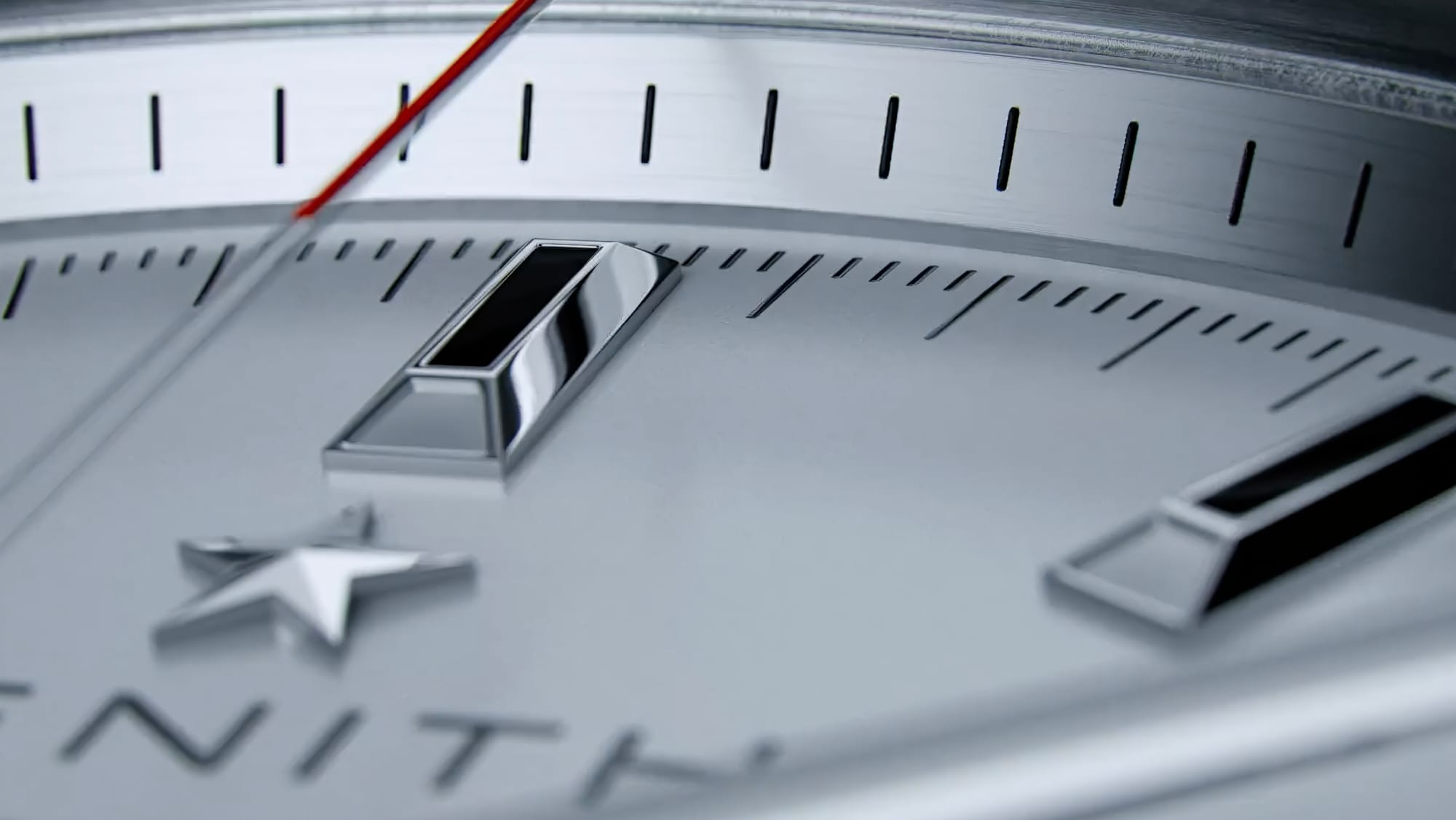
The dial, bezel, and lume
The dial is matte white, and the three subdials overlap slightly, the way they did on the 1969 A386. The arrangement is unconventional. Small running seconds at 9 o'clock in pale grey. A 60-second chronograph counter at 3 o'clock in deep blue. A 60-minute chronograph counter at 6 o'clock in anthracite. The date sits at 4:30 in a window matched to the dial color, with a discreetly lowered surround so that the rectangle doesn't break the symmetry of the indices.
The date wheel snaps. This is a small thing and most reviews won't mention it. They should. The cheap way to build a date complication is to let the wheel drift over the course of an hour or two as midnight approaches, so that by 11pm the date is showing in the window but the next day's number is also creeping into view from below. The expensive way is to build an instantaneous date jump: the wheel holds its position all day, and then at midnight, in a single mechanical instant, it snaps the next day into place. Jaeger-LeCoultre does this on most of their better calibers. Zenith does it here. It's a detail that takes about fifteen seconds a day to appreciate, and after a week of ownership I find myself looking at the dial right before midnight just to watch the change happen.
Three different colors on three different subdials, on a chronograph, in 2026, is a choice. It isn't the safe choice. The safe choice is a panda dial: white background, two black subdials, clean symmetry. Most luxury chronographs aim for that template because most buyers respond to that template. Zenith does the opposite. Tri-color overlapping subdials in grey, blue, and anthracite.
I showed the watch to two people. Neither of them is a watch enthusiast. Neither of them owns a mechanical timepiece. Both of them, independently, said they liked this watch more than other chronographs I had shown them in the past. The reason, when I pressed, was the same in both cases: the colors made it interesting. The dial gave their eyes something to do. A monochrome chronograph, to a person who doesn't collect watches, reads as busy without being beautiful. The Chronomaster Sport reads as busy and beautiful at the same time, because the colors organize the complexity rather than compounding it.
This is the kind of thing that watch enthusiasts often get wrong. We assume the civilian world wants restraint. We assume people who don't know watches want the dial to look like a Rolex. They don't. They want the dial to look like something. And the El Primero tri-color, which has been Zenith's signature since 1969, is something.
The bezel is the technical anchor of the dial. The scale runs from 0 to 100 around the perimeter, marked in tenths, with the words "1/10th OF A SECOND" stamped near the 12 o'clock position. Zenith claims this is the first time a 1/10th-of-a-second scale has appeared on the bezel of a production watch rather than printed onto the rehaut. The reason it's on the bezel is that the central chronograph hand, when running, completes a full rotation in 10 seconds rather than 60. You read your tenths off the bezel position of the hand. The bezel scale isn't a feature. It's a tell.
Lume is the weakest part of the dial. The hour markers carry SuperLuminova. The hands, oddly, don't, or carry so little that in low light the time becomes hard to read. This is a real flaw on a sports chronograph at this price. I have no idea why Zenith made this choice. The published reviews I've read all flag it. So I will too. If you wear watches in dim restaurants or in bed, this is something to know.
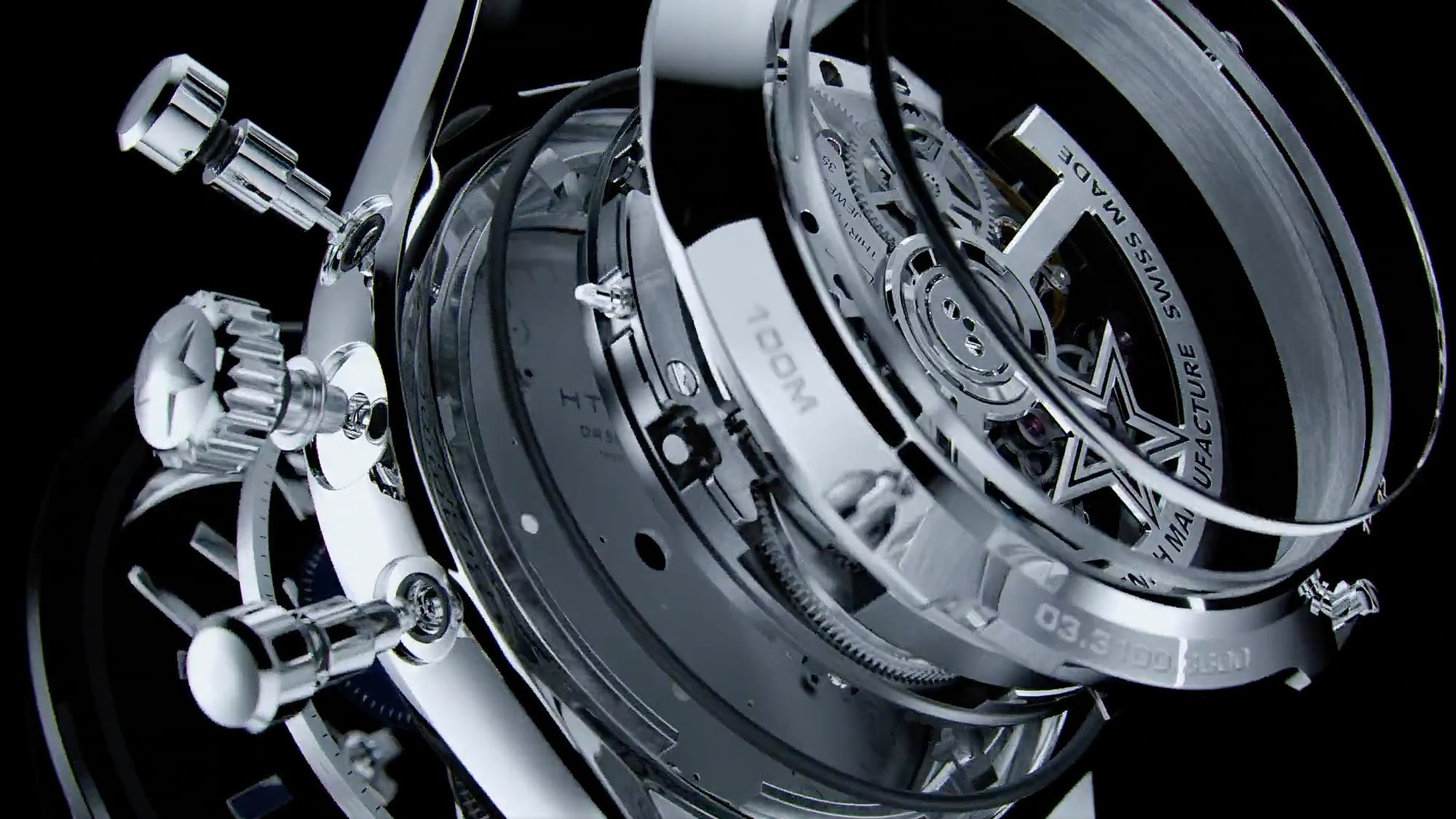
The movement
The Chronomaster Sport runs on the El Primero 3600, the most recent evolution of the caliber Vermot saved. 311 components. 36,000 vibrations per hour, which is to say 5 Hz, which is to say ten beats per second. 60 hours of power reserve. A column wheel controlling the chronograph. A lateral clutch with a patented two-intermediate-wheel design coupling the chronograph train to the going train. And, critically, a set of new gearing ratios that drive the central chronograph hand directly off the escape wheel. That direct drive is what makes this watch different from every other chronograph at any price.
Here's the standard arrangement. A normal automatic chronograph runs at 4 Hz (28,800 vph). When you start the chronograph, the central seconds hand sweeps around the dial and completes one full revolution every 60 seconds. The minute counter ticks over once per revolution. You can read elapsed time to the nearest second, more or less. This is how a Rolex Daytona works. It's how a Speedmaster works. It's how essentially every mechanical chronograph on earth works.
The El Primero 3600 does something different. Because the balance is beating at 5 Hz instead of 4 Hz, and because the chronograph train is driven directly off the escapement instead of through a reduction, the central chronograph hand completes a full rotation in 10 seconds, not 60. You can read elapsed time to the nearest tenth of a second, because the hand moves six times faster than a normal chrono hand and the bezel is graduated to display the tenths. This sounds like a gimmick, and it isn't: it's the trick that makes the watch unfakeable.
The replica watch industry, the part of it that produces what enthusiasts call "super-clones," doesn't actually develop movements. It assembles existing ones. The catalog is small. Tianjin Seagull makes an ST21 (an ETA 2824 clone). Hangzhou makes a 6300 (another 2824 clone). Shanghai produces the 3L series and Liaoning the 4140, both clones of the Valjoux 7750 chronograph caliber that powers most of the genuine mid-range Swiss chronograph industry. These movements run at 28,800 vph. Their chronograph hands sweep at the normal rate. They are what every fake Daytona, every fake Speedmaster, every fake Carrera on a Bangkok street stall uses inside its case.
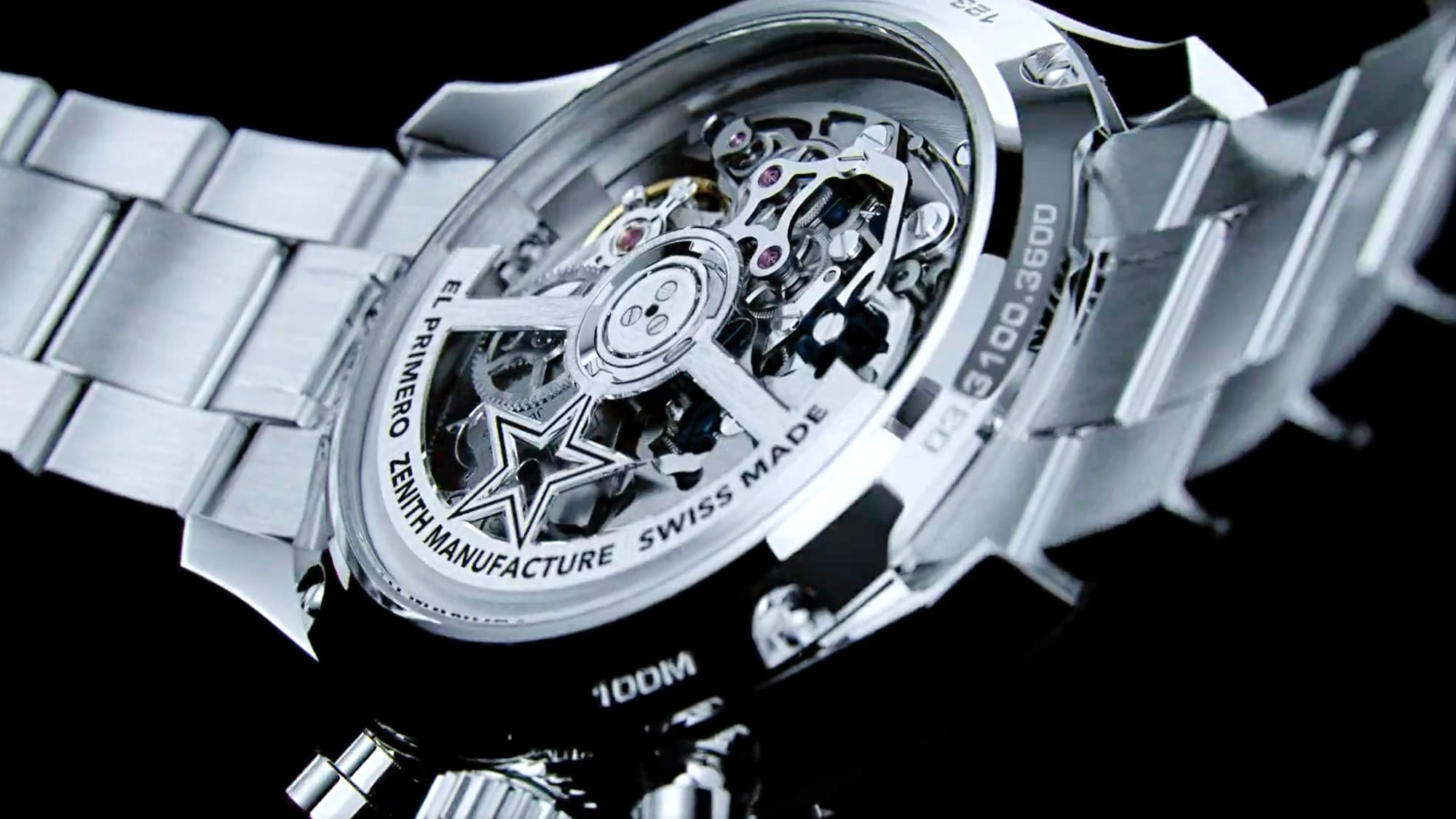
There's no 36,000 vph Chinese chronograph clone movement. There has never been one. The three brands on earth that produce serial 5 Hz movements are Zenith, Grand Seiko, and Longines, and none of them sell their calibers to anyone else. To build a convincing fake Chronomaster Sport, you would need to tool up a brand-new 5 Hz movement architecture, design a column wheel chronograph with a lateral clutch and direct escape-wheel coupling, and source a dry lubricant (Zenith uses molybdenum sulfate, because traditional oils get flung off a hairspring oscillating at this rate) that doesn't exist in the clone supply chain. The development cost would run into the millions. And the buyer pool for the result, a watch that the most discriminating fake-Daytona collectors would still flag as inauthentic the moment the chronograph started running, is too thin to amortize the investment.
So nobody builds it. The replica forums have threads about this. The most reliable answer, when somebody asks where to find a super-clone Chronomaster Sport, is "it doesn't exist." The few sellers who claim otherwise are putting 7750-clone movements into Zenith-shaped cases. Start the chronograph. Watch the hand. If it takes 60 seconds to come back around, the watch is a fake. If it takes 10, it's real.
This is the part of the watch I find most fascinating. The verification mechanism isn't a serial number, not a holographic sticker, not a certificate in a drawer at home. It's the visible behavior of a piece of metal in front of your eyes. Anyone who knows what to look for can authenticate this watch from across a room in three seconds without picking it up.
The 60-hour power reserve is the other refinement. The original El Primero ran for 50 hours. The 3600 adds a third more autonomy without sacrificing the high beat rate, which is a non-trivial engineering achievement. You can take the watch off on Friday night and put it back on Sunday morning and it will still be running. For a chronograph, this matters. Chronographs are notoriously power-hungry, especially at 5 Hz, and the 3600's reserve gives you the kind of weekend buffer that earlier El Primeros couldn't.
On the wrist
I've had the watch for one week. The first thing you notice, putting it on, is the weight. Steel bracelet on steel case is never light, and the Chronomaster Sport at 41mm has presence. The second thing you notice is the bracelet taper. The links narrow noticeably from the case to the clasp, which keeps the weight balanced and prevents the watch from sliding around on the wrist.
The third thing you notice, and the thing you keep noticing all week, is the chronograph hand. I've started the chronograph more times in the last seven days than I've started chronographs on every other watch I own in the last year, combined. The reason is the hand. A normal chronograph hand sweeps. It glides around the dial, lap by minute, indistinguishable from a running seconds hand on most watches. The Chronomaster Sport's hand whips. It tears around the dial six times per minute. The motion is so quick that it reads almost as continuous, like the second hand of an electronic stopwatch rather than a mechanical movement. Then you look closer and you can see the individual ten-beats-per-second of the escapement, the high-frequency stutter beneath the speed.
It's the most hypnotic thing I have ever seen on a watch dial. I haven't stopped pushing the button.
The pushers themselves are firm. The start-stop pusher at 2 o'clock has a satisfying click. The reset at 4 o'clock takes a firmer press, especially for the minute counter, which is consistent with what I've read about the 3600's lateral clutch behavior. Once in a while, perhaps one start in fifty, the chronograph hand will hesitate briefly before engaging. This is a known characteristic of the El Primero's lateral clutch and isn't a defect. It's the visible consequence of two gears trying to mesh while the wheel train is moving at 5 Hz. The Speedmaster's caliber 1863 does the same thing for the same reason. It's the price you pay for column wheel chronograph architecture in a high-beat movement.
I bought the watch direct from Zenith. I have a contact at the boutique and I've always preferred to deal that way. The authorized dealer system, with its waiting lists and its allocations and its choreographed relationship-building, has never made sense to me for anything outside a few specific brands. I will play that game for a Panerai limited edition. I will play it for a Konstantin Chaykin. I will probably play it for the upcoming Universal Geneve reissues. But for most watches, including this one, I have the cash and they have the watch and there's no good reason to involve anyone else.
Buying direct cost more than the secondary market would have. Non-Rolex watches, even brand-new and sealed, lose a few thousand dollars the moment they leave the boutique. A friend at work offered me a barely-worn Chronomaster Sport about two years ago and I almost took the deal. I didn't, because I wanted the watch to be mine from the start. The Zenith warranty extends. The provenance is clean. There's no story about the previous owner I have to carry around. For a watch I've wanted for three years, the premium was the right call.
Comparisons
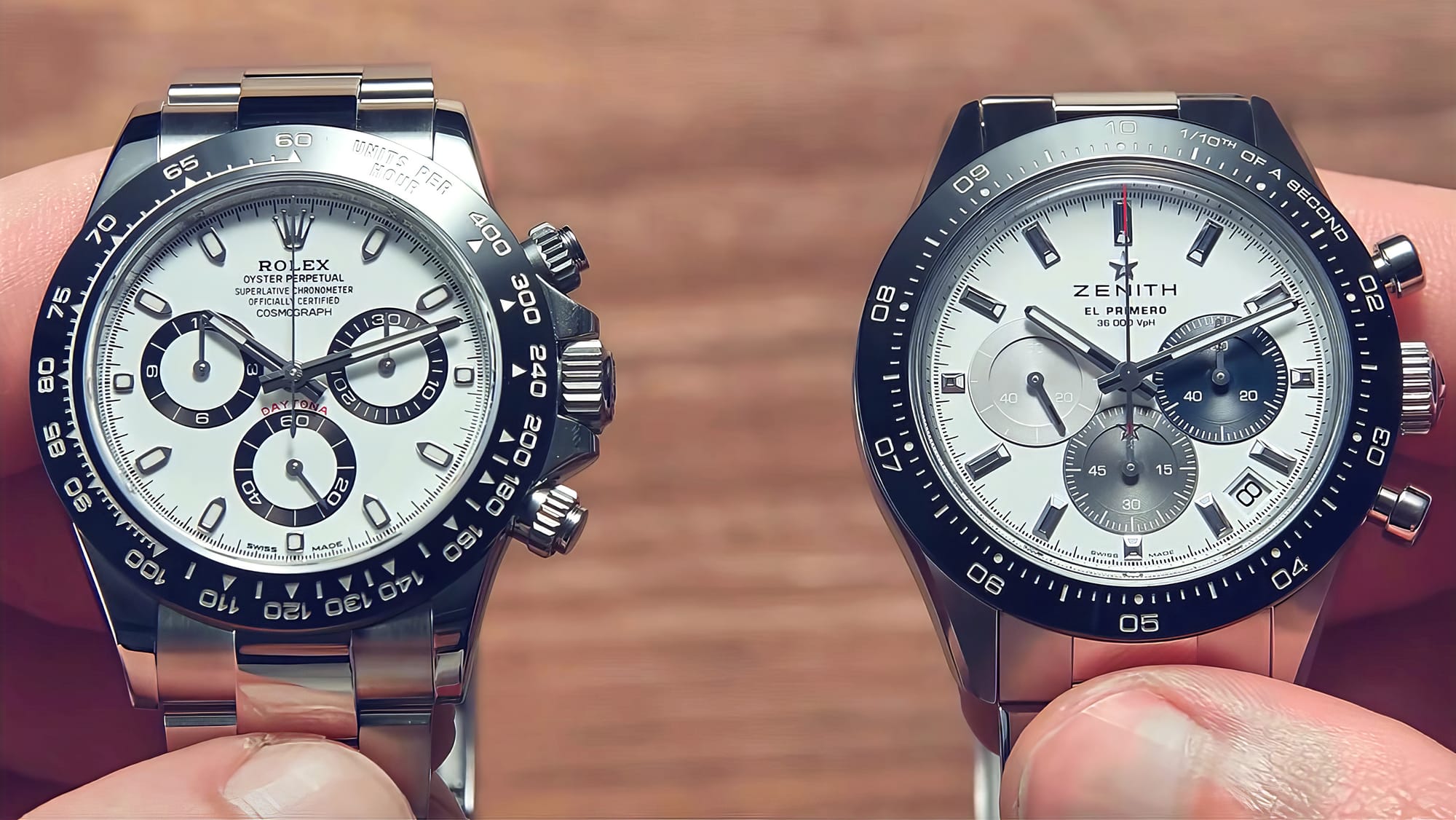
The Chronomaster Sport is going to get compared to the Rolex Daytona by everyone who writes about it, including the people writing about it now. The comparison isn't lazy. It's structural. The Daytona uses pump pushers, a ceramic bezel with a tachymeter scale, and an integrated steel bracelet on a 40mm case. The Chronomaster Sport uses pump pushers, a ceramic bezel with a 1/10th-second scale, and an integrated steel bracelet on a 41mm case. The visual language is from the same dictionary.
The comparison also has historical weight. The reference 16520 Daytona, from 1988 to 2000, ran on a modified El Primero. Zenith powered the Daytona for twelve years. When people say the Chronomaster Sport "looks like a Daytona," they're partially right, but the influence ran the other way: the modern Daytona looks like what it does because of the watches Zenith was making in the late eighties, and because the El Primero's high-beat heritage shaped Rolex's entire idea of what an automatic chronograph should be.
So the Chronomaster Sport isn't a Daytona alternative in the way most reviewers frame it. It isn't the watch you buy because you can't get a Daytona. It's the watch you buy because you understand where the Daytona came from.
I don't own a Daytona. I have nothing against the watch. The reason I've stayed away is that I've always preferred chronographs that announce themselves as chronographs. A Daytona, on most wrists, reads first as a Rolex and second as a chronograph. The Chronomaster Sport reads first as a chronograph. That's what I wanted.
The other comparison worth making is the Omega Speedmaster. The Speedmaster is a different conversation. It runs at a lower beat rate, lacks the 1/10th capability, carries a history the Zenith doesn't pretend to match, and costs less. If your priority is heritage, the Speedmaster wins. If your priority is engineering, the Chronomaster Sport wins. They aren't really competing for the same customer, even though they look similar at a glance.
The Tudor Black Bay Chrono is the dark-horse comparison. Tudor's chronograph uses a modified Breitling B01 caliber, runs at 4 Hz, and offers a 70-hour power reserve. It's half the price of the Zenith. It's, by any rational measure, an excellent watch. The difference is that the Tudor uses the same kind of movement as half of every other Swiss chronograph on the market, while the Zenith uses the only movement of its kind in current production. You aren't paying for the bracelet, the case, or the dial. You are paying for the movement.
Final thoughts
There's a tax that most luxury watches pay. I've come to think of it as the Recognition Tax. It works like this. Somewhere out there, for almost every famous reference, a counterfeit exists that, in average light, on a stranger's wrist, you can't distinguish from the real thing. The Daytona pays this tax. The Royal Oak pays this tax. The Nautilus pays this tax. The owner of the real watch knows what they're wearing. Nobody else does. And so every social encounter the watch participates in carries a small cloud of doubt that the watch itself can't disperse.
You see a Daytona in the wild and the first thought, if you know watches, isn't admiration. It's calculation. Is it real? Which reference? Could I tell from here? Especially with the rarer or more expensive Daytonas, the doubt is constant. The watch was supposed to do work that depends on being recognized, and the recognition has been compromised by the fake economy that grew up around it. The Chronomaster Sport doesn't pay this tax.
The reason it doesn't pay this tax is the hand. The 10-second rotation isn't a marketing flourish. It's the only fact about this watch that can't be faked, because the movement that produces it doesn't exist outside of three brands and is impossible to source for a counterfeit operation. If you see a Chronomaster Sport on a wrist and the chronograph is running, you know. Three seconds. Across a room. No serial number, no certificate, no expert opinion required.
This is, I think, what I've actually been buying. Not the El Primero exactly, and not the bracelet, and not the white dial with its three contrasting subdials that even my non-watch friends seem to find interesting. I've been buying the absence of doubt. I've been buying the only luxury chronograph on earth whose authenticity is visible from the other side of a dinner table.
It took me three years to make the call. I almost bought one used, decided against it, and went direct to the boutique. The watch arrived this week. I've started the chronograph maybe thirty times. The hand is still tearing around the dial at six laps a minute and I'm still watching it. I don't think I'll get tired of it.
